Hero illustration for six ways to improve website user experience
07

Published

April 2024

Updated

2026-08-07

6 Ways to Improve User Experience on Your Website

Tyler Mullins

Founder & Owner of OMNI

The importance of UX

Modern-day marketing almost always revolves around a website. Even when you look at traditional forms of marketing, they will often have a website address in them. You can see this on billboards, printed media, and TV ads. Regardless of the business you are in, your users will mostly interact with your company through your website. Therefore, it's important to make the visit to your site pleasant for the user. Here are 6 ways to improve the user experience on your website.

User experience, or UX as it is commonly referred to in web design, is a set of design principles that prioritize how a user will feel after interacting with your website. Unfortunately, although it is crucial to stand out from the competition, it's also sometimes hard to achieve. One way of doing it is by having a beautiful and functional website, which can attract visitors and drive sales. By improving the user experience on your website, you can reduce bounce rates and shopping cart abandonment. At the end of the day, you are there to make money through sales.

6 Ways to improve user experience on your website

1. Mobile-first design
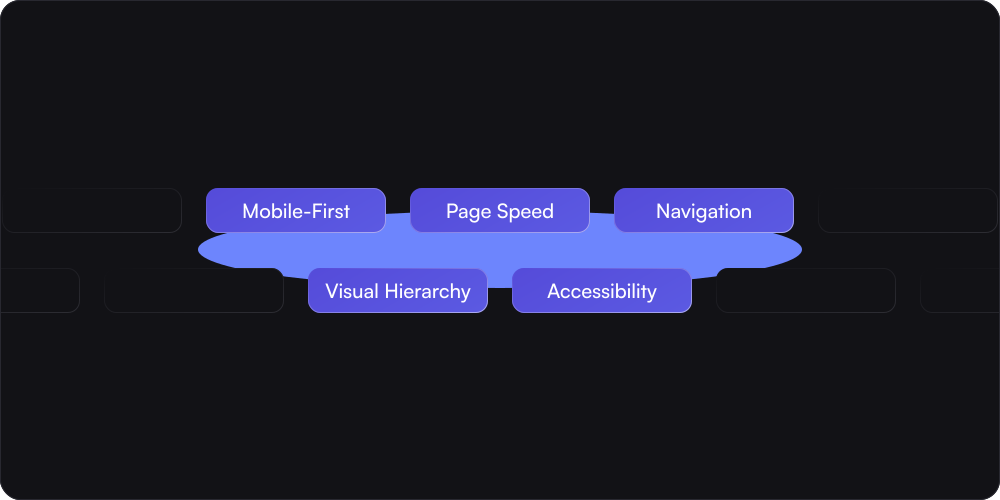
Six UX levers between a bounce and a sale: mobile-first design, valuable content, page speed, intuitive navigation, white space, consistency.

You have probably heard of mobile-friendly design. However, we are already way beyond that. We are at the stage where mobile-first design is pushing desktop users to the sidelines. Website design needs to put mobile users front and center when they are considering how to optimize. People practically live on their phones, and social media is king. Your website needs to be built around the average user who'll most likely be accessing your site through their phone. Trends for websites are changing, and you need to adapt. Even search engines have realized this and have begun punishing websites that lack mobile optimization by giving them a lower rank in search results.

2. Offer valuable content

Simply put, content is what will drive users to your website. It is the main reason they will visit your pages, and content is what will keep them around. Keep in mind that an increasing number of searches are being done on social networks. Plan for social media management and help your users find you. Have widgets for the most popular social platforms to make sharing your content easy for your visitors.

Blog posts are a fantastic form of content. You can use keywords in your posts and optimize them for search engines to generate more traffic for your pages. Aim to make your content evergreen so that it doesn't age out and instead keeps generating value over time. Guides and tutorials are always popular searches, especially if they relate to your business niche.

3. Improve the speed of your website

Nothing is going to leave users more frustrated than if they have to wait ten seconds after each click. Improve the load times for your website by doing some of the following:

  • Optimize image sizes. Resize images to make them load faster. If high-resolution pictures are really important, you can place them in a dedicated gallery section of your website.

  • Disable autoplay on videos. Videos take up a lot of bandwidth, so make sure users can choose if they want to view them or not.

  • Check your server and hosting package. It's possible that the slow load times are not your fault. Ask your service provider if they have faster packages available.

  • Remove bad links. Broken links don't immediately drop an error if you try to access them. They usually try to load, causing unnecessary server loads.

4. Intuitive design and simple navigation

It goes without saying that you should design your website to be intuitive and easy to use. Help users find their way around by making it obvious where they should click to reach what they are looking for. If your website is easy to explore, it will make the audience more involved, and they will spend more time on your page. User engagement through intuitive design will allow you to progress visitors further through the sales funnel.

The more time they spend on your site, the more chances you have to turn visitors into paying customers. Naturally, your website needs to help them make selections, compare products, ask questions and fill out forms. Besides looking at ways to improve user experience on your website, you should simultaneously try to boost sales. It's not hard to make both things happen simultaneously since happy visitors always equate to more sales.

5. Leave some empty space

Avoid making your website feel cramped and claustrophobic. You've surely visited a site that was filled to the brim with banners, toolbars, five different calls to action, as well as every widget the developer could think of. Unfortunately, by adding more content to a single page, they have only succeeded at confusing the visitors.

Leave empty space on your pages to increase the focus of your visitors. This will make the right things stand out. You can design the website around the elements that are actually important. If you want users to be able to find your call to action button, don't surround it with a bunch of junk. Just make it attractive and leave enough space around it to help it stand out more.

6. Be consistent

Build your website to amaze visitors, but realize that you also need to deliver on the expectations you've set up. Consistency will also improve your SEO, which will, in turn, bring more visitors in a positive feedback loop. You can make your website consistent if you have:

  • Proper text formatting. Use bullet points, proper heading, and paragraph distribution. Make your pages easy to read.

  • Useful hyperlinks. Do hyperlinks lead users where they expect? Build a network of interlinked pages to help users and search engines find the relevant content on your site.

  • Working pages and links. Fix any broken links and make sure you have no 404 errors. Remove missing images instead of using up server time while they aimlessly try to load.

In conclusion

As you can see, every one of these six ways to improve user experience on your website also brings quality improvements to your site. Faster load times, higher rank results, and streamlined navigation all lead to the same end goals: happier users and more sales for your company. Start designing with the user in mind; you won't regret it.

No sections found. Check that your blog headings match: h2, h3
FAQ

We've got the answers.

We've got the answers.

How do you improve user experience on a website?

Improve website user experience by fixing the six things visitors feel first: page speed (aim for under 2.5s load), clear navigation, mobile responsiveness, readable typography, obvious calls-to-action, and fast, trustworthy checkout or wallet-connect flows. Start with a data-led audit — heatmaps and session recordings show where users stall. Prioritize the fixes that touch the most traffic, then test changes against bounce rate and conversion.

How do you improve user experience on a website?

Improve website user experience by fixing the six things visitors feel first: page speed (aim for under 2.5s load), clear navigation, mobile responsiveness, readable typography, obvious calls-to-action, and fast, trustworthy checkout or wallet-connect flows. Start with a data-led audit — heatmaps and session recordings show where users stall. Prioritize the fixes that touch the most traffic, then test changes against bounce rate and conversion.

What makes a good crypto or Web3 website?

A strong Web3 site loads fast, explains a complex product in one scroll, and makes the primary action — connect wallet, join community, buy token — impossible to miss. It pairs clean design with trust signals: audits, team, backers, and live metrics. Mobile-first matters because most crypto traffic is mobile. Clarity beats spectacle; confused visitors leave, and in crypto skepticism is the default.

What makes a good crypto or Web3 website?

A strong Web3 site loads fast, explains a complex product in one scroll, and makes the primary action — connect wallet, join community, buy token — impossible to miss. It pairs clean design with trust signals: audits, team, backers, and live metrics. Mobile-first matters because most crypto traffic is mobile. Clarity beats spectacle; confused visitors leave, and in crypto skepticism is the default.

How do you hire a web design agency for a crypto project?

Choose an agency with a Web3 portfolio, not just generic SaaS sites — crypto users expect wallet integrations, token dashboards, and dark-mode-native design. Ask to see live launched sites, load-speed scores, and conversion results. Confirm they handle both design and front-end build so nothing is lost in handoff. OMNI designs and ships Web3 sites in-house, so UX decisions carry straight through to code.

How do you hire a web design agency for a crypto project?

Choose an agency with a Web3 portfolio, not just generic SaaS sites — crypto users expect wallet integrations, token dashboards, and dark-mode-native design. Ask to see live launched sites, load-speed scores, and conversion results. Confirm they handle both design and front-end build so nothing is lost in handoff. OMNI designs and ships Web3 sites in-house, so UX decisions carry straight through to code.

How much does a Web3 website redesign cost?

A professional Web3 website redesign typically runs $5,000–$30,000, depending on page count, custom animation, and wallet or dashboard integrations. A focused UX audit with prioritized fixes usually costs $2,000–$6,000. Agencies price either per project or as a design retainer for ongoing iteration. OMNI scopes site work around page count, required integrations, and whether copy and branding are included alongside design.

How much does a Web3 website redesign cost?

A professional Web3 website redesign typically runs $5,000–$30,000, depending on page count, custom animation, and wallet or dashboard integrations. A focused UX audit with prioritized fixes usually costs $2,000–$6,000. Agencies price either per project or as a design retainer for ongoing iteration. OMNI scopes site work around page count, required integrations, and whether copy and branding are included alongside design.

Should you use an agency or a freelancer for website UX?

Use a freelancer for a single-page tweak or a quick audit on a tight budget. Use an agency when the redesign spans strategy, design, copy, and front-end build — an agency brings a coordinated team so UX, brand, and code stay aligned, and it doesn't disappear mid-project. For revenue-critical crypto sites where wallet flows and trust signals matter, an agency's cross-discipline depth usually pays for itself.

Should you use an agency or a freelancer for website UX?

Use a freelancer for a single-page tweak or a quick audit on a tight budget. Use an agency when the redesign spans strategy, design, copy, and front-end build — an agency brings a coordinated team so UX, brand, and code stay aligned, and it doesn't disappear mid-project. For revenue-critical crypto sites where wallet flows and trust signals matter, an agency's cross-discipline depth usually pays for itself.

What does a website UX audit include?

A proper UX audit reviews page speed, mobile responsiveness, navigation clarity, accessibility, and conversion-path friction, backed by heatmaps, session recordings, and analytics. The deliverable is a prioritized fix list ranked by traffic impact and effort — not a vague report. For crypto sites it also checks wallet-connect flow and trust signals. OMNI's audits end with a ranked action plan you can hand straight to a developer.

What does a website UX audit include?

A proper UX audit reviews page speed, mobile responsiveness, navigation clarity, accessibility, and conversion-path friction, backed by heatmaps, session recordings, and analytics. The deliverable is a prioritized fix list ranked by traffic impact and effort — not a vague report. For crypto sites it also checks wallet-connect flow and trust signals. OMNI's audits end with a ranked action plan you can hand straight to a developer.

What should you look for in a web design agency?

Look for five things: (1) a live portfolio in your industry, (2) proof of load-speed and conversion results, not just pretty screenshots, (3) in-house design and front-end build under one roof, (4) a clear scope with revision rounds defined, and (5) ownership of your files and assets on delivery. For Web3, confirm real wallet-integration and token-dashboard experience before signing.

What should you look for in a web design agency?

Look for five things: (1) a live portfolio in your industry, (2) proof of load-speed and conversion results, not just pretty screenshots, (3) in-house design and front-end build under one roof, (4) a clear scope with revision rounds defined, and (5) ownership of your files and assets on delivery. For Web3, confirm real wallet-integration and token-dashboard experience before signing.

Hero illustration for content marketing for cryptocurrency projects
Editorial hero illustration on the power of Google Ads for business growth