
85
Published
August 2026
Updated
August 2026
PPC Advertising Strategy Toronto: A Web3 Founder’s Guide to Compliant, High-ROI Campaigns

Tyler Mullins
Founder & Owner of OMNI
Introduction
Most Toronto PPC agencies will get your crypto project banned before they deliver a single qualified user.
The problem isn't expertise - it's specialization. Google Premier Partner badges don't prevent account suspensions when you're advertising a DeFi protocol or a token launch. Traditional agencies optimize for "leads" and "conversions," but Web3 founders need wallet connects, TVL growth, and on-chain attribution that generalist firms can't track.
Toronto sits at the intersection of two massive advantages for crypto projects: it's the 3rd largest tech hub in North America, trailing only San Francisco and Seattle, and it operates under a regulatory framework (FINTRAC, OSC) that offers more clarity than most U.S. jurisdictions. But those advantages only matter if your PPC strategy actually works within the 2026 compliance landscape.
This guide breaks down how Toronto Web3 projects can build PPC campaigns that scale - without triggering platform bans, wasting budget on the wrong networks, or tracking vanity metrics that don't connect to protocol growth.
Table of Contents
Does Google Ads Allow Crypto Ads in 2026?
The Toronto Advantage: Why Geography Still Matters for Web3 PPC
The 2026 Compliance Roadmap for Crypto Advertising
Omnichannel Toronto-Native PPC Strategy
Technical Proof: On-Chain Attribution
What Are the Best Crypto Ad Networks in 2026?
How Toronto Web3 Projects Should Structure Their PPC Budget
Frequently Asked Questions
Does Google Ads Allow Crypto Ads in 2026?
Yes, but with strict limitations that most advertisers don't understand until they've already been suspended.
Google allows cryptocurrency advertising in 2026, but only for advertisers who meet platform-specific certification requirements. Starting July 1, 2026, Google requires CASP authorization under MiCA for cryptocurrency exchange/wallet ads in France/EU. For Canadian advertisers targeting European users, this means you need both FINTRAC registration domestically and MiCA compliance for cross-border campaigns.
The real restriction isn't the policy itself - it's how Google's automated systems interpret your landing pages and ad copy. Terms like "guaranteed returns," "10x potential," or even innocuous phrases about "passive income" can trigger immediate disapprovals. Worse, repeat violations lead to account-level suspensions that affect your entire advertising domain, not just the offending campaign.
Here's what actually works: educational positioning. Instead of "Buy [Token]" campaigns, successful 2026 crypto advertisers use "Learn about [Category]" angles that pass automated review, then drive users to communities (Discord, Telegram) where conversion happens organically. This approach requires understanding the difference between search intent and conversion intent - something traditional Toronto agencies rarely optimize for because they're focused on direct-response metrics.
The compliance gap creates opportunity. While competitors struggle with account bans, Toronto projects that understand the certification process and educational framing can capture high-intent search traffic at lower CPCs than they'd face on crypto-native networks.
The Toronto Advantage: Why Geography Still Matters for Web3 PPC
Toronto isn't just another tech hub - it's a regulatory safe harbor with infrastructure advantages that directly impact PPC performance.
Canada's tech talent growth (5.9%) outpaced the U.S. (1.1%) in 2024, creating a deep bench of developers, marketers, and compliance specialists who understand both traditional finance and decentralized systems. But the real advantage is regulatory clarity. FINTRAC (Financial Transactions and Reports Analysis Centre) and OSC (Ontario Securities Commission) provide clearer guidance on crypto advertising than the fragmented U.S. state-by-state approach.
This matters for three reasons:
Time Zone Coverage: Toronto agencies operate in EST, covering overlap with both European morning hours and West Coast afternoons. When you're running time-sensitive campaigns around token launches or governance votes, having a team that can respond to platform issues in real-time across global markets makes the difference between capturing momentum and missing the window entirely.
Institutional Partner Alignment: Toronto hosts major financial institutions, VCs, and family offices that increasingly allocate to crypto. A Toronto-based agency understands how to craft PPC campaigns that speak to both retail enthusiasm and institutional diligence - the dual audience most Web3 projects need to reach.
Ecosystem Density: Toronto's blockchain ecosystem has an estimated value of $2.3 billion with blockchain startups making up 3% of all local startups. This concentration means your PPC partner isn't operating in isolation - they're embedded in the same founder networks, Discord servers, and ecosystem events where your target users actually gather.
The geographic advantage compounds when you consider compliance. A Toronto agency that has successfully navigated FINTRAC requirements can apply that same rigor to MiCA compliance for European campaigns, while U.S.-based agencies are still working through SEC uncertainty that makes multi-jurisdiction campaigns significantly riskier.
The 2026 Compliance Roadmap for Crypto Advertising
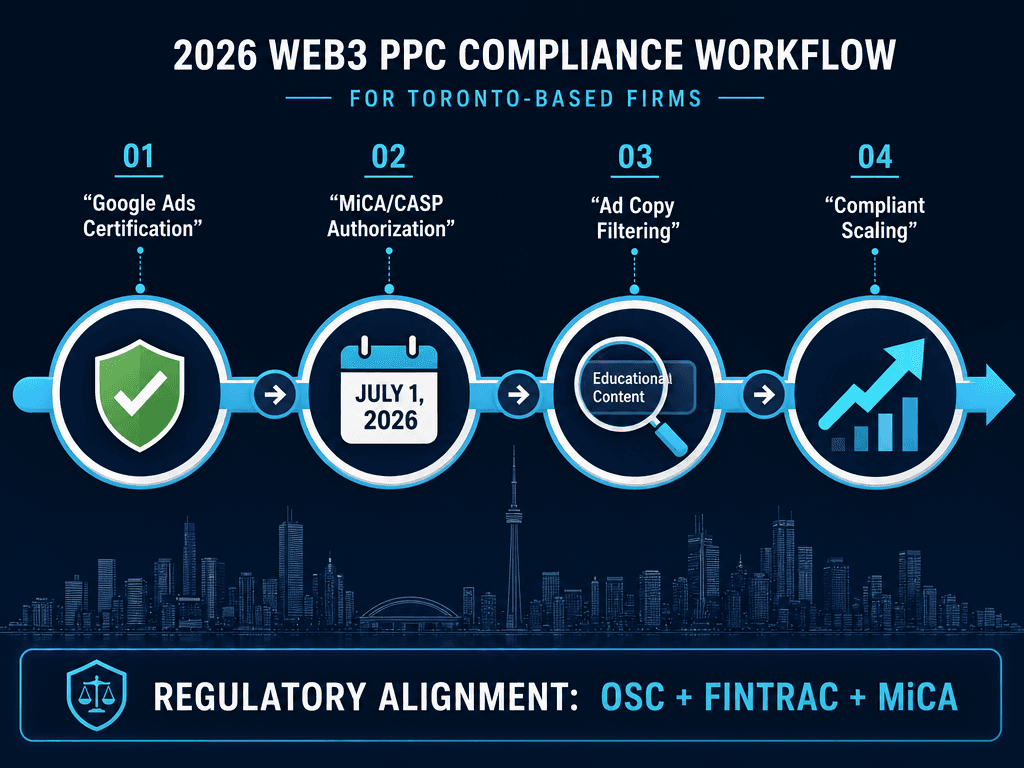
Stay ahead of the July 2026 regulatory shift by aligning your Toronto project with MiCA and CASP standards for global PPC advertising success.
The compliance landscape for crypto advertising in 2026 looks nothing like 2023. Three regulatory frameworks now dictate what you can say, where you can say it, and how you prove you're allowed to say it.
MiCA (Markets in Crypto-Assets Regulation)
The European Union's MiCA framework went into full effect in 2026, requiring any advertiser offering crypto exchange or wallet services to EU residents to obtain CASP (Crypto-Asset Service Provider) authorization. This isn't just a checkbox - it's a months-long authorization process that requires demonstrating custody procedures, KYC compliance, and operational security.
For Toronto projects with global ambitions, this creates a decision point: do you geo-fence EU traffic out of your campaigns, or do you invest in MiCA compliance to access the European market? The answer depends on your total addressable market, but most infrastructure and DeFi projects find that excluding EU traffic significantly reduces their qualified user pool.
FINTRAC (Canada)
Canadian crypto projects already operating under FINTRAC registration have a head start. The ad copy and landing page standards that satisfy FINTRAC's "clear and not misleading" requirements align closely with what Google's automated systems look for. This creates a competitive advantage for Toronto-based projects that U.S. competitors don't have - your compliance infrastructure doubles as your advertising foundation.
Platform-Specific Certification
Google, Meta, and Reddit each maintain their own certification processes beyond governmental regulation. Google's certification requires demonstrating business legitimacy, compliance with local laws, and adherence to their Gambling and Games policy (which crypto falls under). Meta's requirements are similar but focus more heavily on landing page transparency and user protection disclosures.
The mistake most projects make is treating these as one-time hurdles. Platform policies evolve quarterly. What worked in Q1 2026 may trigger suspensions in Q3. A specialized Toronto agency maintains ongoing relationships with platform reps and stays ahead of policy shifts that generalist agencies only discover after client accounts get banned.
The Certification Approach: Educational Content
Here's the practical workaround that compliant campaigns use: educational positioning bypasses most certification requirements while still driving qualified traffic.
Instead of advertising specific token trades or guaranteed outcomes, compliant campaigns advertise educational content about protocol categories and drive users to resources that naturally lead to wallet connection. This approach satisfies platform requirements while still reaching the same audience.
The key is authenticity. Google's quality raters can spot thin educational content designed solely to circumvent restrictions. The content needs to actually educate - which is why successful crypto advertisers treat their blog, YouTube channel, and documentation as core PPC infrastructure, not afterthoughts.
Omnichannel Toronto-Native PPC Strategy
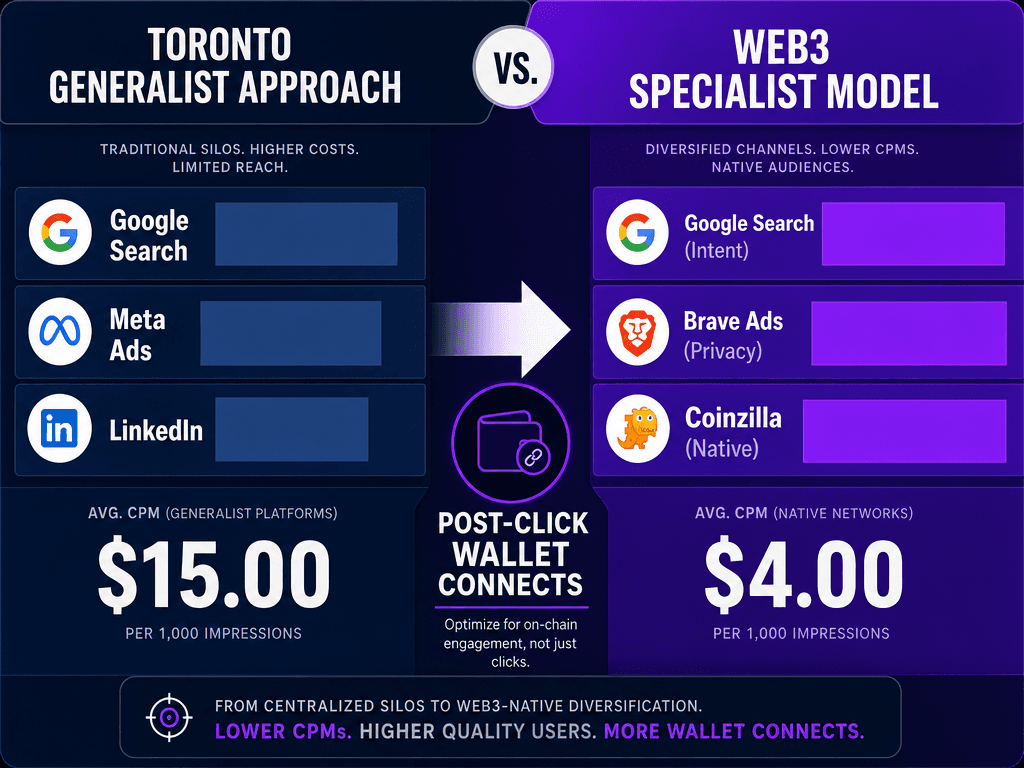
Diversifying your PPC strategy beyond Google and Meta allows Toronto Web3 projects to capture high-intent users at significantly lower CPMs and higher conversion rates.
Traditional PPC strategy assumes a single primary channel (usually Google) with secondary support from display and social. That model fails for Web3 because your highest-intent users don't primarily search Google - they live in crypto-native environments where traditional ad networks have minimal presence.
The effective 2026 approach is true omnichannel orchestration across three distinct phases, each serving a different conversion objective:
Phase 1: Intent Capture (Google Search)
Use Google Search exclusively for bottom-funnel, high-intent queries where users are actively researching specific categories: "best DeFi lending protocols," "how to stake [Category]," "Layer 2 scaling comparison." These users are already crypto-literate and solution-aware - you're competing for consideration, not explaining the category.
Budget allocation: A meaningful portion of total PPC spend focused on high-intent search.
The ROI math works because search intent is qualified. You're not paying to educate someone on what a blockchain is - they already know. You're paying to be the answer when they're ready to choose. CPCs will be higher than crypto-native networks, but conversion rates justify the premium when you're capturing ready-to-transact users.
Landing page strategy matters enormously here. Google rewards pages that comprehensively answer the query intent, which means your landing pages need to function as genuine educational resources first, conversion paths second. The projects that win Google traffic are building documentation-quality content as their primary PPC destination.
Phase 2: Community Building (Brave Ads, Reddit)
Use crypto-native ad networks to drive Discord and Telegram growth. Web3 native ad networks average CPMs: Coinzilla ($5-$10), Bitmedia ($1-$4), Brave Ads ($2-$8), substantially lower than Google Display while reaching an audience that's already crypto-engaged.
Budget allocation: A substantial portion dedicated to community and awareness channels.
Brave Ads are particularly effective because they reach users who've already opted into crypto (by using Brave Browser and earning BAT rewards). These users have self-selected as crypto adopters, making them significantly more qualified than general audience targeting on Google Display.
Reddit targeting within r/cryptocurrency, r/CryptoMoonShots, and vertical-specific subreddits (r/defi, r/ethereum, etc.) allows interest-based filtering that traditional platforms can't match. The challenge is creative - Reddit users are highly skeptical of promotional content, so ads need to lead with genuine insight or utility, not hype.
The conversion goal here isn't immediate wallet connection. It's Discord join, Telegram subscribe, or email capture. You're building the community funnel that will convert over weeks through education and relationship, not through immediate transaction pressure.
Phase 3: Scale and Retargeting (Coinzilla, Bitmedia, Anonymous Ads)
Use crypto-specific display networks to retarget users who've engaged with Phase 1 or Phase 2 content but haven't converted. These networks place ads across crypto news sites, price trackers, DeFi dashboards, and protocol documentation - the actual digital environments where your target users spend time daily.
Budget allocation: The remaining portion focused on retargeting and scaling proven audiences.
These networks offer placement across crypto-native sites with favorable economics. The trade-off is creative flexibility - these networks have policies against misleading claims, and quality standards vary across publisher networks.
The real unlock here is behavioral targeting. Users who visit DeFi protocol documentation, read governance proposals, or actively use Dune Analytics are self-identifying as sophisticated users. Retargeting campaigns can speak to that sophistication with technical messaging that would fail with general audiences.
Anonymous Ads (crypto-native ad network operating on Bitcoin Lightning) allows truly privacy-preserving advertising where neither the advertiser nor the network tracks individual users. CPMs can be notably low, though reach is limited compared to larger networks. It's worth testing for projects where privacy alignment is a core brand value.
Integration: The Toronto Agency Advantage
Running three distinct channel strategies isn't just about budget allocation - it's about creative orchestration, compliance management, and measurement unification. This is where most in-house teams and generalist agencies fail. They can execute individual channels competently, but they can't tie them together into a coherent growth engine where each phase feeds the next.
A specialized Toronto Web3 agency brings infrastructure that treats these phases as a unified system: shared tracking pixels (compliant with crypto-native privacy expectations), creative versioning that maintains brand consistency while adapting to platform requirements, and budget rebalancing based on cohort performance across channels, not just individual campaign ROAS.
For Toronto projects specifically, this means leveraging local advantages: FINTRAC-compliant ad copy that satisfies both Canadian regulators and platform policies, time-zone coverage that allows real-time optimization across North American and European active hours, and ecosystem integration with other Toronto projects for partnership-driven user acquisition that amplifies paid efforts.
Many Toronto Web3 projects have found success by working with agencies that offer integrated crypto paid advertising strategies alongside community management and influencer marketing - creating a true omnichannel approach rather than siloed campaigns.
Technical Proof: On-Chain Attribution

Unlock precise ROI tracking by integrating server-side tagging that connects traditional PPC clicks to verifiable on-chain actions like wallet connects and TVL growth.
Traditional PPC attribution stops at the landing page. A user clicks your ad, arrives on your site, and either completes a form (tracked as a "conversion") or leaves (tracked as a bounce). For Web3 projects, this model is useless.
Your actual conversions happen on-chain: a user connects their wallet, stakes tokens, provides liquidity, or participates in governance. None of these actions fire a traditional conversion pixel. Worse, the user often completes the action hours or days after their initial visit, across multiple sessions, from multiple devices.
On-chain attribution solves this by connecting traditional ad click IDs to wallet addresses, then tracking subsequent on-chain behavior through blockchain explorers and analytics platforms. Here's how it works technically:
Server-Side Tagging Implementation
When a user clicks a PPC ad, the click ID (Google's GCLID, for example) gets stored server-side along with session data. When that user connects their wallet - whether immediately or days later - the wallet address gets associated with the original click ID in your database.
From there, you can track every on-chain action that wallet performs: token purchases, staking deposits, LP provision, governance votes. This data flows back into your PPC dashboard as true conversion events, allowing you to optimize campaigns based on actual protocol engagement rather than vanity metrics like page views or email signups.
The implementation requires technical capability most generalist agencies don't have:
Server-side tracking infrastructure (not just client-side pixels that ad blockers defeat)
Integration with Web3 analytics platforms like Dune Analytics or custom Etherscan API implementations
Database architecture that handles privacy-preserving wallet tracking without storing personally identifiable information
Attribution modeling that accounts for multi-touch journeys across traditional web and blockchain environments
Privacy-Preserving Wallet Tracking
The challenge is doing this while respecting Web3 privacy expectations. Users who connect wallets aren't consenting to comprehensive behavioral tracking in the Web2 sense. The solution is aggregate cohort tracking rather than individual surveillance.
Instead of tracking individual users, you track cohort behavior patterns. This preserves the privacy ethos Web3 users expect while still providing the data you need to optimize spend.
Practically, this means:
Wallet addresses get hashed immediately upon capture, with the hash used for attribution matching rather than the raw address
On-chain behavior gets aggregated at the cohort level (all users from a specific campaign, date range, or creative variant) rather than tracked individually
No linking between wallet addresses and traditional identity data (email, IP, device fingerprints)
Measurement That Actually Matters
With on-chain attribution in place, you stop optimizing for "leads" and start optimizing for metrics that align with protocol growth:
Cost Per Wallet Connect: What you paid in ad spend divided by the number of unique wallets that connected through campaigns. This represents a key efficiency metric for acquisition, though benchmarks vary considerably by category and competition.
Wallet-to-Depositor Rate: What percentage of wallet connects result in an actual deposit or stake. Low rates indicate targeting problems or friction in your onboarding flow. Higher rates suggest you're reaching qualified users with clear value propositions.
Cohort TVL Impact: How much total value locked your campaigns drove in aggregate, and how that TVL behaves over time. TVL from incentivized campaigns often flees immediately when rewards end. TVL from educational campaigns tends to be stickier because users understand the protocol fundamentals.
LTV:CAC by Channel: Traditional lifetime value to customer acquisition cost ratios, but calculated using on-chain revenue (trading fees, protocol revenue share, governance token appreciation) rather than subscription payments. This reveals which channels drive users who actually create protocol value, not just users who connect wallets once and disappear.
Traditional Toronto PPC agencies can't deliver this level of measurement because they've never built the infrastructure. Web3-specialized agencies have the tracking stack, the blockchain data partnerships, and the experience interpreting on-chain behavior patterns that turn raw wallet data into actionable campaign insights.
For projects looking to build comprehensive growth systems, combining technical on-chain attribution with broader crypto marketing strategy ensures that paid campaigns integrate with organic growth, community building, and long-term protocol development rather than operating in isolation.
What Are the Best Crypto Ad Networks in 2026?
The "best" network depends entirely on your user profile, conversion objective, and compliance posture. No single platform serves every Web3 vertical equally.
For High-Intent Search: Google Ads (with certification)
Google remains the dominant platform for bottom-funnel search intent, despite its compliance complexity. Users searching "how to stake ETH" or "best DeFi yield strategies" have clear intent that converts efficiently when you can capture it. The barrier is certification and ad copy compliance.
Best for: Infrastructure projects, DeFi protocols, and any category where users actively search for solutions.
Cost structure: Variable CPC depending on competition and keyword commerciality.
Compliance requirement: Google certification, FINTRAC (for Canadian advertisers), and educational landing page positioning.
For Crypto-Native Reach: Coinzilla & Bitmedia
These networks offer display placement across thousands of crypto-specific publishers: news sites, price trackers, DeFi dashboards, and educational resources. Web3 native ad networks average CPMs: Coinzilla ($5-$10), Bitmedia ($1-$4), making them cost-effective for awareness and retargeting campaigns.
Best for: Retargeting engaged users, building awareness within crypto communities, and reaching users in their natural digital habitats.
Cost structure: CPM-based pricing with favorable economics compared to traditional networks.
Compliance requirement: Moderate - these networks have their own policies but understand crypto positioning in ways Google doesn't.
For Privacy-Aligned Users: Brave Ads
Brave Ads reach users who've self-selected into crypto by using Brave Browser and earning BAT rewards. This audience is substantially more crypto-literate than general populations, making creative messaging more efficient.
Best for: Reaching early adopters, privacy-conscious users, and audiences already comfortable with crypto wallets and self-custody.
Cost structure: CPMs ranging from $2-$8, with cost-per-acquisition often lower than broader networks due to audience qualification.
Compliance requirement: Brave has internal review processes that are crypto-friendly while maintaining quality standards.
For Community Targeting: Reddit Ads
Reddit's subreddit-based targeting allows precision that other platforms can't match. You can advertise exclusively to r/ethereum subscribers, r/defi readers, or niche protocol-specific communities. The challenge is creative - Reddit users are highly skeptical of promotional content.
Best for: Community-driven protocols, governance-focused projects, and technical infrastructure where educated users are your primary target.
Cost structure: Auction-based pricing with costs varying by subreddit competition.
Compliance requirement: Reddit has policies around financial content but allows educational positioning.
For Emerging Options: X (Twitter) Ads
X Ads targeting crypto communities remains viable despite platform volatility. Targeting users who engage with crypto accounts, hashtags, or topics can efficiently reach your audience where they already spend attention.
Best for: Community building, thought leadership amplification, and reaching users already engaged in crypto conversations.
Cost structure: Variable pricing with fluctuation based on news cycles and market conditions.
Compliance requirement: X's policies address promotional content while allowing educational approaches.
The effective 2026 strategy isn't choosing the "best" network - it's orchestrating multiple networks into a cohesive funnel where each serves a specific purpose. Google captures intent, crypto-native networks build awareness and community, and retargeting platforms convert engaged users who need multiple touches before committing.
How Toronto Web3 Projects Should Structure Their PPC Budget
Budget allocation is the most common strategic failure for Web3 PPC. Projects either over-concentrate on a single channel (usually Google, until they get banned) or spread budget so thin across networks that nothing reaches the scale needed to generate meaningful data.
The framework that works for Toronto Web3 projects is phase-based allocation tied to protocol maturity:
Pre-Launch / Stealth (Budget: Lower Range)
Focus: Community building and awareness, not conversion.
Allocation:
Majority to crypto-native display (Coinzilla, Bitmedia) for awareness across DeFi news sites and crypto communities
Significant portion to Reddit and X targeting for driving Discord/Telegram joins
Smaller testing allocation to Google educational content for compliance and messaging validation
Success Metrics: Discord growth rate, engagement in community channels, email capture for launch announcements. You're not optimizing for wallet connects yet because there's nothing to connect to - you're building the community that will provide organic amplification at launch.
Token Launch / Initial Growth (Budget: Mid Range)
Focus: Converting awareness into wallet connects and initial deposits.
Allocation:
Substantial portion to Google Search for capturing high-intent queries around your category
Meaningful allocation to crypto-native display for retargeting users who engaged with pre-launch content
Notable budget to Brave Ads reaching crypto-native audiences
Smaller portion to Reddit/X for maintaining community momentum
Success Metrics: Cost per wallet connect, wallet-to-depositor conversion rate, initial deposit size. You're optimizing for quality users who understand the protocol, not just volume.
Established Protocol (Budget: Upper Range)
Focus: Scaling proven channels and testing new growth levers.
Allocation:
Significant portion to Google Search for category capture as search volume around your protocol grows
Substantial allocation to retargeting campaigns across crypto-native networks targeting users who've visited but haven't connected
Notable budget to partnership and integration amplification (co-marketing with ecosystem partners)
Meaningful portion to influencer amplification (promoting content from trusted voices)
Testing allocation to experimental channels and messaging tests
Success Metrics: Cohort TVL contribution, LTV:CAC by channel, wallet retention at multiple time periods. You're optimizing for protocol economics, not just top-line growth.
Budget Rebalancing Triggers
Static allocation fails because market conditions, competitive dynamics, and platform policies shift constantly. Set clear triggers for rebalancing:
Rebalance when:
A channel's cost per wallet connect increases substantially beyond baseline (shift budget to better-performing channels)
A new platform or network shows promising early data in test budget (scale up allocation)
Compliance policy changes restrict a major channel (redistribute to compliant alternatives)
Market conditions (bull vs. bear) dramatically shift user behavior and search patterns
The Toronto advantage here is access to agencies and advisors who've seen these patterns across multiple protocol launches. You're not guessing at allocation - you're applying pattern-matched learning from similar projects at similar stages.
Many founders find that working with specialists who understand both mastering PPC marketing for blockchain and cryptocurrency businesses and the broader ecosystem significantly accelerates their learning curve and reduces expensive budget allocation mistakes.
h2, h3