
84
Published
August 2026
Updated
August 2026
Toronto Marketing Companies: A Web3 Founder’s Guide to Real Expertise

Tyler Mullins
Founder & Owner of OMNI
Introduction
Toronto has more than 2,000 marketing agencies according to Clutch. But if you're building a DeFi protocol, launching a token, or scaling a DePIN infrastructure project, 1,998 of them won't know the difference between a liquidity pool and a swimming pool.
The real question isn't "Where do I find a Toronto marketing company?" It's "Which agency actually understands on-chain attribution, Discord culture, and crypto compliance?" That's where most founders get burned - hiring a generalist SEO shop that doesn't know how to run a TGE or navigate X's crypto ad restrictions.
This guide cuts through the noise. You'll see which Toronto agencies specialize in Web3 and high-growth tech, which ones are built for traditional B2B, and what the "Toronto advantage" really means for a global crypto project.
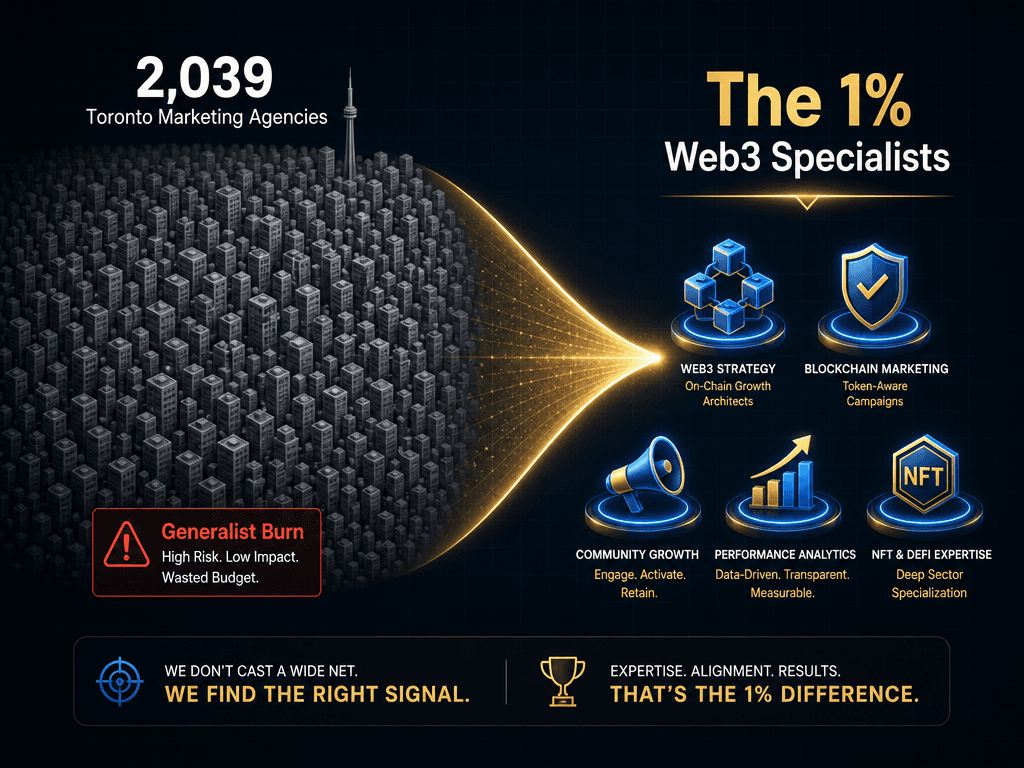
Table of Contents
Why Toronto Agencies for a Global Web3 Project?
The Filter: Generalist vs. Crypto-Native Marketing
Web3 Specialist Agencies in Toronto
Tech-Focused Generalist Agencies
How to Choose the Right Agency for Your Project
The Case Study Difference: Web2 vs. Web3 Results
Frequently Asked Questions
Why Toronto Agencies for a Global Web3 Project?
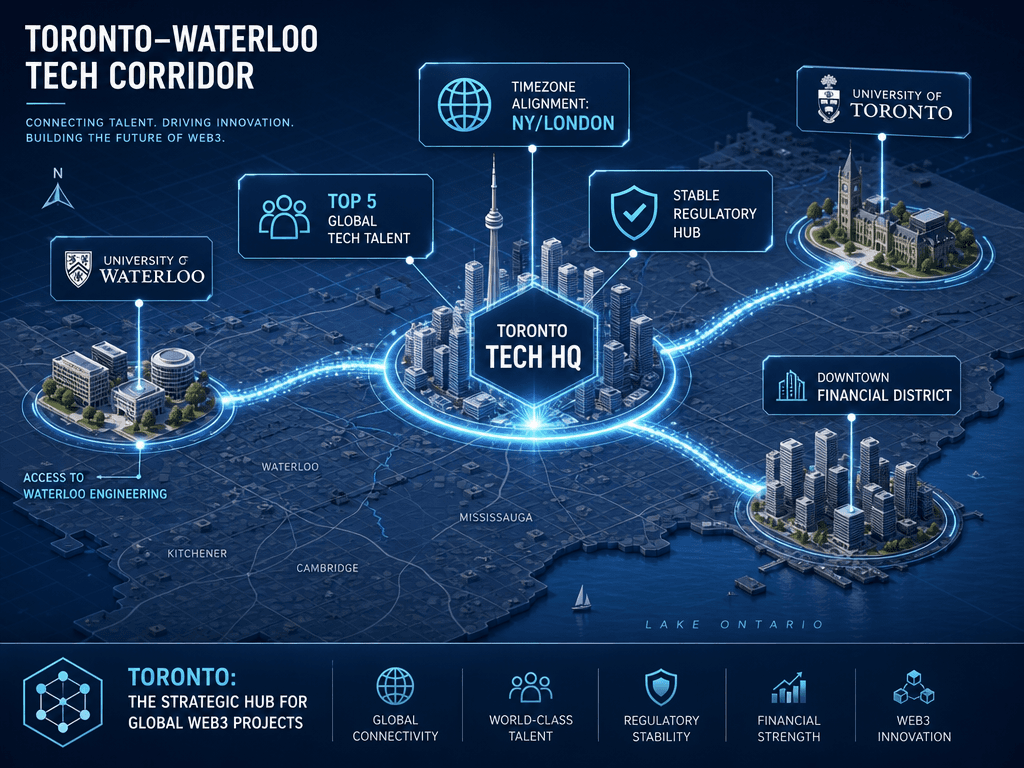
Toronto offers a unique advantage for crypto founders: it's a stable jurisdiction with deep technical talent, favorable timezone alignment with New York, and a regulatory environment that doesn't treat blockchain like contraband.
The Toronto-Waterloo corridor produces more computer science graduates per capita than most major cities. That talent density means local agencies can staff teams who actually understand smart contracts, tokenomics, and the mechanics of how a blockchain works - not just the buzzwords.
Timezone matters more than founders think. When your community is arguing about a Discord moderation decision at 2am EST, you need a team that's awake. When you're coordinating a synchronized influencer campaign across X and Telegram for a token launch, you can't wait six hours for a Slack reply from Singapore.
The regulatory angle is straightforward. Canadian agencies operate under clear advertising and financial promotion rules. That clarity matters when you're running paid campaigns for a crypto product and need partners who understand FINTRAC requirements, not just how to dodge Google's ad policies.
The Filter: Generalist vs. Crypto-Native Marketing
Most Toronto agencies that claim crypto expertise added a "Web3 services" page in the last 12 months. The difference between a generalist dabbling in crypto and a crypto-native shop shows up immediately in execution.
A generalist agency will pitch you on LinkedIn ads and Google Display campaigns. A crypto-native team knows those channels convert at 0.2% for token projects because Web3 users don't click banner ads - they follow KOLs on X, lurk in protocol Discords, and read Delphi research reports.
The language gap is real. When you say "we need to drive TVL before the Binance listing," a generalist hears jargon. A specialist knows you mean total value locked, understands the game theory behind liquidity mining incentives, and has run that exact playbook before.
Content strategy reveals the divide fastest. A traditional agency will write a blog post titled "Top 10 Benefits of Our DeFi Platform." A Web3 shop knows your audience wants technical breakdowns of your AMM curve, security audit summaries, and founder backgrounds - not generic listicles.
Here's what separates the two approaches:
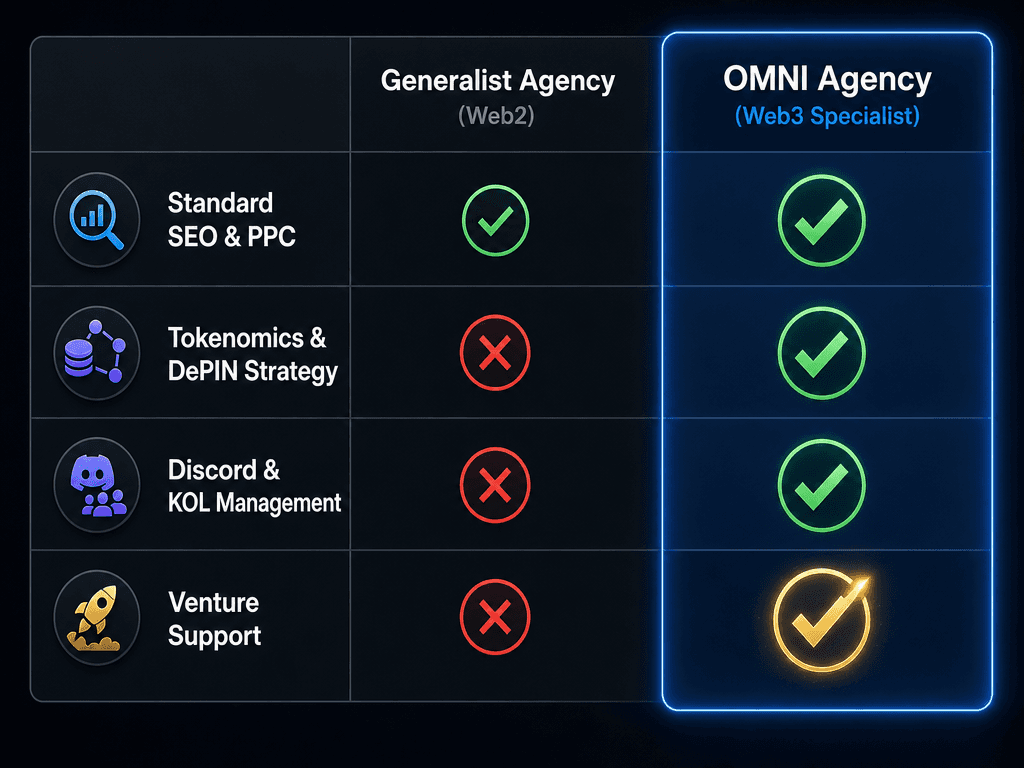
Web2 Generalist Focus:
SEO keyword stuffing without understanding on-chain user behavior
Facebook and Instagram ads (banned for most crypto products)
Email drip campaigns using purchased lists
Generic "thought leadership" content
No community management infrastructure
Web3 Specialist Focus:
Discord server architecture and moderation
KOL relationship networks and on-chain attribution
Tokenomics messaging and whitepaper clarity
Crypto-native paid channels (Brave, X, crypto media networks)
PR through CoinDesk, Cointelegraph, Decrypt, The Block
The cost of hiring wrong is measured in months. A generalist agency will spend three months "learning" your vertical while burning budget on channels that don't convert. You'll get traffic that doesn't convert to wallets, followers who don't join your Discord, and content that ranks for keywords nobody in crypto actually searches.
Web3 Specialist Agencies in Toronto
Only a handful of Toronto agencies operate as true Web3 specialists with multi-year track records in crypto-native growth.
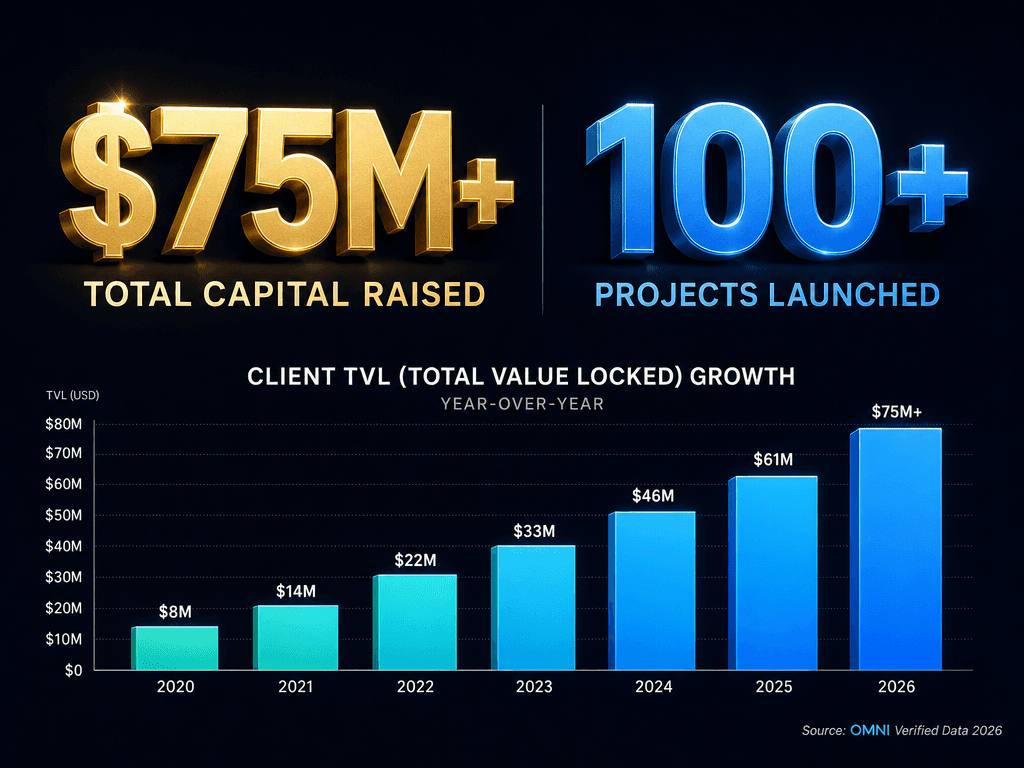
OMNI Agency has spent five years building the infrastructure that crypto projects need - from community management and Discord moderation to influencer networks spanning 400+ verified KOLs. The team has helped clients raise over $75M+ across 100+ projects according to the company, including work with Polkadot, OKX, and Paysafe.
AP Collective ranks OMNI as #13 globally for Web3 growth in their agency analysis, which matters because global rankings filter for actual results, not just local presence. The team's collective experience includes 20 years in venture-backed startup environments per the official site.
What sets OMNI apart is the full-stack approach. Most agencies specialize in one or two channels. OMNI handles everything from paid media and social strategy to crypto PR and SEO built for blockchain. That matters when you're coordinating a token launch across eight channels simultaneously.
The Slingshot case study shows the model in action - OMNI took a project from zero awareness to a highly anticipated token sale by coordinating community growth, influencer campaigns, and media placement as one synchronized strategy.
Blockwiz operates at scale with a team that has managed 600+ campaigns using a network of 1,200 verified influencers according to AP Collective. Their strength is volume - when you need 50 KOLs activated in one week for a product launch, Blockwiz has the infrastructure.
The difference between the two comes down to structure. OMNI runs smaller, deeply integrated teams embedded in client projects. Blockwiz operates more like a network - high throughput, wide distribution, best for projects that need reach over surgical precision.
Both agencies understand the mechanics that matter: how to structure a Discord server for a token community, which Telegram channels actually drive conversions, how to message tokenomics without triggering securities concerns, and where to place PR to hit the right investor and user audiences.
Tech-Focused Generalist Agencies
Some Toronto agencies aren't crypto-native but have strong track records in adjacent verticals - SaaS, fintech, and high-growth B2B tech. They can be solid partners if your needs skew more toward traditional growth channels.
Search + Gather specializes in paid search and SEO for B2B technology companies. They won't run your Discord or coordinate a KOL campaign, but if you need programmatic SEO for a blockchain infrastructure product targeting enterprise buyers, they understand that motion.
CAYK Marketing has deep experience in PPC and analytics for technology brands. Their strength is attribution and funnel optimization - useful if you're running a crypto product with traditional SaaS-style onboarding and need to track conversion paths across multiple touchpoints.
Pound & Grain focuses on brand strategy and creative for Series B and C stage companies. If you've raised significant capital and need to professionalize your brand identity before a major exchange listing or partnership announcement, they're built for that scale of project.
The tradeoff with tech generalists is clear: you get professionalism and polish, but you lose crypto-specific expertise. They won't have relationships with Messari or Delphi. They won't know which X accounts actually move opinion in your vertical. They won't have case studies showing how they grew a protocol from 500 to 50,000 Discord members.
For founders building crypto products, the gap usually isn't worth bridging unless your go-to-market is deliberately Web2-adjacent - like a blockchain API targeting traditional enterprises who don't care about your token.
How to Choose the Right Agency for Your Project
Start by filtering agencies on their client roster. Look for projects you recognize in your vertical. If an agency claims Web3 expertise but their case studies show e-commerce brands and local restaurants, that's your answer.
Ask specific questions that reveal real experience:
"How do you handle Discord server architecture for a 10,000-member community?" A real answer involves role hierarchies, verification systems, bot integrations, and moderation workflows. A vague answer about "engagement strategies" means they don't actually run Discord communities.
"What's your approach to crypto influencer vetting?" You want to hear about follower authenticity checks, engagement rate benchmarks, previous crypto campaign performance, and on-chain attribution methods. If they talk about "Instagram reach," run.
"How do you navigate paid advertising restrictions for crypto products?" The answer should include specific platform policies (Google's crypto certification requirements, X's financial services rules, Brave's crypto-native network), compliant creative approaches, and backup channels when mainstream platforms reject campaigns.
Look for skin in the game. Some agencies take token allocations or equity alongside cash fees. That alignment matters - it means they win only when you win. OMNI's venture arm (Omni Ventures) invests in select client projects, which creates different incentives than pure service fees.
Check for vertical depth. An agency that works across DeFi, gaming, and infrastructure is usually stronger than one claiming to do "everything Web3." Depth in one or two verticals means they understand the nuances - like how DeFi marketing differs from NFT collection launches or how DePIN projects need different positioning than pure financial protocols.
Red flags to watch:
Case studies with no verifiable metrics or project names
Teams with zero on-chain presence (no ENS domains, no public wallets, no protocol governance participation)
Pricing that's suspiciously low compared to market rates for specialized work
Guarantees about rankings, ROI, or specific outcomes (nobody can guarantee a token price or exchange listing)
No clear process for compliance review or legal coordination
The best agencies will push back on unrealistic timelines, question assumptions in your strategy, and tell you when something won't work. That friction is valuable - it means they're thinking critically, not just taking orders.
The Case Study Difference: Web2 vs. Web3 Results
Looking at real outcomes shows the gap between generalist marketing and crypto-native execution.
A traditional digital agency running an SEO campaign for a technology company might deliver a 20% increase in organic traffic and celebrate it as success. That result matters in B2B SaaS where traffic converts to demo requests and sales pipeline.
Compare that to OMNI's work with Slingshot, which went from zero brand awareness to a highly anticipated token sale that raised $16M. The mechanics are completely different - coordinating 200+ influencers, building a 50,000-member Discord community, securing coverage in Cointelegraph and Decrypt, and timing everything to peak exactly at the token generation event.
Or look at what it takes to drive actual protocol adoption. When OMNI worked with Polkadot on ecosystem growth, the goal wasn't website traffic - it was getting developers to build on the network and users to interact with parachains. That requires completely different strategies: developer documentation, hackathon sponsorships, builder community programs, and narrative positioning in the right technical communities.
The metrics that matter in Web3 often don't show up in Google Analytics. You're tracking Discord active members, wallet connections, transaction volume, TVL growth, governance participation rates, and community sentiment across Telegram and X. A generalist agency doesn't have dashboards for those KPIs because they've never needed to measure them.
Cost per acquisition tells the story. A well-run Web3 marketing strategy might spend $50 to acquire a qualified wallet holder who goes on to contribute $2,000 in TVL. A generalist running Google Ads might spend $30 to acquire a website visitor who bounces after reading one page. The unit economics aren't even comparable.
The timeline difference matters too. Web2 campaigns can afford to ramp slowly over quarters. A token launch needs coordinated execution across every channel within a six-week window. Miss that window and you've lost momentum permanently.
h2, h3