
78
Published
July 2026
Updated
July 2026
Pay Per Click Advertising Firm Guide for Web3 (2026)

Tyler Mullins
Founder & Owner of OMNI
Introduction
Pay-per-click advertising firms manage ad campaigns where businesses pay only when someone clicks on their ad. But in the Web3 space, a good PPC firm must do far more than bid on keywords and set budgets. The real value lies in navigating crypto-specific compliance hurdles, platform bans, and audience skepticism that generalist agencies simply aren't equipped to handle.
For crypto founders, choosing between a specialist and generalist PPC partner often determines whether your first campaign drives genuine users or just burns budget on banned accounts and bot traffic.
Table of Contents
What Is a Pay-Per-Click Advertising Firm?
How PPC Firms Operate
The Web3 PPC Landscape in 2026
Platform Breakdown & Compliance
The Retargeting Layer Strategy
2026 Budgeting Guide for Web3 Projects
Specialist vs. Generalist: Making the Right Choice
Frequently Asked Questions
What Is a Pay-Per-Click Advertising Firm?
A pay-per-click advertising firm designs, launches, and manages digital ad campaigns across platforms like Google, Meta, X (formerly Twitter), and LinkedIn. The defining feature is the payment model: advertisers pay a fee each time someone clicks on their ad, rather than paying upfront for impressions or reach.
The core mechanism involves bidding on keywords or audience segments in real-time auctions. When someone searches for "best crypto wallet" on Google or scrolls through a feed on Meta, the platform runs an instant auction among advertisers targeting that user. The winning ad appears, and the advertiser pays only when the user clicks.
For Web3 projects, this seemingly straightforward process becomes complicated. Most crypto businesses face account suspensions, policy rejections, and astronomical cost-per-click rates because platforms treat digital assets as high-risk categories. A specialized crypto paid advertising partner understands how to structure campaigns that comply with evolving policies while still reaching the degen audiences and institutional investors that matter.
How PPC Firms Operate
Traditional PPC firms follow a predictable workflow: keyword research, ad creative development, landing page optimization, bid management, and performance reporting. They typically charge either a percentage of ad spend or a flat monthly retainer.
The best firms combine three capabilities:
Technical execution means setting up conversion tracking, managing bid strategies, and conducting A/B tests on ad creative and landing pages. This is table stakes.
Strategic positioning involves understanding your competitive landscape and identifying the search terms, audiences, and messaging angles that convert at acceptable costs. Generalist agencies often fail here with crypto projects because they don't understand that "yield farming" and "liquidity pool" aren't just jargon but actual features users search for.
Compliance navigation separates Web3 specialists from everyone else. Knowing which disclaimers Meta requires, how to apply for Google's crypto certification through the new internal process, and which creative angles trigger automatic rejections takes years of direct experience with platform policy teams.
The Web3 PPC Landscape in 2026
The paid advertising environment for crypto projects has gotten significantly more expensive and complex. The average Meta CPM rose 20.1% from $11.82 in 2025 to $14.19 in 2026, and crypto-specific costs run considerably higher. Facebook CPC rose 11% year-over-year to $1.72 across all industries in 2026, but blockchain projects face steeper rates.
Crypto and blockchain advertisers saw the median CPM on Facebook reach a peak of $66.77 in March 2026, nearly five times the platform average. This premium exists because platforms view digital asset advertising as higher risk and apply stricter review processes.
Three forces are reshaping the landscape:
Rising costs make efficiency paramount. Projects that could afford to experiment with loose targeting and creative in 2023 now need precise audience segmentation and ruthless performance tracking from day one.
Policy evolution continues at a rapid pace. Google's June 2026 UI transition for certification applications caught many agencies off guard, and X's March restriction on crypto paid partnerships forced a complete strategic shift for influencer-led campaigns.
Attribution complexity has intensified as Web3 projects need to connect off-chain ad clicks to on-chain wallet actions. Traditional ecommerce conversion pixels don't capture when a user clicks an ad, visits your site, then returns three days later via an organic search to connect their wallet and provide liquidity.
Platform Breakdown & Compliance
Each advertising platform presents unique opportunities and restrictions for Web3 projects. Understanding the current policies and certification processes determines whether your campaigns launch successfully or get rejected before they start.
Google Ads: The UI Shift
Google remains the largest search advertising platform, but accessing it for crypto advertising requires navigating a certification process that changed substantially in 2026. Google Ads applications for crypto certifications must be submitted via the Google Ads account starting June 2026, moving away from the external help center forms that existed previously.
The new internal process lives in the Admin menu under Policy Manager. Projects must submit documentation proving they operate as registered exchanges or wallets in the jurisdictions they're targeting. The approval process typically takes 5-7 business days, and rejections often stem from incomplete licensing documentation rather than the ads themselves.
Search campaigns work best for capturing high-intent users already researching specific solutions. If you're launching a new DEX, bidding on terms like "decentralized exchange Ethereum" or "best crypto trading platform" can drive qualified traffic from users actively comparing options.
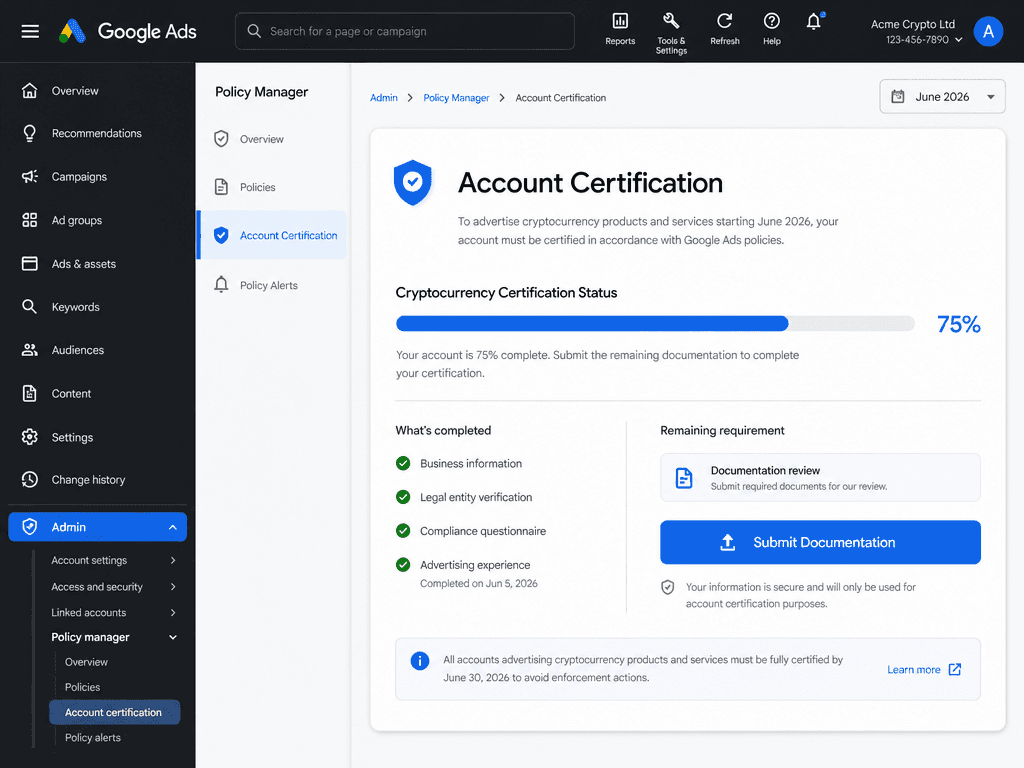
Navigating the June 2026 Google Ads update: certifications for crypto advertising have transitioned from external forms to a streamlined internal Policy Manager interface.
X (Twitter): The Policy Pivot
X holds unique value for Web3 advertising because it's where crypto communities actually gather. The platform hosts real-time discussion of market movements, new protocols, and governance decisions in a way other platforms don't replicate.
However, X implemented a major policy change in March 2026 that prohibits digital asset projects from using the platform's "Paid Partnership" program for influencer collaborations. This closed a popular workaround where projects would pay creators for promoted posts tagged as partnerships rather than running formal ad campaigns.
Now, crypto advertising on X requires using the platform's official ads platform with proper account setup and targeting. The benefit is more robust targeting options and conversion tracking, but the shift forced many projects to rebuild their influencer strategies from scratch.

X's March 2026 policy update mandates a shift from influencer 'Paid Partnership' tags to formal ad accounts for all digital asset promotions to ensure compliance.
Meta Platforms: Navigating Restrictions
Facebook and Instagram allow crypto advertising with limitations. The platforms permit ads for exchanges, wallets, and educational content but prohibit promotional content for most DeFi protocols, yield products, and token sales without additional approvals.
Meta's ad costs for crypto projects run high compared to other industries. The creative that works best tends to be educational rather than directly promotional, focusing on teaching users about blockchain concepts or demonstrating product features rather than pushing immediate conversions.
LinkedIn: B2B Infrastructure Play
For infrastructure projects targeting enterprise clients or developers, LinkedIn offers precision targeting that other platforms can't match. The global CPC benchmark for LinkedIn is $5.58, rising to $6.40 for senior decision-makers, making it expensive but potentially worthwhile for high-value conversions.
LinkedIn works best for chains targeting institutional adoption, enterprise blockchain solutions, and developer tools where the decision-makers are CTOs, VPs of Engineering, and blockchain architects rather than retail investors.
Niche Crypto Networks
Platforms like Coinzilla, Bitmedia, and A-Ads specialize in crypto advertising and offer more lenient policies than mainstream platforms. These networks place ads on crypto news sites, blockchain blogs, and crypto-focused applications.
The targeting is less sophisticated than Google or Meta, but the audiences are pre-qualified as crypto-aware. These networks work well for retargeting users who've already visited your site or for reaching audiences that generalist platforms struggle to serve due to policy restrictions.
The Retargeting Layer Strategy
The most effective Web3 PPC strategies don't rely on a single platform but instead layer broad awareness campaigns with targeted retargeting to optimize for both reach and conversion efficiency.
The framework involves three stages:
Top-of-funnel awareness uses Google and Meta to reach users searching for solutions or browsing crypto-related content. These campaigns prioritize reach and brand visibility, accepting higher cost-per-click in exchange for introducing your project to new audiences.
Mid-funnel consideration targets users who've engaged with your content but haven't converted yet. This stage might use Meta's custom audiences to show different creative to people who visited your site, or Google's remarketing lists to bid higher on users who've already shown interest.
Bottom-of-funnel conversion leverages niche crypto ad networks to retarget warm audiences with more direct calls-to-action. Because these users are already familiar with your project and crypto-savvy, conversion rates tend to be higher even though the overall reach is smaller.
This layered approach helps manage the attribution complexity that plagues Web3 marketing. By using broad platforms for discovery and niche networks for conversion, you can optimize each stage for its specific goal rather than expecting a single platform to handle the entire funnel.
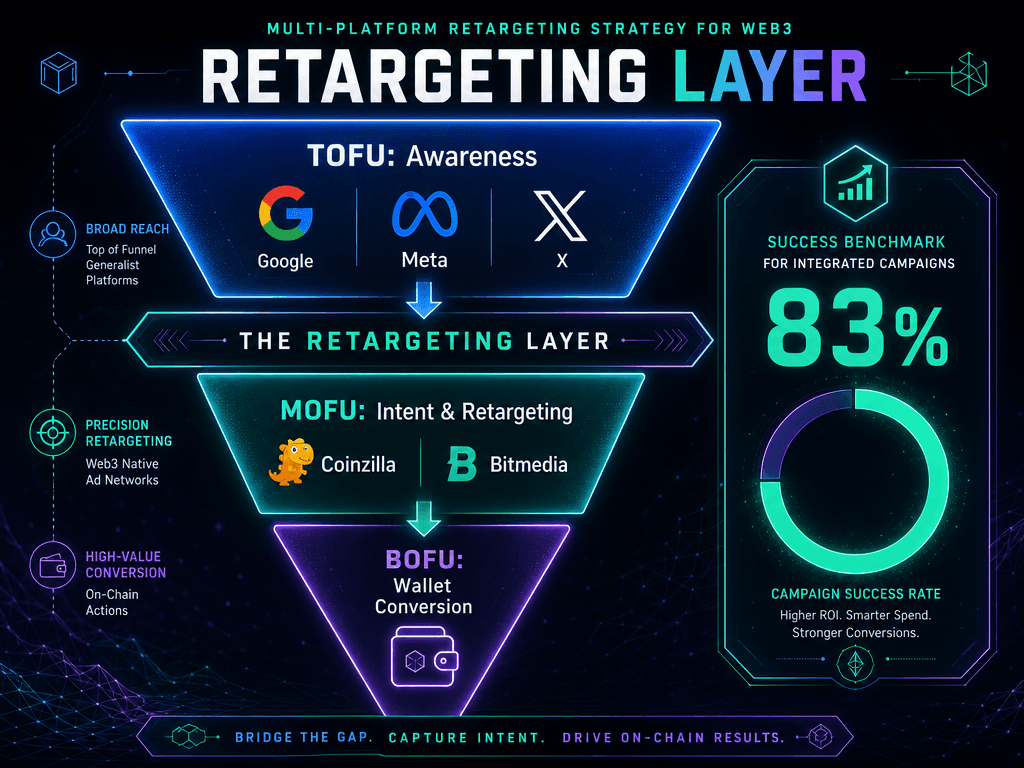
A strategic PPC funnel for Web3 projects uses broad platforms for initial reach while leveraging niche networks for high-conversion retargeting and wallet actions.
2026 Budgeting Guide for Web3 Projects
Setting realistic PPC budgets for Web3 projects requires understanding platform-specific costs and adjusting expectations based on your project stage and goals.
Early-stage projects (pre-seed to seed) typically start with substantial monthly test budgets spread across 2-3 platforms. This allows enough spend to gather meaningful data on which channels and audiences convert without overcommitting before you've proven product-market fit.
Growth-stage projects (Series A and beyond) often scale to considerably larger monthly budgets across a full platform mix including Google, Meta, X, LinkedIn, and niche networks. At this stage, the focus shifts from testing to optimization and scaling winning campaigns.
Platform-specific cost expectations based on 2026 benchmarks:
Google Search typically requires higher CPCs for competitive crypto keywords, with some high-intent terms exceeding the platform averages. Budget sufficiently to gather meaningful data across your target keywords.
Meta platforms show the widest variance. General crypto interest targeting might achieve moderate CPCs, while highly specific audiences can reach substantially higher rates. The $66.77 peak CPM reflects how expensive impression-based campaigns have become.
X (Twitter) generally costs less than Meta for crypto audiences, making it more accessible for many projects. The challenge is the platform's smaller scale compared to Google or Meta.
LinkedIn commands premium pricing but reaches decision-makers. The $6.40 CPC for senior decision-makers reflects this targeting precision and makes sense only when lifetime customer value justifies the acquisition cost.
Niche crypto networks offer more variable pricing, often using CPM models with rates depending on site quality and audience specificity. These work best as retargeting layers rather than primary acquisition channels.
Accurate budgeting in 2026 requires understanding platform-specific benchmarks, where Meta averages $1.72 CPC and LinkedIn decision-makers command $6.40 per click.
Specialist vs. Generalist: Making the Right Choice
The decision between hiring a Web3-specialized PPC firm versus a generalist digital marketing agency comes down to compliance expertise, audience understanding, and integration with other growth channels.
Generalist agencies bring sophisticated technical execution, established processes, and often larger teams with specialized roles for creative, analytics, and strategy. They excel at conversion rate optimization and have deep experience with ecommerce and SaaS attribution models.
However, they typically lack three critical capabilities for crypto projects:
Compliance navigation means knowing which creative angles trigger automatic rejections, how to structure landing pages that satisfy platform policies, and when to use specific disclaimers. Generalists learn these through trial and error on your budget.
Audience literacy involves understanding that Web3 users think differently about privacy, ownership, and trust than typical SaaS buyers. The messaging that works for enterprise software often falls flat with DeFi users who value transparency and decentralization over polished corporate positioning.
Cross-channel integration becomes essential when your PPC strategy needs to align with crypto influencer marketing, community management, and token launch timing in ways that traditional agencies don't encounter.
Web3-specialized firms like OMNI Agency combine paid media expertise with native understanding of crypto audiences and compliance requirements. Having managed campaigns across DeFi protocols, NFT projects, and infrastructure launches, specialists can predict which approaches will succeed and which will waste budget on policy violations or mismatched audiences.
The five-plus years of working exclusively in Web3 creates pattern recognition that generalists can't replicate quickly. When a specialist sees your project positioning, they can immediately reference similar launches, predict platform policy responses, and suggest creative angles that worked for comparable projects.
h2, h3
