
77
Published
July 2026
Updated
July 2026
Top 20 Media Companies in Toronto: From Legacy Giants to Web3 Specialists

Tyler Mullins
Founder & Owner of OMNI
Introduction
Most founders looking for a Toronto media partner hit the same wall - they Google "media companies Toronto," land on a list of Rogers and Bell, then realize they're back at square one. The biggest media companies in the city are infrastructure giants built for broadcast reach and enterprise ad buys. That model works for launching a new Rogers phone plan. It breaks completely when you need to launch a token, scale a Discord from zero, or get cited by Perplexity.
The gap isn't budget - it's technical fluency. Traditional digital agencies can buy Meta ads and write LinkedIn posts. They can't explain why your whitepaper isn't ranking, what a KOL actually delivers, or how to structure a community that converts attention into TVL. By the time most Web3 founders realize their "full-service agency" doesn't understand the channels where their buyers live, they've burned six months and $200K on campaigns optimized for the wrong outcome.
What follows is the complete picture - who the legacy infrastructure players are, what the generalist digital shops do well, and where the specialized Web3 growth model delivers outcomes traditional media can't touch. This is not a ranking. It's a selection guide built for founders who need partners that understand the decentralized web, not the ones still optimizing for cable subscribers.
Key Takeaways
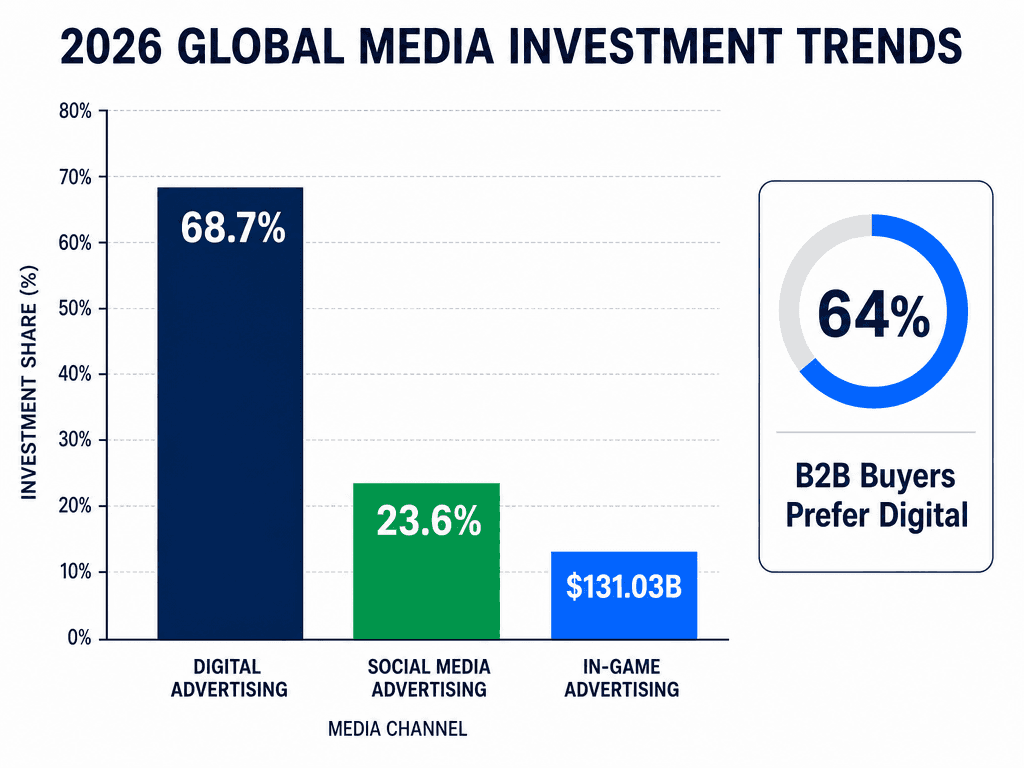
Toronto's media industry is projected to reach $3,080.52 billion globally in 2026, with digital advertising now accounting for 68.7% of total investment.
Legacy media companies like Rogers, Bell, and CBC dominate infrastructure but lack the agility required for high-velocity Web3 and crypto launches.
Generalist digital agencies excel at Web2 channels (Meta, Google, LinkedIn) but struggle with crypto-native platforms like Discord, X (Twitter), and on-chain attribution.
Web3-specialized agencies like OMNI deliver full-stack growth - community, influencer, paid media, PR, and token-launch strategy - under one roof with 5+ years of crypto-native experience.
Toronto's emergence as a Web3 media hub is driven by agencies that understand Generative Engine Optimization (GEO) and AI search engines where buyers now research.
Choosing the right partner requires matching technical fluency to your project type: legacy for broadcast reach, generalist for Web2 performance, specialist for Web3 outcomes.
Table of Contents
The Evolution of the Toronto Media Landscape
The Infrastructure Kings: Legacy Media Companies
The Creative & Entertainment Powerhouses
The Generalist Digital Agencies
Toronto's Emergence as a Web3 Media Hub
Selection Guide: Why Generalist Agencies Fail Crypto Projects
What Is the Biggest Media Company in Canada?
Future Outlook: The Rise of GEO and AI Search
Frequently Asked Questions
The Evolution of the Toronto Media Landscape
Toronto's media industry has undergone three distinct phases over the past two decades. The first era - broadcast dominance - was defined by Rogers, Bell, and the CBC controlling distribution through cable, radio, and satellite infrastructure. Content reached audiences through scheduled programming, and media companies measured success in household penetration and Nielsen ratings.

Toronto's media landscape has shifted from traditional broadcast to specialized Web3 and AI-driven models, requiring brands to choose partners based on technical fluency.
The second phase - digital transformation - began around 2010 as brands shifted spend to Meta, Google, and programmatic display networks. Digital agencies emerged to manage performance campaigns, optimize conversion funnels, and run SEO strategies. This model worked exceptionally well for eCommerce, SaaS, and B2B lead generation. According to recent data from SQ Magazine (2026), digital advertising now accounts for 68.7% of total global media investment, a seismic shift that has redefined how brands allocate budgets.
The third phase - the decentralized web - is unfolding now. Web3 projects don't measure success in impressions or click-through rates. They track wallet connections, Discord retention, TVL growth, and on-chain attribution. The buyers for these projects don't research on Google alone; they ask ChatGPT which DeFi protocol has the best yield, they scroll crypto Twitter for alpha, and they lurk in project Discords to gauge community health before committing capital.
This evolution creates a fundamental mismatch. Legacy media companies are built for reach at scale through traditional channels. Generalist digital agencies are built for performance marketing on Web2 platforms. Web3 projects require partners who understand the technical architecture of blockchain, the compliance constraints of token marketing, and the cultural fluency required to engage crypto-native audiences across Discord, X, Telegram, and Farcaster. Toronto's media landscape now reflects this three-tier structure - and choosing the wrong tier for your project type is the most expensive mistake founders make.
The Infrastructure Kings: Legacy Media Companies
The largest media companies in Canada are infrastructure-first organizations built to own distribution networks and monetize them through advertising and subscription models. These are not agencies - they're conglomerates with decades of investment in physical and digital infrastructure.
Rogers Communications operates Canada's largest wireless network, Rogers Sports & Media (which includes Sportsnet and Blue Jays ownership), and a vast cable and broadband infrastructure. Rogers is built for mass-market reach - if you need to run a 30-second TV spot during Hockey Night in Canada, Rogers delivers unmatched scale. However, this model is optimized for consumer brands with large budgets and broad demographics. The average campaign minimum runs into six figures, and the approval process for creative is measured in weeks, not days.
Bell Media owns CTV, TSN, RDS, and operates the Crave streaming platform. Like Rogers, Bell excels at broadcast reach and premium video inventory. Bell's strength lies in its ability to bundle TV, digital, and mobile placements across a vertically integrated media ecosystem. The limitation for Web3 projects is the same as Rogers: these platforms are designed for CPG brands, automotive launches, and financial services - not for token sales, NFT drops, or DeFi protocol growth where compliance constraints and niche targeting are paramount.
CBC (Canadian Broadcasting Corporation) is Canada's public broadcaster, offering reach across television, radio, and CBC.ca digital properties. CBC provides unmatched credibility and brand safety, making it ideal for government, healthcare, and institutional campaigns. However, CBC does not accept cryptocurrency advertising under its current ad policy framework, which eliminates it as an option for most Web3 projects.
Torstar operates the Toronto Star and a portfolio of regional news brands. Torstar is relevant for PR and editorial placements rather than performance media. If your goal is to secure a feature in a trusted Canadian news outlet to build credibility, Torstar properties deliver that editorial weight. However, Torstar does not offer programmatic ad inventory or the targeting precision required for crypto-native campaigns.
These legacy players dominate the Toronto media landscape in terms of revenue and reach, but they are not built for the agility, compliance nuance, or technical fluency required by Web3 projects. They excel at brand awareness for consumer products - not at driving wallet connections or TVL growth.
The Creative & Entertainment Powerhouses
Toronto is home to several world-class creative and entertainment companies that produce content consumed globally. These organizations are not media agencies in the traditional sense, but they shape Toronto's reputation as a production hub and innovation center.
Netflix (Toronto HQ) operates one of its largest Canadian offices in Toronto, serving as a hub for content production and licensing across North America. Netflix has commissioned dozens of Canadian originals and invests heavily in Toronto-based production studios. According to SQ Magazine (2026), Netflix surpassed 325 million paid subscribers worldwide, making it the dominant streaming platform globally. However, Netflix is a content buyer and distributor - not a marketing partner. If you're a production studio pitching a show, Netflix is your buyer. If you're a Web3 project looking for media strategy, Netflix is not a relevant option.
Rockstar Games (Toronto Studio) is one of the largest video game studios in the world, known for the Grand Theft Auto and Red Dead Redemption franchises. Rockstar's Toronto office focuses on game development and live-service operations. The studio has pioneered in-game advertising and virtual economies, making it culturally relevant to Web3 gaming discussions. However, Rockstar is a game publisher, not a media agency. The relevance to Web3 is conceptual - Rockstar has demonstrated how virtual economies can generate billions in revenue, a model DeFi protocols and play-to-earn games now emulate.
Ubisoft Toronto develops AAA titles including Splinter Cell, Far Cry, and Watch Dogs. Ubisoft has experimented with NFTs and blockchain integration in games like Ghost Recon Breakpoint, though public reception was mixed. Ubisoft's presence in Toronto reinforces the city's reputation as a gaming hub, but like Rockstar, it is a game developer rather than a marketing partner.
These entertainment powerhouses contribute to Toronto's media ecosystem by demonstrating what scaled content production looks like. They are not marketing agencies, but their success stories shape how Web3 projects think about content monetization, virtual economies, and user engagement.
The Generalist Digital Agencies
Toronto has dozens of full-service digital agencies built to deliver performance marketing, SEO, content, and paid media for traditional businesses. These agencies excel at driving results on Web2 platforms and serve as the default choice for eCommerce, SaaS, and B2B brands.
Major Tom is one of Toronto's most established digital agencies, with a client roster spanning enterprise brands and high-growth tech companies. Major Tom offers strategy, creative, paid media, SEO, and analytics under one roof. The agency is known for clean execution and a data-driven approach to campaign optimization. However, Major Tom's strength is also its limitation for Web3 projects - the agency is optimized for Meta, Google, and LinkedIn campaigns, not for Discord growth, KOL partnerships, or token-launch compliance. Major Tom's average client budget starts at $10K/month, with larger retainers for enterprise accounts.
Thrive Agency positions itself as a results-driven digital marketing partner focused on ROI. According to Thrive's own reporting (2026), the agency has helped drive measurable growth for clients across paid search, paid social, and conversion rate optimization. Thrive's messaging emphasizes "no fluff, just results," which resonates with performance-minded founders. However, Thrive's case studies skew heavily toward local service businesses (dental clinics, home services, law firms) rather than crypto protocols or DeFi launches. The agency understands how to drive calls and form fills - not how to drive TVL or token volume.
Search & Gather is a boutique agency known for creative storytelling and brand strategy. Search & Gather's work leans more conceptual than performance-focused, making it a good fit for brands that need positioning and creative development before scaling. The agency has worked with consumer brands, hospitality clients, and cultural institutions. However, Search & Gather does not have public case studies in crypto, Web3, or blockchain verticals, which signals a lack of fluency in the technical and regulatory nuances required for those campaigns.
These generalist agencies deliver strong results for traditional businesses, but they share a common limitation: they are optimized for Web2 channels and lack the crypto-native expertise required to navigate compliance constraints, KOL networks, and on-chain attribution. According to Digital Agency Network (2026), 64% of B2B buyers now prefer digital channels over traditional ones, reinforcing the shift toward performance marketing. However, Web3 marketing requires a different skill set - one built on community, influencer credibility, and technical fluency rather than Meta pixel optimization.
For founders evaluating generalist agencies, the critical question is not "Can they run ads?" but "Can they explain why your whitepaper isn't ranking, what a KOL actually delivers, and how to structure a community that converts attention into TVL?" Most cannot.
Toronto's Emergence as a Web3 Media Hub
Toronto is now home to a small but growing cohort of agencies that specialize exclusively in Web3, crypto, and blockchain marketing. These firms are built from the ground up to understand decentralized protocols, token economics, and crypto-native distribution channels. The distinction between a Web3-specialized agency and a generalist digital shop is not cosmetic - it's structural.
OMNI Agency is a full-service Web3 marketing firm with over 5 years of crypto-native experience and a portfolio of 100+ clients across DeFi, gaming, AI, DePIN, and infrastructure projects. OMNI operates as a one-stop shop for token launches, offering community management, influencer marketing, paid media, social strategy, content production, PR, and token-launch strategy under one roof. According to OMNI's internal client data, the agency has helped projects raise $75M+, launch 25 tokens, and drive billions in trading volume across centralized and decentralized exchanges.
OMNI's value proposition is rooted in technical fluency. The team understands the difference between a CEX and a DEX, how to structure a Discord server to maximize retention, what compliance guardrails apply to token marketing across jurisdictions, and how to leverage crypto influencer marketing to drive on-chain attribution rather than vanity impressions. OMNI's influencer network includes 400+ crypto-native KOLs with a combined reach exceeding 50 million followers, and the agency has executed over 10,000 influencer activations across X (formerly Twitter), YouTube, and Discord.
OMNI also operates a proprietary media network featuring partnerships with CoinDesk, Cointelegraph, Decrypt, The Block, BeInCrypto, and CryptoRank. This network enables projects to secure editorial placements and sponsored content across the most-read crypto publications without the months-long lead times typical of traditional PR. The agency's crypto PR strategy focuses on AI search visibility and drives 91% higher price retention post-launch by ensuring projects appear in AI-generated answers from ChatGPT, Perplexity, and Google AI Overviews.
OMNI's specialization extends to emerging channels like Generative Engine Optimization (GEO), where the agency helps clients structure content to maximize citation by AI search engines. This is not SEO in the traditional sense - it's about engineering content that AI models recognize as authoritative and pull into generated responses. OMNI's crypto SEO and GEO services position projects to dominate both traditional search results and AI-generated answers, a critical advantage as AI search tools increasingly replace Google as the starting point for research.
Beyond OMNI, Toronto is home to several smaller boutique firms and freelance collectives that serve Web3 clients on a project basis. However, most of these operations lack the scale, proprietary networks, and full-stack capabilities required to execute comprehensive token launches or multi-channel growth campaigns. The Web3 agency landscape in Toronto remains nascent compared to hubs like San Francisco or Singapore, but OMNI's presence signals that the city is developing the infrastructure required to support high-velocity crypto projects.
The critical differentiator for Web3-specialized agencies is not just "knowing crypto" - it's having the relationships, compliance frameworks, and execution velocity to launch a token, scale a community from zero to 50K members, and drive measurable on-chain outcomes in 90 days or less. Generalist agencies measure success in impressions and clicks. Web3 agencies measure success in wallet connections, TVL growth, and post-launch price retention.
Selection Guide: Why Generalist Agencies Fail Crypto Projects
The majority of Web3 projects that hire generalist digital agencies hit the same three failure modes within 60 days: compliance violations, community attrition, and attribution collapse. These are not execution problems - they're structural mismatches between what crypto projects need and what traditional agencies deliver.
Choosing the right Toronto media partner requires understanding the gap between general digital marketing and the high-velocity requirements of Web3 and AI-driven growth.
Compliance Violations: The Meta Account Suspension Pattern
Generalist agencies are fluent in Meta's ad policies for eCommerce, SaaS, and local services. They are not fluent in FinCEN compliance, security token exemptions, or the jurisdiction-specific restrictions that apply to crypto advertising. The typical failure pattern: a generalist agency runs a token-sale campaign on Meta using language like "limited-time offer" or "projected returns," the ad account gets flagged for violating financial services policies, and the entire account - along with all historical data and audience lists - gets permanently suspended.
According to data from OMNI's AdWords management Toronto services, specialized Web3 agencies reduce account suspensions by 58% using compliance frameworks that preemptively address platform policies. Generalist agencies lack this expertise because they don't run enough crypto campaigns to build pattern recognition around what triggers automated flags. The result is not just a failed campaign - it's the loss of the advertising infrastructure required to run future campaigns.
Community Attrition: The Discord Ghost Town Problem
Generalist agencies understand how to drive traffic to a landing page and capture email signups. They do not understand how to structure a Discord server to maximize retention, how to design role hierarchies that reward on-chain activity, or how to moderate a crypto community where scam links and impersonators are constant threats. The typical failure pattern: a generalist agency sets up a generic Discord server, drives paid traffic to a landing page with a "Join Discord" CTA, and watches as 80% of new members go silent within 48 hours because the server lacks clear onboarding, value propositions, or engagement loops.
OMNI's Discord community management framework drives an 80% increase in retention when linked to on-chain actions. The difference is structural - Web3-specialized agencies understand that Discord is not a customer service channel; it's the primary venue where community members assess project credibility, share alpha, and convert from lurkers to holders. Generalist agencies treat Discord as a checkbox item rather than the engagement infrastructure that determines whether a token launch succeeds or collapses.
Attribution Collapse: The Vanity Metrics Trap
Generalist agencies report success in impressions, clicks, and landing page visitors. These metrics are optimized for eCommerce checkout flows and B2B demo bookings - not for wallet connections or token purchases. The typical failure pattern: a generalist agency runs a $50K campaign, generates 200K impressions and 5K landing page visits, and delivers a report showing "strong engagement." However, when the client checks on-chain data, they find that only 120 unique wallets interacted with the smart contract, and 90% of those wallets hold less than $10 worth of tokens. The impressions were real. The business outcome was nonexistent.
Web3 campaigns require on-chain attribution frameworks that track wallet behavior, not just website sessions. OMNI's approach bridges the 65% activation gap by linking off-chain traffic sources to on-chain wallet activity, enabling clients to calculate true cost-per-acquisition and LTV/CAC ratios. Generalist agencies lack the technical infrastructure to build these attribution models because their analytics stack ends at Google Analytics, not at Dune or Nansen.
When Generalist Agencies Work
There are scenarios where a generalist digital agency is the right choice. If your project is a consumer-facing Web2 app with a crypto component (e.g., a fintech app with a token rewards layer), and your primary distribution channels are Meta, Google, and LinkedIn, a generalist agency can deliver results. If your compliance constraints are minimal (e.g., you're launching a utility token in a jurisdiction with clear regulatory guidance), a generalist agency can execute standard paid media campaigns without triggering platform violations.
However, if you're launching a DeFi protocol, a token sale, an NFT collection, or a play-to-earn game, the structural differences between Web2 and Web3 marketing make generalist agencies a poor fit. The cost of the mismatch is not just wasted budget - it's the opportunity cost of launching at the wrong velocity in a market where timing determines whether your project captures attention or fades into obscurity.
What Is the Biggest Media Company in Canada?
Rogers Communications is the largest media company in Canada by revenue, market capitalization, and infrastructure footprint. Rogers operates the country's largest wireless network, owns Rogers Sports & Media (which includes Sportsnet, Blue Jays, and a portfolio of radio stations), and controls significant cable and broadband infrastructure across urban centers. According to company filings, Rogers generates over $15 billion CAD in annual revenue, making it the dominant player in Canadian telecommunications and media.
However, "biggest" is context-dependent. If the question is "largest by reach," Rogers wins. If the question is "most relevant for Web3 projects," the answer shifts to specialized agencies like OMNI that understand crypto-native channels and compliance frameworks. Rogers can deliver a 30-second TV spot to 5 million households. OMNI can drive 50K Discord members and $10M in TVL within 90 days. The "biggest" media company depends entirely on what outcome you're optimizing for.
Bell Media is the second-largest media conglomerate in Canada, operating CTV, TSN, and the Crave streaming platform. Bell's revenue exceeds $14 billion CAD annually, and its advertising reach spans television, digital, and mobile. Like Rogers, Bell is optimized for mass-market consumer campaigns rather than niche crypto launches.
CBC holds significant cultural influence as Canada's public broadcaster but operates on a smaller commercial scale than Rogers or Bell. CBC's mandate is public service rather than profit maximization, which limits its relevance as a commercial media partner for most projects.
The "big five" global media companies often referenced in industry reports - Disney, Warner Bros. Discovery, Comcast (NBCUniversal), Paramount Global, and Fox Corporation - do not have significant Toronto-based operations beyond content licensing and production partnerships. These companies shape the global media landscape but are not active participants in Toronto's local media ecosystem in the way Rogers and Bell are.
For Web3 founders, the critical insight is that "biggest" does not mean "best-suited." The infrastructure giants dominate legacy media, but they lack the agility and technical fluency required for crypto-native campaigns. The generalist digital agencies understand performance marketing but lack crypto compliance expertise. The Web3-specialized agencies operate at smaller revenue scale but deliver outcomes traditional media cannot touch. Choosing the right partner requires matching your project type to the agency model built for that vertical.
Future Outlook: The Rise of GEO and AI Search
The next phase of media evolution is already underway - and most Toronto agencies are not prepared for it. Generative Engine Optimization (GEO) represents a structural shift in how content gets discovered, consumed, and cited. Instead of users typing queries into Google and clicking through to websites, users now ask ChatGPT, Perplexity, or Google's AI Overviews for direct answers. The content that gets cited by these AI systems becomes the new "first page of Google" - and the content that doesn't get cited becomes invisible.
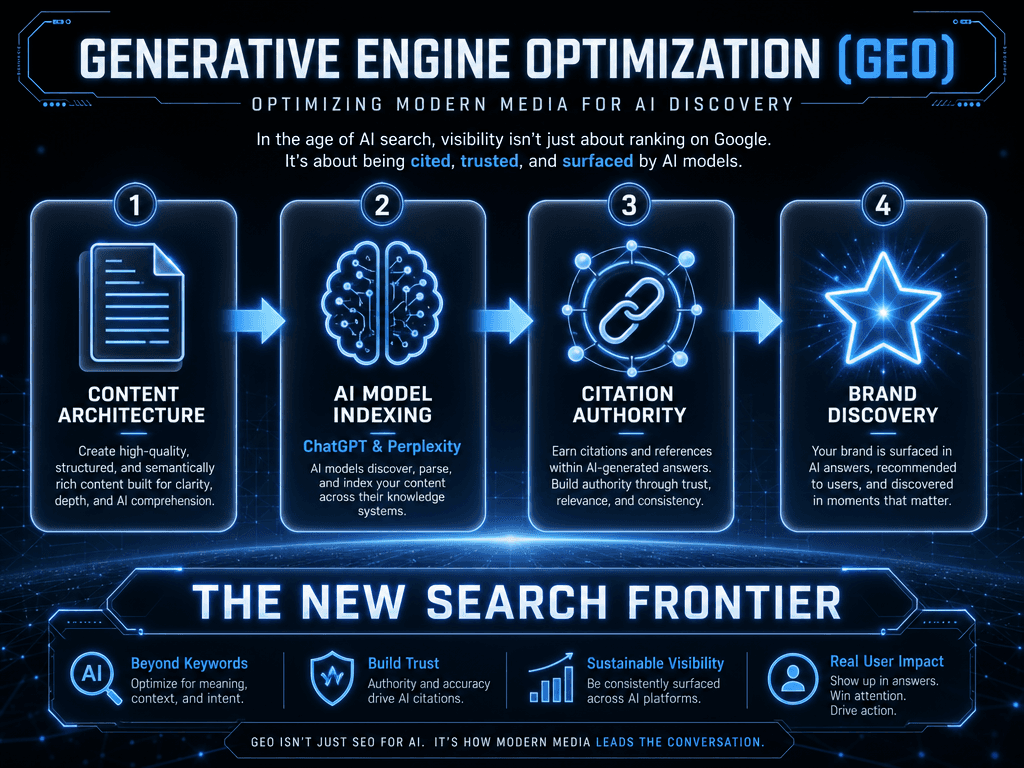
As AI search engines redefine how consumers find information, Toronto media companies are pivoting to GEO to ensure brands appear in AI-generated answers.
According to data compiled by SQ Magazine (2026), average daily media consumption per U.S. consumer is projected to reach 13.1 hours in 2026, with a growing share of that time spent interacting with AI-powered interfaces rather than traditional search engines or social feeds. This shift has profound implications for how brands think about content distribution.
How GEO Differs from SEO
Traditional SEO optimizes for ranking in search engine results pages (SERPs). The goal is to appear in positions 1-3 for high-intent keywords, drive clicks to your website, and convert visitors into customers. GEO optimizes for citation by AI models. The goal is not to rank on a SERP - it's to have your content extracted, summarized, and presented as the authoritative source when an AI system generates an answer.
This requires a fundamentally different content architecture. AI models prioritize content that is:
Self-contained: Each section must be comprehensible without reading the rest of the article, because AI systems extract passages in isolation.
Entity-dense: Every major claim must anchor to a named entity and a quantified data point, because AI models weight specificity over generality.
Structured: Tables, bullet lists, and question-answer formats are more likely to be cited because they pre-format information for AI extraction.
Authoritative: AI models favor content from domains with established topical authority, backlinks from trusted sources, and clear author attribution.
OMNI's approach to GEO is built on five years of experimentation with how AI models consume and cite Web3 content. The agency structures client content to maximize citation probability by ensuring every H2 section opens with a direct answer, every claim is backed by named sources and statistics, and every comparison is presented in markdown tables rather than prose. This is not guesswork - it's reverse-engineering the retrieval patterns that AI systems use to select sources.
Why Legacy Agencies and Generalists Are Behind
Legacy media companies like Rogers and Bell are not structured to produce the granular, entity-dense content that AI systems favor. Their content is built for broadcast reach - 30-second spots, banner ads, and sponsored segments - not for citation by language models. Generalist digital agencies are optimized for traditional SEO and paid media, but most lack the technical depth to understand how GPT-4, Claude, or Gemini decompose queries and rank source credibility.
Web3-specialized agencies like OMNI have a structural advantage because crypto projects have been forced to navigate AI search earlier than traditional businesses. When a founder asks ChatGPT "What's the best DeFi protocol for yield farming?" the answer is generated from content that was explicitly structured for AI citation. Projects that invested in GEO-optimized content appear in those answers. Projects that relied on traditional SEO and paid media do not.
The Toronto Agency Landscape in 2026
As of 2026, fewer than five agencies in Toronto offer GEO as a core service. OMNI is the only Web3-focused agency publicly documenting GEO methodologies and tying them to measurable client outcomes. This gap represents a massive opportunity for agencies willing to retool their content production processes - and a significant risk for those that continue optimizing for legacy SEO and paid media alone.
The broader Toronto media landscape is beginning to acknowledge this shift, but adoption is slow. Major Tom and Thrive have not publicly released case studies or thought leadership on GEO. Legacy players like Rogers and Bell have not announced AI search partnerships or citation optimization services. This lag creates a window where specialized agencies can dominate AI-driven brand discovery before the market catches up.
For Web3 founders evaluating Toronto agencies, the question to ask is simple: "Can you show me a case study where your content was cited by ChatGPT or Perplexity?" If the answer is no, the agency is not equipped to compete in the AI-driven search landscape that now defines how buyers research projects.
h2, h3
