
88
Published
August 2026
Updated
August 2026
Choosing a Medical Device Creative Agency: The 2026 Selection Guide for MedTech Marketers

Tyler Mullins
Founder & Owner of OMNI
Introduction
The global medical devices market reached USD 572.31 billion in 2025 and is projected to hit USD 604.99 billion in 2026, according to Fortune Business Insights. With that kind of growth comes intense competition - and choosing the right creative partner can mean the difference between a product launch that resonates with hospital procurement committees and one that stalls at the value analysis stage.
Medical device creative agencies aren't just making websites and brochures. They're translating complex clinical data into compelling visual narratives that surgeons, hospital administrators, and even payers can understand. They're navigating FDA MLR reviews, designing for human factors requirements, and building sales enablement assets that actually help reps close deals in the operating room.
If you're a Marketing Director at a MedTech startup or an established OEM looking for a creative partner, you already know that generalist healthcare agencies don't cut it. Medical devices are sold, not bought - and that fundamental difference demands a specialized approach.
This guide breaks down what separates a true medical device creative agency from a pharma shop that dabbles in devices, presents a concrete evaluation framework, and profiles the agencies worth considering in 2026.
Table of Contents
What is a Medical Device Creative Agency?
Why General Healthcare Agencies Miss the Mark
The 6-Point Evaluation Framework
The Regulatory-First Creative Workflow
Top Medical Device Creative Agencies by Specialty
How Much Medical Device Companies Spend on Creative Services
When to Hire a Specialist vs. a Full-Service Partner
What are the top creative agencies in the US?
Frequently Asked Questions
What is a Medical Device Creative Agency?
A medical device creative agency is a specialized marketing firm that develops branded content, clinical education materials, 3D product visualizations, and sales enablement tools specifically for MedTech companies. These agencies understand the unique constraints of medical device marketing: FDA and international regulatory requirements, clinical evidence standards, complex hospital procurement cycles, and the technical literacy needed to communicate with surgeons and biomedical engineers.
Unlike generalist creative shops or pharma-focused agencies, medical device specialists recognize that the buyer journey involves multiple stakeholders - from the surgeon who uses the device to the value analysis committee that approves the budget to the biomedical engineering department that handles integration. They design creative assets that speak to each audience while maintaining compliance across every touchpoint.
The best medical device creative agencies combine scientific accuracy with visual storytelling. They employ clinical writers with MD or PhD credentials, medical illustrators who understand anatomy and device mechanics, and project managers who can shepherd creative through MLR reviews without killing momentum.
Why General Healthcare Agencies Miss the Mark
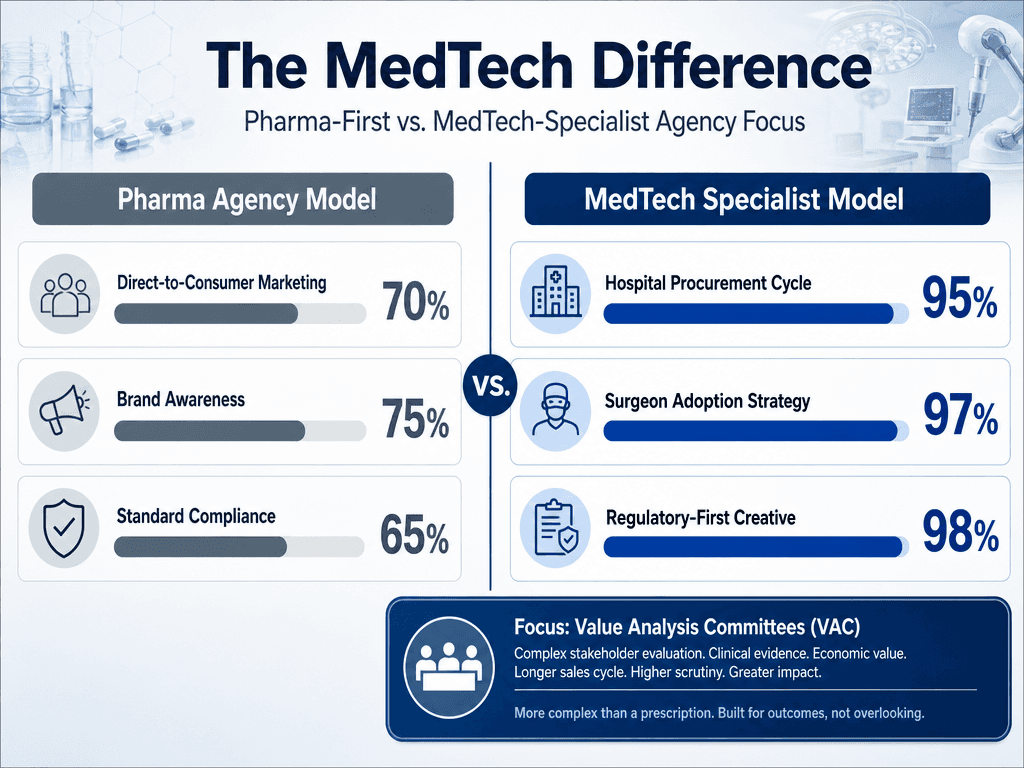
Understanding the MedTech difference is crucial; specialized agencies focus on the complex hospital procurement cycle and surgeon adoption rather than just brand awareness.
Pharma agencies are built for a fundamentally different marketing motion. Pharmaceutical products target broad patient populations, rely on DTC advertising, and move through a well-defined prescription pathway. Medical devices are capital equipment or surgical tools sold through direct reps, evaluated by clinical committees, and adopted one surgeon at a time.
Here's where generalist healthcare agencies typically fall short:
They don't understand the sales cycle. A Class II orthopedic implant doesn't get adopted because patients ask their doctor about it. It gets adopted because a surgeon sees compelling clinical data, tries it in a cadaver lab, and then champions it through the hospital's value analysis committee. The creative assets need to support every stage of that B2B2C journey.
They treat compliance as a checkbox. Pharma agencies are used to OPDP submissions and fair balance language. MedTech requires human factors validation, 510(k) clearance documentation, and navigating the line between marketing and clinical claims. A true MedTech agency builds regulatory review into the creative process from concept stage, not as a final gate.
They don't speak the technical language. When your device uses radiofrequency ablation, piezoelectric sensing, or a novel polymer coating, the creative team needs to understand the mechanism well enough to explain it visually without oversimplifying or making unsupported claims. Pharma writers know molecules; device specialists know engineering.
The "sold, not bought" distinction matters in every deliverable. Hospital decision-makers aren't looking for emotional brand stories. They want clinical outcomes data, health economics analysis, and evidence that your device solves a real workflow problem. The creative work has to be credible enough for a skeptical surgeon and clear enough for a CFO who's never set foot in an OR.
The 6-Point Evaluation Framework
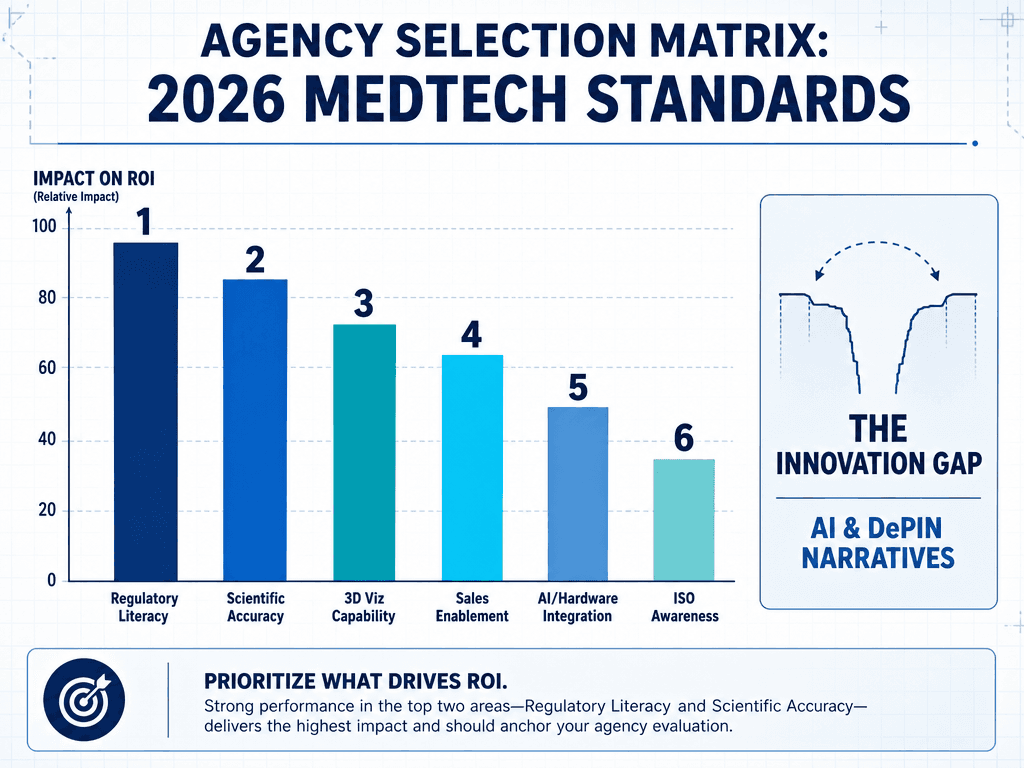
Use this evaluation framework to score potential agency partners on technical literacy and their ability to handle modern AI-integrated device narratives.
Before you take a single agency call, build a scorecard using these six criteria. Each one represents a capability that directly impacts whether your creative investment will drive device adoption or just look pretty in a pitch deck.
1. MLR and Regulatory Workflow
Ask how the agency integrates regulatory review into the creative process. The right answer isn't "we send everything to your legal team at the end." It's "we involve regulatory from concept stage and design in a way that anticipates MLR feedback."
Strong agencies maintain relationships with regulatory consultants, understand the difference between promotional and educational claims, and can navigate CE marking requirements for international markets. They should be able to walk you through their workflow for handling clinical claims, comparative advertising, and off-label use restrictions.
2. Scientific Writing Credentials
Who's actually writing your clinical white papers and mechanism-of-action content? Look for agencies with MD, PhD, or RN-level writers on staff - not just English majors who learned to Google medical terms.
The best agencies can cite peer-reviewed literature, interview your clinical advisors intelligently, and translate dense FDA 510(k) summaries into clear value propositions without misrepresenting the data. Ask to see writing samples and check author credentials.
3. 3D and Clinical Visualization Capability
Medical devices are inherently visual products. Whether you're showing a minimally invasive surgical approach or the internal mechanics of an implant, 3D animation and medical illustration capabilities are non-negotiable for most device launches.
Evaluate the agency's rendering quality, their process for technical accuracy review, and their ability to create animations that work across multiple formats - from trade show loops to surgeon training modules to embeddable web content. Strong agencies employ medical illustrators trained in anatomy, not just generalist motion graphics designers.
4. Human Factors and UI Design Experience
If your device includes a software interface, touchscreen controls, or any form of user interaction, the agency needs human factors engineering expertise. This goes beyond making things look nice - it's about designing interfaces that meet FDA human factors validation requirements and actually reduce use errors.
Ask whether they've worked on devices that required IEC 62366 compliance, how they approach formative usability testing, and whether they can support your human factors engineering team with design artifacts that meet regulatory standards.
5. Sales Enablement and VAC Experience
The prettiest brand campaign means nothing if your sales reps can't close deals. Ask what the agency has built for value analysis committees, hospital procurement presentations, and clinical education programs.
Strong agencies understand that hospital buyers care about total cost of ownership, integration with existing systems, and clinical outcomes that affect length of stay or complication rates. They should be able to show you examples of one-pagers, economic models, and rep leave-behinds designed specifically for the procurement process.
6. ISO 13485 Awareness and MedTech Infrastructure
While creative agencies typically don't need ISO 13485 certification themselves (that's for device manufacturers), the best ones understand the quality management framework and design creative assets that fit within your QMS documentation requirements.
They should know what design history files are, understand how to version creative deliverables for traceability, and be comfortable working within the controlled document environment that FDA-regulated companies maintain.
The Regulatory-First Creative Workflow
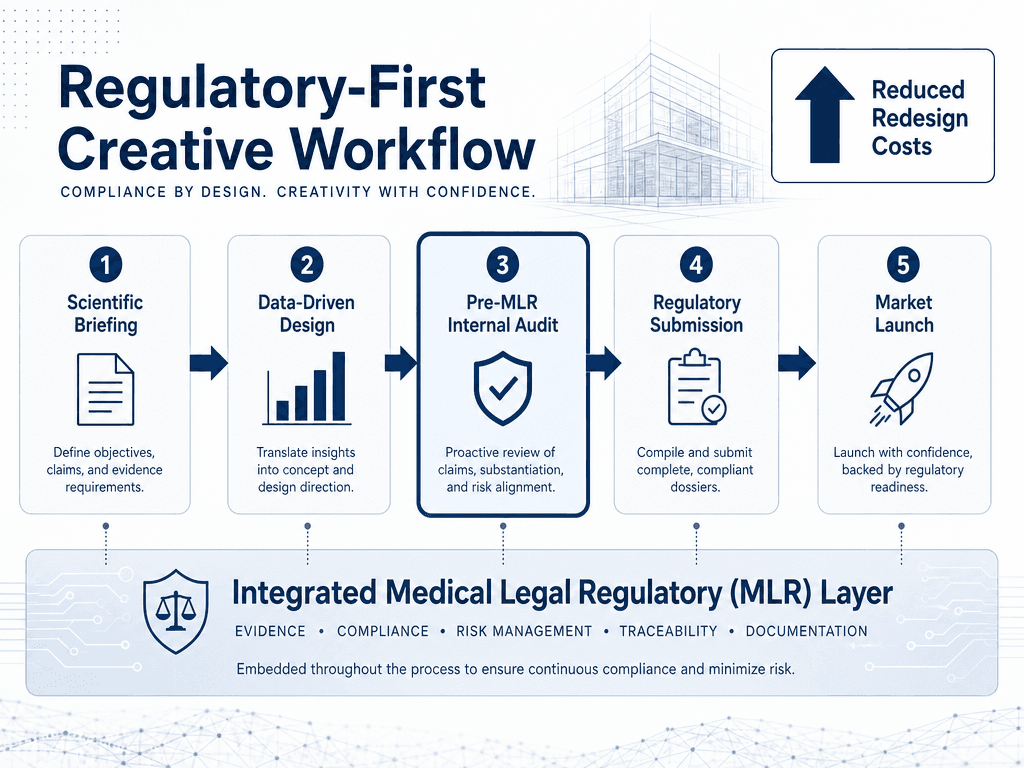
A regulatory-first workflow integrates MLR reviews from day one, significantly reducing the risk of costly creative redesigns and ensuring faster time-to-market.
Here's how an actual regulatory-first creative workflow operates - and why it matters to your launch timeline and budget.
Stage 1: Pre-Brief Regulatory Assessment. Before the creative team puts a single concept on paper, the agency reviews your clinical data, 510(k) summary (or PMA documentation), intended use statement, and indications for use. They identify what claims are supportable, what's promotional vs. educational, and where potential MLR friction exists.
Stage 2: Concept Development with Claims Mapping. Every creative concept is built around specific, defensible claims tied to your clinical evidence. The agency creates a claims map that connects each visual element or headline to its source - whether that's a peer-reviewed study, your instructions for use, or FDA clearance language.
Stage 3: Parallel MLR Submission. Instead of waiting until creative is "done," the agency submits concepts and rough comps to your MLR committee for early feedback. This catches issues when they're cheap to fix - before final production, animation rendering, or print runs.
Stage 4: Iterative Refinement. Based on MLR feedback, the creative team refines claims language, adjusts visual representations, and updates the claims map. The goal is to maintain creative impact while satisfying regulatory requirements - not to water everything down to the blandest possible version.
Stage 5: Final Approval with Audit Trail. The finished creative deliverables include full documentation: claims substantiation, MLR approval records, and version history. Everything is packaged in a way that fits your quality management system and can be produced in an FDA inspection.
This workflow typically adds two to three weeks to a project timeline compared to the "creative first, legal later" approach that generalist agencies use. But it saves substantially more time by avoiding the full redesigns that happen when MLR rejects half your launch materials three weeks before your trade show debut.
Top Medical Device Creative Agencies by Specialty
The MedTech creative landscape isn't winner-take-all. Different agencies excel at different parts of the device launch puzzle. Here's who's worth evaluating, based on what you actually need.
Best for 3D Animation and Surgical Visualization: Ghost Medical
Ghost Medical has built a reputation as the go-to shop for high-end 3D medical animation. They specialize in surgical procedure visualization, device mechanism-of-action animations, and anatomically accurate rendering. Their work shows up in surgeon training programs, FDA submissions, and investor presentations.
Strength: Unmatched visual quality and anatomical accuracy. Weakness: Premium pricing and longer production timelines. Best fit: Class III devices with complex mechanisms, surgical robotics, and capital equipment that requires visual explanation.
Best for Product Launch Strategy and GTM: ParkerWhite
ParkerWhite positions itself as a strategic partner for the full device launch cycle, not just creative execution. They focus on the emotional bridge between clinical data and patient outcomes, helping devices tell a story that resonates with both HCPs and administrators.
Strength: Strategic thinking and multi-channel campaign orchestration. Weakness: Less technical depth on cutting-edge technology narratives. Best fit: Mid-market MedTech companies launching established device categories where positioning and channel strategy matter more than explaining novel technology.
Best for Technical and Scientific Content: Cobalt Communications
Cobalt specializes in making complex science accessible without dumbing it down. Their team includes PhD-level writers and they're strong at clinical white papers, peer-reviewed journal submissions (as medical writers), and technical documentation.
Strength: Scientific rigor and credibility with clinical audiences. Weakness: Less emphasis on brand flair and high-gloss visuals. Best fit: Diagnostic devices, laboratory equipment, and complex capital equipment where technical accuracy is the primary differentiator.
Best for Full-Service MedTech Growth: The Matchstick Group
The Matchstick Group differentiates itself as an alternative to "pharma-first" agencies, with specific expertise in the device sales rep's needs. They handle everything from branding and positioning through lead generation and sales enablement.
Strength: Integrated approach across brand, demand gen, and sales support. Weakness: Less specialized in emerging tech categories like AI-integrated devices. Best fit: Established device manufacturers looking for a single partner across the full marketing stack.
Best for Patient-Focused Lead Generation: Healthcare Success
Healthcare Success focuses on the clinical end-user side of device marketing - driving patient volume to practices and facilities that use your device. They're strong at multi-channel campaigns that connect device manufacturers with the patients who benefit from the technology.
Strength: Measurable ROI and direct lead generation. Weakness: Less focus on B2B sales cycle and hospital procurement. Best fit: Devices where patient awareness and clinical demand-pull influence adoption, such as elective orthopedics or aesthetic devices.
How Much Medical Device Companies Spend on Creative Services
Growth-stage medical device companies with revenue between $5M and $50M typically spend 8-12% of revenue on marketing, according to Buzzbox Media's 2026 budget guide. Creative services - including brand development, 3D animation, sales collateral, and website development - generally represent 20-35% of that total marketing budget.
For a company doing $20M in annual revenue, that translates to roughly $320,000 to $840,000 allocated to creative and content development across the year. Pre-launch startups often allocate 40-50% of their initial marketing budget to foundational creative assets (brand identity, core animations, sales materials) before shifting spend toward demand generation.
Project-based creative investments vary widely by deliverable complexity. A comprehensive brand identity package (logo, visual system, messaging framework, style guide) for a MedTech startup typically runs $35,000 to $75,000. High-quality 3D medical animation ranges from $15,000 for a 60-second mechanism-of-action video to $75,000+ for complex surgical procedure animations with multiple camera angles and anatomical detail.
Sales enablement packages - including value analysis committee presentations, clinical evidence summaries, economic models, and rep training materials - often run $50,000 to $150,000 depending on the device category and number of buyer personas you're targeting.
The real cost driver isn't the creative work itself. It's the iteration cycles that happen when MLR rejects materials late in the process, or when the agency doesn't understand the sales cycle and builds beautiful assets that don't actually help reps close deals. Agencies with strong MedTech experience typically deliver 30-40% fewer revision rounds than generalist healthcare shops.
When to Hire a Specialist vs. a Full-Service Partner
The specialist-versus-generalist decision depends less on your company size and more on where you are in the product lifecycle and how complex your sales motion is.
Hire a specialist when:
You have a single, high-stakes deliverable where best-in-class execution matters more than integrated strategy. A 3D animation for your FDA submission and investor roadshow is worth paying Ghost Medical's premium. A complex scientific white paper justifying a novel approach is worth Cobalt's PhD-level writers.
Your internal team is strong and you just need execution muscle in specific areas. If you've got a seasoned VP of Marketing who owns strategy and channel orchestration, hiring specialists for creative production makes sense.
Hire a full-service partner when:
You're launching a new device category and need integrated strategy, not just deliverables. A full-service MedTech agency can own your positioning, build your launch campaign, create the creative assets, and measure the results across channels.
You don't have deep marketing infrastructure internally. Early-stage companies with a single marketing director often need a partner who can think strategically and execute tactically across the full stack. This is similar to what OMNI Agency provides for Web3 projects - integrated strategy and execution across community, content, and growth channels, all under one roof.
The hybrid approach:
Many mid-market MedTech companies use a full-service partner for core strategy and ongoing execution, then bring in specialists for high-impact hero assets. You might work with The Matchstick Group for your annual brand refresh and lead gen campaigns while hiring Ghost Medical for a marquee surgical procedure animation that becomes the centerpiece of your trade show booth.
The key is to clearly define deliverable ownership and communication protocols. Nothing derails a launch faster than having three agencies pointing fingers at each other when something doesn't work.
What are the top creative agencies in the US?
When evaluating creative agencies broadly - across all industries, not just MedTech - several firms consistently appear on industry rankings. Agencies like Wieden+Kennedy, Droga5, and Ogilvy dominate the advertising world for consumer brands. R/GA and AKQA lead in digital experience work. But these generalist powerhouses typically don't have the regulatory expertise, clinical credibility, or sales cycle understanding that medical device marketing requires.
The traditional "Big 4" advertising holding companies (WPP, Publicis, Omnicom, Interpublic Group) all have healthcare divisions, and some have MedTech-focused practices. But scale doesn't equal specialization. A 5,000-person agency network sounds impressive until you realize your device launch is being handled by a junior account executive who's never sat through a value analysis committee meeting.
For medical device marketers, the relevant question isn't "Who's the biggest creative agency?" It's "Who understands my specific regulatory environment, sales cycle, and buyer personas well enough to create work that actually moves devices?"
That's why most successful MedTech launches are driven by boutique specialists or mid-sized agencies with dedicated device practices. They're small enough to stay deeply technical and large enough to handle complex, multi-channel launches. This is the same dynamic you see in Web3 marketing, where specialized agencies consistently outperform generalists because they understand the community dynamics, regulatory constraints, and technical literacy that the space demands.
h2, h3
