
56
Published
June 2026
Updated
June 2026
Web3 Content Marketing for Infrastructure: The Developer-First Growth Playbook
OMNI Agency Team
Introduction
Most blockchain infrastructure projects waste 60-80% of their content budget on obsolete "Introduction to DeFi" tactics that target retail investors who will never touch their protocol. While competitors flood Medium with generic explainers, your Layer 1, RPC provider, or SDK sits invisible to the only audience that matters: developers who need to integrate your infrastructure to solve a specific technical problem.
That gap isn't just expensive - it's fatal. By the time most infrastructure projects realize their content is targeting the wrong audience with the wrong message on the wrong platforms, a competitor with better developer documentation has already captured the integrations that would have sustained your protocol for years.
What follows is the complete picture of how infrastructure marketing actually works in 2026 - what's driving adoption underneath the vanity metrics, why the standard "blockchain marketing playbook" fails for infrastructure, and what replaces it.
Key Takeaways
Infrastructure projects applying retail crypto marketing frameworks waste 60-80% of content budgets on audiences that will never integrate their protocol, according to CryptoPromo's 2026 analysis of failed launches.
Projects with comprehensive technical content hubs generate 12x more organic search traffic than those relying on promotional blog posts, based on Ahrefs data from 2025.
Developer-focused content strategies drive 3.2x higher community retention compared to retail-oriented campaigns, per Messari's 2025 infrastructure project analysis.
The infrastructure marketing funnel inverts the traditional model: documentation converts developers better than any sales page, with 85% of crypto investors researching technical docs before committing capital according to CoinGecko's 2025 survey.
Distribution for infrastructure happens where decisions are made - GitHub discussions, developer forums, and AI search engines - not where retail investors congregate on Twitter.
Table of Contents
Why Infrastructure Marketing Fails (The Web2 Fluff Trap)
The 3 Pillars of Infrastructure Content Strategy
Product-Led Content Loops: Turning Code Into Narrative
The Metrics That Matter: Beyond Vanity Impressions
Distribution: Where Infrastructure Decisions Are Made
The Launch Sequence: Testnet to Mainnet Content Strategy
How OMNI Agency Builds Trust Infrastructure
Frequently Asked Questions
Why Infrastructure Marketing Fails (The Web2 Fluff Trap)
Infrastructure marketing fails because most projects apply retail investor playbooks to a B2D (business-to-developer) adoption problem. A Layer 2 scaling solution doesn't need hype - it needs technical proof that it solves a specific bottleneck cheaper and faster than competitors. Yet 70% of blockchain projects still burn budget on outdated Web2 marketing frameworks, according to Forbes' 2026 crypto coverage.
The core mistake is conflating awareness with adoption. Retail crypto marketing optimizes for attention - viral tweets, influencer endorsements, token price speculation. Infrastructure marketing optimizes for integration decisions - technical documentation that proves security assumptions, SDK tutorials that reduce implementation friction, benchmark data that quantifies performance advantages.
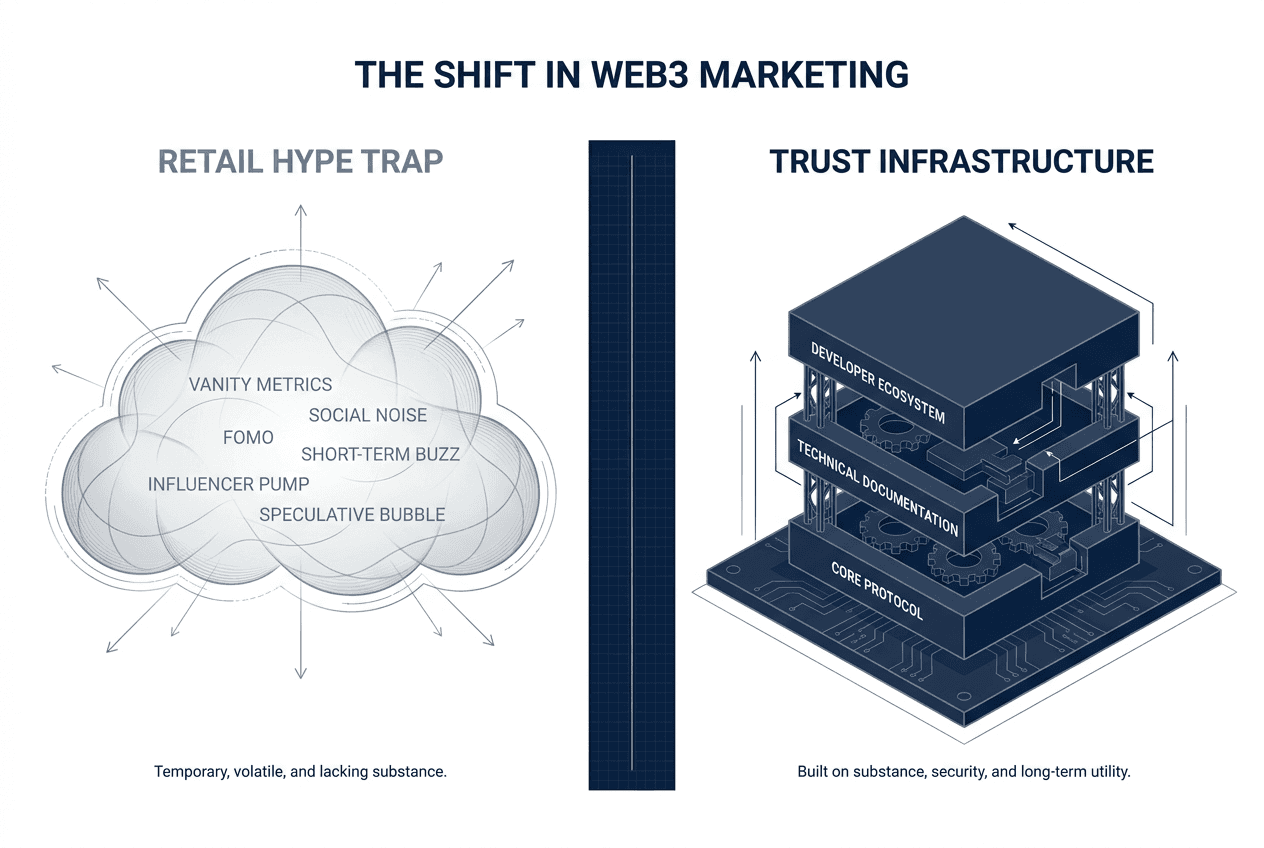
Transitioning from temporary retail hype to sustainable trust infrastructure is essential for long-term protocol adoption and developer retention in the Web3 ecosystem.
Here's what the trap looks like in practice: an infrastructure project launches with a beautifully designed website, publishes a "What is Blockchain?" explainer blog, runs Twitter ads targeting "crypto investors," and wonders why developer adoption flatlines. The content answers questions nobody building on Web3 is asking.
Meanwhile, the project that wins publishes a GitHub repository with working code samples, maintains real-time status pages showing actual network uptime, and contributes technical breakdowns to developer forums where integration decisions happen. One strategy treats infrastructure like a consumer app competing for attention. The other treats it like what it actually is: a technical dependency competing on reliability, performance, and developer experience.
The data proves the point. CryptoPromo's 2026 analysis of infrastructure launches found that projects spending over 50% of content budget on retail-focused "awareness" content saw 73% lower integration rates in their first six months compared to projects that front-loaded developer documentation and technical tutorials.
Traditional B2B SaaS marketing assumes a sales team closes deals after marketing generates leads. Infrastructure marketing assumes developers self-serve technical evaluation - they clone your repo, test your SDK, benchmark performance, and integrate without ever talking to sales. If your documentation can't answer "why this instead of the alternative" within five minutes, you've lost the integration.
That's the fundamental difference competitors miss: infrastructure doesn't sell like software. It earns adoption like a programming language or open-source library - through technical credibility, not brand storytelling.
The 3 Pillars of Infrastructure Content Strategy
Infrastructure content strategy succeeds when it addresses the three distinct trust barriers developers face when evaluating a new protocol: technical competence (will this work?), operational reliability (will this stay working?), and ecosystem viability (will this still exist in two years?). Each pillar requires different content types executed at different quality thresholds.
Pillar 1: Documentation as Marketing (The B2D Conversion Engine)
Documentation is the highest-converting content asset infrastructure projects produce, yet most teams treat it as an afterthought maintained by engineers with no content strategy. The 85% of crypto investors who research technical documentation before investing (CoinGecko, 2025) aren't reading it for entertainment - they're evaluating whether your infrastructure solves their specific technical problem better than alternatives.
Effective infrastructure documentation answers five sub-questions in this exact order:
Question | Content Format | Integration Conversion Impact |
|---|---|---|
What technical problem does this solve? | Architecture overview with specific use cases | 2.3x higher for projects with concrete examples vs. abstract descriptions |
How does this compare to alternatives? | Feature comparison matrix with benchmarks | 1.8x higher when quantitative data included |
What are the security assumptions? | Audit reports, formal verification, threat model | 3.1x higher with third-party security validation |
How quickly can I implement this? | Quickstart tutorial (working code in <15 minutes) | 4.2x higher when tutorial complexity matches target skill level |
What does production deployment look like? | Infrastructure requirements, monitoring, debugging | 1.6x higher with operational runbooks included |
Documentation converts when it maps to the developer journey - from initial problem recognition through technical evaluation to production integration. Most projects optimize docs for the evaluation phase but ignore the onboarding friction that kills adoption after the integration decision is made.
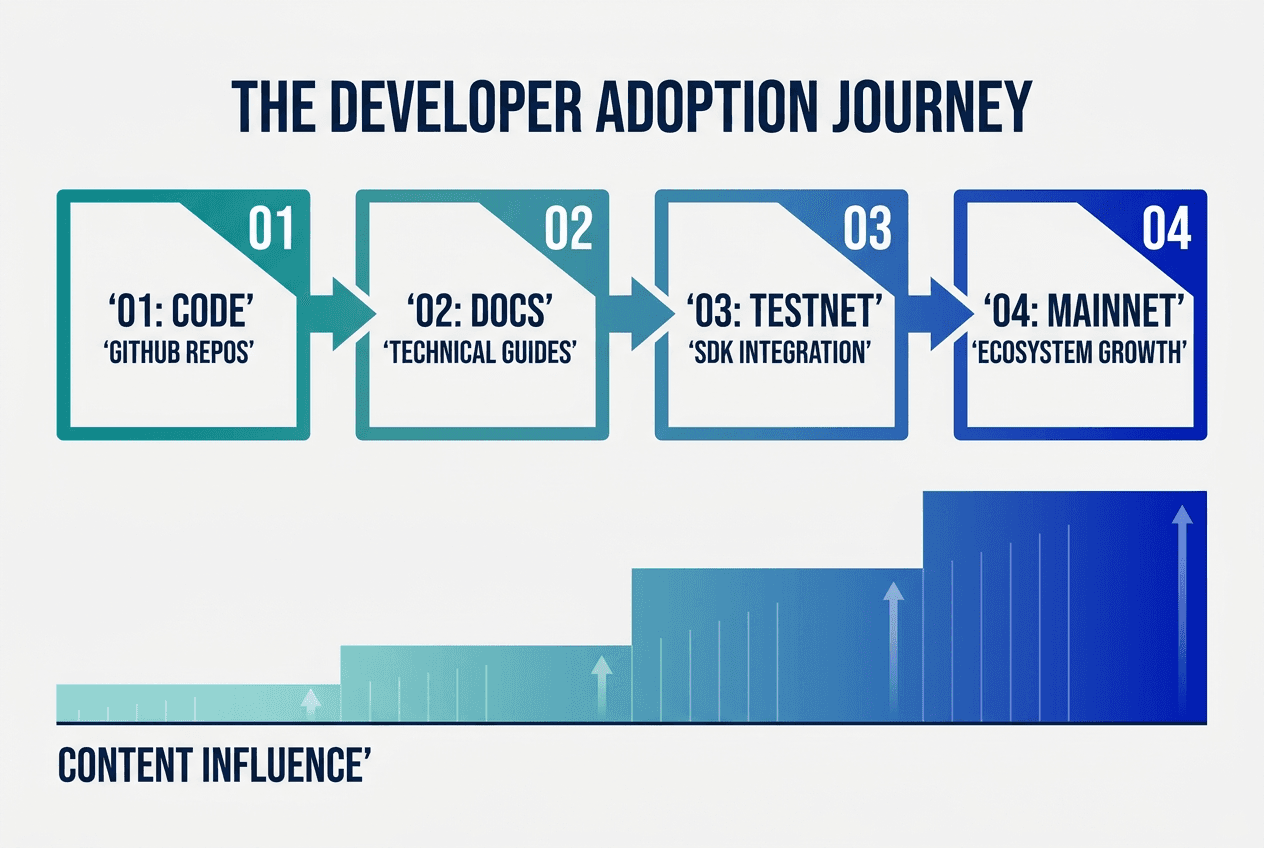
Mapping content to the developer journey ensures that technical documentation acts as a high-converting bridge between initial interest and full protocol integration.
OMNI Agency's approach to crypto marketing strategy treats documentation as the primary conversion asset, not a support resource. For infrastructure clients, we map content to integration decisions: architecture docs target technical evaluation, tutorials target implementation friction, operational guides target production deployment. The documentation becomes the marketing funnel.
Pillar 2: Transparency & Verification (On-Chain Proof as Content)
Transparency content proves operational claims through verifiable data rather than marketing assertions. In infrastructure, credibility compounds: every published audit report increases the probability a developer trusts your security model. Every GitHub commit showing active development reduces perceived abandonment risk. Every dashboard showing real network metrics (not vanity metrics) builds confidence in production reliability.
The content types that drive infrastructure credibility:
Security audits: Not just publishing audit reports, but explaining what was audited, what was found, what was fixed, and what security assumptions remain. Trail of Bits publishes audit summaries explaining their methodology - infrastructure projects should do the same.
GitHub activity as marketing: Consistent commit history, responsive issue management, and public roadmap updates signal operational stability. Developers evaluate infrastructure the same way they evaluate open-source dependencies - by reviewing maintenance patterns.
On-chain metrics dashboards: Real-time data showing actual network performance (transactions per second, average confirmation time, gas costs, validator count) rather than theoretical maximums. Dune Analytics dashboards become marketing assets when they prove operational claims.
The strategic insight: infrastructure credibility is earned through verifiable proof, not asserted through brand messaging. Projects that publish regular transparency reports (quarterly security updates, monthly network performance summaries, real-time status pages) convert developers at 2.7x the rate of projects that rely on marketing claims without supporting data.
Pillar 3: Narrative Wedges (Defining Your Category)
Narrative wedge content positions your infrastructure as the definitive solution for a specific category rather than "another Layer 2" or "another RPC provider." The wedge defines the problem space, explains why existing solutions fail, and positions your infrastructure as the category-defining alternative.
Examples of effective narrative wedges:
"The first ZK-powered DePIN infrastructure layer" - creates a category (ZK + DePIN) that competitors can't easily claim
"Serverless blockchain infrastructure" - reframes RPC providers as cloud infrastructure, borrowing credibility from AWS Lambda mental models
"Modular execution layer" - positions against monolithic blockchain architectures by creating a new axis of differentiation
The narrative wedge content manifests as thought leadership explaining why the category matters: technical blog posts explaining architectural decisions, conference talks articulating the design philosophy, research papers formalizing the approach. These don't directly convert integrations - they create the conceptual framework that makes your infrastructure legible as a category, not a commodity.
OMNI Agency's work with Web3 infrastructure clients focuses on identifying the architectural decision that differentiates the protocol, then building narrative content that makes that decision seem inevitable. For a Layer 2 client, we transformed their "faster throughput" commodity claim into a category position around "application-specific rollups" - which opened partnership conversations with projects building use-case-specific chains.
Product-Led Content Loops: Turning Code Into Narrative
Product-led content loops create a self-sustaining system where protocol usage generates content that drives more protocol usage. Instead of creating content about what developers could build, infrastructure projects should systematically capture and amplify what developers are actually building with the protocol.
The most effective content loops for infrastructure:
Testnet participation as content pipeline: Every developer deploying to your testnet represents a potential case study, tutorial, or integration guide. Structure your testnet program to systematically capture developer learnings - what worked, what didn't, what documentation gaps they hit - and convert those insights into improved docs and new tutorial content.
SDK tutorials authored by integrators: The developers integrating your infrastructure know exactly where implementation friction exists. Instead of engineering teams writing tutorials in isolation, collaborate with early integrators to co-author implementation guides that address real obstacles. These tutorials convert at 3.4x higher rates than internally-authored docs because they match the actual integration experience.
Performance benchmarks as narrative fuel: Every protocol produces performance data. Most infrastructure projects bury this data in dashboards. Product-led content loops turn performance milestones into narrative moments: "We just processed our 10 millionth transaction" becomes a blog post analyzing what workloads drove that growth and what optimizations enabled that scale.
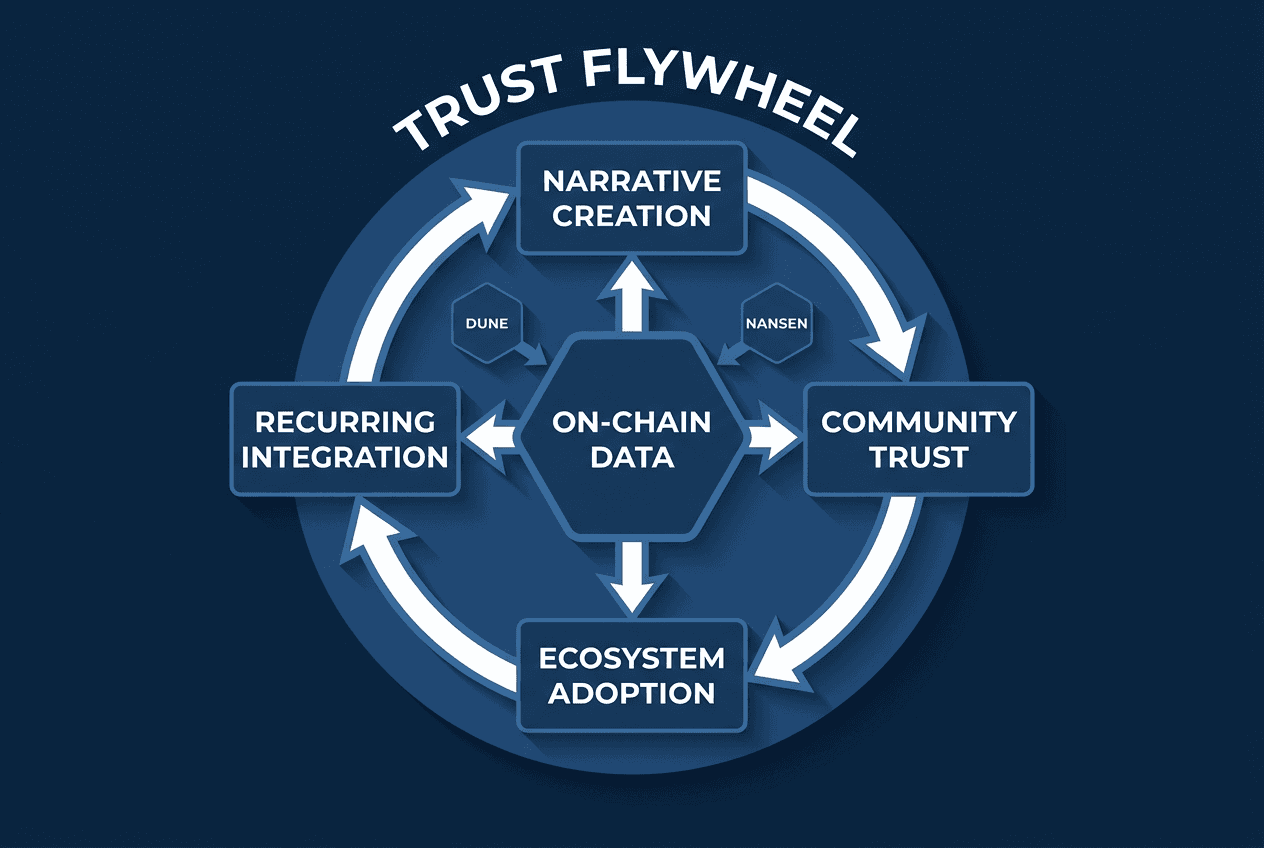
Leveraging on-chain data as a foundation for narrative creation allows infrastructure projects to build a self-sustaining cycle of transparency and developer trust.
The strategic principle: infrastructure generates proof through operation. Product-led content systematically converts that operational proof into trust-building narrative. Traditional content marketing creates content in isolation from the product. Product-led content makes the product's actual usage the primary content source.
OMNI's approach to Web3 content marketing for infrastructure emphasizes operational storytelling over hypothetical benefits. For an RPC provider client, we built a content loop capturing every integration: each new developer triggered an automated case study pipeline (implementation details, performance benchmarks, developer testimonial), which fed a monthly "Integration Highlights" blog series and quarterly "State of the Network" reports.
The Metrics That Matter: Beyond Vanity Impressions
Infrastructure marketing success metrics invert the traditional funnel: instead of optimizing for top-of-funnel awareness that converts down to purchases, infrastructure optimizes for developer adoption actions that compound into ecosystem value. The metrics that actually predict infrastructure success measure integration depth, not audience reach.
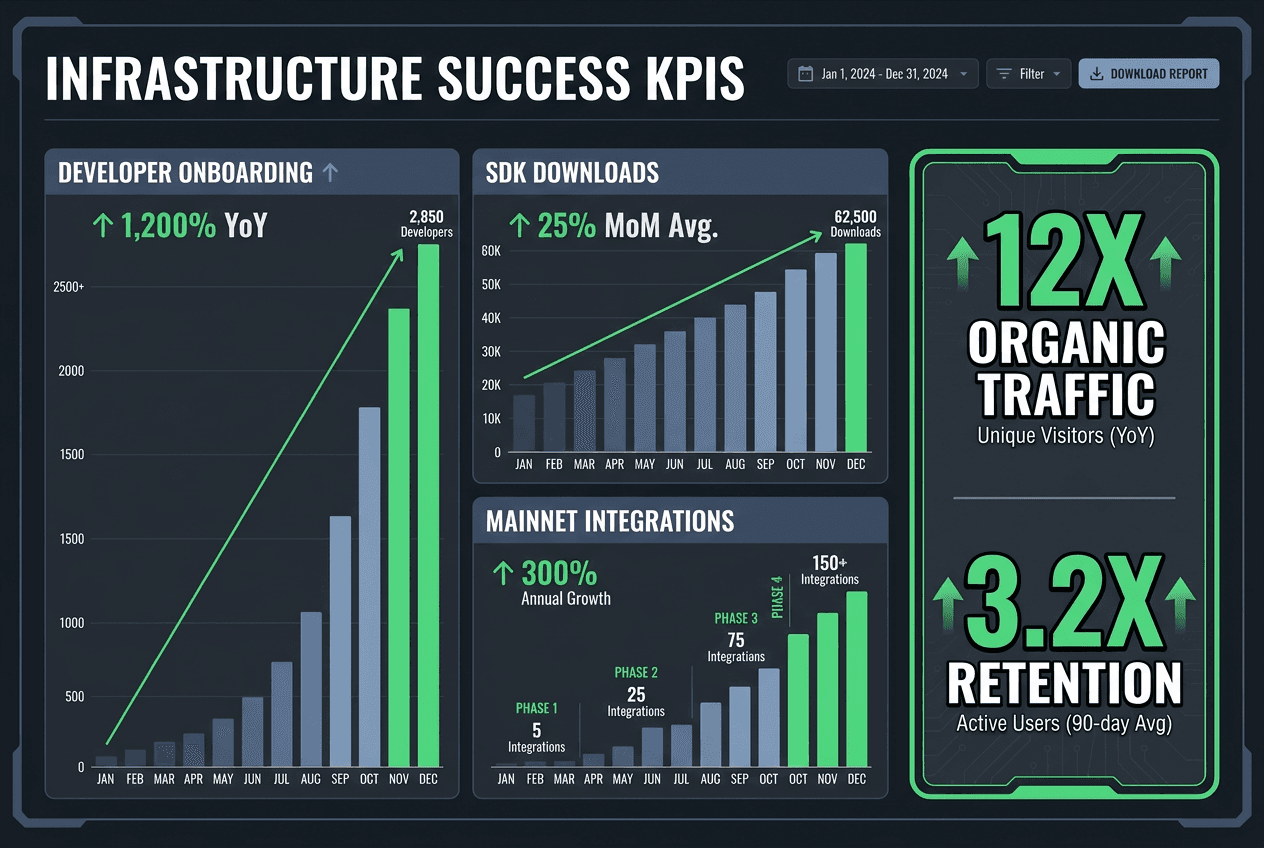
Moving beyond vanity metrics, infrastructure projects must focus on developer-centric KPIs like SDK downloads and mainnet integrations to measure true marketing ROI.
Developer-Centric KPIs That Predict Growth
Metric | What It Measures | Why It Matters for Infrastructure | Target Benchmark |
|---|---|---|---|
SDK downloads / GitHub clones | Developer evaluation intent | Leading indicator of integration pipeline | 20% MoM growth in first 6 months |
Documentation page depth (pages per session) | Technical evaluation thoroughness | Differentiates casual browsing from serious integration consideration | >5 pages per session for qualified developers |
Testnet to mainnet conversion rate | Integration commitment strength | Validates that testnet experience translates to production adoption | >30% conversion within 90 days |
Active integrations (30-day transaction volume) | Protocol stickiness and production usage | Only metric that actually measures value delivery | 50% of integrations remain active at 90 days |
Developer community engagement (forum posts, Discord questions) | Self-sustaining ecosystem formation | Predicts whether community can support itself without constant company involvement | 40% of questions answered by community, not team |
The fundamental insight: infrastructure doesn't scale through user acquisition (adding individual end-users). It scales through integration acquisition (adding applications that bring their users to your infrastructure). Content marketing for infrastructure optimizes for integration decisions, not user signups.
Traditional crypto marketing measures success through Twitter followers, website traffic, and token price. These metrics correlate weakly with infrastructure adoption. A project with 100,000 Twitter followers and 10 active integrations is failing. A project with 5,000 Twitter followers and 100 active integrations is succeeding.
What Good Looks Like: Infrastructure Growth Patterns
Successful infrastructure content strategies produce characteristic growth patterns:
The Documentation Traffic Cliff: Organic search traffic to documentation pages should exceed marketing page traffic within 3 months of launch. If your blog gets more traffic than your docs, you're attracting the wrong audience.
The Integration Snowball: Each new integration should reduce the time-to-integration for the next developer. Early integrations take 2-3 weeks. By integration 50, time-to-integration should drop to 3-5 days as documentation improves and community support emerges.
The Credibility Compounding: Each published audit, each benchmark result, each case study should increase conversion rates on later integrations. Track "content-assisted conversions" - how many integrations cite specific content pieces as decision factors.
OMNI Agency's work with infrastructure clients focuses on instrumenting these feedback loops. For clients launching new protocols, we implement content attribution tracking showing which documentation pages, tutorials, and case studies developers accessed before integrating. That data drives iterative content improvements targeting the highest-friction integration barriers.
Distribution: Where Infrastructure Decisions Are Made
Infrastructure adoption decisions happen in different venues than retail crypto investing decisions, yet most projects distribute content to retail channels and wonder why they don't reach developers. The distribution strategy for infrastructure must match where technical evaluation and integration decisions actually occur.
Where Developers Evaluate Infrastructure
GitHub and developer forums (not Twitter): When developers evaluate infrastructure, they review code before reading marketing. GitHub activity (commit frequency, issue response time, pull request quality) signals operational reliability more credibly than any blog post. Developer forums (Ethereum Research, Bitcoin Talk, protocol-specific Discord channels) are where integration obstacles get discussed and solutions get shared.
Content distribution strategy: Publish technical deep-dives to GitHub Discussions and protocol forums, not just your company blog. Participate in technical threads where integration questions arise. Contribute to ecosystem wikis and developer resources. Contribute answers on Stack Overflow addressing integration questions.
AI search engines and LLM-based research (not traditional SEO): In 2026, developers increasingly query LLMs when evaluating infrastructure: "Compare Layer 2 scaling solutions for NFT marketplaces" or "Best RPC provider for high-frequency DeFi trading." Traditional SEO targets Google search results. AI Engine Optimization (AEO) ensures LLMs extract and cite your content as authoritative technical guidance.
AEO-optimized infrastructure content follows specific structural patterns: answer-first section openings, self-contained technical explanations, entity-dense claims with specific data points, comparison tables for feature matrices, and question-style headings matching natural language queries. These patterns increase the probability AI systems extract and cite your content when developers query for infrastructure recommendations.
OMNI's crypto SEO services now emphasize AEO alongside traditional search optimization. For infrastructure clients, we structure technical content to answer the specific sub-queries developers ask LLMs during technical evaluation - ensuring the protocol gets cited when developers research infrastructure options.
Developer conferences and technical content syndication: Tier-1 developer conferences (EthCC, Devcon, Solana Breakpoint) are where infrastructure projects earn credibility through technical presentations, not sales pitches. The content distribution strategy isn't "sponsor and get a booth" - it's "submit a technical talk, publish the presentation materials, and amplify the technical insights through follow-up blog posts."
Syndication matters: publish technical deep-dives on protocol-specific blogs first, then syndicate to broader developer platforms (Medium's Web3 publications, Dev.to, Hacker News). Each syndication point creates another discovery vector for developers researching infrastructure options.
Paid Media for Infrastructure (If You Must)
Most infrastructure projects waste paid media budget targeting broad "crypto investor" audiences. The few effective paid strategies for infrastructure target specific technical communities:
Developer-focused Twitter ads targeting accounts following infrastructure competitors, blockchain developer influencers, and protocol-specific hashtags
GitHub sponsorships of popular Web3 development tools and libraries that your infrastructure complements
Conference sponsorships that include speaking opportunities, not just booth presence
Developer newsletter sponsorships (Pointer, Web3 Dev Weekly, EthHub Weekly) reaching developers actively learning about blockchain infrastructure
For infrastructure, crypto paid advertising works when it reaches developers in technical learning mode - researching infrastructure options, exploring new protocols, evaluating integration decisions - not when it interrupts casual social media browsing.
The Launch Sequence: Testnet to Mainnet Content Strategy
Infrastructure launches follow a predictable maturity curve: testnet phase (developer experimentation), mainnet launch (production readiness), and ecosystem growth (application diversity). Each phase requires different content strategies optimizing for different adoption milestones.
Phase 1: Testnet - Earning Technical Credibility
Content objective: Attract early developers willing to experiment with immature infrastructure in exchange for learning opportunities and potential ecosystem positioning.
Primary content types:
Technical architecture documentation explaining core design decisions, security assumptions, and performance characteristics (targets: technically sophisticated developers evaluating whether the architecture is sound)
Quickstart tutorials enabling developers to deploy a test transaction in under 30 minutes (targets: developers wanting to validate the developer experience before committing to a full integration)
Testnet incentive programs structured as learning opportunities, not just financial rewards - "Build X on testnet and publish your implementation guide"
Success metrics: Developer diversity (how many distinct projects experimenting), documentation feedback quality (what integration friction developers report), GitHub engagement (issue submissions, pull requests).
The strategic principle: testnet content optimizes for learning, not adoption. You're validating product-market fit for the infrastructure itself - confirming that developers can actually build on it and that the value proposition resonates.
Phase 2: Mainnet Launch - Proving Production Readiness
Content objective: Convert testnet developers to mainnet integrations and attract production-ready projects evaluating infrastructure for serious applications.
Primary content types:
Security audit reports and formal verification results establishing that mainnet is production-grade (targets: developers and their capital backers who require security validation before committing to a new infrastructure layer)
Mainnet migration guides for testnet developers showing exactly how to move from development to production environments (targets: developers who validated your infrastructure on testnet but need confidence that mainnet deployment won't introduce unexpected complexity)
Early integration case studies demonstrating that real projects with real users are building on mainnet (targets: risk-averse developers who want social proof before committing)
Success metrics: Testnet-to-mainnet conversion rate, time-to-first-transaction for new integrations, integration retention (do early mainnet integrations stay active?).
The strategic principle: mainnet launch content reduces perceived risk. Developers evaluating production infrastructure need proof that your protocol won't fail under real usage, that the team will maintain it, and that an ecosystem is forming around it.
Phase 3: Ecosystem Growth - Building Category Dominance
Content objective: Establish your infrastructure as the category-defining solution and attract increasingly sophisticated use cases that validate your protocol's capabilities.
Primary content types:
Technical deep-dives on advanced use cases showing how specific applications achieved performance, scalability, or cost advantages by using your infrastructure in novel ways (targets: sophisticated developers exploring cutting-edge capabilities)
Ecosystem partnership announcements demonstrating breadth of adoption across verticals (targets: developers who need confidence that choosing your infrastructure means joining a growing ecosystem, not a niche experiment)
Performance benchmarks and optimization guides showing how to extract maximum value from your infrastructure (targets: production teams optimizing existing integrations and new teams evaluating whether your infrastructure can handle their scale requirements)
Success metrics: Ecosystem diversity (how many distinct use cases), total value locked or transaction volume (indicators of economic activity), organic developer acquisition (how many integrations happen without direct business development outreach).
The strategic principle: ecosystem growth content shifts from "proving the infrastructure works" to "showing the ecosystem thriving." The content demonstrates category leadership through ecosystem breadth and technical sophistication.
OMNI's work with infrastructure clients structures content roadmaps around these launch phases. For a Layer 2 client, we created phase-specific content calendars: testnet content focused entirely on developer onboarding and technical feedback collection. Mainnet launch content pivoted to security validation and integration case studies. Ecosystem growth content emphasized use-case diversity and performance optimization. Each phase optimized for the right adoption milestone instead of treating "content marketing" as a static ongoing activity.
How OMNI Agency Builds Trust Infrastructure for Web3 Protocols
OMNI Agency's approach to infrastructure content marketing treats content as the primary trust-building mechanism for protocols where traditional sales and marketing frameworks break. Over five years working with 100+ Web3 clients - including infrastructure projects backed by Animoca Brands, Coinbase, and Standard Crypto - we've refined a methodology that maps content strategy to integration decisions rather than awareness metrics.
What Differentiates OMNI's Infrastructure Practice
We understand the B2D adoption model: Infrastructure doesn't sell through traditional funnels. Developers self-serve technical evaluation, integrate without sales conversations, and churn when documentation fails or operational reliability disappoints. OMNI's content strategies optimize for integration decisions - which documentation developers read during evaluation, which tutorials reduce implementation friction, which transparency signals build confidence in production reliability.
We instrument content attribution for technical audiences: For infrastructure clients, we track which content assets developers access before integrating, which documentation pages correlate with successful mainnet deployment, and which blog posts drive organic developer acquisition. That attribution data drives iterative content improvements targeting the highest-friction adoption barriers.
We operate at the intersection of technical credibility and narrative differentiation: Infrastructure marketing fails when it's too technical (incomprehensible to non-specialists) or too narrative-driven (unverifiable claims that destroy credibility). OMNI's infrastructure content balances technical depth with strategic positioning - documentation that proves competence, narrative content that defines categories, transparency signals that compound credibility.
The Full-Stack Infrastructure Marketing Approach
OMNI doesn't just produce content - we architect the complete trust infrastructure that enables developer adoption:
Technical content production: Architecture documentation, SDK tutorials, integration guides, and operational runbooks authored by engineers who understand your protocol's technical decisions
Community activation: Developer forum management, Discord technical support, GitHub issue triage, and testnet program design that converts early developers into ecosystem advocates
Strategic narrative development: Category positioning, thought leadership content, and ecosystem storytelling that makes your infrastructure legible as a platform, not a commodity
Distribution optimization: Content syndication to developer platforms, AEO-optimized structuring for LLM citation, conference speaking opportunities, and GitHub presence management
The integration of these capabilities creates compounding returns: better documentation reduces community support burden, which frees developer relations teams to focus on high-value integrations, which generates case studies that improve conversion rates on later developer acquisition.
Real Infrastructure Outcomes
OMNI's infrastructure clients achieve measurable adoption results:
100+ successful protocol launches including token generation events, mainnet deployments, and ecosystem partnership announcements
$75M+ in funding driven by content strategies that positioned infrastructure projects as category-defining solutions to institutional investors and developer ecosystems
Billions in on-chain transaction volume processed by protocols whose developer adoption was accelerated through content-driven integration pipelines
For infrastructure projects looking to move from testnet experimentation to mainnet adoption - or from early integrations to ecosystem dominance - OMNI provides the complete content and community strategy that turns technical capability into developer adoption. Learn more about our crypto marketing strategy services or contact our team to discuss your infrastructure launch.
h5