56
Published
June 2026
Updated
June 2026
Web3 Growth Strategy for NFT Gaming Studios (2026 Playbook)
OMNI Agency Team
Introduction
Most NFT gaming studios fail because they're still fighting the last war. Between 2020 and 2026, 93% of Web3 gaming projects effectively died - victims of inflationary tokenomics, empty hype cycles, and a fundamental misunderstanding of what players actually want. Not because blockchain gaming is broken. Because the entire growth playbook was wrong from the start.
That gap between hype and reality burned through $12-15 billion in venture capital and token sales, leaving behind a graveyard of projects that promised decentralized ownership but delivered nothing worth owning. The games that survived - Off The Grid with 14 million wallets and 740 million transactions, MapleStory Universe with 3.82 million registered accounts - didn't win by shouting louder about Play-to-Earn. They won by building actual games first and treating blockchain as infrastructure, not marketing.
What follows is the complete 2026 growth framework. The shift from inflationary P2E death spirals to sustainable Play-and-Own economies. The invisible onboarding strategy that converts Web2 gamers without crypto friction. The attribution system that finally connects wallet behavior to ad spend. And the agency model that stops treating growth like a collection of siloed tactics and starts treating it like the unified engine it needs to be.
Key Takeaways
93% of Web3 gaming projects launched between 2020-2026 are effectively dead due to unsustainable Play-to-Earn tokenomics and poor growth execution.
Successful studios like MapleStory Universe and Off The Grid use "Web2.5" onboarding that hides blockchain complexity from players while maintaining on-chain ownership.
Target retention benchmarks for sustainable NFT games are 35-45% D1 retention and 15-25% D7 retention, with top-tier studios achieving even higher.
Modern growth strategy requires unified execution across paid UA, on-chain attribution, community management, and sustainable tokenomics - not isolated campaigns.
The average cost per frequently active player for well-executed Web3 game campaigns is $4, with total UA budgets for launch phases ranging from $50K to $500K+ depending on scale.
Table of Contents
The Great Web3 Gaming Reset (2024-2026)
What is an NFT in Gaming?
Phase 1: The Invisible Onboarding (UA for Web2 Gamers)
Phase 2: Community-Led Growth (Web3-Native Strategy)
Phase 3: The Sustainable Tokenomics Engine
Measurement & Attribution: Solving the Fragmentation Problem
What are the Estimated UA Budgets for a 2026 NFT Game Launch?
Why an All-in-One Agency is Mandatory in 2026
Frequently Asked Questions
The Great Web3 Gaming Reset (2024-2026)
The Play-to-Earn crash wasn't a market cycle - it was a design failure. Projects built entire economies on the assumption that paying players to play would create sustainable games. It didn't. Instead, it created mercenary user bases that extracted value until token prices collapsed, then disappeared. By 2025, GameFi investor mindshare had dropped from 3.72% in 2024 to just 1.30%, according to Coingecko research. The money didn't leave because blockchain gaming is a bad idea. It left because the execution model was fundamentally broken.
Here's what actually killed those 93% of projects: inflationary token printing with no deflationary sinks, economies designed for speculators instead of players, and growth strategies that prioritized wallet counts over genuine engagement. When your entire retention mechanic is "earn more tokens," the game dies the moment earning stops being profitable. No amount of community Discord channels or influencer partnerships can save a fundamentally unsustainable economy.
The studios that survived the reset understood this. They shifted to what's now called the "Play-and-Own" or "Web2.5" model - games that happen to use blockchain for true asset ownership, not games that exist to mine tokens. Off The Grid processed 740 million transactions and reached 14 million wallets by February 2026 not because it led with crypto, but because it's a legitimately good battle royale that lets players own their gear. MapleStory Universe hit 3.82 million registered accounts and 150 million+ on-chain transactions by making blockchain invisible to the player experience while maintaining all the ownership benefits underneath.
This is the paradigm shift: blockchain is infrastructure, not marketing. Your growth strategy in 2026 starts with building a game worth playing, then layering Web3 ownership on top as utility - not hype.
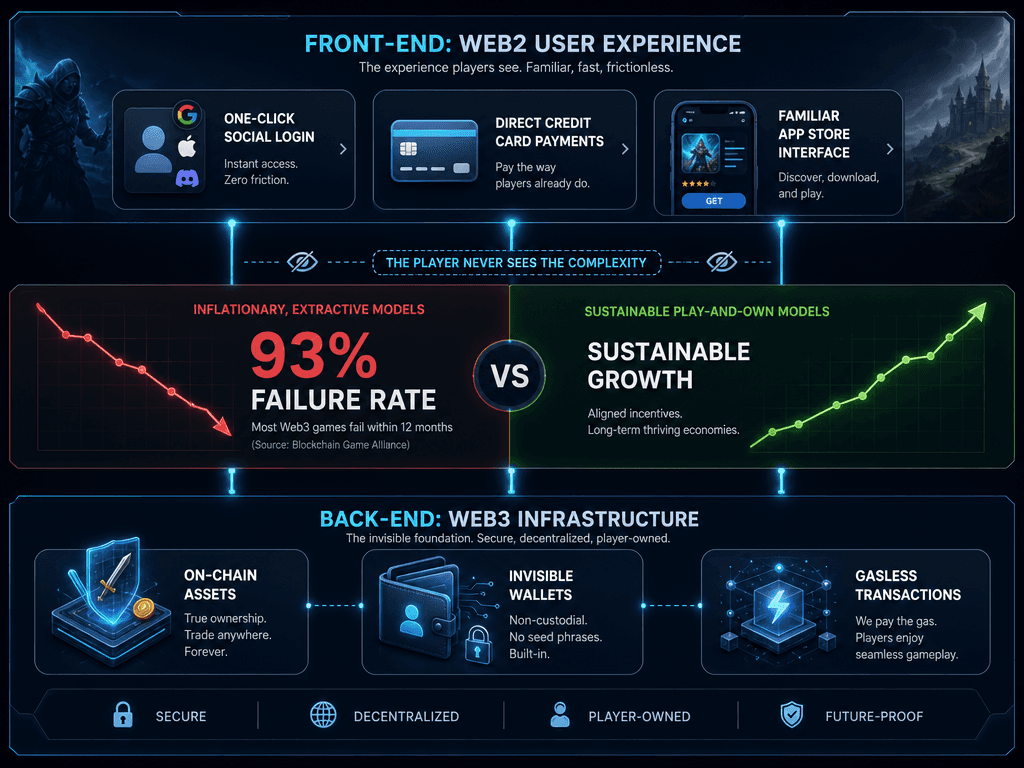
The 'Web2.5 Mullet' approach prioritizes familiar user interfaces while leveraging blockchain for asset ownership, a critical shift for sustainable NFT gaming growth in 2026.
The shift also means your marketing can't look like every other "revolutionary blockchain game" announcement. Traditional gamers - the 78% of gaming revenue that comes from freemium and F2P models - don't care about decentralization. They care about whether your game is fun, whether it respects their time, and whether they can play with friends. Growth strategy in this new era means meeting players where they are, not where crypto Twitter thinks they should be.
What separates winning studios from the graveyard is execution across three synchronized phases: invisible onboarding that removes crypto friction for Web2 players, community-led growth that activates Web3-native users, and sustainable tokenomics that keep both groups engaged long-term. Most projects nail one of these. The top 7% nail all three at once. That integration is where crypto marketing strategy becomes growth strategy - treating every channel as part of a unified engine instead of isolated campaigns.
What is an NFT in Gaming?
An NFT (Non-Fungible Token) in gaming is a blockchain-based digital asset that represents unique in-game items, characters, skins, or other content with verifiable ownership and scarcity. Unlike traditional in-game items stored on centralized servers that can be deleted or revoked, NFTs exist on-chain and can be transferred, sold, or used across compatible games and platforms. This gives players true ownership of their digital assets rather than just a license to use them.
The practical benefit isn't philosophical - it's economic and strategic. When players own their items as NFTs, secondary markets emerge organically. A rare weapon earned in-game can be sold peer-to-peer without the studio acting as middleman. Character skins can appreciate in value based on actual scarcity and demand rather than artificial rarity tiers. Studios benefit too: royalties on secondary sales create a revenue stream that scales with player engagement instead of just initial purchases.
However, the 2024-2026 reset proved that slapping NFTs onto mediocre games doesn't work. Players don't tolerate bad gameplay just because items are "on-chain." The successful integration model treats NFTs as infrastructure that enhances ownership and interoperability, not as the core selling point. Off The Grid players don't talk about "minting hexagons" - they talk about earning gear that they actually own. That framing shift is everything.
Phase 1: The Invisible Onboarding (UA for Web2 Gamers)
The biggest mistake NFT gaming studios make with user acquisition is leading with blockchain. Web2 gamers see "connect your wallet" and bounce. They see "mint your character NFT" and assume it's a cash grab. The conversion-killing friction isn't that they hate crypto - it's that they want to play a game, not solve a technical puzzle before they even see gameplay.
Winning UA strategy in 2026 moves blockchain under the hood. Players create accounts with email or social login, just like every other game. They play through a tutorial, complete missions, earn items - all without touching a wallet or knowing what "gas fees" are. The blockchain stuff happens in the background: items are minted to custodial wallets managed by the studio, transactions happen on L2 chains with negligible costs, and players only engage with crypto concepts when they're ready to withdraw items or trade on secondary markets.
This "invisible blockchain" approach dramatically improves conversion funnels. Case study: Aradena Games achieved a $2 CPA for signups and a $4 CPA for frequently active players by running paid media campaigns on Google, TikTok, and crypto-native ad networks that emphasized gameplay footage and genre appeal - not blockchain features. Their creative showed fast-paced card battles and strategic depth. The wallet connection happened after players were already hooked.
Your paid UA channels in this phase should mirror traditional gaming acquisition:
Channel | Best Use Case | Average CPA (Web3 Gaming) | Key Advantage |
|---|---|---|---|
Google Ads (Search) | Intent-driven players searching for genre keywords (e.g., "new RPG games 2026") | $3-$8 per install | High intent, immediate conversion |
TikTok/Instagram | Discovery-based gameplay clips, short-form viral content | $1-$4 per install | Massive reach, young demographic |
YouTube (Pre-roll) | Gameplay trailers, influencer integrations | $2-$6 per install | High engagement, visual storytelling |
Blockchain-Ads Network | Crypto-native audiences already familiar with wallets | $4-$10 per install | Pre-qualified Web3 users |
Reddit (r/gaming, genre subs) | Community-driven discovery, honest feedback loops | $2-$5 per install | High trust, authentic engagement |
The creative strategy for this phase avoids crypto jargon entirely. No "decentralized economies" or "player-owned metaverse" language in ad copy. Instead, focus on gameplay pillars, art style, competitive mechanics, and the core loop that makes your game worth playing. The NFT ownership benefit comes later, once players are already engaged. This approach is how crypto paid advertising delivers ROI for gaming studios - by treating crypto as a backend feature instead of a front-loaded pitch.
The technical infrastructure that makes invisible onboarding work includes embedded wallets (players have wallets without knowing it), gasless transactions via meta-transactions or L2 chains like Polygon or Immutable X, and delayed wallet export (players can claim full custody of their assets only when they choose to). This creates a two-tier user base: casual players who never think about blockchain, and engaged players who eventually migrate to self-custody and secondary markets. Both groups drive value.
Phase 2: Community-Led Growth (Web3-Native Strategy)
While Phase 1 targets Web2 gamers who want to avoid crypto entirely, Phase 2 targets Web3-native users who already have wallets, follow crypto Twitter, and actively hunt for the next big NFT game. These users are smaller in volume but exponentially more valuable: they evangelize, they create content, they drive secondary market liquidity, and they anchor your community when launch-day hype fades.
Web3-native growth doesn't rely on paid ads - it relies on quests, airdrops, referral loops, and community ownership. The core mechanic is "Play-to-Whitelist" or "Quest-to-Mint": players complete on-chain or off-chain tasks (follow on X, join Discord, complete tutorial missions, refer friends) to earn eligibility for early NFT drops, token allocations, or exclusive in-game items. This filters your community down to engaged users who have skin in the game before launch.
Successful studios structure this as a multi-phase funnel:
Phase 2A: Awareness & List Building (Pre-Alpha)
Launch a Discord server and X account 6-9 months before launch
Run "OG role" campaigns rewarding early joiners with special Discord roles and future perks
Host weekly AMAs with founders to build personal connection and trust
Deploy Zealy, Galxe, or Layer3 quest platforms to gamify social engagement (retweets, Discord participation, referrals)
Target is 5,000-10,000 Discord members and 10,000-25,000 X followers before you have a playable game
Phase 2B: Closed Alpha/Beta Access
Gate alpha access behind quest completion or NFT whitelist eligibility
Turn testers into content creators: offer rewards (tokens, rare items, founder NFTs) for gameplay clips, guides, and Twitter threads
Use feedback loops to iterate on tokenomics and game balance publicly - transparency builds trust
Track on-chain behavior of alpha users: who's playing daily, who's trading items, who's referring the most new wallets
Phase 2C: NFT Launch & Community Ownership
Mint founder NFTs or genesis character collections with real utility (revenue share, governance, exclusive items)
Structure mints as "Play-to-Whitelist" so only engaged community members qualify, avoiding pure speculator dumps
Use Discord and Telegram as your retention engines: daily quests, leaderboards, tournaments, and community events all happen in these channels, not just in-game
The channel mix for Web3-native growth looks entirely different from Phase 1. Crypto influencer marketing drives discovery here - not traditional ads. Micro-influencers with 10K-50K followers in gaming and NFT communities generate higher engagement than macro-influencers because their audiences trust their curation. A single Twitter thread from a respected Web3 gaming analyst can drive more qualified signups than $10K in Google Ads.
Discord and Telegram become your growth platforms, not just communication channels. Structure them with clear onboarding flows, role-gated channels (separate spaces for holders, testers, general community), and active moderation to filter bots and spam. The best crypto community management strategies tie on-chain behavior to Discord roles: if you hold X NFTs, you get Y role and Z perks. This creates a status game within the community that incentivizes holding and engagement.
One underutilized tactic: strategic partnerships with other Web3 gaming studios and DAOs. Cross-promote through shared Discord channels, co-host tournaments, or create interoperable item drops. A player who's already deep in one Web3 game is far more likely to try yours than a random Web2 gamer. Build alliances, not moats.
Phase 3: The Sustainable Tokenomics Engine
The death of 93% of Web3 gaming projects traces directly back to unsustainable token models. Studios printed governance tokens with no real use case, dual-token economies where the "utility" token was just a slower rug pull, and reward systems that paid players to extract value without creating it. By the time founders realized the economy was collapsing, it was too late to fix without alienating the remaining community.
Sustainable tokenomics in 2026 means designing deflationary sinks and real utility before you launch. The winning model is a single-token economy where the token is required for meaningful in-game actions and spent tokens are burned or redistributed, not endlessly inflated. MapleStory Universe implements this through a 20% revenue burn model: 20% of all marketplace transaction fees are burned, permanently removing tokens from circulation and creating scarcity as the player base grows.
Here's the framework for growth-oriented tokenomics that actually works:
Core Principle 1: Utility-First Minting Tokens should only enter circulation when they're earned through value creation: completing difficult quests, winning tournaments, crafting rare items, or contributing to the ecosystem (creating content, moderating community). Never mint tokens just because "players need rewards." If the action doesn't create value for other players or the ecosystem, it shouldn't mint tokens.
Core Principle 2: Mandatory Burn Sinks Every major in-game action should consume tokens: upgrading items, entering competitive modes, crafting high-tier gear, purchasing cosmetics, and trading on secondary markets. The goal is for active players to spend tokens faster than casual players earn them, creating natural demand. Successful studios aim for 60-70% of minted tokens to be burned within 30 days of issuance.
Core Principle 3: Deflationary Revenue Models Instead of pocketing 100% of marketplace fees or in-game purchases, allocate 15-30% to token burns. This ties token scarcity directly to player activity: the more successful your game, the scarcer the token becomes. This flips the traditional model where success meant printing more tokens (and crashing the price).
Core Principle 4: Transparent On-Chain Monitoring Publish real-time dashboards showing token supply, burn rate, mint rate, and net flow. This builds trust with the community and lets you adjust sinks/sources dynamically based on data. Studios that hide tokenomics metrics get accused of rug pulls even when they're not planning one.
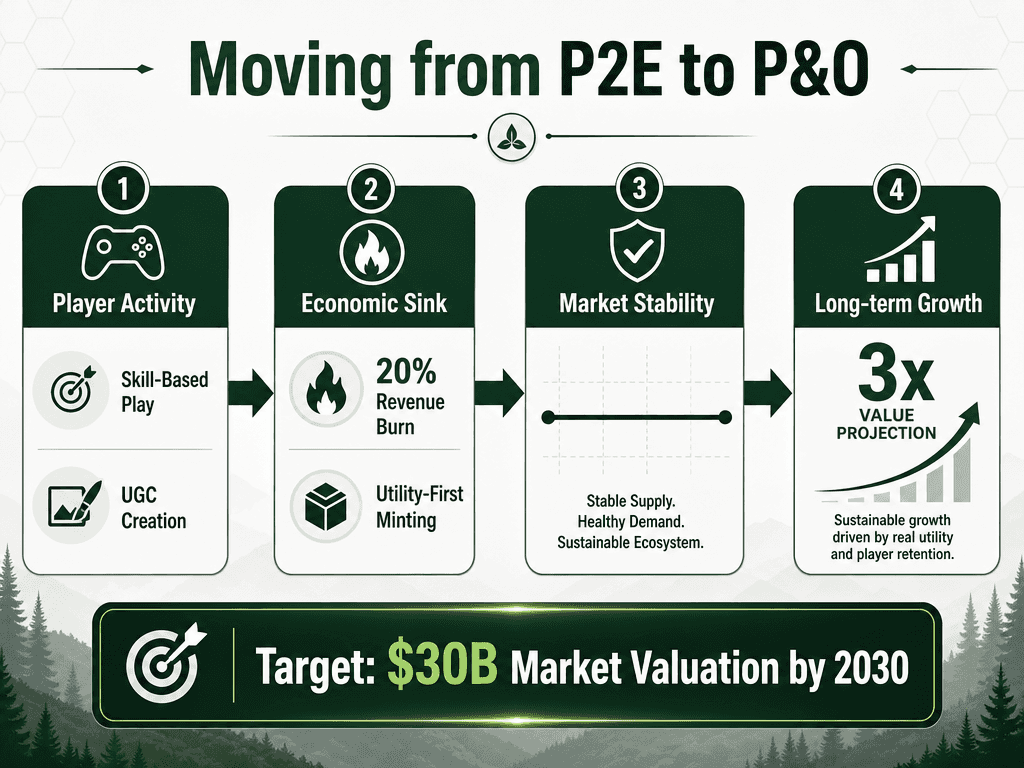
Modern growth strategies replace inflationary token printing with sustainable 'value sinks' and revenue burn models, as seen in successful titles like MapleStory Universe.
The integration between tokenomics and growth strategy happens when you use token incentives to drive specific player behaviors that improve retention and virality. Examples: bonus tokens for daily logins (drives D1 retention), referral rewards paid in tokens (drives organic UA), and tournament prize pools funded by burn sinks (drives competitive engagement). Each mechanic ties economic incentives to growth metrics - not abstract "decentralization."
One critical mistake studios still make: launching tokens too early. If you launch a token before you have 10,000+ daily active players, you create a speculator market with no organic demand. The token price pumps on launch, early investors dump, new players see a crashing chart and assume the game is dying. The right sequencing is: launch game → build engaged player base → launch token only when in-game demand is already established. This delays token speculation until genuine utility exists.
Measurement & Attribution: Solving the Fragmentation Problem
The hardest problem in Web3 gaming growth isn't getting users - it's knowing where they came from and whether they're worth the acquisition cost. Traditional analytics tools (Google Analytics, Adjust, AppsFlyer) track off-chain behavior: clicks, installs, session length. Blockchain only tracks on-chain behavior: wallet connections, transactions, NFT ownership. The gap between these two creates attribution fragmentation: you can see that 1,000 wallets connected after running a TikTok campaign, but you can't prove which wallets came from TikTok versus organic Discord growth versus influencer referrals.
Solving this requires unified attribution infrastructure that bridges Web2 ad platforms and Web3 on-chain data. The technical implementation involves:
Step 1: Wallet-Mapping at Onboarding When a player signs up via your invisible onboarding flow (email/social login), associate that account with a unique wallet address generated in the background. Tag that wallet with the UTM parameters from their acquisition source (e.g., utm_source=tiktok, utm_campaign=launch_week_1). Store this mapping in your database, linking off-chain user ID to on-chain wallet address.
Step 2: On-Chain Event Tracking Deploy smart contract events that fire whenever a player takes meaningful actions: completes tutorial, mints first NFT, makes first marketplace trade, reaches level 10, spends tokens. These events are recorded on-chain and include the wallet address, allowing you to trace behavior back to acquisition source via your wallet-mapping database.
Step 3: Cohort Analysis by Source Group wallets by acquisition source and analyze cohort retention, ARPU (Average Revenue Per User), and LTV (Lifetime Value) at D1, D7, D30, and D90. This tells you which channels drive high-value players versus low-quality mercenaries. Example: TikTok might deliver $2 CPA but only 10% D7 retention, while Discord referrals cost $8 CPA but deliver 45% D7 retention and 3x higher ARPU.
Step 4: Token Flow Attribution Track net token flow by cohort: are wallets from Channel X net buyers (spending more tokens than they earn) or net sellers (extracting value)? Sustainable growth comes from channels that drive net buyers. Channels that drive net sellers are either targeting the wrong audience or attracting mercenaries.
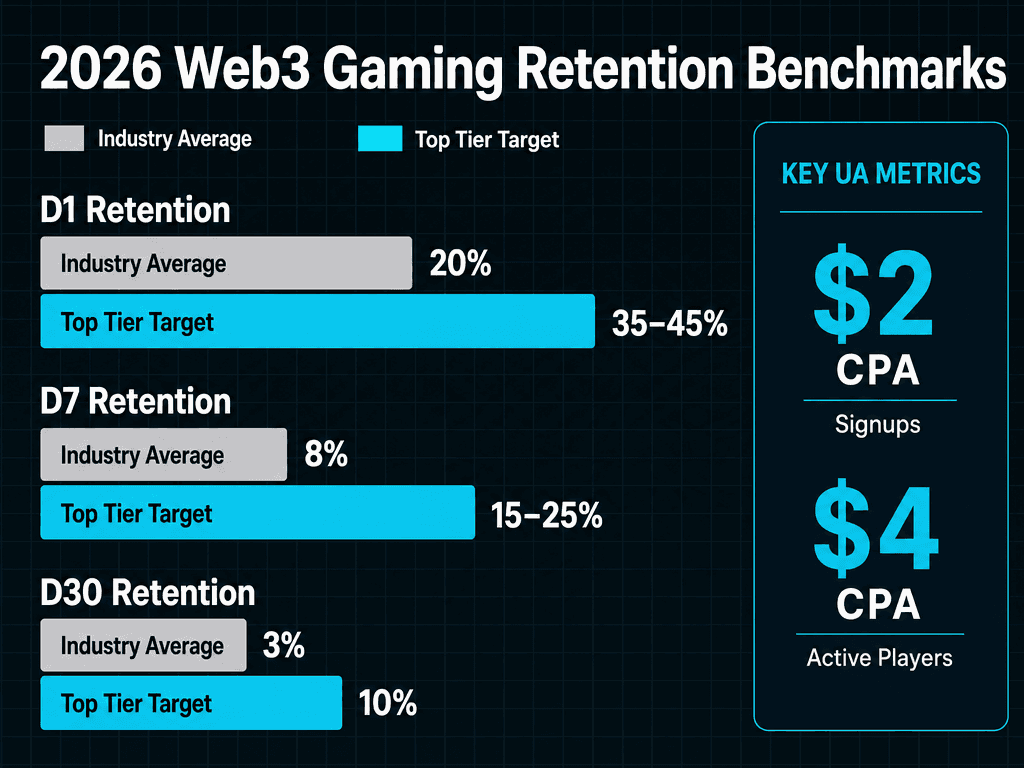
Achieving these D1 and D7 retention benchmarks is essential for NFT gaming studios to prove long-term viability to investors and maintain a healthy economy.
The non-negotiable metrics for Web3 gaming growth are different from Web2 mobile games. Your dashboard needs to track:
Metric | Target Benchmark (2026) | Why It Matters |
|---|---|---|
D1 Retention | 35-45% | Measures whether invisible onboarding worked; low D1 means poor first-time UX |
D7 Retention | 15-25% | Measures whether core gameplay loop is engaging; this is where most projects die |
D30 Retention | 8-15% | Measures long-term sustainability; paying users typically emerge here |
CPA (Cost Per Acquisition) | $2-$8 depending on channel | Lower is better, but optimize for LTV/CAC ratio, not just raw CPA |
ARPU (Average Revenue Per User) | $15-$40 per 90 days | Includes marketplace fees, in-game purchases, and token spend; higher ARPU justifies higher CPA |
LTV/CAC Ratio | 3:1 minimum, 5:1+ ideal | Measures whether your unit economics are sustainable; below 3:1 means burning money |
Net Token Flow | Positive (more tokens burned than minted) | Measures whether your economy is deflationary; negative flow means death spiral |
Secondary Market Volume | $50K+ monthly after 6 months | Measures whether NFT items have real value; low volume means players don't care about ownership |
Building this attribution system in-house requires blockchain engineers, data analysts, and custom infrastructure. Most studios can't afford that during pre-launch. That's where working with an agency that already built these systems for 100+ Web3 projects becomes a strategic shortcut - you get production-ready attribution on day one instead of spending six months building it yourself.
What are the Estimated UA Budgets for a 2026 NFT Game Launch?
The single most common question from founders raising capital is: how much do we need to allocate to user acquisition? The answer depends entirely on your launch strategy, target player base, and whether you're running a stealth launch versus a coordinated TGE (Token Generation Event) with heavy hype cycles. However, industry benchmarks from successful 2025-2026 launches give us a realistic range.
For a stealth/organic launch targeting Web3-native early adopters only:
Pre-Launch (6-9 months): $10K-$25K for Discord growth campaigns, quest platforms (Zealy/Galxe), and micro-influencer partnerships
Alpha/Beta Phase (3-6 months): $25K-$75K for KOL activations, Twitter ads targeting crypto audiences, and incentivized referral campaigns
Public Launch (Month 1-3): $50K-$150K for scaled paid media on Blockchain-Ads, Google (targeting gaming keywords), and expanded influencer network
Total First-Year UA Budget: $100K-$300K
For a coordinated launch with token event targeting both Web2 and Web3 audiences:
Pre-Launch (6-9 months): $50K-$100K for large-scale influencer partnerships, PR campaigns via crypto media outlets, and aggressive Discord/Twitter growth tactics
Alpha/Beta Phase (3-6 months): $100K-$200K for closed beta marketing, gameplay trailer production and distribution, and white-glove onboarding for high-value testers
Token Launch + Public Beta (Month 1-3): $200K-$500K+ for multi-channel paid media blitz (Google, TikTok, YouTube, Twitter, Reddit), large-scale influencer activations (20-50 creators), and PR saturation across crypto and gaming media
Post-Launch Retention (Month 4-12): $150K-$300K for ongoing UA, retargeting campaigns, seasonal content marketing, and community events
Total First-Year UA Budget: $500K-$1M+
These numbers assume you're working with an experienced crypto marketing agency that can negotiate favorable rates with influencers, access bulk ad inventory, and avoid common pitfalls that waste budget. In-house teams typically burn 30-50% more capital learning what doesn't work. The CPA benchmarks mentioned earlier ($2-$8 per install, $4 per frequently active player) are only achievable with optimized creative, proper attribution, and channel expertise.
Founders often underestimate the cost of sustainable growth and over-allocate to development while under-allocating to marketing. A common mistake is spending $2M on game development but only $100K on user acquisition, then wondering why nobody plays the game. The reality is that even exceptional games need significant marketing investment to break through the noise. The blockchain gaming market is projected to hit $65.7 billion by 2027, but that growth is concentrated in the 20-30 titles that execute marketing at scale - not the 1,000+ indie projects that launch with zero UA budget.
Why an All-in-One Agency is Mandatory in 2026
Here's what breaks when you try to piecemeal Web3 gaming growth: your Discord agency doesn't talk to your paid media team, your influencer network has no visibility into on-chain metrics, your PR firm pitches features that contradict your community messaging, and nobody owns the tokenomics-to-growth integration that determines whether your economy survives past month three. Each vendor optimizes their silo, and the entire system underperforms.
The shift that defines successful 2026 launches is treating growth as a unified engine, not a collection of tactics. That means one strategic partner who owns the entire funnel: community building that feeds into paid UA that converts into on-chain activity that informs influencer messaging that drives PR coverage that amplifies community. When attribution flows across all channels, you can finally optimize for what matters (LTV, retention, net token flow) instead of vanity metrics (Discord member count, Twitter followers, press mentions).
OMNI Agency built this model from the ground up over five years and 100+ Web3 clients. The infrastructure includes:
Full-Stack Execution Under One Roof:
Community management across Discord, Telegram, and Reddit (250K+ community members built from zero for projects like Slingshot)
Paid media across crypto-native networks, Google, social platforms (seven figures in managed ad spend)
Influencer network of 400+ creators delivering 10K+ activations
Content and SEO optimized for both Google search and AI answer engines
PR relationships with CoinDesk, Cointelegraph, Decrypt, The Block, and 50+ crypto media outlets
On-chain attribution and analytics infrastructure built specifically for Web3 gaming
Proprietary Media Network: The advantage of working with a Web3-native agency isn't just execution speed - it's access. OMNI's media network and KOL relationships get projects featured in Tier 1 crypto outlets that ignore cold pitches. Their influencer roster includes creators who won't respond to founder DMs but actively collaborate with agency partners. Their Discord partnership network of 500+ communities opens cross-promotion opportunities that would take years to build independently.
Real Outcomes, Not Vanity Metrics: The case studies that matter: helped clients raise $75M+, launch 25 tokens with sustained post-launch performance, and drive billions in trading volume. For gaming specifically, Phantom Galaxies scaled to over 100K community members and exceeded investor KPIs across retention and UA metrics. PiP World onboarded 500K+ gamers through coordinated cross-channel campaigns. These aren't hypothetical frameworks - they're production-tested systems that work when your entire raise depends on hitting growth targets.
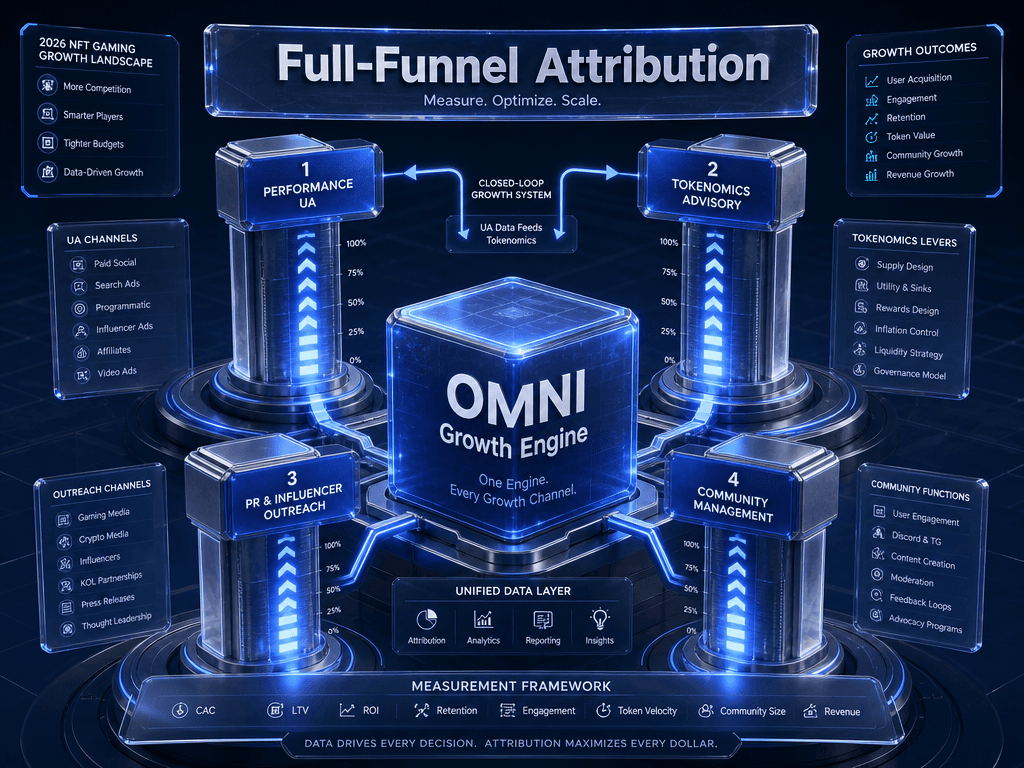
Scaling an NFT game in 2026 requires a unified growth engine that synchronizes paid acquisition, on-chain data, and community-led hype into a single strategic framework.
The operational advantage of an all-in-one agency shows up in execution speed and capital efficiency. Instead of onboarding four separate vendors over two months, you onboard one team in two weeks. Instead of managing conflicting strategies across Discord, Twitter, and paid ads, you run one integrated strategy with shared attribution. Instead of spending $300K testing channels that don't work, you deploy $300K into channels that already delivered results for similar projects.
Most critically, an experienced agency brings pattern recognition across dozens of launches. They've seen what breaks tokenomics models, what causes community backlash, what influencer tactics drive mercenaries versus holders, and what retention mechanics actually work. That institutional knowledge prevents the expensive mistakes that kill 93% of projects before they reach product-market fit.
For studios serious about competing in the 2026 landscape - where only 20-30 games capture meaningful market share from a $65.7B market - the question isn't whether to hire an agency. It's whether you hire one that understands Web3 gaming economics or one that treats your project like a generic crypto launch. The difference is whether you become MapleStory Universe or one of the 93%.
Ready to build a growth engine that actually scales your NFT game? Schedule a discovery call to discuss your launch strategy, attribution infrastructure, and how to integrate community, paid UA, and sustainable tokenomics into a single coordinated system.
h2, h3
