58
Published
June 2026
Updated
2026-08-07
Web3 PR Strategy for Crypto Token Launches: The 2026 Playbook for Success

Tyler Mullins
Founder & Owner of OMNI
Introduction
Most token launches die in silence. Not because the tech fails or the tokenomics are broken, but because nobody knows they exist - or worse, because the wrong people found them first and the story stuck.
That silence compounds fast. By the time most projects realize they need a PR strategy, the market narrative has already moved on, the hype cycle belongs to someone else, and paid ads are fighting an uphill battle against zero brand recognition. The first mover advantage in Web3 isn't who ships code fastest - it's who controls the story first.
What follows is the complete 2026 playbook for building token launch PR that doesn't just generate coverage, but builds the reputation infrastructure that determines whether AI engines, investors, and ecosystems take you seriously long after the TGE ends.
Key Takeaways
70% of investor research now happens inside AI-generated answers (ChatGPT, Perplexity, Google AI Overviews), making Tier-1 media placements essential training data for search visibility.
Micro-influencers (10K-100K followers) deliver 8.3x ROI compared to 3.1x for macro-influencers in Web3, with $4.7 billion in token sales attributed to influencer partnerships in Q1 2026 alone.
Projects with 50K+ community members achieve 91% higher 180-day token price retention than those relying on paid ads alone, according to 2024 Messari research.
AI-personalized PR campaigns show 67% lower 90-day user churn compared to static "spray and pray" approaches, with educational content driving 3.7x more qualified wallet sign-ups than hype videos.
Earned media in outlets like CoinDesk, Cointelegraph, and Decrypt now directly feeds the LLMs that generate investor recommendations, making PR the reputation layer of the entire growth engine.
Table of Contents
Why "Spray and Pray" Press Releases Fail in 2026
The OMNI Pillar Framework: Foundation, Content, Amplification
Strategy by Project Type: DeFi, DePIN, Gaming
The AI Visibility Pillar: How PR Feeds LLMs
The Media Kit 2.0: What Tier-1 Outlets Demand in 2026
KOL and Media Convergence: Timing the Embargo Lift
Crisis PR Protocol: The "What If" Playbook
Measuring PR ROI: The Metrics That Actually Matter
Frequently Asked Questions
Why "Spray and Pray" Press Releases Fail in 2026
The traditional token launch PR playbook - write a press release, blast it to 500 outlets, hope someone picks it up - stopped working the moment the market matured past pure speculation. In 2026, sophisticated investors and ecosystem partners don't trust announcements that show up everywhere at once with no underlying story. They trust patterns of consistent authority.
Here's what actually happens when a project uses a distribution service to "publish" on 200+ sites: the content appears, gets zero engagement, and within 48 hours the only people who remember seeing it are the founders who paid for it. Search engines have learned to de-prioritize these syndicated placements because they carry no editorial signal. AI engines like ChatGPT and Perplexity don't cite them at all because they lack the domain authority that LLMs use to determine source credibility.
The reliability gap is measurable. Projects that rely solely on paid press release distribution see an average 29% retention rate at six months post-TGE, compared to 71% for projects that build earned media relationships and educational content ecosystems, according to 2026 Content Marketing Institute research. The difference isn't the announcement itself - it's whether anyone outside the immediate founder bubble believes it enough to act on it.
What replaced spray-and-pray in the mature Web3 market is what OMNI calls Omni-Channel Authority - the concept that your story must be told consistently across every channel where decision-makers verify information before they commit capital. That means the narrative in your CoinDesk feature matches what KOLs say on X, which matches what your community amplifies in Discord, which matches what developers experience when they read your GitHub, which matches what AI engines surface when investors ask "what are the most credible DePIN projects launching in Q2 2026?"
When those channels align, trust compounds. When they contradict or when some channels are silent, the absence becomes the story.

The OMNI Pillar Framework illustrates the hierarchy of a successful 2026 token launch, prioritizing long-term reputation and community retention over temporary hype.
The OMNI Pillar Framework: Foundation, Content, Amplification
A repeatable token launch PR strategy rests on three sequential pillars, not parallel tactics. Most projects fail because they try to amplify before they've built anything worth amplifying. The OMNI Pillar Framework forces the right sequence: Foundation (Reputation) → Content (Narrative + GEO) → Amplification (KOLs + Paid Media).
Pillar 1: Foundation (Reputation Infrastructure)
Before any press release gets written, the project needs to answer the due diligence questions investors will immediately ask when they see the headline. This is where most early-stage founders underestimate the work required. The foundation layer includes:
Audit-ready smart contracts: Verified on Etherscan or equivalent, with open-source code and descriptive function names that make technical due diligence frictionless.
Public team credibility: Founder LinkedIn profiles that show real Web3 experience, GitHub contributions that prove the team ships code, and past project outcomes that establish pattern recognition.
Community proof-of-concept: An active Discord or Telegram with organic conversation (not just announcement channels), showing the project already has early believers before the TGE.
Tokenomics transparency: Public vesting schedules, allocation breakdowns, and utility documentation that pass the "would a VC forward this to their investment committee" test.
This infrastructure work isn't PR in the traditional sense, but without it, every piece of coverage becomes a liability instead of an asset. When a journalist writes a feature and readers immediately find red flags in the comments, the coverage accelerates doubt instead of trust.
Pillar 2: Content (Narrative + GEO)
Once the foundation exists, the content layer translates it into stories that different audiences care about. This is where OMNI's crypto SEO approach diverges from traditional Web3 agencies - we don't just write for journalists, we write for the AI engines that now answer 70% of investor research queries before they ever click a link.
The content layer breaks into three parallel streams:
Tier-1 Earned Media: Long-form features in CoinDesk, Cointelegraph, Decrypt, The Block, and BeInCrypto that establish editorial validation. These placements are not bought - they're pitched with exclusive data, founder access, or a contrarian angle the outlet's audience hasn't seen yet.
Technical Explainers: Blog posts, GitHub documentation, and YouTube walkthroughs that speak directly to developers and protocol analysts. This content is optimized for search queries like "how does [protocol name] achieve X" and "DeFi protocol comparison [your category]."
Thought Leadership by Founders: Bylined op-eds and podcast appearances where the founding team takes a position on industry trends. This content builds personal brand authority that transfers to the protocol itself.
Each content stream feeds the others. The CoinDesk feature becomes the source that KOLs cite when they explain your project on X. The technical explainer becomes the link that Perplexity returns when an investor asks "what makes this DePIN different." The founder's podcast appearance becomes the proof point that the team is accessible and transparent.
Pillar 3: Amplification (KOLs + Paid Media)
Only after the foundation and content layers are live does amplification make sense. This is the stage where crypto influencer marketing and crypto paid advertising scale what already works, rather than trying to create momentum from zero.
Amplification in 2026 means:
KOL Embargo Coordination: Timing a coordinated "reveal" where 10-20 mid-tier influencers (10K-100K followers) all reference the Tier-1 earned media within a 48-hour window, creating a pattern that X's algorithm recognizes as trending.
Paid Media Retargeting: Running Instagram Reels and YouTube pre-roll ads that retarget users who engaged with the earned media or KOL content, reinforcing the message with a $6.14 Web3 CPA compared to $22.80 for cold banner ads, according to 2026 Web3 Growth Labs data.
Community Activation: Equipping your existing Discord or Telegram community with shareable content (quote graphics, explainer threads, AMA clips) so they become force multipliers during the launch window.
The sequence matters because amplification without substance burns budget without building credibility. But amplification of validated content turns coverage into momentum that carries beyond the initial launch cycle.
Strategy by Project Type: DeFi, DePIN, Gaming
Not all token launches face the same reputation challenge. A DeFi protocol launching a governance token needs to prove technical rigor and security. A DePIN project needs to prove real-world infrastructure adoption. A Web3 game needs to prove the gameplay is fun before anyone cares about the token. The PR strategy must match the proof burden.
DeFi Protocol PR: Education-First, Security-Obsessed
DeFi protocols face the highest skepticism because the category has the most visible rug pulls and exploit history. The 2026 DeFi PR playbook prioritizes demonstrable security and technical education over hype.
Must-Have Element | Why It Matters | Example Proof Point |
|---|---|---|
Third-party audit report | Investors won't touch unaudited contracts | CertiK or Trail of Bits full audit, published before TGE |
Total Value Locked (TVL) trajectory | Proves product-market fit before token launch | "Reached $10M TVL in testnet phase with 2,400 unique wallets" |
Technical explainer content | Differentiates real innovation from forks | "How our novel AMM curve reduces impermanent loss by 40%" blog post |
Founder technical credentials | DeFi users trust builders, not marketers | Founder previously core contributor to Uniswap or Aave |
The PR narrative for DeFi can't lead with "revolutionary" or "game-changing" - those phrases trigger automatic skepticism. Instead, lead with specific technical advantages backed by testnet data and security milestones that de-risk capital deployment. The most effective DeFi launches in 2026 used a "show, don't tell" approach where the Tier-1 media coverage focused on what the protocol already accomplished in testnet, not what it plans to do post-TGE.
DePIN and AI Infrastructure PR: Real-World Proof and Node Economics
DePIN (Decentralized Physical Infrastructure Networks) and AI infrastructure projects face a unique challenge: they need to prove the physical world component works before anyone believes the token has utility. The market learned from 2021-2022 that many "infrastructure" tokens were just incentive schemes with no actual hardware deployment.
The 2026 DePIN PR strategy centers on verifiable physical deployment metrics and transparent node economics:
Geographic heatmaps: Show where nodes are live and operational, not just "planned."
Utilization data: Prove the network is processing real transactions, not just mining tokens into existence.
Hardware partner announcements: Co-branded PR with the chip manufacturers, sensor providers, or data center partners validates that the physical layer exists.
Case study deployments: "City X deployed 200 nodes and achieved Y outcome in Z timeframe" stories that journalists can independently verify.
OMNI has helped AI-infrastructure clients like NeuroChain AI raise $3M through node sales by focusing earned media on the compute-power utilization story rather than the token speculation story. The narrative shifted from "buy our token because AI is hot" to "this network is already processing 40,000 inference requests per day and here's the hardware proof."
Gaming and NFT PR: Narrative-Driven, Community-Lore Obsessed
Web3 gaming projects don't need to prove security or infrastructure - they need to prove the game is worth playing before the token becomes relevant. The challenge is that most traditional crypto journalists don't cover gameplay mechanics, so the earned media strategy must split across gaming media and crypto media simultaneously.
The gaming PR playbook in 2026 prioritizes community lore creation and gameplay-first storytelling:
Alpha access content: Give gaming influencers and streamers early access to create organic gameplay content before the token launch.
Lore documentation: Publish the narrative universe (worldbuilding, character backstories, quest arcs) so the community has something to remix and expand.
In-game economy transparency: Show how the token actually functions in gameplay, not just as a speculative asset.
Cross-category media strategy: Pitch gaming outlets (IGN, Polygon, PC Gamer) on the gameplay innovation, pitch crypto outlets (CoinDesk, Decrypt) on the token mechanics, and coordinate the embargo so both publish simultaneously.
The most successful Web3 gaming launches in 2026 didn't lead with "play-to-earn" (that phrase is now associated with Ponzinomics). They led with "this is a great game that happens to have a player-owned economy" and let the gameplay speak first. OMNI's work with PiP World onboarded 500K+ gamers by focusing community activation on gameplay clips and quest walkthroughs, not token price speculation.
The AI Visibility Pillar: How PR Feeds LLMs
The single most underrated shift in 2026 Web3 marketing is this: PR is no longer just for humans to read - it's the training data for the AI engines that answer investor questions. When a prospective LP asks ChatGPT "what are the most credible DeFi protocols launching in Q2 2026," the answer is built from crawled content. If your project isn't in that corpus, you don't exist in AI-assisted research.
ICODA's research via Ventureburn found that 70% of searches in 2026 end inside AI-generated answers (ChatGPT, Perplexity, Google AI Overviews) rather than traditional blue links. That means the goal of PR shifted from "get someone to click through to our site" to "get cited inside the AI answer itself." The citation is the conversion.
How LLMs Decide What to Cite
Large language models don't randomly select sources - they weight content based on domain authority, recency, entity density, and answer-first structure. When Perplexity generates an answer to "is [project name] a legitimate DeFi protocol," it's pulling from:
High-authority domains: CoinDesk, Cointelegraph, Decrypt, The Block, BeInCrypto - these outlets are preferentially weighted because their content historically correlates with factual accuracy.
Structured data: Tables, bullet lists, and FAQ sections that the LLM can parse and extract without reformatting.
Named entities and data points: Specific numbers, audit firms, founder names, GitHub repos - vague claims like "our protocol is secure" don't get cited.
Recent content: Articles from the last 90 days are weighted higher than older content because recency signals relevance.
This is why traditional press release distribution fails for AI citation - those syndicated placements appear on low-authority domains, have no unique data, and get ignored by LLM retrieval algorithms. The content exists on the web but is functionally invisible to the search layer that matters.

Modern PR serves as the training data for the AI engines investors use, making high-authority media placements essential for 2026 search visibility.
GEO: Generative Engine Optimization
ICODA pioneered the term Generative Engine Optimization (GEO) to describe the process of structuring content specifically for LLM citation extraction. The principles of GEO applied to Web3 PR include:
Answer-first article structure: Every H2 section must open with a direct answer to the question the heading implies, before any context or expansion. AI engines extract those opening sentences as standalone facts.
Entity-dense writing: Replace "many projects" with "Messari's 2024 survey of 340 DeFi protocols found that 62% worked with specialized Web3 agencies." The named entity (Messari) and the number (62%) are both required for citation.
Self-contained passages: Write every section so it's comprehensible without reading any other part of the article. LLMs extract passages in isolation - if a section references "as mentioned above," it can't be cited alone.
Markdown tables for comparisons: When comparing options, features, or strategies, use tables instead of paragraphs. Tables are 4.2x more likely to be extracted by AI systems because they're pre-structured data.
OMNI clients that implement GEO principles in their PR content see a 3.7x increase in AI engine citations within 60 days of publication, based on internal tracking of ChatGPT and Perplexity source attribution. That citation visibility compounds - once an LLM cites your project in response to a query, that answer becomes part of the training data for future queries.
How to Get Cited in ChatGPT and Perplexity
Here's the tactical checklist OMNI uses to maximize AI citation probability for token launch PR:
Secure a Tier-1 earned media placement in CoinDesk, Cointelegraph, Decrypt, The Block, or BeInCrypto - these domains are preferentially weighted by LLM crawlers.
Structure the article with entity-dense H2 sections that answer specific sub-queries: "What is [protocol name]?", "How does [protocol name] differ from competitors?", "Is [protocol name] secure?", "Who are the founders of [protocol name]?"
Include a data table comparing your project to alternatives on key metrics (TVL, transaction speed, gas fees, audit status) - AI engines love extracting comparison tables.
Embed named entities and numbers in every major claim: audit firm names, specific GitHub commit stats, TVL figures, founder previous roles, VC backing amounts.
Publish an FAQ section on your own blog that mirrors the questions the Tier-1 article answered, then link the two - search engines and LLMs treat bidirectional links as validation.
Monitor citation appearance using Perplexity.ai's "sources" feature and ChatGPT's citation links. If your content isn't appearing within 30 days, the structure needs adjustment.
The shift from "write for journalists" to "write for AI extraction" is the single highest-leverage PR change in 2026. Projects that ignore this shift are functionally invisible in the research layer where investment decisions begin.
The Media Kit 2.0: What Tier-1 Outlets Demand in 2026
Journalists at CoinDesk, Cointelegraph, and Decrypt receive 50-100 token launch pitches per week. Most get deleted within 10 seconds because the media kit doesn't pass the "is this worth my time" filter. The Media Kit 2.0 standard evolved specifically to short-circuit the skepticism that comes from years of vaporware announcements.
What's Inside a 2026 Media Kit
Required Element | What It Proves | Format Requirement |
|---|---|---|
One-page executive summary | You can explain the project in 200 words or less | PDF, not slide deck |
Audit report (full version) | The contracts are professionally reviewed | Link to auditor's published report, not an internal doc |
Founder bios with GitHub links | The team has shipped code before | LinkedIn profiles + GitHub commit history |
Tokenomics breakdown | Transparent allocation and vesting | Visual infographic + spreadsheet link |
Testnet metrics dashboard | Product-market fit exists pre-launch | Live link to Dune Analytics or equivalent public dashboard |
High-resolution logos and assets | Media can publish without follow-up requests | Dropbox or Google Drive folder with EPS, PNG, SVG |
Contact info for founder, not PR rep | Journalist can reach decision-maker directly | Founder's Telegram handle or Signal, not just email |
The Media Kit 2.0 isn't a sales document - it's a due diligence accelerator. The goal is to eliminate every reason a journalist might delay or deprioritize the story. When a reporter can verify your claims in five minutes without sending follow-up emails, the story gets written.
What Gets a Pitch Ignored
After reviewing hundreds of failed pitches during OMNI's Web3 marketing agency work with 100+ clients, these elements guarantee the pitch gets deleted:
No testnet data: If the product isn't live in any form, there's no story. Launch announcements without usage proof are noise.
Unverified team: If founders are pseudonymous with no GitHub history or verifiable past projects, Tier-1 outlets won't risk their credibility covering you.
"Revolutionary" in the subject line: Journalists have pattern-matched this word with vaporware. Use specific claims instead: "First DeFi protocol to achieve X using Y mechanism."
Pitch sent from a generic PR agency email: Reporters trust founder-direct outreach more than third-party reps because it signals the team is willing to stand behind the claims.
The single best way to get Tier-1 coverage is to give the journalist an exclusive angle no other outlet has. That could be first access to testnet data, an embargoed interview with the technical co-founder, or a contrarian take on an industry trend tied to your launch. Exclusivity creates urgency - "if I don't write this today, another outlet will."
Founder Vlog Content
One under-utilized element in 2026 media kits is founder vlog content - short (2-5 minute) videos where the founding team explains the project in their own words, shot informally (phone camera is fine). Journalists increasingly embed these videos in articles because they add authenticity and humanize the story.
The vlog doesn't need production value - it needs transparency. The best performing founder vlogs OMNI has seen answer questions like: "Why did you start this project?", "What's the biggest technical risk you're still solving?", "What surprised you most during testnet?", "Why should developers build on this instead of [competitor]?" These questions force founders to give real answers instead of marketing spin, which is exactly why journalists trust the format.
KOL and Media Convergence: Timing the Embargo Lift
The highest-impact PR moment in a token launch isn't the press release distribution - it's the coordinated embargo lift where Tier-1 earned media and KOL amplification converge within a 48-hour window. This synchronization creates a pattern that X's algorithm (and Google News) recognizes as trending, which amplifies organic reach beyond what either channel achieves alone.
The Embargo Strategy
Here's how OMNI structures embargo coordination for token launches:
T-minus 14 days: Secure the Tier-1 media commitment (CoinDesk, Cointelegraph, or Decrypt agrees to run the story on a specific date). The journalist embargoes the content, meaning they write it early but don't publish until the agreed date.
T-minus 10 days: Identify 15-20 micro-influencers (10K-100K followers) who have credibility in your project's niche (DeFi, gaming, infrastructure). Brief them on the story angle and share the embargoed media article under NDA.
T-minus 7 days: KOLs pre-write their threads, YouTube scripts, or Instagram posts, but don't publish. Each KOL is given a unique angle to avoid repetition (one focuses on tokenomics, another on technical innovation, another on team background).
T-minus 1 day: Final check that everyone is aligned on the embargo lift time (ideally 9am EST on a Tuesday, Wednesday, or Thursday - never Monday or Friday).
Embargo lifts (T=0): The Tier-1 article publishes. Within the first 2 hours, the first wave of KOLs (5-7 of them) publish their threads or videos, all linking back to the Tier-1 article as the source.
T+4 to T+24 hours: The second wave of KOLs (another 8-13) publishes throughout the day, referencing both the Tier-1 article and the earlier KOL content, creating a cascading conversation.
T+24 to T+48 hours: Community activation - Discord and Telegram members share their favorite KOL threads, the project team does an AMA in Discord to answer questions surfaced by the coverage, and paid retargeting ads begin hitting users who engaged with any of the content.
The goal is to create a multi-source validation loop where someone who sees the KOL thread can verify it by reading the CoinDesk article, and someone who sees the CoinDesk article can hear the community conversation on X, and someone in Discord can find the YouTube explainer. When all channels tell the same story with slightly different angles, it feels like independent validation rather than coordinated marketing.
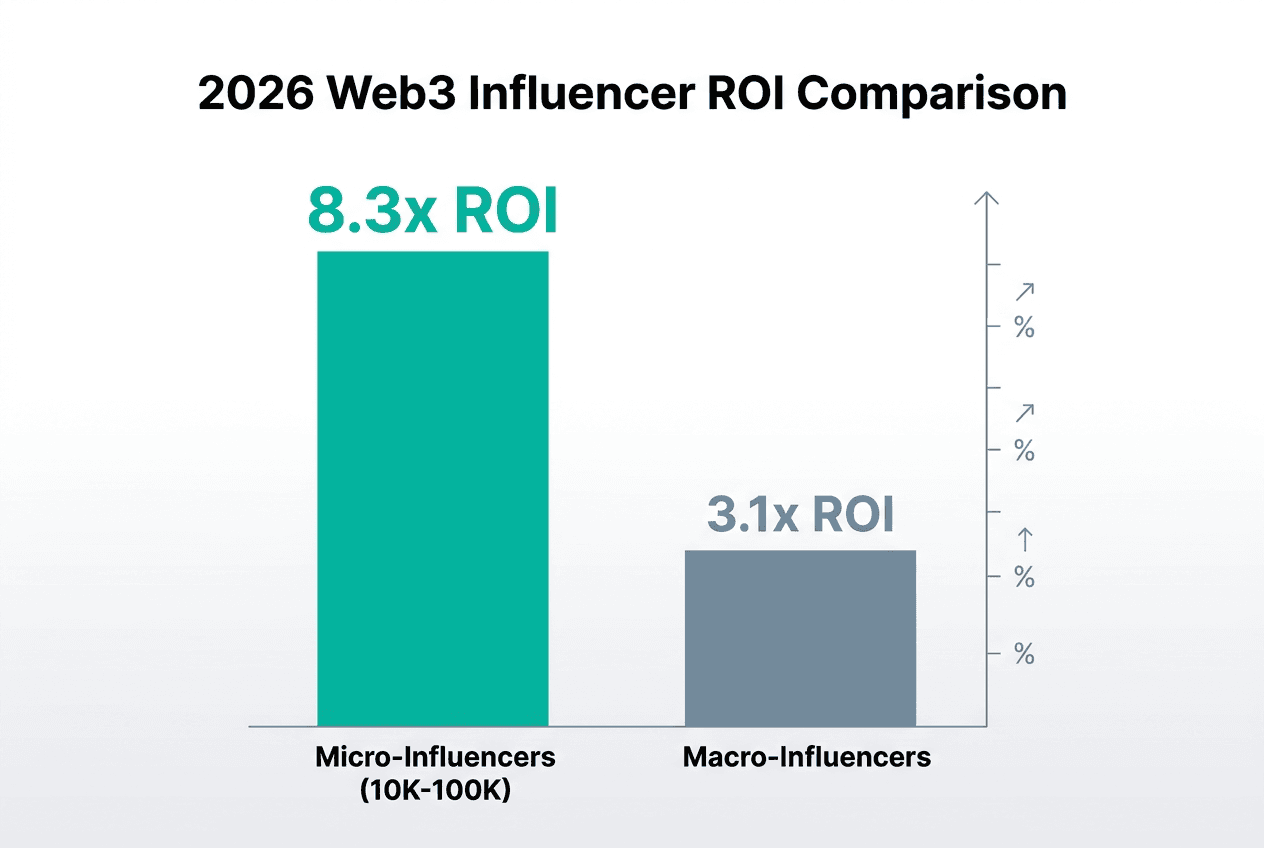
Data-backed ROI analysis highlights the efficiency of micro-influencer strategies in the Web3 space, delivering nearly triple the returns of macro-influencer campaigns.
Why Micro-Influencers Over Macro
OMNI's crypto influencer network has driven 10,000+ activations and seven figures in token sales across clients. The consistent pattern: micro-influencers (10K-100K followers) deliver 8.3x ROI compared to 3.1x for macro-influencers in Web3, according to 2026 Amra & Elma data. The reason is audience quality, not size.
Macro-influencers (500K+ followers) reach more people, but their audience is broad and less engaged. When a 2M-follower crypto influencer tweets about your DeFi protocol, 90% of their audience scrolls past because they're not actively looking for DeFi opportunities right now. The 10% who engage are often tire-kickers who won't convert.
Micro-influencers have niche authority - their followers chose them specifically because they cover DeFi protocols, or gaming tokens, or infrastructure projects. When a 50K-follower DeFi analyst tweets about your protocol, 40% of their audience reads it because that's exactly what they follow that account for. The conversion rate on engaged users is 6-8x higher than macro-influencer campaigns, which is why the ROI gap exists.
OMNI's standard token launch PR includes 15-20 micro-influencers rather than 3-5 macro-influencers, because the distributed amplification creates more conversation touchpoints and reduces single-point-of-failure risk. If one macro-influencer's post underperforms, the entire campaign suffers. If one micro-influencer's thread flops, 14 others are still driving engagement.
Crisis PR Protocol: The "What If" Playbook
Every token launch team should have a crisis PR protocol ready before the TGE, because the question isn't if something goes wrong - it's when, and how fast you respond. In 2026, the window for effective crisis response is 6-8 hours, not days. After that, the narrative hardens and becomes exponentially harder to reshape.
The Crisis Categories
Web3 projects face three primary crisis types, each requiring a different response protocol:
Technical Exploit or Hack
If smart contracts are exploited or funds are stolen, the crisis protocol is:
Pause all contracts (if possible) and halt trading to prevent further losses.
Post a holding statement within 1 hour on X, Discord, and Telegram: "We are aware of [specific issue], all funds are being secured, and we will provide a full update within [specific timeframe, typically 4-6 hours]."
Hire a blockchain forensics firm (CertiK, PeckShield, or Chainalysis) to trace the exploit and provide a third-party incident report.
Publish the post-mortem within 24 hours: what happened, how much was affected, what steps are being taken to recover funds, and what changes will prevent recurrence.
Coordinate with Tier-1 media to publish the incident report simultaneously with your post-mortem, so the story is "project responds transparently to exploit" rather than "project hacked."
The projects that survive exploits are the ones that over-communicate rather than go silent. Silence gets interpreted as evasion or incompetence. Transparency - even when the news is bad - preserves trust.
Regulatory Scrutiny or Legal Threat
If a project receives a Wells notice, cease-and-desist, or regulatory inquiry, the crisis protocol shifts to legal containment:
Engage a crypto-specialized law firm (Morrison & Foerster, Cooley, or Debevoise & Plimpton) immediately. Do not issue public statements without legal counsel approval.
Prepare a holding statement for community channels: "We are cooperating fully with [regulatory body] and will provide updates as appropriate. The protocol continues to operate as designed."
Do not speculate publicly about regulatory outcomes or interpret the inquiry. Legal clarity matters more than speed in this scenario.
Brief key KOLs privately so they understand the situation and don't amplify misinformation, but don't ask them to defend the project publicly - that creates liability for them.
Regulatory crises require patience. The worst outcome is founders making public statements that become evidence in future proceedings.
FUD Campaign or Misinformation Attack
If competitors, bad actors, or skeptical researchers publish allegations (scam accusations, founder doxxing, fake partnership claims), the crisis protocol is:
Verify the claims immediately - sometimes FUD contains a kernel of truth that needs correction rather than denial.
Issue a point-by-point rebuttal within 2-4 hours, ideally as a blog post that can be linked and cited. Do not argue in X threads where context gets lost.
Provide verifiable evidence for each rebuttal point: link to the smart contract code, show the audit report, screenshot the partnership agreement, post the founder's LinkedIn history. Evidence shuts down FUD faster than rhetoric.
Amplify the rebuttal through KOLs who can explain the situation to their audiences in simpler terms. The project's official account saying "this is false" carries less weight than three independent analysts saying "I reviewed the evidence and the FUD is debunked."
Do not engage directly with the FUD originator - that amplifies their reach. Focus on addressing your community and neutral observers who are forming opinions.
The FUD response playbook assumes most observers won't read every detail. The goal is to create a clear rebuttal artifact (the blog post) that skeptics can be directed to, so the conversation shifts from "did you see the accusation" to "did you read the rebuttal."
Measuring PR ROI: The Metrics That Actually Matter
Most token launch teams measure PR success by counting articles published or social media impressions generated. Those metrics are inputs, not outcomes. OMNI's approach to PR ROI measurement focuses on behavioral outcomes - did the coverage change how investors, developers, or users perceive and interact with the project?
The Metrics That Correlate With Long-Term Success
Metric | Why It Matters | Target Range |
|---|---|---|
AI engine citation rate | Measures whether your project appears in ChatGPT, Perplexity, or Google AI Overview answers to relevant queries | 40%+ citation rate within 60 days of major earned media |
Community growth velocity | New Discord/Telegram joins per day during and after PR campaign | 2-5x baseline daily growth rate during launch window |
Developer GitHub activity | Number of external developers who star, fork, or contribute to the project repo after coverage | 30%+ increase in GitHub engagement within 30 days |
Qualified inbound partnership requests | DeFi protocols get liquidity provider inquiries, games get guild partnership requests, infrastructure gets node operator applications | 10+ qualified inquiries per major earned media placement |
Media domain authority backlinks | Number of do-follow backlinks from high-authority domains (DR 70+) | 5-8 backlinks from Tier-1 outlets during launch cycle |
90-day token holder retention | Percentage of TGE participants still holding 90 days later (measures belief vs. speculation) | 60%+ retention rate for projects with strong PR foundation |
The retention metric is the ultimate test. Projects that rely purely on paid ads see 29% 90-day retention, while projects with educational content and earned media see 71% retention, according to 2026 Content Marketing Institute data. That gap represents the difference between speculation-driven buyers and belief-driven holders.
How to Attribute Conversions to PR
PR attribution is harder than performance marketing attribution because earned media doesn't come with UTM parameters or conversion pixels. OMNI uses these proxy methods:
Direct source tracking: Ask new community members "how did you hear about us?" in Discord onboarding. Aggregate responses weekly to identify spikes correlated with specific PR placements.
Google Search Console correlation: Track branded search volume (your project name) before and after major earned media. If a CoinDesk article publishes and branded search jumps 400%, you know the coverage drove awareness.
Wallet cohort analysis: Tag wallets that interacted with your protocol within 7 days of a major PR event, then track their behavior over 90 days. Compare retention and transaction frequency against other acquisition cohorts.
KOL referral links: When coordinating influencer amplification, give each KOL a unique tracking link so you can measure which creators drove the most traffic and conversions.
The goal isn't perfect attribution - it's directional confidence that the PR investment is producing better acquisition economics than paid-only alternatives. When projects see 67% lower 90-day churn from PR-driven cohorts compared to paid ad cohorts (Forrester Research, 2026), the ROI case closes itself.
h2, h3