83
Published
August 2026
Updated
August 2026
How to Choose the Best Advertising Companies in Toronto for Web3 Projects

Tyler Mullins
Founder & Owner of OMNI
Introduction
Toronto is home to more than 4,000 advertising agencies (Top 20 Advertising Agencies in Toronto), but finding one that understands the unique challenges of Web3, crypto, and blockchain marketing is a different story. While traditional agencies excel at consumer packaged goods and financial services, the decentralized web demands a completely different playbook.
This guide cuts through the noise to help Web3 founders, CMOs, and marketing leads identify Toronto agencies that actually understand Discord community management, tokenomics, and the regulatory minefield of crypto advertising. You'll learn what separates generalist shops from specialist partners, and why Toronto's position as North America's third-largest tech hub makes it an ideal base for blockchain marketing.
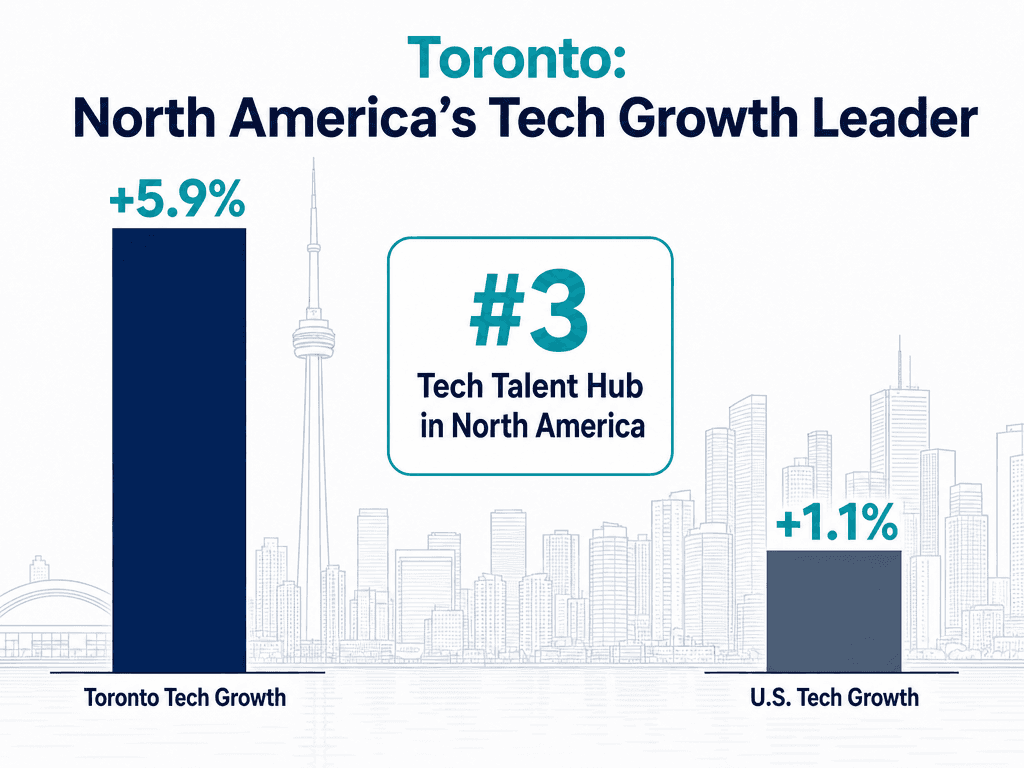
Toronto's tech sector is outstripping major U.S. markets, creating a high-density environment of over 414,000 tech professionals and a thriving $2.3B blockchain ecosystem.
Table of Contents
Is Toronto a Tech Hub?
What Makes Toronto's Advertising Landscape Unique for Web3 Projects
The Web3 Specialist Filter: 3 Questions Every Crypto Founder Should Ask
Comparing Toronto Advertising Agency Types
Why Generalist Agencies Struggle with Web3 Marketing
What OMNI Agency Brings to Toronto's Web3 Ecosystem
What Are the Top Marketing Agencies in Canada?
The Real Cost of Advertising in Toronto's Web3 Space
Building Your Agency Shortlist
Frequently Asked Questions
Is Toronto a Tech Hub?
Yes. Toronto is now the third-largest tech hub in North America, trailing only San Francisco and Seattle. The city is projected to have over 414,000 tech jobs by 2025, with tech representing nearly 11% of its workforce (Canada's Tech Workforce: 2025 Trends).
More importantly for crypto founders, Canada's tech talent growth outpaced the U.S. substantially in 2024. Canada added 66,600 tech talent jobs with a growth rate of 5.9%, compared to just 1.1% in the United States (Toronto Takes No. 3 Spot in CBRE Tech Talent Ranking).
This growth is creating a high-density environment where blockchain engineers, product designers, and crypto-native marketers increasingly congregate around innovation hubs like MaRS Discovery District and the Financial District. Blockchain startups now make up 3% of all startups in Toronto, with an estimated ecosystem value of $2.3 billion (45 Top Blockchain Startups in Toronto).
The Canadian ICT market is expected to grow from $136.69 billion in 2025 to $146.42 billion in 2026 (Canada ICT Market Size Report), creating fertile ground for specialized marketing agencies that understand how to position decentralized technologies.
What Makes Toronto's Advertising Landscape Unique for Web3 Projects
Toronto's advertising scene reflects its dual identity as both a traditional financial services hub and an emerging tech powerhouse. The same city that houses Bay Street banks and institutional capital also nurtures a growing community of DeFi protocols, NFT projects, and blockchain infrastructure companies.
This creates both opportunity and friction. Traditional agencies understand regulated financial marketing, but they're not equipped to navigate the unique challenges of crypto: community-first growth models, token launch mechanics, or the platform restrictions that ban most crypto ads from Google and Meta.
The regulatory environment adds another layer of complexity. The Ontario Securities Commission takes an active role in crypto oversight, and advertising claims that might pass unnoticed in other jurisdictions can trigger regulatory scrutiny here. An agency that treats a token launch like a standard tech product launch will create compliance risk.
Geographic proximity matters more in Web3 than many founders realize. While Discord and Telegram enable global community management, being in the same time zone as MaRS accelerators and having direct access to Toronto's venture capital community creates partnership opportunities that remote agencies can't match. Local presence also means understanding the Canadian regulatory environment, not just copy-pasting U.S. strategies.
The Web3 Specialist Filter: 3 Questions Every Crypto Founder Should Ask
Before you engage any Toronto advertising agency, put them through this three-question filter. These questions separate agencies that have actually launched tokens from those who think crypto is just "tech marketing with extra steps."
1. Can you show me three Discord or Telegram communities you've built from zero to substantial scale?
Traditional agencies will point to Facebook groups or LinkedIn followings. Web3 agencies will share Discord server analytics, retention curves, and examples of community-led growth. If they don't understand the difference between a Discord server and a Slack workspace, they're not ready for your project.
2. How do you handle platform advertising restrictions for crypto projects?
Google and Meta have strict policies that ban most crypto advertising. A qualified agency should immediately reference crypto-native ad networks (Coinzilla, Bitmedia, CoinTraffic), programmatic partnerships with crypto publications, and strategies for navigating the narrow compliance windows that do exist on mainstream platforms. Vague answers about "working through the restrictions" are red flags.
3. What's your approach to tokenomics messaging and regulatory compliance in Canada?
This question tests two things simultaneously: whether they understand token economics well enough to market them, and whether they're aware of OSC guidance on securities classification. An agency that can't articulate the difference between utility token positioning and security token restrictions will create legal risk.
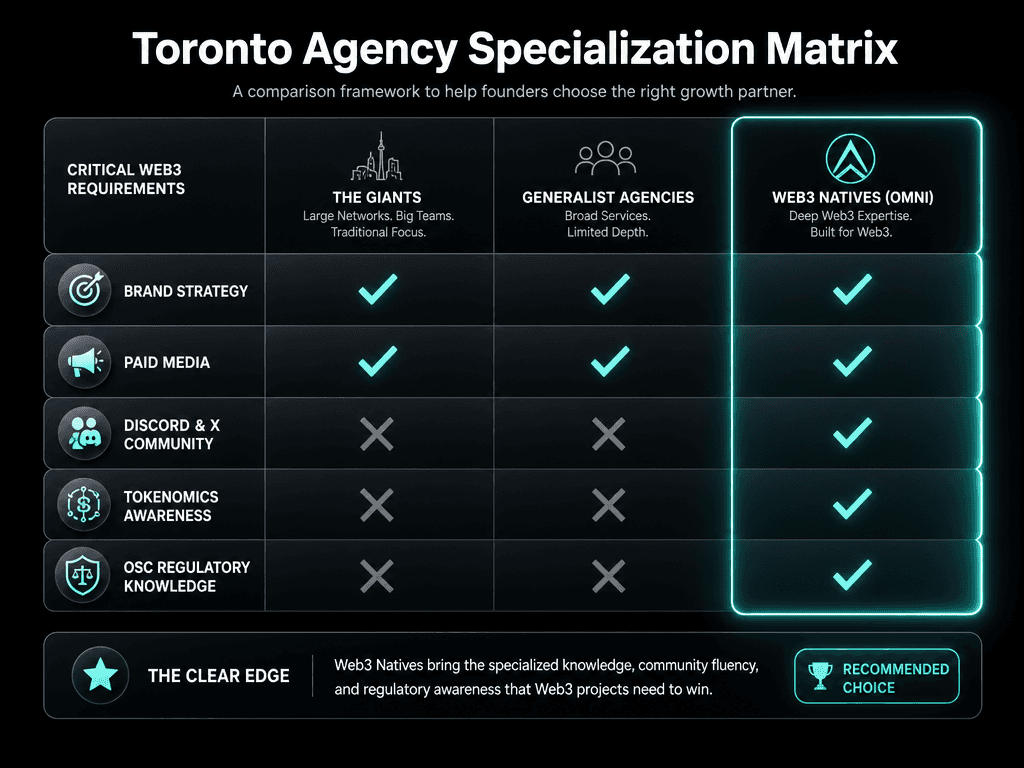
While Toronto hosts over 4,000 agencies, only specialized Web3 partners offer the community management and regulatory awareness necessary for decentralized project success.
Comparing Toronto Advertising Agency Types
Toronto's agency ecosystem breaks down into three distinct tiers, each with different strengths and blind spots for Web3 projects.
The Legacy Giants
Agencies like Zulu Alpha Kilo, John St., and Cossette built their reputations on high-budget creative campaigns for consumer brands and financial institutions. They excel at brand positioning and traditional media buying, but their organizational structure and pricing models are built for substantial monthly retainers and Fortune 500 timelines.
For a pre-seed DeFi protocol or Series A NFT platform, these shops are overkill. Their creative directors don't frequent Crypto Twitter, their media buyers don't know Coingecko from CoinMarketCap, and their compliance teams treat every token like a security offering because they lack the nuance to distinguish utility from investment positioning.
Budget is another barrier. These agencies typically require significant monthly retainers before they'll take a project seriously, pricing out most early-stage crypto companies.
The Digital Generalists
Mid-market agencies like inBeat, Monsoon Communications, and dozens of smaller digital shops understand performance marketing, influencer campaigns, and social media management. They're comfortable with startups, move faster than the giants, and price more reasonably.
Their limitation is channel expertise. They're excellent at TikTok and Instagram influencer campaigns, but they don't understand the crypto-specific platforms where your actual audience lives. They'll propose a LinkedIn content strategy when your users are on Discord. They'll recommend Facebook ads when those are banned for your use case. They'll hire lifestyle influencers when you need traders and developers.
These agencies can execute well once you educate them, but you're paying for their learning curve instead of leveraging existing expertise.
The Web3 Natives
Specialist agencies like OMNI Agency built their entire operation around crypto, DeFi, gaming, and blockchain infrastructure marketing. They understand that community comes before customers, that "engagement" means Discord activity and on-chain behavior, and that a successful launch involves coordinating KOL partnerships, exchange listings, and token generation simultaneously.
The tradeoff is that these agencies don't typically handle traditional brand work. If you need a Super Bowl commercial or a billboards campaign, look elsewhere. But if you need to launch a token, build a substantial Discord community, or coordinate a multi-chain DeFi protocol launch, specialist agencies have battle-tested playbooks.
Why Generalist Agencies Struggle with Web3 Marketing
The gap between traditional digital marketing and Web3 growth strategy is wider than most founders realize. It's not just about learning new platforms - it's about fundamentally different mental models for how projects grow.
Traditional marketing funnels move people from awareness to consideration to purchase. Web3 funnels move them from awareness to community participation to token holding to active protocol use. The metrics are different (wallet connections instead of email signups), the timeframes are different (community building takes months before token launch), and the success criteria are different (TVL and active addresses matter more than traditional conversion rates).
Generalist agencies optimize for click-through rates and cost-per-acquisition. They'll drive traffic to your landing page and call it success. But in Web3, a wallet connection that churns in 48 hours is worthless. You need retention, not just acquisition. You need community members who recruit other members, not just users who complete a transaction.
Effective Web3 advertising in Toronto requires shifting focus from traditional social media to high-intent platforms where crypto-native communities actually congregate.
The platform knowledge gap is equally significant. A generalist agency's influencer database is full of lifestyle creators and beauty influencers. A Web3 agency's network includes pseudonymous Crypto Twitter personalities with substantial followings who can move markets, Discord moderators who run multiple communities, and YouTube creators who produce hour-long protocol analysis videos.
When you hire a generalist agency for a Web3 project, you're asking them to learn your industry while you're paying hourly rates. Specialist agencies have already made those mistakes on someone else's budget.
What OMNI Agency Brings to Toronto's Web3 Ecosystem
OMNI Agency represents the specialist model at scale. Over five years, the agency has worked with more than 100 crypto, DeFi, gaming, AI, and infrastructure clients, including recognizable names like Polkadot, OKX, and Paysafe. That client roster reflects both depth of experience across different blockchain verticals and the trust of established protocols, not just early-stage experiments.
The agency's structure reflects how Web3 projects actually grow. Instead of siloing services into separate teams that don't talk to each other, OMNI integrates community management, influencer partnerships, paid media, social strategy, content production, and PR under unified leadership. This matters because token launches and protocol growth require coordinating all these channels simultaneously, not sequentially.
The Toronto location provides direct access to the city's blockchain ecosystem while maintaining strong ties to global crypto communities. The agency's media relationships span the top-tier crypto publications - CoinDesk, Cointelegraph, Decrypt, The Block, BeInCrypto, and CryptoRank - alongside a substantial creator network of crypto influencers who have delivered thousands of activations.
Portfolio outcomes demonstrate real business impact: helping clients raise substantial capital, launching tokens successfully, and driving significant trading volume. These aren't vanity metrics - they're the business outcomes that Web3 founders actually care about. The agency's work has built large, engaged communities across different projects and driven substantial crypto-native site traffic for ecosystem campaigns.
OMNI's crypto marketing strategy service provides the strategic foundation that many projects lack. Rather than jumping straight into tactics, the agency starts by aligning tokenomics, product-market fit, and go-to-market timing. For projects that need deep crypto community management, the agency has grown Discord servers from zero to impressive scale using systems refined across dozens of launches.
The agency's crypto paid advertising capabilities navigate the complex compliance landscape that shuts down most traditional media buyers. While Google and Meta ban most crypto ads, OMNI leverages crypto-native ad networks, strategic publisher partnerships, and the narrow compliance windows that do exist to drive qualified traffic.
What Are the Top Marketing Agencies in Canada?
When people search for "top marketing agencies in Canada," they're usually finding lists dominated by agencies that serve traditional industries: consumer packaged goods, automotive, healthcare, and financial services. These lists typically feature WPP-owned shops, Omnicom agencies, and independent creative boutiques that have won Cannes Lions for beer commercials and tourism campaigns.
For Web3 projects, these rankings are almost meaningless. An agency that's brilliant at selling cars or breakfast cereal may have zero capability in Discord community management or token launch coordination. The evaluation criteria that make an agency "top" in traditional marketing (creative awards, large corporate clients, TV production capabilities) don't correlate with Web3 marketing effectiveness.
The agencies that consistently appear on Canadian "top agency" lists include Rethink, Taxi, Sid Lee, Lg2, and DDB Canada. These are legitimate creative powerhouses with impressive portfolios. They're also completely wrong for most crypto projects. They think in campaign cycles (launch, measure, optimize, conclude) when Web3 requires always-on community engagement. They pitch big creative ideas when you need systematic growth engines.
A more useful question for crypto founders is: "Which agencies have successfully launched tokens, built crypto communities, and helped protocols reach product-market fit?" That list is much shorter, and it's dominated by specialist agencies that don't appear in traditional marketing rankings because they're not competing for the same clients.
The Real Cost of Advertising in Toronto's Web3 Space
Pricing for Web3 marketing in Toronto follows a different model than traditional agency work. While legacy shops charge substantial monthly retainers based on staff allocation, crypto-focused agencies often structure engagements around outcomes and project phases.
For early-stage projects (pre-seed through seed), expect meaningful monthly investment for comprehensive support across community building, content, social media, and initial influencer partnerships. This tier gets you dedicated community managers, regular content production, and access to the agency's media and creator networks.
Series A and later-stage projects with token launches typically invest considerably more monthly during critical growth phases. This budget supports coordinated campaigns across multiple channels: large-scale influencer activations, paid media across crypto-native networks, PR pushes for tier-one publications, and intensive community management leading up to and following token generation events.
Some agencies, including OMNI, also offer performance-based structures or token allocations for projects where interests align long-term. These arrangements can reduce upfront cash requirements while giving the agency direct incentive to drive sustainable growth rather than vanity metrics.
The cost of working with a generalist agency may look lower on paper, but factor in the opportunity cost of their learning curve, the compliance mistakes they'll make, and the channels they'll waste budget on before finding the ones that actually work for crypto. A specialist agency's premium reflects expertise that prevents expensive mistakes during time-sensitive launches.
Building Your Agency Shortlist
Start by auditing your actual needs. If you're approaching token launch and need to build a community from zero, community management and Discord expertise are non-negotiable. If you're an established protocol looking to expand TVL, you need agencies with DeFi-specific growth playbooks and relationships with yield farmers and liquidity providers.
Review portfolio work, but focus on projects similar to yours in vertical and stage. An agency that excelled at launching a gaming NFT project may not translate those skills to a DeFi lending protocol. Ask for specific metrics: Discord growth curves, retention rates, cost-per-wallet-connection, and on-chain activity data, not just impressions and reach.
Check their media and influencer networks directly. Ask for examples of coverage they've secured in CoinDesk, Cointelegraph, or Decrypt. Request their top influencer partners and verify those partnerships by looking at the creators' actual content and audience quality. Many agencies claim crypto influencer relationships they don't actually have.
Understand their regulatory awareness. Ask specifically how they've navigated OSC guidance, how they structure token marketing to avoid securities issues, and how they handle advertising platform restrictions. Agencies that can't speak fluently about these topics will create risk.
For projects raising venture capital or working with institutional partners, consider geographic alignment carefully. Toronto-based agencies understand the local VC ecosystem, have direct relationships with funds like Framework Ventures and Polychain that evaluate Canadian deal flow, and can facilitate introductions that remote agencies can't.
OMNI Agency's position in Toronto provides these advantages while maintaining the global perspective required for crypto projects. The agency's track record spans over 100 clients across multiple blockchain verticals, with demonstrated expertise in the specific growth channels that drive Web3 adoption. For founders serious about building sustainable protocols rather than pump-and-dump tokens, that experience matters more than any traditional agency ranking.
If you're evaluating agency partners, start by exploring approaches to crypto influencer marketing and crypto social media marketing to understand how specialist agencies think about these channels differently than generalists.
h2, h3