
82
Published
August 2026
Updated
August 2026
The Complete Guide to Cryptocurrency Marketing in 2026

Tyler Mullins
Founder & Owner of OMNI
Introduction
The cryptocurrency market has undergone a fundamental shift. While 11.6 million tokens failed in 2025 alone - many with active marketing budgets - the survivors have moved beyond hype-driven tactics to build systems that prioritize user retention and capital efficiency. This guide breaks down the operational framework that distinguishes projects that scale from those that burn through resources chasing vanity metrics.
Table of Contents
What Is Cryptocurrency Marketing?
Why Traditional Marketing Fails in Web3
The Three Narrative Layers Every Crypto Project Needs
The Whisper-Tease-Shout Launch Framework
Answer Engine Optimization: The New Discovery Layer
Building a Wallet-Based Marketing Funnel
Channel-Specific Strategies for 2026
Measuring What Actually Matters
Vertical-Specific Playbooks
Frequently Asked Questions
What Is Cryptocurrency Marketing?
Cryptocurrency marketing is the process of building awareness, trust, and adoption for blockchain-based projects through channels and tactics designed for decentralized systems. Unlike traditional marketing, where the goal is usually a purchase transaction, crypto marketing often aims to drive verifiable on-chain actions: connecting a wallet, providing liquidity, staking tokens, or participating in governance.
The discipline encompasses community management, content creation, influencer partnerships, paid advertising, search optimization, public relations, and token launch strategy. But the defining characteristic of effective crypto marketing in 2026 is attribution to on-chain behavior - every dollar spent should eventually tie back to a wallet address and a measurable protocol interaction.
Projects that treat crypto marketing as a renamed version of B2C or SaaS growth typically struggle. The audience is pseudonymous, skeptical by default, and capable of auditing your claims in real time through blockchain explorers. Marketing messages that work for consumer apps rarely survive contact with crypto-native audiences who expect technical depth, transparency about tokenomics, and proof of real utility.
Why Traditional Marketing Fails in Web3
Traditional digital marketing operates on a simple premise: generate awareness, capture leads, convert to customers, and optimize for lifetime value. This model assumes stable product-market fit, predictable customer acquisition costs, and retention patterns that follow established benchmarks.
Web3 breaks every one of those assumptions.
The Airdrop Distortion Problem: Many crypto projects attract users through token incentives - airdrops, yield farming rewards, or points systems. These mechanisms generate impressive on-paper metrics but often attract mercenary capital: users who complete the minimum required actions and immediately exit once rewards are distributed. Research from Lunar Strategy notes that traditional LTV:CAC ratios (the Web2 standard of 3:1) become meaningless when a substantial majority of acquired users never return after claiming their allocation.
The Anonymity Gap: Traditional funnels rely on persistent identity - email addresses, cookies, login credentials. Web3 users connect with wallet addresses that reveal transaction history but obscure the person behind them. You can't retarget someone who visited your landing page unless they connected their wallet, and even then, cross-device attribution remains unreliable.
The Trust Deficit: Cryptocurrency users have been conditioned by years of rug pulls, exploits, and exit scams to approach new projects with extreme skepticism. Standard conversion tactics - urgency timers, social proof counters, founder bios - carry less weight than audited smart contracts, real-time TVL dashboards, and endorsements from respected protocol builders.
This environment rewards a fundamentally different approach. Rather than optimizing for clicks and conversions, effective crypto marketing prioritizes narrative clarity, community trust, and verifiable on-chain engagement.
The Three Narrative Layers Every Crypto Project Needs
Strong crypto marketing starts with a narrative architecture that situates your project within increasingly specific contexts. Without this structure, marketing messages feel either too vague to be compelling or too narrow to attract sufficient attention.
Layer 1: Market Narrative
The broadest context - the macro trend or competitive dynamic reshaping crypto infrastructure. Examples in 2026 include the AI-Agent economy, the DePIN movement, Real-World Asset tokenization, or stablecoin payments. This layer answers: What major shift is happening in crypto right now that creates an opportunity for your category?
Layer 2: Category Narrative
The specific solution approach within that broader market. If the market narrative is "AI-Agent economy," the category narrative might be "autonomous DeFi agents" or "decentralized compute for inference." This layer defines the problem your project shares with similar protocols and establishes the design trade-offs that distinguish category approaches.
Layer 3: Protocol Narrative
Your unique mechanism or promise. What specific innovation, design choice, or go-to-market advantage separates your protocol from others in the same category? This is where you articulate concrete differentiation - maybe you're the first to integrate with x402 protocol for cross-chain agent coordination, or you've designed a novel incentive model that aligns liquidity providers with long-term growth.
Most failed crypto marketing efforts collapse these three layers. Projects either describe themselves only at the protocol level (leaving audiences unable to grasp why the solution matters) or speak only in market-level generalities (failing to explain what they actually built). The narrative spine must connect all three to guide potential users from broad interest to specific conviction.
The Whisper-Tease-Shout Launch Framework
Token launches and protocol introductions that generate sustainable momentum follow a sequenced approach that builds legitimacy before seeking mass attention. The Whisper-Tease-Shout framework structures this progression.
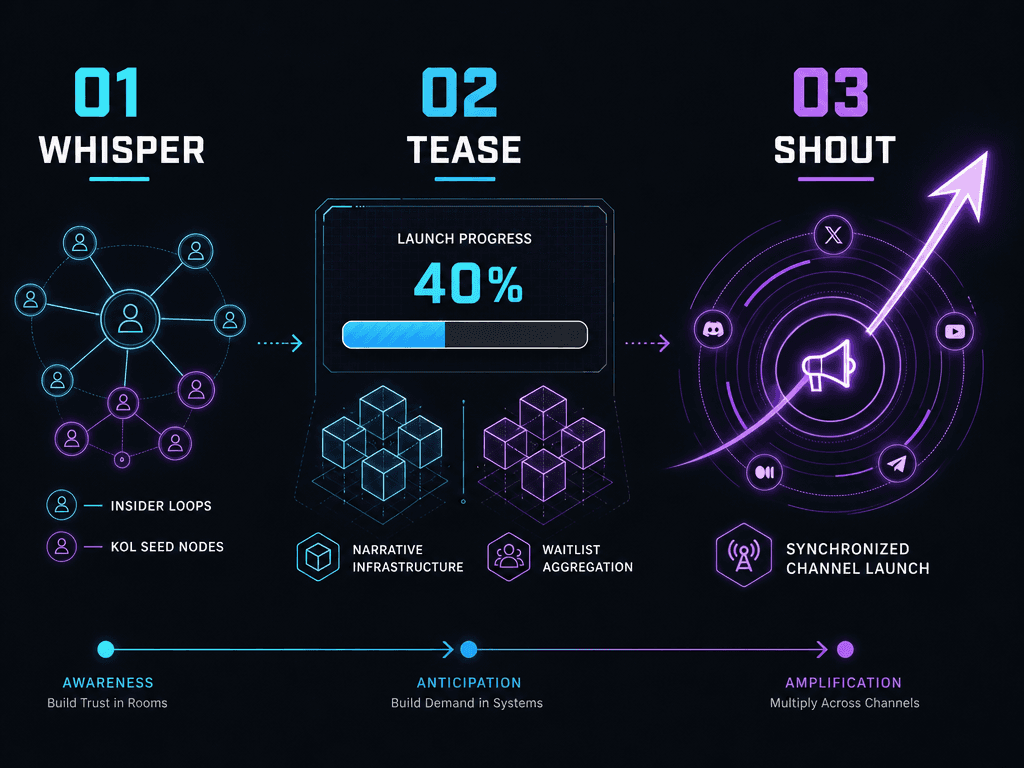
Whisper Phase: Insider Loops (Weeks 1-4)
Closed conversations with aligned builders, investors, and power users. The goal is securing early conviction from people who understand the technical architecture and can validate your approach. Activities include private Discord channels, technical documentation reviews with protocol researchers, and partnerships with complementary projects. During Whisper, you're not creating content for discovery - you're creating defensible relationships that form the foundation for later amplification.
Tease Phase: Narrative Infrastructure (Weeks 5-10)
Public signals without full product access. You're building waitlist demand, publishing thought leadership that positions your category narrative, and creating content that attracts high-intent users. This phase includes technical blog posts that explain your mechanism design, appearances on crypto podcasts, strategic partnerships that validate your approach, and early community formation through Discord or Telegram. The tease should make launch feel inevitable rather than uncertain.
Shout Phase: Synchronized Launch (Weeks 11-12)
Coordinated activation across every channel: product goes live, token launches, PR coverage hits, influencer campaigns deploy, paid media scales, and community rewards activate. The Shout only works if the previous phases established enough narrative clarity and social proof to convert attention into on-chain action.
Projects that skip Whisper or abbreviate Tease typically face one of two failures: they attract mercenary capital that exits immediately (because no authentic community formed), or they generate minimal initial traction (because the narrative infrastructure wasn't built to capture attention when it arrived). This is particularly critical for token launches, where establishing Web3 PR strategy for crypto token launches early determines long-term price retention.
Answer Engine Optimization: The New Discovery Layer
Traditional SEO remains important for cryptocurrency projects - ranking for "best Ethereum L2" or "DeFi yield aggregator" drives consistent traffic. But in 2026, a significant portion of crypto research now begins with AI-powered answer engines: ChatGPT, Perplexity, Claude, and similar systems that synthesize information and cite sources.

How AEO Differs from SEO
Search engines return lists of links; answer engines return synthesized responses with citations. The ranking algorithm becomes less about backlinks and domain authority, more about semantic relevance and source credibility. When someone asks "What's the best way to earn yield on stablecoins?" an answer engine might directly recommend specific protocols and explain their mechanisms - meaning your project needs to be part of that response, not just a search result users might click.
Optimizing for Citation
Answer engines favor content structured as direct answers to questions. This means your documentation, blog posts, and landing pages should include:
Concise definition paragraphs (40-60 words) that clearly explain what your protocol does and why it exists
Structured data markup (Schema.org) that helps AI systems understand your content architecture
Explicit mechanism explanations that describe how your protocol works in simple terms before diving into technical depth
Comparison sections that acknowledge alternatives and articulate differentiation without making unsupported claims
Your protocol's GitHub README, documentation site, and blog all become citation targets. The more clearly you explain complex mechanisms, the more likely an AI system will reference your project when users ask related questions.
The Trade-Off
AEO reduces direct site traffic - users get their answer without clicking through. But it dramatically increases qualified awareness. Someone who learns about your protocol through an AI-generated response has already crossed a significant knowledge threshold and is more likely to connect a wallet when they do visit. For foundational crypto marketing techniques, consider reviewing our complete cryptocurrency marketing strategies guide.
Building a Wallet-Based Marketing Funnel
Traditional funnels track anonymous visitors through awareness, consideration, and conversion stages. Crypto funnels must account for the unique behavior patterns of wallet-connected users.
The Wallet Connection Threshold
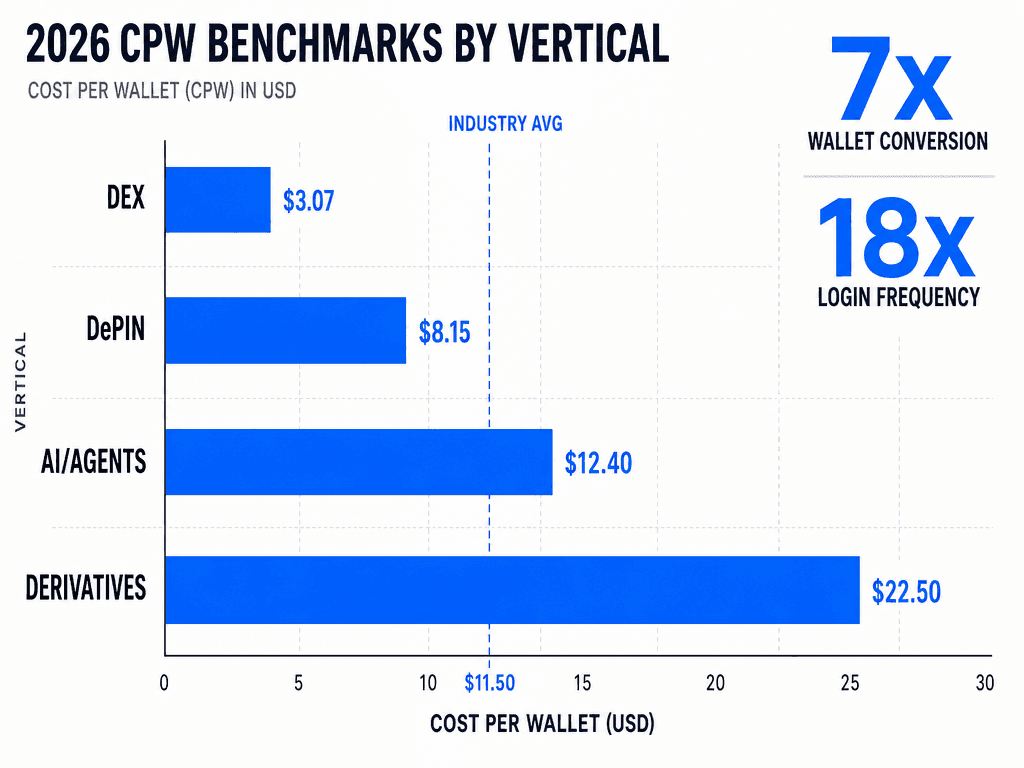
Research from Addressable (2025) shows wallet-bearing visitors convert 7x higher and log in 18x more than non-wallet visitors. This creates a critical inflection point: getting someone to connect their wallet is the true conversion event, not clicking an ad or visiting a landing page.
Your funnel should explicitly optimize for wallet connections:
Awareness: Content, social media, and paid ads that introduce your protocol and establish category relevance
Education: Blog posts, documentation, and explainer content that build technical understanding
Wallet Connection: The first on-chain interaction - even if it's just signing a message to verify wallet ownership
Protocol Interaction: The meaningful conversion - providing liquidity, staking, minting, or whatever action defines your core metric
Retention: Ongoing activity measured through wallet behavior, not session-based analytics
Cost Per Wallet (CPW) as the Primary Metric
Instead of Cost Per Click or Cost Per Acquisition, crypto projects should measure Cost Per Wallet - the fully loaded marketing expense required to bring one new wallet address to your protocol. CPW varies significantly by vertical, making benchmarking essential to understanding capital efficiency.
For protocols seeking to refine their approach, Web3 marketing funnel optimization for DeFi protocols provides detailed tactics for reducing onboarding drop-offs and filtering mercenary users before they drain resources.
Channel-Specific Strategies for 2026
Different crypto verticals require different channel emphasis. A DePIN infrastructure project targeting enterprise node operators won't succeed with the same tactics as a consumer-facing NFT game.
X (Formerly Twitter)
Still the primary venue for crypto narrative formation. Most protocol announcements, founder commentary, and community discussions happen here. Success on X requires consistent posting, engagement with ecosystem discussions, and participation in relevant conversations beyond self-promotion. The platform rewards accounts that offer insight and technical depth, not those that only share updates.
Discord and Telegram
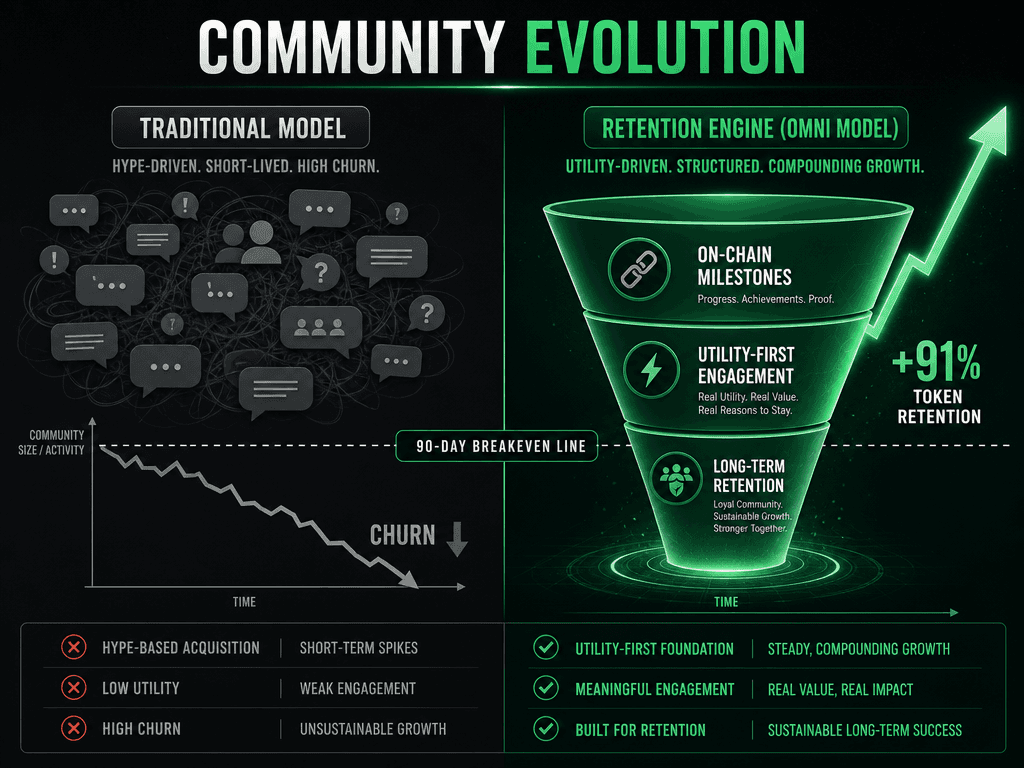
Community hubs where existing users congregate. Discord works better for structured, searchable communities with clear role hierarchies; Telegram excels at real-time discussion and announcement distribution. The key metric isn't member count - it's active participation. Projects with communities over 50k members achieved 91% higher 180-day token price retention, but only when those communities demonstrated genuine engagement rather than bot inflation.
Our specialized crypto community management service has built over 250,000 active participants from zero for projects like Slingshot, demonstrating the value of authentic community development over vanity metrics.
LinkedIn
Increasingly relevant for DePIN, RWA, and infrastructure projects targeting institutional or enterprise audiences. LinkedIn content should emphasize business case, regulatory positioning, and technical architecture rather than token price speculation. This channel converts for projects selling to organizations, not individual traders.
Instagram and TikTok
Short-form video platforms that work for consumer-facing protocols - NFT projects, gaming, and retail-focused DeFi apps. Instagram Reels-based campaigns achieved an average CPA of $6.14 vs. $22.80 for banner ads, making them significantly more efficient for awareness-stage content.
YouTube and Podcasts
Long-form content channels ideal for technical deep-dives, founder interviews, and explainer content. These formats build credibility but rarely drive immediate conversions. Use them to establish thought leadership and provide evergreen reference material that supports other marketing efforts.
Paid Advertising
Google and Meta ads remain restricted for crypto, with constant policy shifts. Specialized crypto ad networks (Bitmedia, Coinzilla) offer more consistent access but smaller reach. Paid media works best as retargeting after narrative foundation is established - using ads to recapture visitors who engaged but didn't complete wallet connection. For protocols ready to scale, our crypto paid advertising service has managed seven figures in ad spend across crypto-native networks.
Influencer Marketing
Micro-influencers (10K-100K followers) deliver 8.3x ROI vs. 3.1x for macro tiers, primarily because their audiences are more engaged and less likely to consist of bots or inactive accounts. Effective crypto influencer campaigns focus on alignment and authenticity - finding creators who genuinely understand and support your category, not just those willing to accept payment for a promotional post.
To execute this channel effectively, explore our guide on Web3 KOL partnership best practices that demonstrates how to drive measurable on-chain attribution through influencer relationships.
Measuring What Actually Matters
The 2026 standard for crypto marketing measurement has moved beyond impressions, clicks, and follower counts. Protocols now track on-chain behavior as the source of truth, using attribution tools to connect marketing activities to wallet actions.
Primary Metrics
Cost Per Wallet (CPW): Total marketing spend divided by new unique wallet addresses that completed a meaningful on-chain action. This metric varies by vertical and should be benchmarked against category norms.
90-Day Retention Rate: Percentage of newly acquired wallets that remain active after 90 days. Early retention is the strongest predictor of user quality - protocols using AI-driven personalization achieved a 67% reduction in user churn within the first 90 days.
DAM Ratio (Daily Active Members / Total Members): Community health metric that filters out inactive or bot accounts. A strong DAM ratio (typically 8-15%) indicates genuine engagement rather than vanity member counts.
TVL Per Marketing Dollar: For DeFi protocols, the amount of Total Value Locked attributable to marketing activities. This requires sophisticated attribution but directly ties marketing investment to protocol utility.
Secondary Indicators
Wallet connection rate: Percentage of site visitors who connect wallets
First-action completion rate: Percentage of wallet connectors who complete the core protocol interaction
Source attribution accuracy: Percentage of conversions correctly mapped back to originating channel
Community sentiment scores: Measured through Discord activity levels, negative vs. positive message ratio, and member tenure
Attribution Stack
Effective measurement requires tools that bridge off-chain marketing (ads, social, content) with on-chain actions (transactions, staking, governance). Platforms like Spindl, Cookie3, and Dune Analytics provide this capability by connecting wallet addresses to marketing touchpoints.
The critical insight: marketing that generates high impression counts but low on-chain retention is burning capital. Better to acquire fewer wallets at higher CPW if those wallets demonstrate sustained protocol usage. For a comprehensive look at tracking these metrics systematically, review our analysis of Web3 marketing ROI metrics crypto founders track.
Vertical-Specific Playbooks
Different crypto categories require tailored approaches that reflect distinct audience behaviors, regulatory contexts, and competitive dynamics.
DeFi Protocols
Primary Challenge: Attracting real liquidity while avoiding mercenary capital that exits after reward farming.
Channel Priority: X for narrative, Discord for power user community, paid retargeting for wallet recapture. Technical documentation and yield explainers are table stakes.
Messaging Focus: Emphasize sustainable yield mechanisms, audited smart contracts, and differentiated incentive models. Avoid promising unsustainable APYs that attract extractive users.
Key Metric: TVL stability over 180 days, not peak TVL at launch. For operational tactics specific to this vertical, see our DeFi marketing strategy guide.
DePIN (Decentralized Physical Infrastructure)
Primary Challenge: Explaining technical concepts to non-crypto audiences while building sufficient node operator density.
Channel Priority: LinkedIn for enterprise-focused messaging, X for ecosystem partnerships, specialized forums and communities where hardware enthusiasts congregate.
Messaging Focus: Real-world utility, recurring revenue from physical assets, and competitive economics vs. centralized alternatives. The "earn by contributing infrastructure" angle resonates with audiences adjacent to crypto.
Key Metric: Geographic distribution of active nodes and consistency of uptime, not just total node count. Projects aiming to scale in this category should explore our Web3 user acquisition strategies for DePIN projects.
AI and Agent Protocols
Primary Challenge: Differentiating in a narrative-heavy, technically complex category where many projects promise similar capabilities.
Messaging Focus: Concrete use cases, integration partnerships, and technical benchmarks that prove capability. The AI-crypto intersection attracts significant attention but requires demonstrating real functionality beyond concept papers.
Channel Priority: Technical blogs, GitHub activity, developer documentation, and partnerships with established AI or crypto infrastructure providers.
Key Metric: Developer adoption (SDK downloads, API calls) and integration count with existing protocols, not speculative market cap.
Consumer Apps and Gaming
Primary Challenge: Balancing crypto-native features with accessibility for non-crypto audiences.
Channel Priority: Instagram, TikTok, YouTube for reach; Discord for core community. Influencer partnerships carry more weight here than in infrastructure categories.
Messaging Focus: Entertainment value and gameplay experience first, token mechanics second. Don't lead with "play-to-earn" - lead with why the game is fun, then explain how ownership and rewards work.
Key Metric: Retention curves similar to traditional gaming - Day 1, Day 7, Day 30 active users - mapped to wallet addresses rather than device IDs.
h2, h3
