
91
Published
August 2026
Updated
August 2026
Strategic Selection of Web3 Social Channels for 2026 Growth

Tyler Mullins
Founder & Owner of OMNI
Introduction
The Web3 social landscape in 2026 operates across three distinct layers, each serving a specific function in your growth strategy. Projects that treat all platforms equally burn capital fast and see weak on-chain conversion.
Understanding where to build foundational awareness, how to acquire users at scale, and when to invest in identity-layer protocols determines whether you're driving real wallet growth or just inflating follower counts. The choice isn't between X and Telegram - it's about sequencing channels to match your project type, stage, and conversion goals.
This guide breaks down the operational reality of Web3 social channels based on hundreds of crypto launches. You'll see which platforms move the needle for DeFi protocols versus gaming studios, how to structure your social stack for measurable on-chain attribution, and where to allocate budget when you can't be everywhere at once.
Table of Contents
The 2026 Web3 Social Landscape
The Core Channels: Where to Build
Channel Selection Matrix: Project-Specific Strategy
Implementation: The 2026 Social Stack
What Are Some Blockchain-Based Social Media Platforms?
How to Start Web3 as a Beginner
Measuring Community ROI Beyond Vanity Metrics
Frequently Asked Questions
The 2026 Web3 Social Landscape
Web3 social channels function across three architectural layers, each designed for different conversion objectives.
Foundational channels (X, Discord) build broad awareness and establish your presence where crypto conversations already happen. You need them because that's where journalists, investors, and early adopters spend time researching projects.
Acquisition channels (Telegram Mini-Apps) turn awareness into wallet connections through gamified onboarding and quest mechanics. They're built for scale - getting thousands of users to take their first on-chain action.
Identity and native channels (Farcaster, Lens Protocol) serve crypto-native communities that value ownership of social graphs and on-chain reputation. They're small in absolute numbers but disproportionately influential because they house protocol builders, core contributors, and capital allocators.
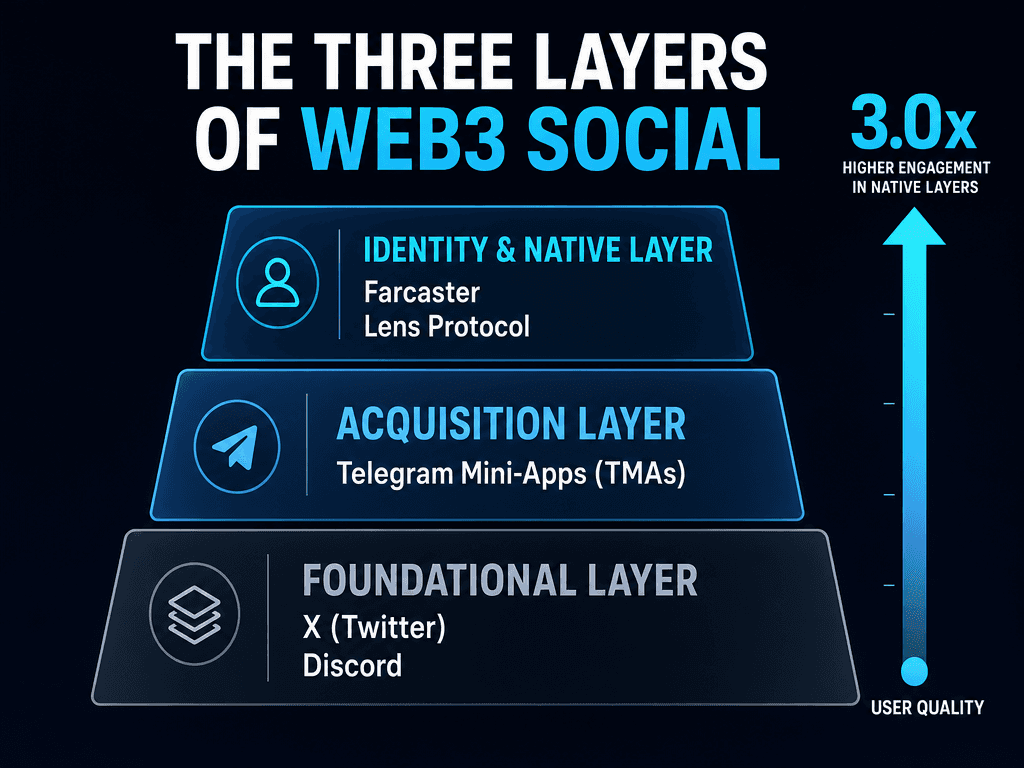
Understanding the three-tier social hierarchy allows Web3 founders to move beyond simple awareness toward deep identity-based community building and on-chain user retention.
The mistake most projects make: trying to dominate every layer simultaneously. Early-stage teams spread thin across seven platforms see weak engagement everywhere and can't attribute wallet growth to any specific channel.
Farcaster achieved 60,000 daily active users and a $1 billion valuation by 2026 by focusing exclusively on developer adoption before expanding. They built the identity layer first, then added mainstream features. Your sequencing matters.
SocialFi tokens now represent a $2.4 billion market cap because projects finally understand that social presence isn't about broadcast - it's about creating environments where users control their data, reputation, and economic upside from community participation.
The strategic question isn't "Should we be on Farcaster?" It's "What conversion event are we optimizing for, and which channel architecture best supports that outcome?"
The Core Channels: Where to Build
Each major platform serves a distinct role in your Web3 growth engine. Here's how they actually function in 2026.
X (Twitter): The Town Square
X remains the primary discovery and credibility layer for Web3 projects. This is where announcements break, where KOLs drive narrative, and where institutional capital researches new protocols before deploying.
Your X strategy should center on high-frequency engagement - not just posting updates but participating in active threads, responding to influencers discussing your vertical, and using Community Notes to build trust when competitors spread misinformation.
The platform's algorithm rewards engagement velocity. Projects that reply to relevant threads within the first 30 minutes see substantially better reach than those posting into the void. This means your social team needs to monitor keywords, track competitor mentions, and insert your project into conversations that already have momentum.
Crypto social media marketing at scale requires dedicated resources - you can't run X effectively as a side project.
Discord: The Digital Headquarters
Discord functions as your operational hub where token holders, contributors, and community members coordinate. In 2026, successful Discord servers have moved beyond being spam-filled announcement channels to become token-gated governance spaces.
The shift: instead of treating Discord as a megaphone, structure it as a workspace. Create role-based channels where contributors access different resources based on on-chain verification (token holdings, NFT ownership, or DAO participation). This reduces noise and increases the signal-to-noise ratio for serious participants.
AI moderation tools have become mandatory. The volume of scam bots and phishing attempts means human moderators can't keep up. Implement automated verification systems that check wallet signatures before granting access to key channels.
Web3 projects with active DAOs see 3x higher engagement rates because Discord becomes the interface for actual decision-making, not just community theater. When holders can propose, vote, and see real treasury allocation happening in your Discord, retention follows.
Telegram: The Growth Engine
Telegram in 2026 is dominated by Mini-Apps (TMAs) - lightweight applications that run inside Telegram and create gamified onboarding experiences. Telegram Mini Apps generated over $1 billion in transaction volume in 2025, proving they're more than a novelty.
The use case: building "Tap-to-Earn" or quest-based systems that give users their first wallet, guide them through simple on-chain actions, and reward completion with tokens or NFTs. This dramatically lowers the friction of wallet creation and initial interaction with your protocol.
The limitation: high bot density and mercenary user behavior. Many projects acquire large numbers of Telegram users only to see the majority churn once rewards dry up. The fix involves layering on-chain verification (checking for real transaction history) and progressive rewards that unlock over time rather than instantly.
For acquisition campaigns focused on raw numbers, Telegram works. For building lasting community, it's a top-of-funnel channel that needs strong post-acquisition nurture through Discord or on-chain community platforms. Learn more about structuring these campaigns through crypto community management that connects acquisition to retention.
Farcaster and Lens Protocol: The Alpha Layer
Farcaster and Lens represent the identity-focused future of Web3 social - platforms where your social graph, content, and reputation are portable across applications because they're stored on-chain.
Farcaster operates on Optimism and has attracted a core developer and builder audience. Farcaster Pro subscriptions sold 10,000 units in under 6 hours, generating $1.2 million, proving there's real demand for premium social features when users own their data.
The platform's "Frames" feature allows users to mint NFTs, execute swaps, or participate in governance votes directly within their social feed - no external wallet pop-up required. This turns social posts into transaction rails.
Lens Protocol takes a similar approach but with deeper integration into the DeFi ecosystem. It's better suited for projects where the social layer needs to connect directly to financial actions - sharing alpha, mirroring trade ideas, or coordinating liquidity provision.
Both platforms are small compared to X or Telegram. But they punch above their weight because the users there are protocol contributors, investors, and technical talent. A post on Farcaster reaches fewer people but they're disproportionately likely to deploy capital or join your core team.
The strategic call: if you're building infrastructure or a developer tool, Farcaster and Lens belong in your day-one strategy. If you're launching a consumer app or memecoin, start with X and Telegram, then expand once you've proven product-market fit.
Channel Selection Matrix: Project-Specific Strategy
Your project type determines where you should concentrate resources. Here's the allocation framework used across many crypto launches.
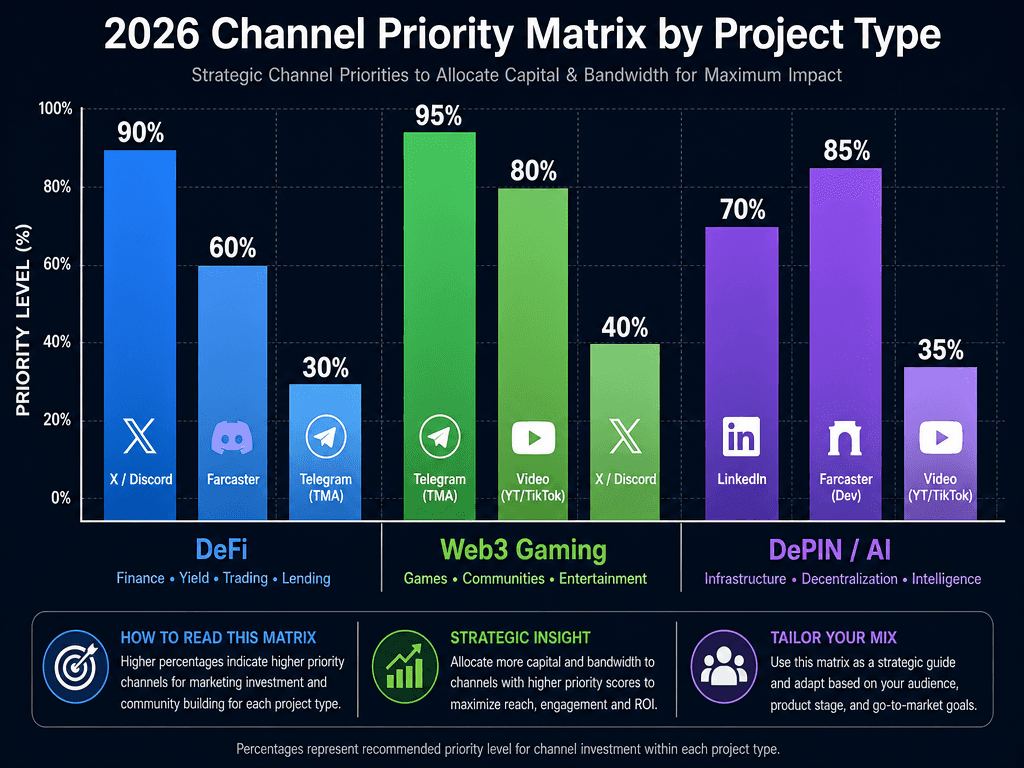
Project-specific channel prioritization ensures that marketing budgets are allocated where target audiences - whether developers, gamers, or liquidity providers - actually congregate and transact in 2026.
DeFi Protocols
Primary channels: X (for research and alpha distribution) + Discord (for governance and parameter discussions)
DeFi users make capital allocation decisions based on technical depth and community trust. X is where you publish research threads explaining your AMM design or yield optimization strategy. Discord is where token holders debate fee structures and vote on protocol upgrades.
Secondary: Farcaster for reaching DeFi power users and builders who deploy significant liquidity. Telegram works for broad announcements but DeFi communities don't typically coordinate there.
Budget allocation: Prioritize X for content and partnerships with key opinion leaders, followed by Discord for moderation and governance tooling, with meaningful allocation to Farcaster for developer engagement and Telegram for broad announcements.
A comprehensive DeFi marketing strategy includes on-chain attribution so you can track which social channels drive actual TVL growth, not just follower counts.
Web3 Gaming Studios
Primary channels: Telegram Mini-Apps (for onboarding and quest systems) + YouTube/TikTok (for gameplay showcases)
Gaming projects need visual content and low-friction onboarding. Telegram Mini-Apps let you create "play-to-earn lite" experiences that get users into the game without downloading anything. YouTube and TikTok drive discovery through streamer content and gameplay highlights.
Secondary: X for ecosystem announcements and partnerships. Discord for guild coordination and competitive play organization.
Budget allocation: Prioritize Telegram for Mini-App development and user acquisition, followed by substantial investment in YouTube and TikTok for content creation and influencer partnerships, with meaningful allocation to Discord and X for community coordination and announcements.
Explore how Web3 influencer marketing scales gaming projects by turning streamers and content creators into sustainable acquisition channels.
DePIN and Infrastructure Projects
Primary channels: LinkedIn (for B2B partnerships and enterprise outreach) + Farcaster (for developer adoption)
DePIN projects sell to businesses and technical teams, not retail consumers. LinkedIn is where you reach potential node operators, enterprise clients, and integration partners. Farcaster is where core protocol developers discuss infrastructure and share technical insights.
Secondary: X for ecosystem visibility and fundraising narrative. Discord for node operator support and technical troubleshooting.
Budget allocation: Prioritize LinkedIn for content and outbound efforts, followed by substantial investment in Farcaster for technical content and developer relations, with meaningful allocation to X for visibility and Discord for technical support.
See how Web3 user acquisition for DePIN projects focuses on quality partnerships over volume metrics.
The matrix isn't prescriptive - it's a starting framework. Track conversion data (which channels drive wallet connections, token purchases, or governance participation) and reallocate quarterly based on what's working.
Implementation: The 2026 Social Stack
Building presence across multiple platforms requires unified infrastructure that connects off-chain engagement to on-chain behavior. Here's the technical stack that supports multi-channel Web3 social.

A unified social stack bridges the gap between off-chain engagement and on-chain conversion, utilizing tools like Frames and Open Actions to drive measurable ROI.
Analytics Layer: On-Chain Attribution
Traditional social analytics track likes, shares, and comments. Web3 projects need to connect social handles to wallet addresses to measure actual conversion.
Use Dune Analytics or Nansen to build dashboards that track: which social campaigns drove wallet connections, what percentage of Twitter followers hold your token, and which Discord members are active governance participants versus lurkers.
This requires wallet verification flows. When users connect wallets in Discord or complete Telegram quests, capture that association. Over time, you'll see which channels attract real users versus bots, and which platforms drive long-term holders versus mercenary farmers.
Engagement Layer: Native Social Actions
Farcaster's "Frames" and Lens Protocol's "Open Actions" turn social posts into transaction interfaces. Instead of linking users to an external dApp, they mint, swap, or vote directly in their feed.
Implementation: when announcing a new NFT drop on Farcaster, embed a Frame that shows supply, price, and a "Mint Now" button. Users complete the transaction without leaving Warpcast (Farcaster's main client). This reduces drop-off by removing the friction of external navigation.
For Lens, use Open Actions to let followers mirror your content for token rewards or automatically follow wallet addresses that interact with your smart contracts. This creates viral loops where engagement generates on-chain value.
Community Layer: Reputation Systems
Move beyond simple role assignments (token holder, contributor, moderator) to reputation scores that reward quality participation over volume.
Tools like Coordinape or SourceCred track who's answering questions in Discord, contributing to GitHub, or voting consistently in governance. These systems distribute tokens or access privileges based on contribution quality, creating incentives for constructive behavior.
Token-based loyalty programs see 40% higher customer retention rates because they align incentives - users who add value earn more influence and rewards, while passive lurkers don't accumulate power just for showing up early.
Content Distribution: Synchronized Publishing
Maintain consistent messaging across channels without manually posting everywhere. Use tools like Buffer or Hootsuite for scheduled X threads, Discord announcement formatting, and Telegram broadcasts.
The nuance: each platform has different content expectations. A 15-tweet thread on X becomes a single condensed message on Telegram and a technical deep-dive on Farcaster. Don't copy-paste - adapt the core message to fit platform norms and audience sophistication.
For deeper content strategy that balances new creation with optimization of existing assets, review the framework in new content vs optimizing existing content.
The unified stack reduces team overhead (one analytics dashboard instead of seven different tools) while maintaining the ability to meet users where they are with platform-appropriate content.
What Are Some Blockchain-Based Social Media Platforms?
Blockchain-based social media platforms give users ownership of their content, social graph, and reputation through on-chain data storage and cryptographic verification.
The main platforms in 2026:
Farcaster operates on Optimism and stores user profiles, follows, and content on-chain. Users pay a small annual fee to maintain their identity and can switch between client applications (Warpcast, Supercast, etc.) without losing their social graph or content history.
Lens Protocol runs on Polygon and treats social relationships as NFTs. Following someone mints a token, which means you can sell or transfer your follower network. Creators can monetize content through collect fees and set rules for who can mirror their posts.
DeSo (Decentralized Social) focuses on creator monetization with built-in features for selling creator coins, NFTs, and premium content. It's less focused on protocol-layer infrastructure and more on end-user applications.
Bluesky uses the AT Protocol to create portable identity across different social apps. While not strictly blockchain-based, it shares Web3's philosophy of user-owned data and interoperable social graphs.
The advantage of blockchain social: you're not locked into a single company's algorithm or subject to arbitrary account suspension. Your followers, content, and reputation are assets you control.
The limitation: these platforms are small. Farcaster has 60,000 daily users compared to X's hundreds of millions. You're trading reach for sovereignty and alignment with crypto-native values.
Use blockchain social platforms when your audience values decentralization and on-chain reputation, or when you're building infrastructure that needs to integrate social actions with smart contracts. For broad market awareness, you still need X and Telegram.
How to Start Web3 as a Beginner
Starting in Web3 social requires understanding the tools, culture, and conversion mechanics that differ from traditional platforms.
Get a wallet and on-chain identity first. You can't fully participate in Web3 social without an Ethereum wallet (MetaMask, Rainbow, or Coinbase Wallet). Most decentralized platforms verify you by signing messages with your wallet rather than email/password login.
Create an ENS name (yourname.eth) to give your wallet a human-readable identity. This becomes your username across Farcaster, Lens, and many Web3 apps.
Start on X (Twitter) to learn the culture. Follow prominent crypto accounts, read threads on projects similar to what you're building, and understand how crypto communities communicate. The language, memes, and norms are different from traditional tech Twitter.
Set up Discord and join existing communities. Find several projects you admire and join their Discords. Observe how they structure channels, how moderators handle questions, and what types of engagement drive real participation versus spam.
Experiment with Farcaster or Lens. Create a profile on Warpcast (for Farcaster) or Lenster (for Lens). Post a few times, engage with others, and see how the interface differs from Web2 social. The audience is small but sophisticated.
Connect your social presence to on-chain activity. When you tweet about a project, include your wallet address or ENS name so people can verify you're not just talking - you're participating. Web3 rewards transparency.
For projects rather than individuals: the sequencing matters. Build on X first to establish awareness, add Discord for community coordination, then expand to Telegram for growth and Farcaster for core builders. Don't try to launch everywhere simultaneously - you'll burn resources without gaining traction anywhere.
If you're transitioning an existing brand to Web3, study how to guide to Twitter marketing adapted for crypto audiences, then layer on Web3-native platforms once you've built initial momentum.
Measuring Community ROI Beyond Vanity Metrics
Follower counts and Discord member numbers mean nothing if they don't convert to on-chain activity. Here's how to measure social channels based on actual business outcomes.
Cost per wallet connection tracks how much you spend on each channel to get a user to connect their wallet to your dApp or join your on-chain community. Calculate total channel spend (content, ads, moderation) divided by new verified wallets. This reveals which platforms attract real users versus bots.
Retention cohorts show how many users acquired through each social channel remain active over time. A Telegram campaign that brings substantial users but sees rapid churn is far worse than a Farcaster initiative that brings fewer users who remain active for months.
LTV to CAC ratio (lifetime value to customer acquisition cost) measures whether your social spending is profitable. Track the total value generated by users from each channel - token purchases, trading fees, subscription revenue - against the cost to acquire them. Sustainable channels maintain healthy ratios.
Governance participation rate tells you which platforms drive engaged community members versus passive observers. Of users acquired through each channel, what percentage votes in governance proposals, contributes to Discord discussions, or helps onboard new members?
Attribution to TVL or active addresses connects social presence to protocol growth. Use wallet tracking to see which marketing initiatives drive actual capital deployment (for DeFi) or daily active users (for apps and games). This requires connecting your social channels to on-chain analytics tools.
Move beyond vanity metrics to concrete acquisition and retention data that shows verified wallet growth, engagement rates, and transaction volume per cohort.
The measurement infrastructure (analytics dashboards, attribution modeling, cohort tracking) takes time to build but it's the only way to optimize channel allocation based on outcomes rather than guesswork. Partner with teams that understand both Web3 marketing ROI metrics and the technical implementation required to capture on-chain attribution.
h2, h3
