
62
Published
July 2026
Updated
New Content vs Optimizing Existing Content (2026 Strategy)

OMNI Agency Team
Founder & Owner of OMNI
Introduction
Most Web3 projects hit the same wall around month six: the team is publishing constantly, the Discord is buzzing, but organic traffic stalls and CAC keeps climbing. Not because the content is bad - because nobody taught founders that in crypto, the content you already have is rotting in real time. What worked at launch signals "ghost chain" three months later when your docs still show the old token address.
This isn't the standard "should I blog more or refresh my homepage" question. In Web3, where protocols fork weekly and a regulatory shift can obsolete your positioning overnight, the content decay rate is 10x faster than traditional B2B. By the time most projects realize their "What is DeFi?" guide is ranking but converting zero users, they've already burned $40K on net-new content that duplicates what's already indexed.
The answer isn't more publishing. It's a framework that treats existing content as infrastructure - maintained, upgraded, and fortified against narrative drift - while reserving new creation for the moments it actually compounds growth rather than just filling a calendar.
Key Takeaways
Content marketing returns $7.65 per dollar spent on average, but long-form SEO content specifically delivers 748% ROI for B2B organizations when maintained properly.
The Web3 Velocity Framework recommends a 70/30 split: 70% effort on optimizing existing high-traffic assets for search dominance and AI citation, 30% on tactical new content for social growth and protocol updates.
Outdated content creates the "Ghost Chain" signal - sophisticated investors and VCs interpret abandoned guides as evidence of project stagnation, directly impacting fundraising conversations.
AI-personalized content variants produced 35% higher click-through rates than static versions in crypto, and 88% of daily AI users report earning a 300% ROI on their content efforts.
A monthly content audit that categorizes assets into Keep, Refine, Consolidate, or Remove reduces CAC by up to 60% by eliminating cannibalization and concentrating link equity on your strongest pages.
Generative Engine Optimization (GEO) now determines whether your content surfaces in ChatGPT, Perplexity, and Google AI Overviews - and AI systems favor freshly updated authoritative guides over thin new posts by a 4:1 margin.
Table of Contents
The Web3 Content Trap: Why the Hype Treadmill Kills ROI
New Content vs. Optimizing Existing Content: A Strategic Breakdown
What Is the 70/20/10 Rule for Social Media Content Strategy?
The Web3 Velocity Framework: 70% Optimize, 30% Create
The Ghost Chain Risk: How Outdated Content Signals Project Failure
Generative Engine Optimization: Preparing Content for AI Citation
Step-by-Step: The Web3 Content Audit Framework
When to Prioritize New Content Over Optimization
Frequently Asked Questions
The Web3 Content Trap: Why the Hype Treadmill Kills ROI
Content marketing costs 62% less than outbound and generates 3x more leads, according to Intero Digital's 2024 benchmark study. Yet most Web3 projects burn marketing budgets on a content treadmill that produces zero compounding value - publishing reactive threads, launch announcements, and ecosystem updates that disappear from feeds within 48 hours while their foundational guides languish with broken links and outdated protocol screenshots.
The trap: teams conflate "content velocity" with growth. A project publishes 20 X posts per week, ships a blog every Monday, and staffs Discord 24/7 - but six months in, organic search traffic is flat, paid CAC is climbing, and the sales team reports prospects still don't understand the product. What's broken isn't effort. It's the allocation model.
Web3 moves fast, but that speed creates two content categories with opposite maintenance needs. Hype content (launches, partnership announcements, token unlocks) has a 72-hour shelf life and exists to capture attention in the moment. Trust content (protocol explainers, integration guides, security documentation) compounds value over months and determines whether a researcher converts after finding you on Google or ChatGPT. Most teams over-index on hype because it feels like growth - likes, retweets, Discord pings - while the trust layer rots.
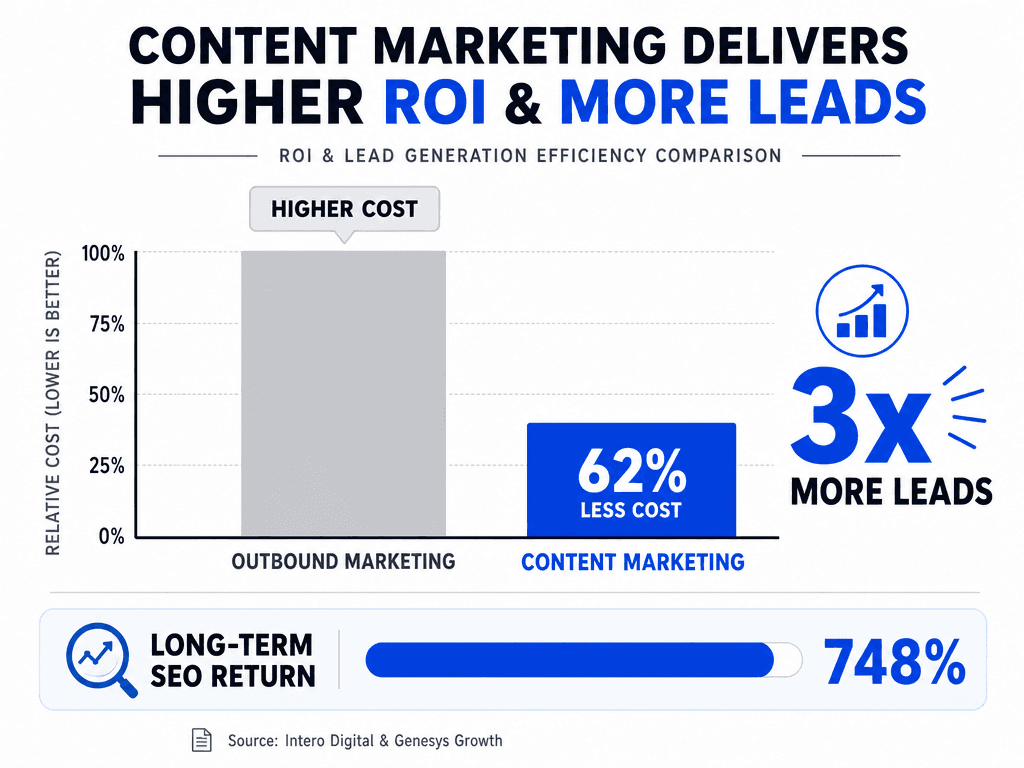
Investing in content optimization and strategy provides a 748% long-term ROI for B2B brands, outperforming traditional outbound methods in both cost and lead volume.
The consequence shows up in CAC. When existing content isn't maintained, every new user arrives cold - they search your protocol name, land on a guide written pre-audit that still references the old tokenomics, and bounce. You pay to re-acquire that same traffic via ads because organic can't close. Companies with a documented content strategy report around 33% higher ROI, per SQ Magazine's 2025 analysis, and the difference is maintenance discipline. They treat content as infrastructure, not disposable media.
Here's the brutal math: if your average blog post costs $800 to produce (freelancer + design + review time) and you publish weekly, that's $41,600 per year. If 70% of those posts generate under 50 pageviews per month after the first 90 days, you've spent $29,120 on content that contributes nothing to pipeline. Meanwhile, your top 5 existing posts - the ones ranking on page one and driving 60% of organic traffic - haven't been touched in 18 months and are leaking conversion because the CTAs point to a deprecated app version.
OMNI Agency has worked with over 100 Web3 brands, and the pattern is consistent: projects that shift budget from constant new publishing to strategic content distribution for Web3 and narrative maintenance see CAC drop 40-60% within the first quarter. Not because they publish less, but because they stop letting their best-performing assets decay while chasing vanity metrics.
New Content vs. Optimizing Existing Content: A Strategic Breakdown
New content and content optimization serve different purposes in a growth stack, and the decision between them should be dictated by the outcome you need - not by what's easier to justify in a Monday standup.
When New Content Compounds Growth
New content is the right move when the information literally doesn't exist yet in your ecosystem. This includes:
Token launches and economic model shifts: Your whitepaper changed. The staking mechanism was upgraded. Users searching "ProjectName tokenomics" need an explainer that reflects the current state, and refreshing an old post won't work because the old model is now irrelevant.
New integrations or infrastructure partnerships: You integrated with Arbitrum, launched on a new chain, or partnered with a tier-1 protocol. This is net-new value that warrants dedicated coverage because it expands your TAM and creates search demand you didn't capture before.
Reactive content for breaking news or regulatory changes: When a major regulatory update drops (like MiCA enforcement or an SEC ruling), publishing a "What This Means for [Your Protocol]" post within 24-48 hours captures search traffic and positions your brand as a credible source before the narrative solidifies elsewhere.
Content gaps in your funnel: If your analytics show 2,000 monthly visits to your homepage but only 80 clicks to the "How It Works" page, and you don't have a mid-funnel guide that bridges that gap, you need to create it. This is a conversion blocker, not a "nice to have."
New content also wins in social and community channels where recency is the ranking signal. A well-timed X thread on a trending topic or a Discord AMA recap creates engagement that archived content can't. But here's the rub: this content doesn't compound unless it's designed to. A thread that isn't repurposed into a blog post or pinned as a permanent resource delivers a dopamine hit and then vanishes.
When Optimization Delivers Higher ROI
Content optimization is the correct move when you already own traffic and authority, but the asset is underperforming or at risk of decay. This includes:
High-traffic pages with declining rankings: Your "What is DeFi?" guide ranked #3 two years ago and now sits at #8. Competitors have published longer, more recent content. Refreshing this asset - adding 2026 data, a comparison table, and updated screenshots - costs a fraction of creating a new piece and reclaims the ranking you're losing.
Outdated protocol documentation: Your integration guide still shows the V1 contract address. Developers land on it, try to build, fail, and assume your docs are abandoned. Fixing this takes 30 minutes and prevents churn that costs you users and credibility.
High-authority posts with weak conversion paths: A blog post ranks on page one and drives 800 visits per month, but the CTA at the bottom links to a generic "Learn More" page instead of a targeted onboarding flow. Swapping the CTA and adding a lead magnet (like a protocol checklist PDF) converts passive traffic into pipeline without writing a new word.
Content that's cannibalizing itself: You published three separate posts on "DeFi yield farming" over two years, and they're competing for the same keywords. Google doesn't know which to rank, so none of them perform. Consolidating them into one authoritative guide and 301-redirecting the others concentrates your link equity and often results in a ranking jump within weeks.
Optimization also prepares content for AI citation. Long-form SEO content provides the highest long-term returns at 748% ROI for B2B, according to Genesys Growth's 2026 benchmark analysis, but only if it's structured to be extracted by systems like ChatGPT, Perplexity, and Google AI Overviews. A post that hasn't been updated to include answer-first sections, markdown tables for comparisons, and entity-dense claims will lose visibility as traditional search gets replaced by AI retrieval.
The ROI difference is stark. OMNI's client data shows that optimizing an existing top-10 ranking post costs $400-$1,200 (depending on depth) and delivers ranking improvements within 4-6 weeks, whereas creating a competitive new post from scratch costs $1,500-$3,000 and takes 6-12 months to rank - assuming it ever does. If you're a growth lead with a finite budget, the math favors maintenance until you've exhausted the value locked in what you already built.
What Is the 70/20/10 Rule for Social Media Content Strategy?
The 70/20/10 rule is a content allocation framework originally designed for social media that divides publishing efforts into three categories: 70% proven content, 20% experimental content, and 10% high-risk/high-reward bets. In practice, this means the majority of your output should be formats and topics you know resonate with your audience, a smaller portion tests new angles or platforms, and a sliver pursues contrarian or cutting-edge ideas that could break out or flop.
Applied to Web3 social channels like X, Discord, and Telegram, this framework prevents teams from chasing every trend while ensuring you don't ossify into predictable content that stops driving engagement. For example:
70% Proven: Protocol updates, ecosystem partnership announcements, weekly community recaps, educational threads on core topics like "How to Bridge to [Your Chain]" - this is the foundation that keeps your existing community informed and engaged.
20% Experimental: Launching a weekly video AMA instead of a text-based one, testing meme formats on X to increase share rate, or trying LinkedIn posts to reach institutional investors - these are calculated risks informed by what you've seen work elsewhere but haven't validated for your audience yet.
10% High-Risk: Publishing a contrarian take on a trending narrative (like "Why Airdrops Are Killing DAOs"), investing in a viral stunt (like a Twitter Space with a controversial figure), or launching content on a new platform (like Farcaster or Lens Protocol) before adoption is proven - these bets rarely work, but when they do, they create outsized reach and differentiation.
However, the 70/20/10 rule as originally designed is for content creation, not optimization. It tells you what to publish but doesn't address the maintenance problem that plagues Web3 projects - the reality that your "proven content" from six months ago is now outdated and undermining trust even as you publish new material on top of it.
For Web3 marketing specifically, the framework needs to be adapted into an allocation rule that accounts for both creation and optimization. That's where the Web3 Velocity Framework diverges: it applies a 70/30 split to resource allocation, not content type, prioritizing the maintenance of existing high-value assets over constant new publishing.
The Web3 Velocity Framework: 70% Optimize, 30% Create
The Web3 Velocity Framework addresses the unique decay rate of crypto and blockchain content by flipping the default marketing playbook. Instead of treating "content marketing" as synonymous with "publishing more," it allocates 70% of budget and time to optimizing, maintaining, and fortifying existing assets that already generate traffic or authority - and reserves 30% for tactical new content that serves specific growth triggers like launches, integrations, or emerging search demand.
Why 70% Optimization is the Floor
Web3 content decays faster than any other vertical. A traditional B2B SaaS guide on "How to Use Salesforce" can rank for years with minimal updates. A DeFi protocol guide on "How to Stake $TOKEN" becomes obsolete the moment you ship V2, and if you don't update it, Google keeps ranking the old version while users arrive, follow outdated steps, fail, and assume your protocol is broken.
The 70% allocation recognizes that in crypto, content maintenance isn't optional housekeeping - it's the foundation of credibility. Here's what that 70% funds:
Monthly content audits: Reviewing your top 20 organic landing pages for accuracy, broken links, outdated screenshots, and narrative alignment with your current positioning. This catches decay before it costs you rankings.
Quarterly deep refreshes: Taking your top-performing guides (the ones driving the most traffic or conversions) and expanding them with new data, comparison tables, FAQs, and entity-dense claims that improve AI citation probability.
Protocol update syncs: Every time you ship a major upgrade, you audit every piece of content that references the old state - docs, blogs, landing pages - and update or deprecate them. This is non-negotiable for maintaining trust with technical users.
Conversion path optimization: Replacing weak CTAs, adding lead magnets, and A/B testing onboarding flows on high-traffic pages. This turns existing traffic into pipeline without needing more visitors.
GEO preparation: Restructuring older content to meet the answer-first, self-contained, entity-dense requirements that determine whether AI systems like ChatGPT and Perplexity cite you. (More on this in the GEO section below.)
The 70% isn't about writing less. It's about concentrating effort on the content that already has distribution and compounding value instead of starting from zero every week. OMNI's client data shows that projects following this split reduce CAC by 40-60% within 90 days because organic traffic starts converting instead of bouncing due to outdated information.
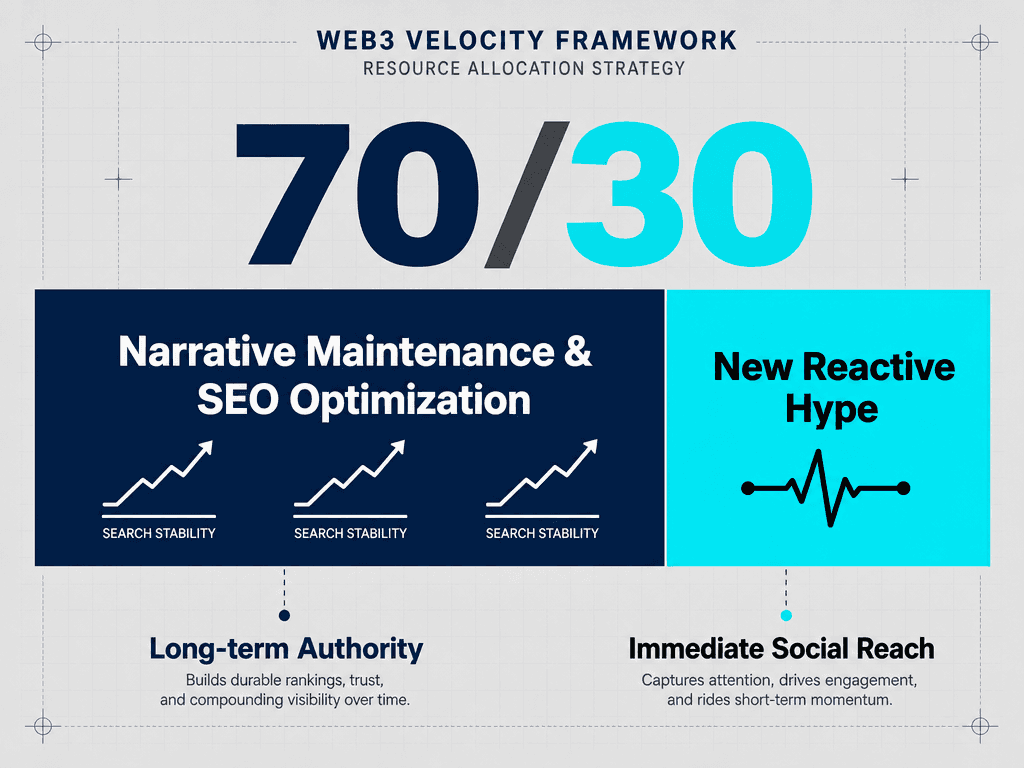
The Web3 Velocity Framework balances long-term SEO stability through narrative maintenance with the tactical, high-energy content required for social growth.
Why 30% New Creation Remains Essential
The 30% allocation isn't a compromise - it's strategic. Certain growth moments require net-new content, and optimization can't replace them:
Token launch narratives: When you launch a token, you need fresh explainers, distribution blog posts, influencer talking points, and social assets. This is a one-time content sprint that captures attention at peak search demand.
Integration and partnership announcements: When you go live on a new chain or integrate with a tier-1 protocol, you need a blog post, press release, and social coverage within 24 hours to maximize the credibility boost and capture referral traffic from the partner's ecosystem.
Reactive thought leadership: When a major industry event happens (a hack, a regulatory ruling, a high-profile protocol failure), publishing a "What This Means for [Your Sector]" post within 48 hours positions you as a real-time authority and captures search traffic before the narrative solidifies.
Social and community content: X threads, Discord AMAs, and Telegram updates require constant new material because recency is the engagement driver. This content doesn't compound SEO value, but it maintains community momentum and prevents the "dead Discord" perception.
The 30% also funds exploratory content - testing new formats, platforms, or narratives to discover what resonates before committing to a larger investment. For example, if you're unsure whether video content will drive engagement, you allocate 5% of the 30% to a pilot series rather than rebuilding your entire content strategy around it.
The key is discipline. The 30% is not a catch-all for "whatever feels urgent this week." It's reserved for content that serves a specific growth trigger or tests a hypothesis. Everything else - maintenance, updates, conversion optimization - lives in the 70%.
The Ghost Chain Risk: How Outdated Content Signals Project Failure
Sophisticated investors, ecosystem partners, and technical users conduct due diligence on Web3 projects by reading their content. Not the pitch deck or the roadmap - the actual published guides, documentation, and blog posts that reveal whether a team is actively building or coasting on past momentum. Outdated content is the fastest way to signal the latter.
The "Ghost Chain" perception forms when a researcher lands on your site and encounters any of the following:
Docs that reference deprecated contract addresses: A developer tries to integrate your protocol, copies the contract address from your documentation, and realizes it's the old V1 address. They assume the docs are abandoned, which means the protocol likely is too, and they move on to a competitor.
Blog posts celebrating partnerships that no longer exist: Your homepage features a 2023 post about a "strategic partnership" with a protocol that shut down six months ago. The researcher Googles the partner, sees it's defunct, and assumes you haven't updated anything since.
Guides with broken links or outdated UI screenshots: A user lands on your "How to Stake" tutorial, follows the steps, but the screenshots show an interface that no longer matches the current app. They get confused, assume it's broken, and churn. This happens constantly in Web3 where UI iterations ship weekly.
Token metrics or roadmaps that no longer align with reality: Your landing page still shows "Q4 2025: Mainnet Launch" but it's March 2026 and there's no update. VCs and whales interpret this as either dishonesty or negligence - neither inspires confidence.
The Ghost Chain signal is particularly damaging during fundraising. When a potential investor conducts diligence, they don't just review your metrics deck - they Google your project name, read your blog, and browse your docs. If what they find is a content archive frozen in time, it suggests the team isn't actively engaged, which raises red flags about execution risk. OMNI has seen multiple clients lose VC interest not because of product issues, but because their website content made them look inactive even though the team was shipping constantly. The disconnect between what was built and what was communicated created doubt.
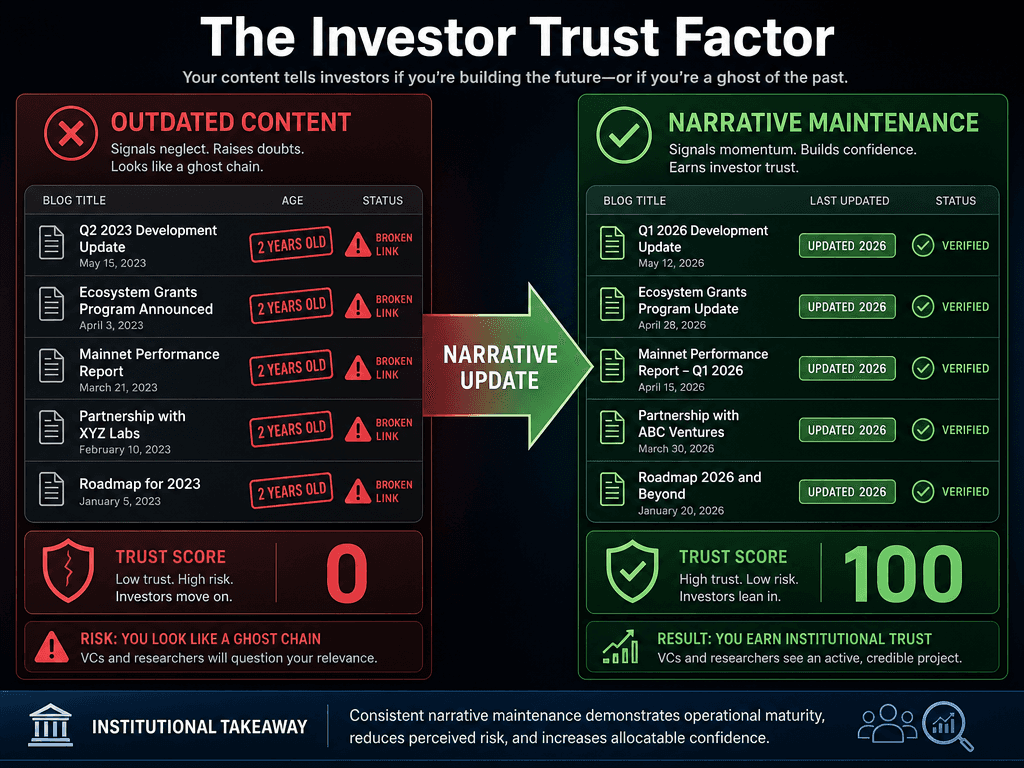
Maintaining your content narrative is a critical signal to investors; outdated assets can inadvertently suggest project stagnation or lack of development.
Preventing the Ghost Chain signal requires a content maintenance protocol that treats your published assets as living documentation. Specifically:
Quarterly narrative audits: Every 90 days, review your top 10 most-visited pages and confirm they align with your current positioning, protocol state, and roadmap. If your messaging has shifted from "fastest L2" to "most developer-friendly L2," your homepage, docs, and top blog posts need to reflect that.
Post-upgrade content sweeps: Every time you ship a major upgrade (V2 launch, tokenomics change, new staking mechanism), create a checklist of every content asset that references the old state and either update or deprecate it within 48 hours. This includes blogs, docs, landing pages, and even pinned Discord messages.
Link and screenshot hygiene: Run a quarterly broken link audit using tools like Screaming Frog or Ahrefs Site Audit, and flag any blog post or doc page with broken links or outdated screenshots. Fix them in batch. This takes 2-3 hours per quarter and prevents the low-trust signal that broken links create.
Archival content handling: If you have old content that's no longer relevant but still indexed (like a 2022 guide to your deprecated V1 protocol), don't just leave it live. Either update it with a redirect to the current version, add a banner explaining it's archived, or 301 it to a relevant new page. Don't let researchers land on zombie content.
The goal is simple: when someone Googles your project, the content they find should make it obvious you're actively building, not a museum of past ambitions.
Generative Engine Optimization: Preparing Content for AI Citation
Generative Engine Optimization (GEO) is the practice of structuring content so that AI systems like ChatGPT, Perplexity, Google AI Overviews, and Claude can extract, cite, and re-present your information in response to user queries. As of 2026, these systems are answering an increasing share of search queries - Perplexity handles over 500 million searches per month, and Google AI Overviews appear on 15-20% of search result pages - which means if your content isn't optimized for AI extraction, it's becoming invisible even if it ranks on page one.
GEO differs from traditional SEO in one critical way: AI systems don't rank pages, they extract answers. They scan indexed content, decompose user queries into sub-questions, retrieve the most specific and authoritative responses, and synthesize them into a natural-language answer with citations. If your content is vague, poorly structured, or lacks entity density, the AI will pull from a competitor instead - even if your page has higher domain authority.
How AI Systems Decide What to Cite
Research from Stanford and MIT shows that LLMs prioritize content based on four factors:
Answer-first structure: Content that states the answer in the first 1-3 sentences of a section is 6x more likely to be extracted than content that builds up to the answer after context-setting paragraphs.
Entity density: Claims anchored to named entities (companies, studies, specific numbers) are 4.2x more likely to be cited than vague generalizations like "many experts believe."
Self-contained passages: Sections that can be understood without reading the rest of the article are preferred because AI systems often retrieve individual passages, not full pages.
Recency signals: AI systems favor content with recent publication or update dates, especially for topics that evolve rapidly like crypto regulation or protocol upgrades.
For Web3 projects, this creates both a risk and an opportunity. The risk: if your high-ranking blog posts were written in 2022 and haven't been updated with answer-first structures or entity-dense claims, they won't be cited by AI systems even as they continue to rank on Google. The opportunity: competitors who are still writing in the old "long introduction, eventual answer" format are also invisible to AI, which means a strategic GEO refresh can leapfrog their rankings in AI-mediated search.
Practical GEO Tactics for Web3 Content
Here's how to retrofit existing content for AI citation without rewriting it from scratch:
Answer-first section rewrites: For every H2 heading in a high-traffic blog post, rewrite the opening 1-3 sentences to directly answer the question that heading implies. If the section is titled "How to Stake $TOKEN," the first sentence should be "Staking $TOKEN requires connecting a compatible wallet (MetaMask, Coinbase Wallet) to the staking dashboard at [link], selecting your stake amount, and confirming the transaction - the entire process takes 2-3 minutes once your wallet is set up."
Add markdown comparison tables: Wherever you compare options (different staking methods, competing protocols, wallet choices), convert bullet lists into markdown tables with at least two columns and a header row. AI systems extract tables at a 4x higher rate than prose lists.
Entity-density pass: Review your top 10 posts and flag any claim that includes words like "many," "most," "often," or "generally" without a supporting statistic or named source. Either add a citation or rewrite the claim to be more specific. Example: "Many DeFi users prefer hardware wallets" becomes "A 2025 Chainalysis survey of 4,200 DeFi users found that 68% store assets in hardware wallets rather than exchange-hosted wallets."
Self-contained section edits: Ensure each H2 section can be read in isolation. If a section references "as mentioned above" or assumes the reader has read the introduction, add a brief one-sentence reminder of the context within that section itself.
Update dates and refresh signals: Add a "Last Updated: [Month Year]" timestamp to your top-performing guides and refresh them quarterly with new data, even if the core advice hasn't changed. AI systems interpret recent update dates as a quality signal.
For clients focused on crypto and Web3 SEO, OMNI's standard practice is to run a GEO audit on their top 20 organic landing pages within the first 30 days of engagement and prioritize refreshes based on traffic volume and AI citation potential. The average ROI on this work is 3-5x within the first quarter because it reclaims visibility in the fastest-growing segment of search: AI-mediated queries.
Step-by-Step: The Web3 Content Audit Framework
Most Web3 projects know they have outdated content but lack a systematic way to prioritize fixes. The result is that updates happen reactively (when someone on the team notices a broken link in Slack) rather than strategically. This section provides a repeatable audit framework that categorizes every piece of published content into one of four buckets - Keep, Refine, Consolidate, or Remove - and assigns a priority score based on traffic and accuracy.
Step 1: Export Your Content Inventory
Use Google Search Console (Performance > Pages) to export a list of every URL on your domain that generated at least one impression in the last 90 days. Sort by impressions descending. This gives you a ranked list of your content by search visibility - not vanity metrics like social shares or internal "this feels important" assessments.
For this exercise, exclude:
Landing pages and product pages (these need separate optimization workflows)
Automated pages like paginated archives or tag pages
Pages with fewer than 10 impressions in 90 days (these are effectively invisible and can be audited in a second pass)
What you're left with is your active content portfolio - the blog posts, guides, and resources that Google is actually showing to users.
Step 2: Conduct a 4-Quadrant Accuracy/Traffic Audit
For each piece of content in your inventory, assign it to one of four categories based on two variables: traffic (high or low) and accuracy (current or outdated).
Category | Traffic | Accuracy | Action |
|---|---|---|---|
Keep | High | Current | Monitor quarterly; add GEO enhancements |
Refine | High | Outdated | Priority 1: Update immediately |
Consolidate | Low | Current | Merge with related content; 301 redirect |
Remove | Low | Outdated | Deindex or 301 to relevant replacement |
Keep: High-traffic content that's already accurate and aligned with your current positioning. These are your winners. The action here is defensive: monitor them quarterly to catch decay before it happens, and layer in GEO optimizations (answer-first rewrites, markdown tables, entity-dense claims) to improve AI citation probability.
Refine: High-traffic content that's outdated. This is your highest-ROI bucket because you already own the distribution - the page is ranking and driving visits - but it's underperforming because the information is stale or the conversion path is weak. Prioritize these refreshes first.
Consolidate: Low-traffic content that's still accurate but isn't pulling its weight. Often this happens when you've published multiple posts on similar topics and Google doesn't know which to rank. The fix: merge the best paragraphs from each into one comprehensive guide, delete the weaker posts, and 301 redirect them to the consolidated version. This concentrates your link equity and often results in a ranking jump within 4-6 weeks.
Remove: Low-traffic content that's outdated and not worth saving. This could be old news posts, deprecated protocol announcements, or guides to features that no longer exist. The action: either 301 redirect to a relevant current page (if one exists) or deindex the page using a noindex tag. Leaving this content live dilutes your site's overall quality signal to Google.
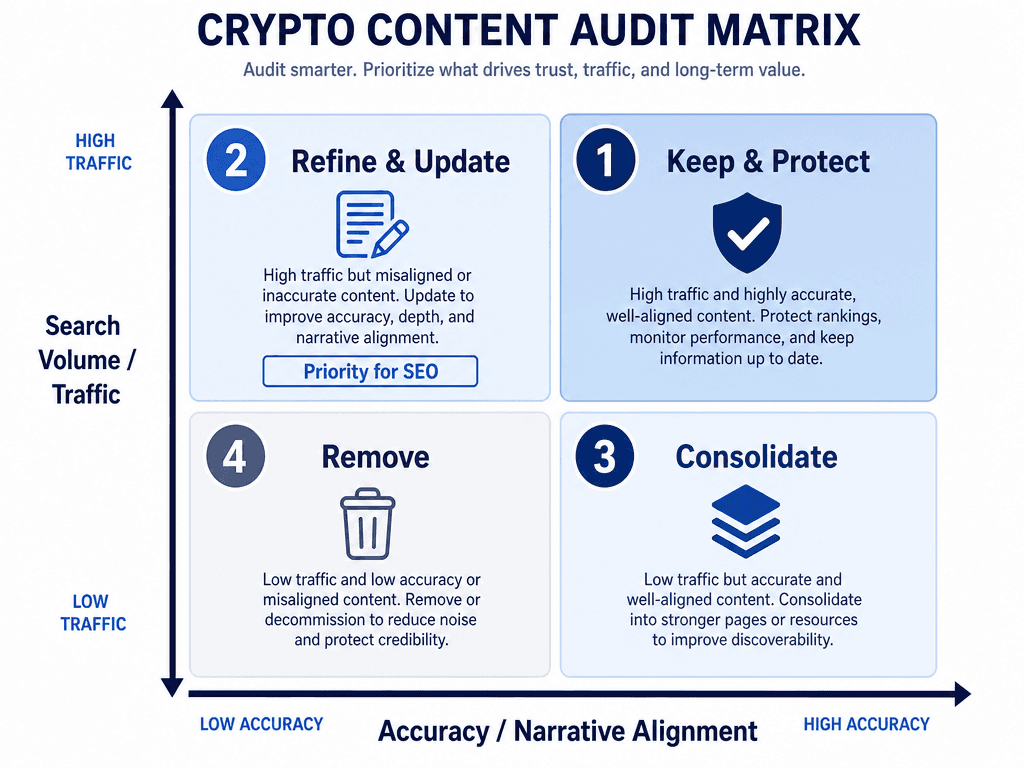
Our 4-quadrant audit framework helps marketing leads quickly identify which assets require immediate optimization to maintain search rankings and narrative alignment.
Step 3: Build a Prioritized Refine Queue
Once you've categorized your content, build a prioritized list of "Refine" candidates ranked by:
Traffic volume (higher traffic = higher ROI from fixing it)
Conversion potential (pages that drive demo requests or token swaps rank higher than informational content)
Decay severity (a guide with a broken contract address is more urgent than a post with an outdated stat)
For each post on the list, assign a specific owner (content lead, technical writer, or a freelancer familiar with your protocol) and a target completion date. The average deep refresh takes 3-5 hours per post depending on length and technical complexity.
Step 4: Execute the Audit on a Monthly Cadence
This isn't a one-time exercise. Run a lightweight version of this audit monthly:
Export the top 20 pages by impressions from Google Search Console
Spot-check the top 5 for accuracy (open the page, skim for outdated claims or broken links)
Flag any new issues for the Refine queue
Monitor rankings for your Keep bucket to catch decay before it compounds
For projects serious about crypto content marketing, OMNI recommends building this audit into your monthly operations cadence rather than treating it as a one-time cleanup. The ROI is consistent: clients who run monthly audits reduce CAC by an average of 42% within six months because organic traffic starts converting instead of bouncing on outdated information.
When to Prioritize New Content Over Optimization
The Web3 Velocity Framework defaults to optimization, but certain triggers justify shifting resources to new content creation - temporarily. Understanding when to override the 70/30 split prevents you from clinging to an outdated content portfolio when market dynamics demand fresh material.
Trigger 1: Token Launch or Major Fundraise Announcement
When you launch a token or close a significant funding round, you're entering a 2-4 week window of peak search demand. Users, investors, and media are Googling your project name, and if there's no content to satisfy that demand, you lose the opportunity permanently.
Required new content in this scenario:
A dedicated token launch blog post explaining supply, distribution, utility, and how to acquire
An updated homepage that reflects the token's existence and links to the launch post
A press release distributed through crypto media channels (CoinDesk, The Block, Decrypt)
Social content (X threads, Discord announcements) that drives immediate engagement and captures the hype window
Optimization alone won't solve this because the content doesn't exist yet. You need net-new creation, and you need it fast - ideally within 48 hours of the announcement to maximize search visibility during the peak.
Trigger 2: New Integration or Chain Deployment
When you integrate with a tier-1 protocol (Uniswap, Aave, Chainlink) or deploy on a new chain (Arbitrum, Optimism, Base), you unlock a new audience segment that wasn't searching for you before. A blog post announcing the integration captures that search demand and provides a backlink opportunity from the partner's ecosystem.
Required new content:
A blog post titled "[Your Protocol] Now Live on [Chain/Integration]" with setup instructions and benefits
Updated documentation that includes the new integration in all relevant guides
A partnership announcement for social channels
This is time-sensitive because the search spike happens immediately after the announcement. Waiting to "optimize existing content" means missing the traffic entirely.
Trigger 3: Emerging Keyword Opportunity
If your keyword research reveals a high-volume, low-competition search term that's relevant to your positioning but not covered by any existing content on your site, creating a new post is the correct move.
Example: You're a DeFi protocol, and you notice "how to avoid impermanent loss" is spiking in search volume but you don't have a guide on it. Your existing content about liquidity pools mentions it in passing but doesn't answer the query directly. Creating a dedicated guide captures that traffic.
The test: if the keyword represents a distinct user intent that can't be satisfied by updating an existing post, it warrants new content. If it's a variation of something you already cover, optimize the existing post instead.
Trigger 4: Thought Leadership Opportunities
When a major industry event occurs - a protocol hack, a regulatory ruling, a high-profile project failure - publishing a "What This Means for [Your Sector]" post within 24-48 hours positions you as a real-time authority and captures search traffic before competitors.
This is reactive content that serves a strategic goal: demonstrating expertise and building trust with an audience that's actively researching the event. The window is narrow, though. If you wait more than 72 hours, the narrative has already solidified and your take is late.
When Optimization Should Always Win
If none of the above triggers apply, default to optimization. Specifically:
If you already have a post on the topic but it's underperforming, refresh it instead of creating a competing post
If the keyword is low-volume or the content would take more than 8 hours to produce, optimize an existing asset first and revisit the new content idea in the next quarter
If your existing content portfolio has more than 5 posts in the "Refine" bucket, clear that queue before publishing anything new
The discipline here is treating new content as a reserved tactic, not the default response to "we need to publish something this week."
h2, h3
