
61
Published
June 2026
Updated
July 2026
Discord Channel Ideas: Web3 Growth & Security (2026)

OMNI Agency Team
Founder & Owner of OMNI
Introduction
Discord has become an important platform for Web3 projects, but many founders struggle with server architecture that can lead to user attrition and security vulnerabilities. Your server structure can influence community retention, governance participation, and protocol adoption.
This guide covers considerations for structuring your Discord server across the full project lifecycle, from stealth mode through token launch and beyond. You'll learn how to organize channels by vertical (DeFi, DePIN, AI, Gaming), address common security challenges in public servers, and balance the needs of builders, traders, and end users under one roof.
Table of Contents
Why Discord Channel Architecture Matters for Web3 Projects
The Foundation: Security-First Architecture
Strategic Channel Clusters by Project Type
Community Engagement Mechanics for Growth
Implementation Checklist: Scaling from Alpha to Mainnet
What is the 13 rule on Discord?
How to organize channels in a Discord server?
Frequently Asked Questions
Why Discord Channel Architecture Matters for Web3 Projects
Your Discord structure may influence how visitors perceive your project maturity. A bloated server with 50 low-activity channels can signal disorganization. A locked-down fortress with no clear entry point can frustrate genuine users. Finding the middle ground requires understanding that channel architecture serves three distinct functions: security gating, user segmentation, and lifecycle management.
Security is important because public Discord servers face persistent threats. Drainer bots, impersonation scams, and phishing links remain common challenges in open channels. Many projects have moved toward role-gated, verification-first models to address these concerns. Projects that maintained wide-open #general channels have experienced user trust issues as scam complaints accumulated.
Segmentation matters because Web3 communities contain fundamentally different stakeholder groups with conflicting needs. DeFi protocols must serve yield farmers hunting alpha, developers debugging smart contracts, and governance participants debating proposals. Treating these audiences as a monolith through generic channels can create noise. Proper segmentation lets each group find signal without wading through irrelevant chatter.
Lifecycle awareness can help prevent premature scaling. Discord servers may benefit from different architectures at different maturity stages. A pre-launch project with seven tight channels focused on builders may see more focused discussion than a server with 40 empty categories optimistically labeled for features that don't exist yet. Knowing when to add channels and when to archive them can help keep your community aligned with your actual product development stage.
Standing out requires deliberate design choices rather than copying the first template you find. The channel ideas that follow address common operational challenges across Web3 verticals rather than offering generic names you could apply to any project.
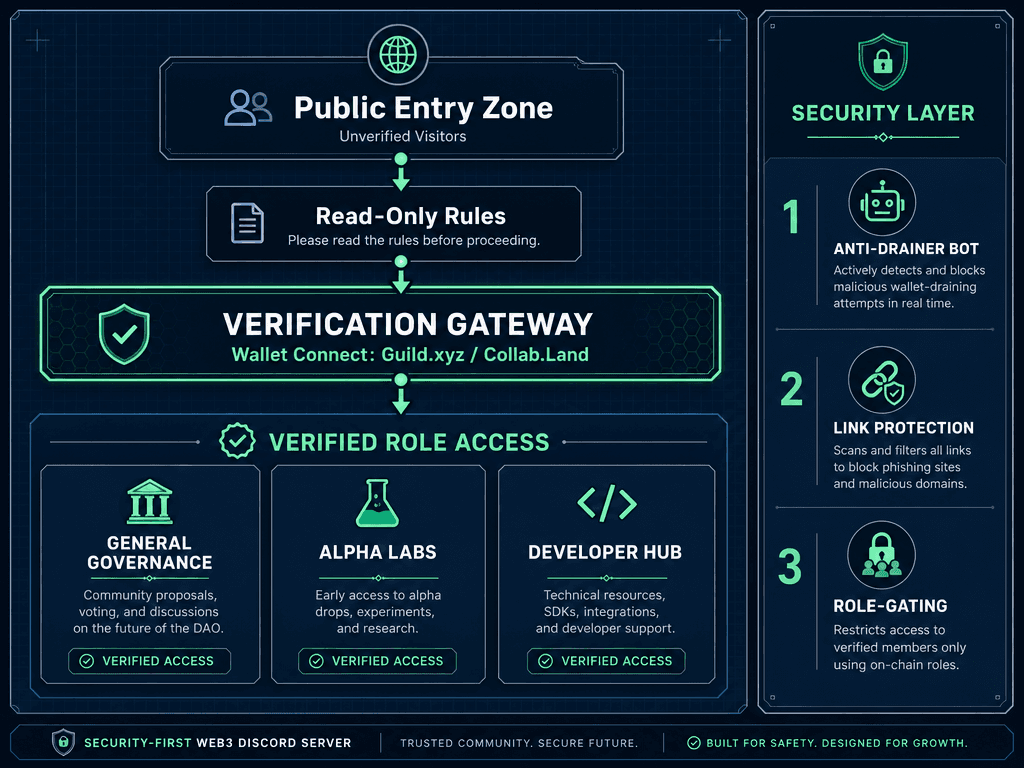
Establish a security-first foundation by using role-gated verification hubs to protect your Web3 community from bot spam and common drainer scams.
The Foundation: Security-First Architecture
Every Web3 Discord needs a verification layer before users access community channels. This addresses the difference between a functional community and a scam-filled environment that loses members.
The Verification Hub
Start with a read-only landing zone containing three elements: welcome message with clear instructions, rules channel outlining acceptable behavior and scam warnings, and verification channel where users connect their wallet or complete CAPTCHA challenges. Tools like Guild.xyz and Collab.Land automate this process by granting roles based on token holdings, NFT ownership, or simple proof-of-humanity checks.
The verification flow should balance convenience for legitimate users with friction for bots. Requiring users to click through multiple reaction roles or answer questions about your project can filter automated attacks. Once verified, users receive a role that unlocks the rest of your server.
Role-Gated Channel Access
Consider making your primary discussion channels visible only after verification. This means your actual #general, #announcements, and project-specific channels would only appear after someone passes the verification gate. Role-gating can make mass attacks harder to execute at scale.
Structure your roles to reflect engagement tiers and access levels. A basic "Verified" role unlocks standard channels. An "Active Member" role earned through time and message count grants access to alpha channels. A "Node Operator" or "LP Provider" role verified through on-chain holdings opens technical support channels. This creates natural progression while maintaining security boundaries.
Admin and Monitoring Layers
Create private admin channels invisible to regular members. These serve as your command center for coordinating moderation actions, tracking on-chain protocol health, and responding to emergencies. Essential admin channels include mod-only chat for discussing community issues, alert feeds pulling data from on-chain monitoring tools, and incident response for coordinating during security events or major announcements.
Automated monitoring bots can post to these channels when specific conditions trigger: large token movements, unusual trading volume, smart contract interactions, or spikes in support ticket volume. This gives your team situational awareness without requiring constant manual checks. For protocols with serious security requirements, consider integrating tools that track wallet addresses attempting to join your server and flag those associated with previous exploits.
Strategic Channel Clusters by Project Type
Generic Discord templates may not address the technical and operational realities of specific Web3 verticals. A DeFi protocol needs fundamentally different communication infrastructure than a play-to-earn game or DePIN network. These clusters reflect channel architectures that can support different project types.
DeFi Protocols: Governance and Risk Management
DeFi communities often revolve around financial decisions requiring transparency and structured discussion. Your channel architecture can support informed participation.
Create a #governance-proposals channel linked directly to your Snapshot or Tally space. Each proposal gets its own thread where community members can debate specifics without cluttering the main feed. Pin active votes and archive completed proposals to maintain signal. This channel should be read-only except for proposal authors, with all discussion happening in threads.
Add a #risk-analysis channel where community members share due diligence on protocol mechanics, smart contract audits, and DeFi strategy risks. This becomes particularly valuable for protocols with complex yield strategies or leverage mechanisms. Users naturally want to understand what they're exposing their capital to, and consolidating technical risk discussion in one place may help reduce support burden.
Include #yield-strategies for community-led alpha sharing. Users who've found optimal compounding paths or arbitrage opportunities can share them here, creating organic content that keeps engagement high between major protocol updates. This channel often generates significant daily activity in mature DeFi communities because users have real money at stake and want to optimize returns.
A #liquidity-mining or #rewards-tracking channel with bot integration displays current APYs, emissions schedules, and claimable rewards. This reduces repetitive "wen rewards" questions while giving users a persistent reference for program mechanics.
For a complete DeFi marketing approach that aligns your Discord strategy with broader protocol growth, explore proven DeFi marketing tactics that increase total value locked and governance participation.
DePIN & Infrastructure: Technical Operations
Decentralized physical infrastructure networks need channels that support hardware troubleshooting, geographic coordination, and real-time network health monitoring. These are operationally intensive communities where information quality directly impacts network performance.
Create a #node-operator-support channel segmented by hardware type if your network supports multiple specifications. Users running different setups face different issues; mixing them can create confusion. Consider separate threads or channels for Raspberry Pi operators, enterprise server deployments, and custom hardware builds. Each segment benefits from focused troubleshooting without noise from irrelevant configurations.
Add #geo-coordination channels when network topology or coverage matters to your protocol. For projects where node placement impacts service quality, users may need to coordinate on coverage gaps, regional partnerships, and geographic redundancy. This might mean region-specific channels for North America, Europe, Asia-Pacific, and other zones where your network operates.
Include #latency-benchmarks and #network-metrics where operators share performance data. This creates transparency around network health while helping operators optimize their own setups by comparing against peers. Bot integration can post aggregated metrics automatically, turning this into a living dashboard that demonstrates network growth to potential new operators.
A #hardware-marketplace facilitates peer-to-peer equipment sales and coordination on group buys for compatible components. DePIN operators frequently upgrade or help new participants source gear; giving them a dedicated space keeps this valuable activity within your community rather than scattering across external forums.
Learn how infrastructure projects attract and retain node operators through targeted Web3 user acquisition strategies that reduce churn and improve unit economics.
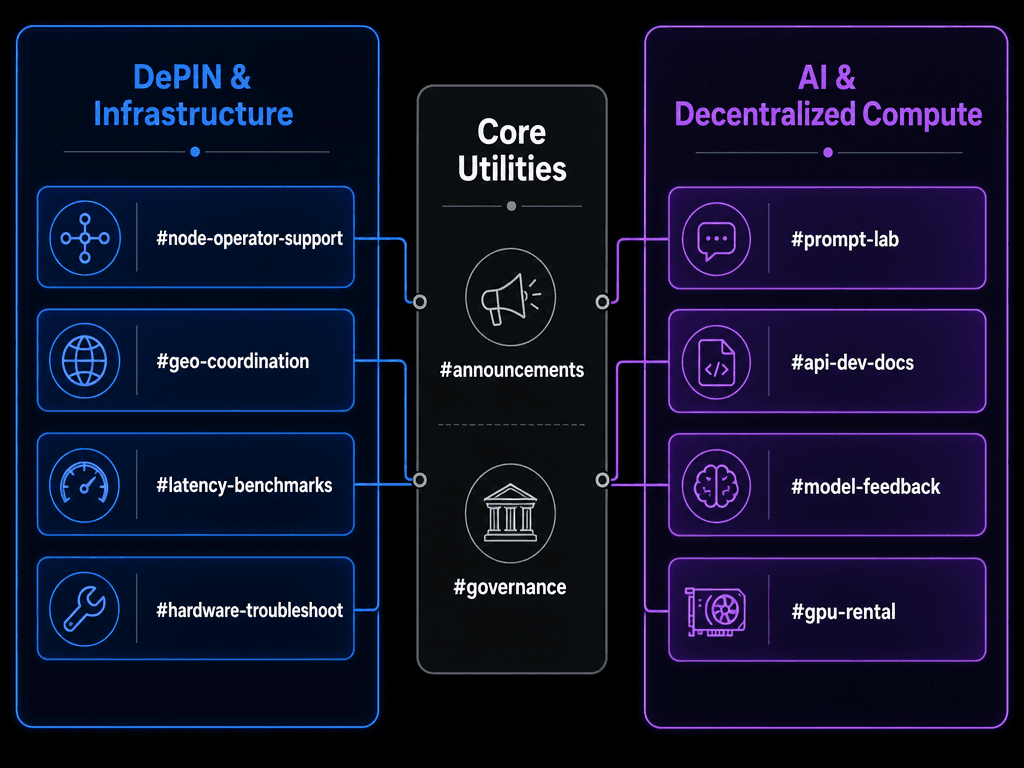
Customize your server architecture with niche-specific clusters that cater to the unique technical requirements of node operators or AI developers.
AI & Decentralized Compute: Development and Experimentation
AI protocols attract developers who want to test models, share prompts, and compare outputs. Your Discord can function as a collaborative laboratory where technical users can iterate quickly.
Create a #prompt-lab where users showcase AI outputs and share effective prompts. This becomes particularly valuable for image generation, LLM fine-tuning, or other creative applications where the community wants to see what's possible. Pin exceptional examples and consider running regular contests that reward standout submissions with recognition or token rewards.
Add #api-dev-docs as a persistent technical reference channel where your team posts code examples, SDK updates, and integration guides. This should be low-traffic and highly organized, functioning more like a constantly updated documentation hub than a discussion channel. Pair it with a separate #developer-support channel where users can ask implementation questions without cluttering the reference material.
Include #model-feedback for users testing different AI models or compute configurations on your network. This creates a feedback loop between your development team and power users while helping new participants understand capabilities and limitations. Users can share benchmark results, cost comparisons, and use case recommendations.
A #compute-marketplace connects users who need processing power with operators providing it. For networks with dynamic resource allocation, this channel can facilitate direct coordination that supplements automated matching systems.
Web3 Gaming: Community and Competition
Gaming communities thrive on social competition and shared experiences. Your channel structure can support guilds, showcase achievements, and create spaces for organic team formation.
Create a #loot-brag channel with bot integration that automatically posts on-chain drops, rare item acquisitions, and achievement unlocks. This provides constant social proof of active gameplay while giving players a place to celebrate wins. Automate as much of this as possible so players don't have to manually screenshot and post; the game client or smart contract monitoring should feed directly into Discord.
Add #guild-war-rooms as private, role-gated channels for competitive teams. These give organized groups coordination space without exposing strategy to rivals. Structure these carefully with clear membership criteria and periodic activity requirements to prevent channel sprawl from inactive guilds cluttering your server.
Include #bug-bounty where players report exploits, glitches, or balance issues. This becomes critical quality assurance infrastructure if you incentivize participation with token rewards for verified reports. Clear reporting templates and a transparent triage process show you're serious about game quality while channeling player frustration into productive feedback.
A #lfg-looking-for-group channel helps solo players find teammates for cooperative content. This often becomes one of the most active channels in gaming Discords because it directly enables gameplay. Consider bot integration that lets users tag their preferences, availability, and skill level to make matchmaking more efficient.
Establish clear processes for crypto community management that keep gaming communities engaged across the full player lifecycle.
Community Engagement Mechanics for Growth
Channel architecture alone doesn't create an engaged community. You need deliberate engagement mechanics that give members reasons to return daily and progress through participation tiers. These channels can support growth, retention, and long-term value creation beyond speculation.
Founder Office Hours and Direct Access
Create a #founder-ama channel for scheduled question and answer sessions. This can be text-based or paired with voice channels for live discussion. The key is consistency: weekly or biweekly scheduled sessions where community members know they can get direct responses from leadership can build trust.
Document these sessions thoroughly. Either pin key answers in the channel or maintain a separate #ama-archive where important responses get permanently saved. This creates a searchable knowledge base while demonstrating transparency over time.
Add a #suggestion-box where community members can propose features, partnerships, or improvements. This should be actively triaged; a suggestion box that never sees implementation feedback can become inactive. Weekly or monthly responses showing which suggestions are being considered, which are out of scope, and which have been added to the roadmap can maintain community investment in the channel.
The Professional Ecosystem Hub
Web3 projects exist within broader ecosystems where professional connections carry value. Create channels that support this dimension of community value.
A #job-board where ecosystem projects and community members post opportunities serves the dual purpose of helping your community monetarily while keeping talented people engaged with your ecosystem even if they're not currently core team members. This works particularly well for protocols with strong developer communities who move between projects but maintain connection to your network.
Add #partner-news for announcing integrations, collaborations, and ecosystem developments. This should be announcement-only from your team, keeping signal high. It demonstrates ecosystem growth and creates natural conversation starters as community members discuss new partnerships in related channels.
Include #networking for open-ended professional connections. This looser channel lets community members share their backgrounds, offer services, or seek collaborators on side projects. It often produces unexpected value as community members discover overlapping interests or complementary skills.
Alpha and Beta Testing Channels
Create a private #insider-lab or #alpha-testers channel role-gated for early adopters or token holders above certain thresholds. This space gives your most engaged users early access to features, direct input on product direction, and recognition for their investment. The exclusivity can motivate participation while the early access may make members feel like insiders rather than customers.
Structure testing windows with clear expectations: what you're testing, what feedback you need, and what timeline you're working within. Vague "try this and tell us what you think" requests can produce scattered feedback. Specific questions about user flows, performance, or feature priority can generate more actionable insights.
Reward participation visibly. Alpha testers who provide quality feedback could earn recognition through special roles, token airdrops, or public acknowledgment. This can create a feedback loop where contributing meaningfully to product development carries social status within the community.
Understanding broader engagement patterns helps refine your approach; see how leading projects measure Web3 community engagement metrics to improve retention and participation.
Implementation Checklist: Scaling from Alpha to Mainnet
Discord architecture should evolve with your project rather than remain static from day one. These phases reflect how channel needs may change as you move from stealth building through token launch and into sustained operations.
Phase 1: The Stealth and Alpha Stage
Keep your initial server tight with fewer than ten channels. At this stage you're primarily coordinating with early builders, investors, and advisors. Your focus should be depth of engagement with a small group rather than breadth.
Essential channels for this phase include:
#announcements (read-only updates from the core team)
#general-chat (open discussion for verified members)
#technical-discussion (for developers and technical contributors)
#feedback (structured input on what you're building)
#resources (documentation, links, important references)
This structure keeps everyone aligned without overwhelming participants who are already taking a risk on an unproven project. You want concentrated attention and high-context discussion, which can happen in a limited channel set where every message feels important.
Maintain strict verification requirements even at small scale. Building good security habits from day one prevents having to retrofit protection later when scammers start targeting you. The inconvenience for early members is minimal compared to the protection this provides.
Phase 2: The Launch and Token Generation Event Stage
Expand deliberately as you open to the public and launch your token. This is when channel count typically doubles or triples to accommodate the influx of new users with varying interests and technical backgrounds.
Add channels that segment your growing audience:
#price-discussion (quarantine speculation away from technical channels)
#trading-strategies (for users focused on token mechanics rather than protocol use)
#support (clear triage for common questions)
#media-announcements (for press, partnerships, exchange listings)
You may also need dedicated channels for specific launch mechanics: #token-claim for distribution instructions, #liquidity-mining for yield farming details, #staking-guide for token utility, etc. These serve as persistent references that can reduce repetitive questions during the launch period.
Moderation needs typically increase at this phase. What worked with 200 engaged builders may face challenges with 2,000 new members who don't understand your culture or security practices. Scale your mod team, implement clear rules enforcement, and consider automated moderation bots that filter spam and scam links before human mods even see them.
Coordinate your launch across multiple channels; here's how to build a comprehensive crypto marketing strategy that aligns Discord growth with broader token launch success.
Phase 3: Post-Launch Retention and Governance
After launch momentum fades, many projects watch their Discords lose activity as speculators move on to the next opportunity. Preventing this may require shifting your channel architecture toward long-term utility and governance participation.
Archive channels that served launch purposes but no longer drive meaningful engagement. Channels like #countdown-to-tge or #airdrop-announcements can become low-activity spaces. Clean them out or move them to an archive category that new members don't see when they first join.
Emphasize governance and protocol development channels:
#governance-discussion (for proposal debate and DAO operations)
#research-and-development (sharing protocol improvements and academic work)
#ecosystem-growth (partnerships and integrations that expand utility)
#community-initiatives (member-led projects and working groups)
This shift signals maturity and gives long-term holders reasons to stay engaged beyond price speculation. Communities that successfully navigate this transition can build sustainable engagement that survives bear markets and token price volatility.
Consider regular channel audits where you review message volume and merge or archive low-traffic spaces. A dozen active channels can create a more positive impression than 40 inactive ones. Quality of discussion matters once you've achieved product-market fit.
Manage your community lifecycle by scaling your channel architecture from a tight-knit builder group to a fully decentralized governance model.
What is the 13 rule on Discord?
The "13 rule" refers to Discord's minimum age requirement. The platform requires all users to be at least 13 years old to comply with the Children's Online Privacy Protection Act (COPPA) in the United States and similar regulations globally. This isn't a community-specific guideline; it's a platform-wide legal requirement enforced through Discord's Terms of Service.
For Web3 projects, this matters primarily from a compliance perspective. If your server deals with financial products, token sales, or investment discussions, you likely have additional age restrictions beyond Discord's baseline. Many jurisdictions require users to be 18 or older to participate in securities offerings or speculative financial products. Your server rules should explicitly state these requirements and your verification process should ideally confirm age eligibility before granting access to financial channels.
Discord actively enforces this through automated systems and user reports. If a server is found to knowingly allow underage users, the entire server can be shut down and administrators can face account termination. For projects operating in regulated spaces, the risk extends beyond Discord penalties to potential legal liability for allowing minors to participate in token sales or receive investment advice.
Implement age verification as part of your wallet-connect or role-gating process if your project involves financial products. While this creates additional friction, it protects both your community and your project from regulatory complications.
How to organize channels in a Discord server?
Organize channels by function and audience, not by enthusiasm or future plans. Start with broad categories that group related channels, then create individual channels only when there's clear, demonstrated need for segmentation.
Effective Discord organization follows this hierarchy:
Core categories visible to all verified members include:
Information (announcements, rules, resources)
General Discussion (community chat, introductions)
Support (help desk, FAQs, troubleshooting)
Function-specific categories segment by user type:
Development (technical discussion, API support, bug reports)
Governance (proposals, voting, DAO operations)
Trading and Markets (price discussion, strategies, market analysis)
Special access categories require earned or verified roles:
Node Operators (setup guides, performance optimization)
Token Holders (exclusive alpha, early access)
Contributors (working groups, bounty coordination)
Within each category, individual channels should serve clear, non-overlapping purposes. If you're not sure whether a topic deserves its own channel, create a thread in an existing channel first and promote it only if discussion volume justifies separation.
Use clear, specific channel names that immediately communicate purpose. #general-discussion works better than #chat. #smart-contract-audits beats #security. #latency-benchmarks is clearer than #performance. Avoid cute names or inside jokes that confuse new members trying to find where their question belongs.
Implement channel descriptions that appear when users expand the info panel. These should explain what belongs in each channel, what doesn't, and link to related resources. This small detail can reduce off-topic posting and help new members navigate your community structure.
Order channels by importance and frequency of use. Your most active channels should sit at the top of their category where members see them first. Archive or hide channels with low activity rather than letting them clutter the visible server structure. A streamlined visible channel list may make your community feel more organized than a sprawling structure filled with low-activity channels.
For communities managing complex Web3 operations, implementing robust crypto community management practices can support channel organization.
h2, h3
