
63
Published
July 2026
Updated
July 2026
Web3 Influencer Marketing for DeFi: The 2026 Campaign Planning Blueprint

Tyler Mullins
Founder & Owner of OMNI
Introduction
Most DeFi protocols fail influencer campaigns not because they picked the wrong KOLs - they failed because they treated a high-friction financial decision like a lifestyle brand awareness play. A follower liking a fitness post will never behave like a user connecting their wallet and depositing $5,000 into a liquidity pool. The first requires attention. The second requires trust, technical understanding, and conviction that the protocol won't rug.
That gap - between impression and on-chain action - is where most DeFi influencer budgets evaporate. By the time most founders realize influencer views don't automatically translate to TVL (Total Value Locked), they've burned 60% of their marketing allocation on engagement metrics that mean nothing to their CFO. The 2026 reality is even harsher: with MiCA enforcement in the EU, FCA scrutiny in the UK, and 73% of brands now favoring micro-creators over celebrity KOLs, generic "crypto influencer" strategies are dead on arrival.
What follows is the complete operational framework - how to plan, execute, and measure DeFi influencer campaigns that move the only metric that matters: verified users taking on-chain actions. This isn't theory. It's built on five years of execution across 100+ Web3 launches, including protocols that scaled from zero to nine-figure TVL.
Key Takeaways
DeFi influencer marketing requires a "trust funnel" approach where conversion happens at wallet connection and liquidity deposit, not at awareness or engagement.
The 2026 regulatory landscape under MiCA, FCA, and SEC guidelines mandates transparent financial promotion disclosures and restricts high-promise-low-substance campaigns.
Micro-creators (10K-100K followers) deliver a cost-per-engagement of $0.20 versus $0.33 for macro-creators, with higher trust signals in technical DeFi content.
On-chain attribution tracking via smart contract event monitoring is the only way to prove true ROI, moving beyond vanity metrics like likes and impressions.
YouTube educational walkthroughs convert 4-8x better than X/Twitter threads for DeFi protocols because they demonstrate actual product usage and reduce perceived complexity.
The global influencer marketing industry reached $32.55 billion in 2026, with brands earning an average ROI of $5.78 for every $1 spent - but only when campaigns target verified user acquisition, not awareness.
Table of Contents
Why DeFi Influencer Marketing is a "Trust Funnel," Not a Popularity Contest
The 5-Step Campaign Planning Framework
How to Plan an Influencer Campaign (The DeFi-Specific Version)
Platform Breakdown: Where DeFi Liquidity Lives
Measuring What Matters: ROI in the DeFi Context
Closing the Connect-to-Deposit Gap: Converting Viewers into Protocol Users
What is a DeFi Marketing Strategy (And Why Influencer is Just One Layer)
Why OMNI Agency is the Full-Service Alternative to Fragmented Strategy
Frequently Asked Questions
Why DeFi Influencer Marketing is a "Trust Funnel," Not a Popularity Contest
DeFi influencer marketing functions as a multi-stage trust funnel where the goal is not reach but risk mitigation in the mind of the user. Unlike consumer product campaigns where the conversion event is a $30 purchase on Amazon, DeFi conversions require users to connect a non-custodial wallet, sign a smart contract interaction, and deposit capital into a protocol they've known for less than 48 hours. Each of those steps carries technical friction and perceived financial risk that generic "viral" content cannot overcome.
Research from Binance in 2024 showed DeFi Total Value Locked increased 75.1% in early 2024, rising from $54.2 billion to $94.9 billion - but that growth concentrated in protocols that demonstrated technical credibility through educational content and third-party security audits, not meme-driven awareness plays. The difference between a successful DeFi influencer campaign and a failed one is this: successful campaigns build technical trust at every stage, from initial exposure to final deposit. Failed campaigns optimize for eyeballs and wonder why no one connects their wallet.
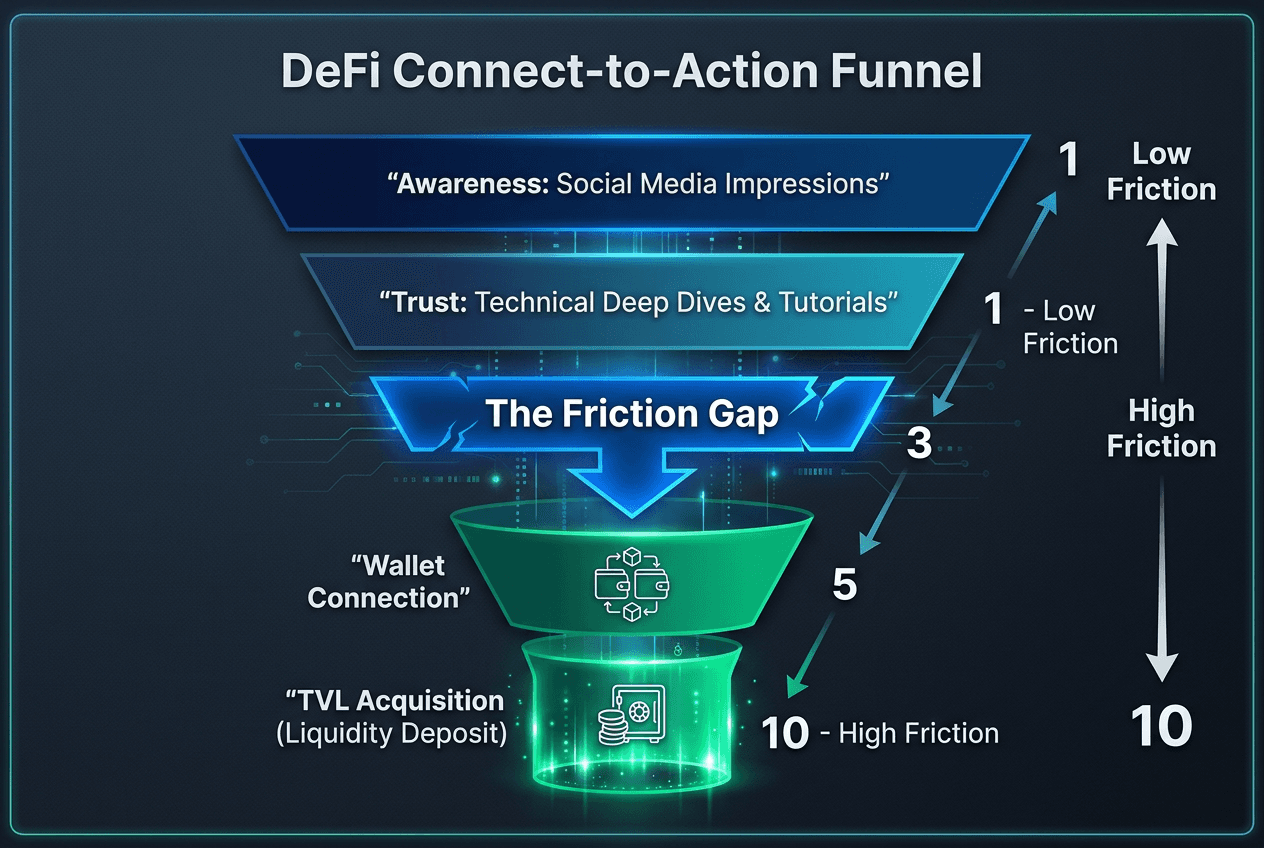
This DeFi-specific trust funnel highlights the high-friction journey from initial awareness to on-chain liquidity deposits, emphasizing where most generic campaigns fail to convert.
The trust funnel for DeFi breaks into four conversion gates:
Awareness Layer - User discovers the protocol exists (social posts, videos, podcasts).
Technical Credibility Layer - User verifies the protocol is legitimate and technically sound (educational walkthroughs, audit mentions, developer explainers).
Wallet Connection Gate - User takes the first on-chain action, connecting their wallet to the protocol's dApp interface.
Capital Deployment Gate - User deposits liquidity, stakes tokens, or executes a swap.
Generic influencer campaigns stop at layer one. Effective DeFi campaigns architect content for all four layers, recognizing that the creator's job isn't just to get attention - it's to reduce perceived risk at each decision point.
The "Vibe Marketing" Trap vs. Utility-First Positioning
Most crypto influencer campaigns operate on "vibe marketing" - hype-driven narratives that generate excitement but provide zero technical substance. This works for memecoins with no technical product. It fails catastrophically for DeFi protocols where users need to understand what the protocol does, how it generates yield, what the smart contract risk profile looks like, and why it's different from the 47 other yield aggregators launched this quarter.
Utility-first positioning means influencer content must answer the questions a sophisticated user asks before deploying capital:
What problem does this solve that existing protocols don't?
Where does the yield come from, and is it sustainable?
Has the smart contract been audited, and by whom?
What is the total value locked, and who are the other liquidity providers?
What happens if I need to exit my position tomorrow?
Influencers who can't answer those questions - or who deflect them with "NFA, DYOR" disclaimers - don't build trust. They generate impressions that never convert. The 2026 shift toward micro-creators (10K-100K followers) at $0.20 cost-per-engagement versus $0.33 for macro-creators reflects this reality: smaller, technically credible voices outperform celebrity KOLs because DeFi audiences trust domain expertise over follower count.
The 5-Step Campaign Planning Framework
A DeFi influencer campaign that drives on-chain growth requires five distinct planning layers, executed in sequence. Skipping any layer results in wasted spend and campaigns that generate social noise but zero TVL.
1. The Objective Layer: Define Success Beyond Vanity Metrics
The first planning failure is treating "impressions" or "engagement" as success metrics. Those are outputs, not outcomes. A DeFi influencer campaign must anchor to a single on-chain conversion event that proves user adoption. That event is one of three:
Objective Type | On-Chain Event | Measurement |
|---|---|---|
Wallet Acquisition | User connects wallet to dApp | Unique wallet addresses interacting with protocol smart contract |
TVL Growth | User deposits capital into liquidity pool or vault | USD value locked in protocol, tracked via smart contract events |
Transaction Volume | User executes swaps, borrows, or other protocol actions | On-chain transaction count and volume via block explorer |
Every other metric - views, likes, shares, follower growth - is a leading indicator at best, noise at worst. The objective layer forces clarity: are you optimizing for awareness (wallets), liquidity (TVL), or activity (volume)? Each requires a different influencer profile, content format, and attribution model. A campaign optimizing for TVL growth needs educational long-form content from technical creators. A campaign optimizing for transaction volume needs high-frequency traders and DeFi power users with audiences that actively ape into new protocols.
According to a Coinbound case study, high-intent Web3 signups were achieved at a CPA as low as $9.29 through targeted influencer funneling - but only when the funnel was designed for a specific on-chain action, not generic "sign up for our waitlist" conversions. For more insights on how crypto marketing agencies approach comprehensive DeFi marketing strategy, explore how the best frameworks align influencer spend with TVL targets from day one.
2. The Discovery Layer: Vetting for Audit-Ready Influencers
The second planning layer is creator vetting - not for follower count but for reputation risk and regulatory compliance. In 2026, DeFi protocols face heightened scrutiny from regulators, and working with influencers who previously promoted rug pulls, unregistered securities, or made misleading yield claims creates legal liability.
The vetting checklist:
Historical Promotion Audit - Has the creator promoted projects that later collapsed, rugged, or faced SEC enforcement? Use on-chain analysis tools to trace which protocols they promoted and what happened to those projects.
Disclosure Compliance - Does the creator follow FTC disclosure rules and crypto-specific financial promotion guidelines? In 2026, MiCA in the EU and FCA rules in the UK mandate clear sponsorship disclosures for any paid crypto content.
Audience Authenticity - What percentage of their followers are real, engaged users versus bot accounts? Tools like Social Blade and HypeAuditor surface engagement anomalies that indicate fake follower inflation.
Technical Credibility - Can this creator explain how your protocol works, or will they copy-paste your marketing deck verbatim? DeFi audiences punish surface-level shilling.
Working with a creator who has 500K followers but promoted three rug pulls in 2024 doesn't just waste budget - it damages your protocol's reputation and creates regulatory exposure. The best DeFi influencer campaigns in 2026 work with smaller, technically credible voices who have never promoted a failed project. Those creators cost more per post but convert at 4-6x the rate because their audiences trust them.
3. The Messaging Layer: Tutorials, AMAs, and Narrative Velocity
The third layer is matching content format to the stage of the trust funnel. DeFi influencer content falls into three formats, each serving a different conversion purpose:
Tutorials and Walkthroughs - Step-by-step videos showing how to use the protocol. These reduce technical friction and are the highest-converting format for new user acquisition. A 10-minute YouTube video walking through wallet connection, deposit flow, and yield tracking converts 4-8x better than a Twitter thread because it visually demonstrates the exact steps a user needs to take.
AMAs (Ask Me Anything) and Deep Dives - Long-form conversations with founders or protocol developers. These build credibility for audiences evaluating whether the project is legitimate. AMAs work best on Twitter Spaces, YouTube live streams, or Discord stage channels where the audience can ask technical questions in real time.
Narrative Velocity Content - Short, frequent posts that keep the protocol top-of-mind within DeFi Twitter and Telegram communities. This is the "always-on" layer that maintains visibility between major announcements. Narrative velocity content doesn't convert directly - it primes audiences for deeper content formats.
The messaging layer mistake is running only one format. Effective campaigns layer all three: narrative velocity keeps the protocol visible, AMAs build credibility, tutorials convert awareness into action. A protocol that runs 10 Twitter threads but zero tutorials will see high engagement and zero TVL growth.
4. The Technical Layer: On-Chain Attribution and Connect-to-Action Tracking
The fourth layer is instrumentation - setting up the technical infrastructure to track which influencer drove which on-chain action. Traditional UTM parameters and click tracking don't work for DeFi because the conversion happens on-chain, not on a landing page.
Beyond UTMs: Implementing On-Chain Event Attribution
On-chain attribution requires embedding referral codes or tracking parameters directly into the wallet connection flow. When a user connects their wallet after clicking an influencer's link, the protocol's smart contract or front-end dApp logs that wallet address and associates it with the referral source. Every subsequent action - deposit, swap, stake - is then attributed back to the originating influencer.
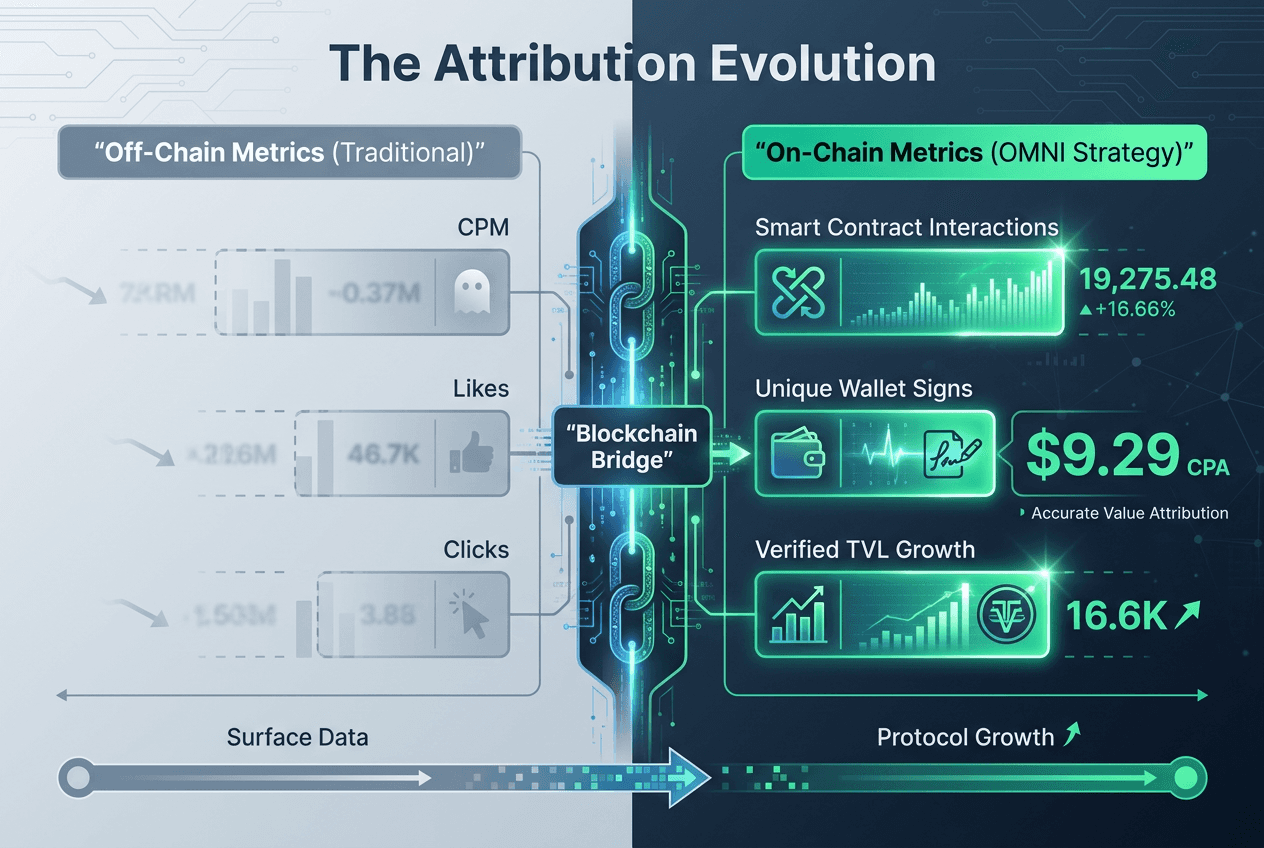
Moving beyond surface-level clicks, on-chain attribution allows DeFi protocols to track the exact ROI of influencer campaigns by monitoring smart contract events and TVL.
The implementation options:
Front-End Referral Parameter - Append a unique
?ref=influencer_nameparameter to the dApp URL. The front end captures this parameter and stores it with the user's wallet address upon connection.Smart Contract Referral Tracking - For protocols with on-chain referral systems, pass the referral code as a parameter in the wallet connection transaction. This creates an immutable on-chain record of the referral source.
Wallet Fingerprinting via Session Tracking - Use session cookies or local storage to associate the referring link with the connected wallet, then push that data to an analytics backend.
Without on-chain attribution, DeFi campaigns devolve into guesswork. You'll know 10,000 people clicked the influencer's link. You won't know if any of them deposited liquidity. On-chain attribution closes that loop and proves ROI at the wallet level. For protocols building sophisticated growth infrastructure, crypto paid advertising and influencer efforts must share the same attribution layer to understand true cost-per-acquisition across channels.
The 2026 Compliance Checklist: MiCA, FCA, and SEC Guardrails
The fifth sub-layer within the technical planning stage is regulatory compliance infrastructure. As of 2026, DeFi influencer campaigns must navigate three major regulatory frameworks:
MiCA (Markets in Crypto-Assets) - EU: Requires influencers promoting crypto assets to clearly disclose paid partnerships and prohibits misleading performance claims. Influencers must state whether content is sponsored and cannot guarantee returns or downplay risk.
FCA (Financial Conduct Authority) - UK: Mandates that crypto promotions include risk warnings and restricts influencers from promoting high-risk investments to retail audiences without clear disclaimers. Non-compliant promotions face fines up to £5 million.
SEC - United States: Treats many DeFi tokens as unregistered securities, making influencer promotions subject to securities law. Influencers promoting tokens later deemed securities face enforcement risk, as seen in several 2024-2025 cases.
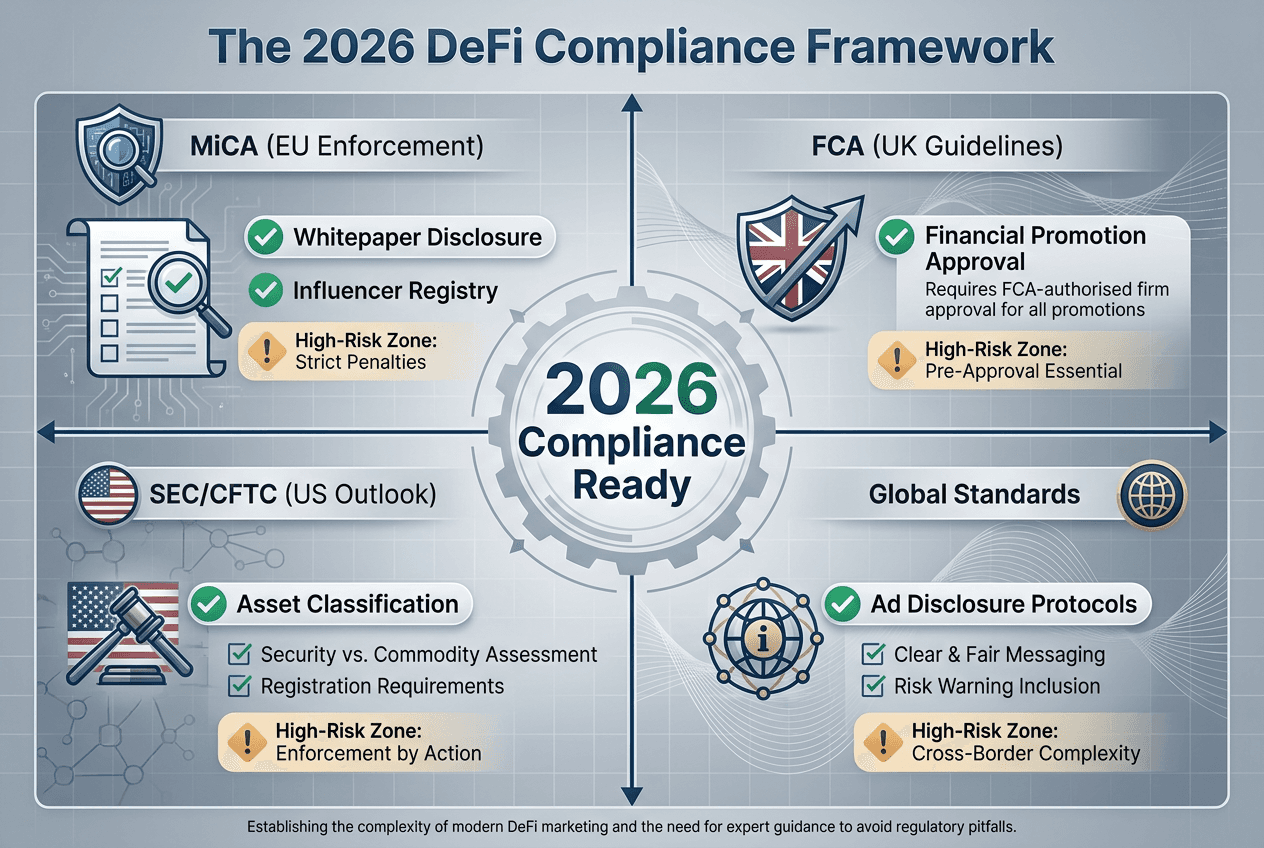
Navigating the 2026 regulatory landscape requires a multi-jurisdictional approach to compliance, ensuring influencer partnerships meet MiCA, FCA, and SEC standards for financial promotion.
Compliance checklist for every DeFi influencer activation:
Paid Partnership Disclosure: Every post must clearly state "Paid partnership with [Protocol Name]" or equivalent language at the top of the content.
Risk Warning: Include language like "Cryptocurrency and DeFi protocols carry significant risk. You may lose your entire investment."
No Guaranteed Returns: Never allow influencers to claim specific APY percentages as guaranteed or permanent. Phrase as "current yield" or "historical APY."
Jurisdiction Restrictions: If your protocol restricts U.S. users, ensure influencer content includes clear geo-restrictions and disclaimers.
Working with a crypto marketing agency that understands 2026 compliance requirements isn't optional - it's the difference between a campaign that scales and one that triggers regulatory action.
5. The Content Calendar Layer: Campaign Pacing and Frequency
The final planning layer is pacing. DeFi influencer campaigns fail when they front-load all spend into a single "launch week" and then go silent. Effective campaigns distribute content across three phases:
Pre-Launch Phase (2-4 weeks before protocol launch) - Teaser content, founder interviews, and waitlist builds. Goal: create awareness and build anticipation.
Launch Phase (week of launch + 1 week after) - Tutorial content, AMAs, and high-frequency posting. Goal: convert awareness into first deposits.
Sustain Phase (ongoing) - Monthly deep dives, protocol updates, and community highlights. Goal: retain users and drive repeat activity.
Most protocols blow 80% of their influencer budget in the launch phase and then wonder why TVL declines in month two. The sustain phase is where long-term growth happens - but it requires ongoing influencer relationships, not one-off activations.
How to Plan an Influencer Campaign (The DeFi-Specific Version)
Planning a DeFi influencer campaign isn't "find KOLs, send them your deck, and hope they post." It's a structured process that begins months before launch and requires cross-functional coordination between marketing, product, and legal teams.
Step 1: Map Your User Journey from Awareness to TVL
Before identifying influencers, map the exact user journey for your protocol. What does a user need to know, believe, and do to go from "never heard of this protocol" to "deposited $10,000 in liquidity"? That journey defines which influencers you need and what content they'll create.
Example journey for a new yield aggregator:
User sees a Twitter thread explaining yield aggregation and why it matters.
User watches a YouTube tutorial showing the protocol's interface and deposit flow.
User joins the Discord to ask questions about smart contract audits and security.
User connects wallet and deposits a small test amount.
User sees consistent performance and deposits more capital.
That journey requires three influencer types: thread writers for step 1, video creators for step 2, and community moderators for step 3. Trying to do all three with one mega-influencer fails because no single creator excels at every format.
Step 2: Segment Influencers by Audience Type, Not Follower Count
The second mistake is selecting influencers based on reach instead of audience composition. A creator with 200K followers who mostly follow for general crypto news won't convert for a DeFi protocol targeting active liquidity providers. A creator with 15K followers who are all DeFi power users will outperform 10-to-1.
Influencer Tier | Follower Range | Best Use Case | Avg. Cost per Post |
|---|---|---|---|
Nano-Creators | 1K-10K | Hyper-targeted communities; early adopter evangelism | $100-$500 |
Micro-Creators | 10K-100K | Technical deep dives; tutorial content | $500-$3,000 |
Mid-Tier Creators | 100K-500K | Awareness and reach for established protocols | $3,000-$10,000 |
Macro-Creators | 500K+ | Brand-building and ecosystem announcements | $10,000-$50,000+ |
According to Hubfluence's 2026 report, micro-creators deliver a cost-per-engagement of $0.20 compared to $0.33 for macro-creators, and 73% of brands now favor smaller, niche creators over celebrity-level influencers. For DeFi, that trend is even more pronounced because technical credibility matters more than clout.
Segment your influencer list by:
Technical DeFi Analysts - Creators who explain protocol mechanics, risk, and tokenomics (e.g., DeFi Dad, Taiki Maeda).
Yield Farmers and Strategists - Users who share their own DeFi portfolio and strategies (e.g., DegenSpartan, Cobie).
Educational Content Creators - YouTubers and thread writers who teach DeFi concepts (e.g., Finematics, The Defiant).
Community Builders - Discord mods and Telegram admins who foster long-term engagement.
Each segment serves a different stage of the trust funnel. Educational creators drive top-of-funnel awareness. Technical analysts build credibility. Yield farmers and strategists convert awareness into action.
Step 3: Negotiate for Performance, Not Posts
The third shift is moving from "pay per post" to "pay per outcome." Instead of paying $5,000 for a single Twitter thread, structure deals where influencers earn a base fee plus performance bonuses tied to on-chain actions.
Example performance structure:
Base Fee: $2,000 for creating and posting the content.
Performance Bonus: $10 for every verified wallet connection attributed to their referral link (capped at 500 wallets = $5,000 max bonus).
TVL Bonus: 0.5% of TVL deposited via their referral code in the first 30 days.
This aligns incentives. Influencers who believe in the protocol will prefer performance deals because they stand to earn more. Influencers who don't believe in it will reject performance terms - which is a signal to avoid working with them. For guidance on structuring these partnerships, see our full guide on Web3 KOL partnership best practices.
Platform Breakdown: Where DeFi Liquidity Lives
Not all social platforms convert equally for DeFi. Each platform serves a different role in the trust funnel, and effective campaigns allocate budget based on where high-intent users consume content.
Platform performance benchmarks reveal that while TikTok leads in raw engagement, YouTube remains the dominant channel for high-intent DeFi educational content and conversion.
X (Twitter): Narrative Velocity and Opinion Leadership
X remains the dominant platform for DeFi discourse and narrative formation. It's where protocols are discovered, debated, and either validated or dismissed by the community. The value of X for DeFi influencer campaigns is narrative velocity - how quickly a protocol's story spreads through DeFi Twitter and becomes part of the conversation.
X strengths for DeFi:
Real-time discussions and breaking protocol news
Direct access to founders, developers, and investors
High concentration of DeFi power users and early adopters
Threaded explainers that break down complex mechanisms
X weaknesses for DeFi:
Low-effort engagement (liking a thread ≠ depositing liquidity)
High noise-to-signal ratio with constant new protocol launches
Difficult to track conversion from tweet impressions to on-chain actions
Short attention spans; threads get buried within hours
X works best for awareness and credibility building, not direct conversion. A well-crafted thread from a respected DeFi analyst can put your protocol on the radar of 10,000 high-intent users - but converting those users requires follow-up content on other platforms.
YouTube: Educational Walkthroughs and High-Intent Conversion
YouTube is the highest-converting platform for DeFi protocols because it allows for long-form educational content that visually demonstrates how to use the protocol. A 10-15 minute YouTube video showing wallet connection, deposit flow, yield tracking, and risk management reduces the technical friction that stops most users from taking action.
YouTube strengths for DeFi:
Step-by-step tutorials that build user confidence
Visual demonstration of protocol interfaces and features
Longer viewer attention spans (avg. 8-12 minutes for DeFi content)
Searchable and evergreen - videos continue to drive conversions months after posting
YouTube weaknesses for DeFi:
Slower production timelines versus Twitter threads
Higher cost per video ($3,000-$10,000 for quality creators)
Requires protocol to have a functional, user-friendly UI worth demonstrating
According to platform performance data from Aspire, YouTube educational content converts at 4-8x the rate of social posts because it removes the "I don't know how to use this" barrier that stops most DeFi conversions. If your budget allows for only one influencer format, prioritize YouTube tutorials.
Telegram and Discord: Retention, Community, and Long-Term Engagement
Telegram and Discord don't drive initial user acquisition - they stabilize and retain users after they've taken their first on-chain action. These platforms are where users ask technical questions, share strategies, report bugs, and form the social bonds that keep them active in the protocol long-term.
Telegram/Discord strengths for DeFi:
Direct access to support and community answers
Real-time protocol updates and governance discussions
Reduces user churn by providing a place to ask questions
Creates network effects as users share strategies and invite others
Telegram/Discord weaknesses for DeFi:
Don't generate new user awareness
Require active moderation and community management to stay valuable
Can become echo chambers if not managed carefully
Influencer strategy for Telegram/Discord: partner with community moderators and active members who can serve as protocol evangelists within their own communities. These influencers don't have traditional "follower counts" but they control access to highly engaged DeFi groups. For best practices on building and managing these communities, review our Web3 Discord community management guide.
TikTok: Emerging But Still Unproven for DeFi
TikTok leads all platforms with a 4.25% average engagement rate and saw budget allocation for creator partnerships surge 171% year-over-year according to Aspire's 2026 data - but its effectiveness for DeFi remains limited. TikTok's strength is entertainment and impulse-driven content. DeFi requires research and deliberation.
TikTok works for:
Brand awareness and reaching younger crypto-curious audiences
Explaining basic DeFi concepts (what is yield farming, what is a liquidity pool)
Driving traffic to more detailed educational content on YouTube or blogs
TikTok doesn't work for:
Driving direct wallet connections or TVL growth
Reaching existing DeFi power users who aren't on the platform
Technical content that requires depth and precision
TikTok should be a secondary platform for DeFi campaigns - valuable for top-of-funnel awareness but not a primary conversion driver.
Measuring What Matters: ROI in the DeFi Context
The failure point for most DeFi influencer campaigns is measurement. Protocols track impressions, likes, and follower growth - vanity metrics that don't correlate with protocol success. Effective measurement focuses exclusively on on-chain outcomes and the unit economics of user acquisition.
The Three Metrics That Actually Matter
1. Cost Per Verified User (CPVU) - How much you spent on influencer activations divided by how many unique wallet addresses connected to your protocol and completed at least one meaningful action (deposit, swap, stake). This is the DeFi equivalent of CAC (Customer Acquisition Cost).
Target benchmark: $15-$50 CPVU for a new protocol is strong. Above $100 signals the campaign isn't working.
2. Connect-to-Action Rate - What percentage of users who connected their wallet went on to deposit liquidity or execute a transaction? This measures how well your influencer content set expectations and reduced friction.
Target benchmark: 20-40% connect-to-action rate is healthy. Below 10% means your traffic is window shopping, not converting.
3. 30-Day Liquidity Provider Retention - Of the users who deposited capital, what percentage remained active (didn't fully withdraw) after 30 days? This measures whether your protocol retained the liquidity the influencer campaign acquired.
Target benchmark: 60%+ retention after 30 days is strong for a new protocol. Below 40% signals product-market fit issues.
These three metrics - CPVU, connect-to-action rate, and 30-day retention - tell you whether your influencer campaign is working. Everything else is noise.
How to Calculate True Influencer ROI
True ROI calculation for DeFi influencer campaigns requires connecting influencer spend to lifetime value of acquired users:
ROI Formula:
Total Protocol Revenue includes:
Trading fees generated by referred users
Interest on borrowed capital
Protocol token emissions captured as TVL growth
Example calculation:
Campaign Cost: $25,000 (5 influencers, mix of Twitter and YouTube)
Wallets Acquired: 800 unique wallets connected via referral links
TVL from Referred Users: $4.2M deposited in first 30 days
Protocol Revenue: $4.2M × 0.3% monthly fee = $12,600 in month one
Projected Annual Revenue: $12,600 × 12 = $151,200
ROI: ($151,200 - $25,000) / $25,000 = 5.04x return
This matches the industry benchmark reported by Hubfluence: brands earn an average ROI of $5.78 for every $1 spent on influencer marketing when campaigns are properly attributed and measured.
The mistake most protocols make is evaluating influencer ROI in the first week. DeFi user acquisition compounds over months as early users invite others, share strategies, and become protocol evangelists. Measure ROI on a 90-day horizon, minimum.
Closing the Connect-to-Deposit Gap: Converting Viewers into Protocol Users
The highest-leverage optimization in any DeFi influencer campaign is reducing the "connect-to-deposit gap" - the percentage of users who click an influencer's link, visit your protocol, connect their wallet, but never deposit capital. Industry data shows 60-80% of wallet connections never convert to deposits. Closing that gap doubles your effective ROI.
The Friction Audit: Where Users Drop Off
Map every step between "user clicks influencer link" and "user completes first deposit." Identify friction points:
Landing Page Clarity - Does the landing page immediately explain what the user should do next? Or does it assume they already know?
Wallet Connection Flow - How many clicks to connect? Does it support the wallet types your target users actually use (MetaMask, Ledger, WalletConnect)?
Smart Contract Approval - Does the user need to approve token spending before depositing? Is it a one-click approval or multiple transactions?
Transaction Confirmation - After deposit, does the UI clearly confirm success and show the user their new balance?
Post-Deposit Experience - What happens after deposit? Does the user see yield accruing? Are there next steps suggested?
Each friction point costs conversions. A protocol that requires three separate transaction approvals before deposit will lose 40-60% of users between wallet connection and action.
Friction Reduction Tactics That Work
Pre-Approve Transactions - For protocols where users deposit common assets (USDC, ETH, WBTC), offer a "one-click deposit" flow that batches approval and deposit into a single transaction.
Gas Estimation and Warnings - Show users the estimated gas cost before they attempt a transaction. Users who click "deposit" and then see a $50 gas fee often abandon. Show the cost upfront.
Demo Mode Without Wallet Connection - Let users explore the protocol interface and simulate a deposit without connecting their wallet first. Reduces fear of commitment.
In-App Support Chat - Embed a live support chat (or AI chatbot) directly in the deposit flow. Users who have a question mid-transaction can get an answer without leaving the page.
Referral Incentives at Deposit - Offer users who deposit via an influencer referral link a small bonus (extra yield for 7 days, airdrop eligibility, etc.). Makes the decision to deposit more compelling.
Protocols that implement these friction-reduction tactics see connect-to-deposit rates improve from 15-20% to 35-50%. That's a 2-3x improvement in campaign ROI with no additional influencer spend.
What is a DeFi Marketing Strategy (And Why Influencer is Just One Layer)
A comprehensive DeFi marketing strategy encompasses multiple channels working in concert, with influencer marketing serving as one pillar within a larger growth framework. Protocols that treat influencer marketing as their entire strategy fail because no single channel drives sustained TVL growth alone.
The Five Pillars of DeFi Marketing
1. Community Building - Discord, Telegram, and forum communities that retain users, answer questions, and create network effects. Community is the retention layer.
2. Content Marketing - Blog posts, protocol documentation, and educational resources that rank on Google and serve as evergreen user education. Content is the trust-building layer.
3. Influencer & KOL Partnerships - Paid collaborations with creators who have access to high-intent DeFi audiences. Influencer is the acquisition layer.
4. Paid Media - Targeted ads on crypto-native platforms (CoinDesk, CoinGecko, DeFiLlama) and programmatic display. Paid media is the scale layer.
5. PR & Ecosystem Partnerships - Media coverage, integration announcements, and partnerships with other protocols. PR is the legitimacy layer.
Each pillar reinforces the others. A user discovers the protocol via influencer content (pillar 3), reads a blog post explaining the mechanics (pillar 2), joins the Discord to ask questions (pillar 1), sees a targeted ad reminding them to deposit (pillar 4), and then reads a press release about a major integration that validates their decision (pillar 5).
Protocols that invest 100% of budget into influencer marketing acquire users but struggle to retain them. Protocols that balance across all five pillars build compounding growth. For a detailed breakdown of this full-stack approach, see our complete DeFi marketing strategy guide.
Why OMNI Agency is the Full-Service Alternative to Fragmented Strategy
Most DeFi protocols cobble together marketing from multiple vendors: one agency for influencer, another for community, a freelancer for content, a different team for paid media. The result is fragmented messaging, duplicated effort, and no single team accountable for TVL growth.
OMNI Agency operates as the unified growth partner, handling all five pillars under one roof with a single point of accountability: on-chain results. Over five years, OMNI has helped 100+ Web3 brands - including Animoca Brands, OKX, and Polkadot - scale from launch to sustainable growth, helping clients raise over $75M and drive billions in trading volume.
What Full-Service Execution Actually Looks Like
Pre-Launch (Months -3 to 0):
Competitive research and positioning strategy
Influencer discovery and relationship building
Content creation (explainers, tutorials, docs)
Community infrastructure setup (Discord, Telegram, forum moderation)
PR pipeline development and journalist outreach
Launch (Week 0 to +4):
Coordinated influencer activations across Twitter, YouTube, and podcasts
Paid media campaigns targeting DeFi power users
Press release distribution and media coverage
Community AMAs and live Q&A sessions
Real-time campaign optimization based on on-chain data
Post-Launch (Months 1-12):
Ongoing influencer partnerships and content refreshes
SEO-optimized blog content to capture Google search traffic
Monthly protocol update announcements via PR channels
Community retention programs and governance initiatives
Quarterly campaign reviews with on-chain ROI reporting
The difference between fragmented vendors and a unified partner: fragmented vendors optimize for their individual KPIs (impressions, clicks, posts published). A unified partner optimizes for the outcome that matters - TVL growth and user retention. OMNI's crypto influencer marketing practice isn't a standalone service - it's integrated with community, content, and paid media to create a compounding growth engine.
Proprietary Media Network and KOL Access
OMNI operates a proprietary media and KOL network built over five years of Web3 execution, including established relationships with CoinDesk, Cointelegraph, Decrypt, The Block, BeInCrypto, and CryptoRank. That network provides two advantages competitors can't replicate:
Guaranteed Media Placements - Protocols working with OMNI don't pitch journalists cold. Coverage is pre-negotiated and coordinated with influencer activations for maximum impact.
Vetted KOL Roster - OMNI's 400+ creator network has delivered over 10,000 activations. Every creator is pre-vetted for compliance, audience authenticity, and historical performance. No experimenting with unproven influencers on your budget.
For DeFi protocols operating in the 2026 regulatory environment, working with an agency that understands MiCA, FCA, and SEC compliance isn't optional - it's existential. OMNI's campaigns are structured from day one to meet cross-jurisdictional requirements, ensuring influencer activations don't create regulatory exposure.
h2, h3
