
60
Published
June 2026
Updated
June 2026
Web3 KOL Partnership Best Practices: The 2026 Performance Playbook

Tyler Mullins
Founder & Owner of OMNI
Introduction
Most Web3 founders burn 15-40% of their marketing budget on influencer deals that deliver nothing but screenshots and engagement theater. They chase follower counts, celebrate retweets, and wonder why their TVL stays flat while the campaign analytics show "great reach."
That disconnect isn't just bad luck. It's the structural failure of treating Web3 KOL partnerships like traditional influencer marketing - where brand awareness is enough, where impressions justify spend, and where no one expects a direct line from a tweet to $1 million in protocol deposits. But in 2026, that gap has become a liability. Projects backed by institutional capital now demand the same rigor from KOL campaigns that they expect from paid media: measurable conversions, attribution models, and ROI that shows up on-chain.
The answer isn't better influencers. It's a complete rewrite of how partnerships are structured, measured, and executed - using the metrics that actually predict performance and the architecture that turns social reach into protocol growth.
Key Takeaways
Micro-influencers (10K-100K followers) deliver an 8.3x ROI in 2026 compared to 3.1x for macro-influencers, making them the highest-performing tier in multi-layer Web3 campaigns.
View Velocity (monthly views divided by follower count) is the new standard KPI that filters out bot networks, which represent 15-20% of followers on legacy crypto accounts.
On-chain attribution mapping connects every KOL post to wallet activations and TVL deposits, enabling $6.50 ROI per dollar when properly implemented.
Instagram Reels-based token campaigns achieved an average CPA of $6.14 versus $22.80 for banner ads in 2026, proving short-form video dominance.
Projects with 50K+ community members saw 91% higher 180-day token price retention, establishing community-first KOL strategies as long-term value drivers.
Table of Contents
Why the Follower Count Era Died in 2025
The New KPIs: View Velocity and On-Chain Attribution
Multi-Tier Architecture: The 10/70/20 Rule
Vertical-Specific KOL Strategies
The 2026 Compliance Checklist
Avoiding the Agency Trap
Frequently Asked Questions
Why the Follower Count Era Died in 2025
The shift from vanity metrics to performance accountability happened fast. By mid-2025, the gap between what generalist agencies sold and what protocols actually needed had become impossible to ignore. Founders watching their token charts realized that 500,000 impressions meant nothing if those impressions came from bot farms in Southeast Asia or crypto tourists who would never connect a wallet.
Research from the Blockchain Marketing Consortium confirmed what sharp operators already knew: 15-20% of followers on many crypto influencer accounts are estimated to be bot networks. That contamination doesn't just inflate reach reports - it destroys signal integrity. When a KOL's audience is one-fifth fake, their engagement rate becomes theater, their click-through becomes noise, and their ability to drive real conversions collapses.
The protocols that survived the 2025 market correction stopped paying for reach and started demanding outcomes. They wanted to know: How many wallet connections came from this campaign? How much TVL entered the protocol in the 48 hours after this post? What was the 30-day retention rate for users who arrived via this influencer?
Those questions couldn't be answered with screenshots of tweets or Dune dashboards showing "community sentiment." They required technical infrastructure - UTM-to-wallet mapping, on-chain event tracking, and attribution models borrowed from performance marketing, not brand awareness playbooks. The agencies that couldn't deliver that infrastructure lost clients to the ones that could.
This wasn't just a technical upgrade. It was a philosophical pivot: from treating KOL partnerships as PR campaigns to treating them as growth channels with measurable unit economics. The protocols making that shift early - especially in DeFi, where capital efficiency determines survival - saw 40-60% improvements in cost-per-acquisition within two quarters.
The New KPIs: View Velocity and On-Chain Attribution
View Velocity is the primary filtering metric for identifying high-signal KOLs in 2026, calculated as monthly views divided by follower count. A KOL with 50,000 followers generating 2 million monthly views has a View Velocity of 40x - meaning their content reaches 40 times their follower base every month through shares, algorithm amplification, and organic discovery. Compare that to a macro-influencer with 500,000 followers generating 1 million monthly views - a View Velocity of just 2x, signaling weak engagement and probable audience decay.
This metric solves the bot problem directly. Fake followers don't watch videos, don't share threads, and don't trigger algorithmic distribution. A KOL with inflated follower counts but authentic content will show low View Velocity because the bot portion of their audience contributes zero views. The inverse is also true: niche creators with smaller but highly engaged audiences routinely hit 30-60x View Velocity because every post gets saved, shared, and discussed.
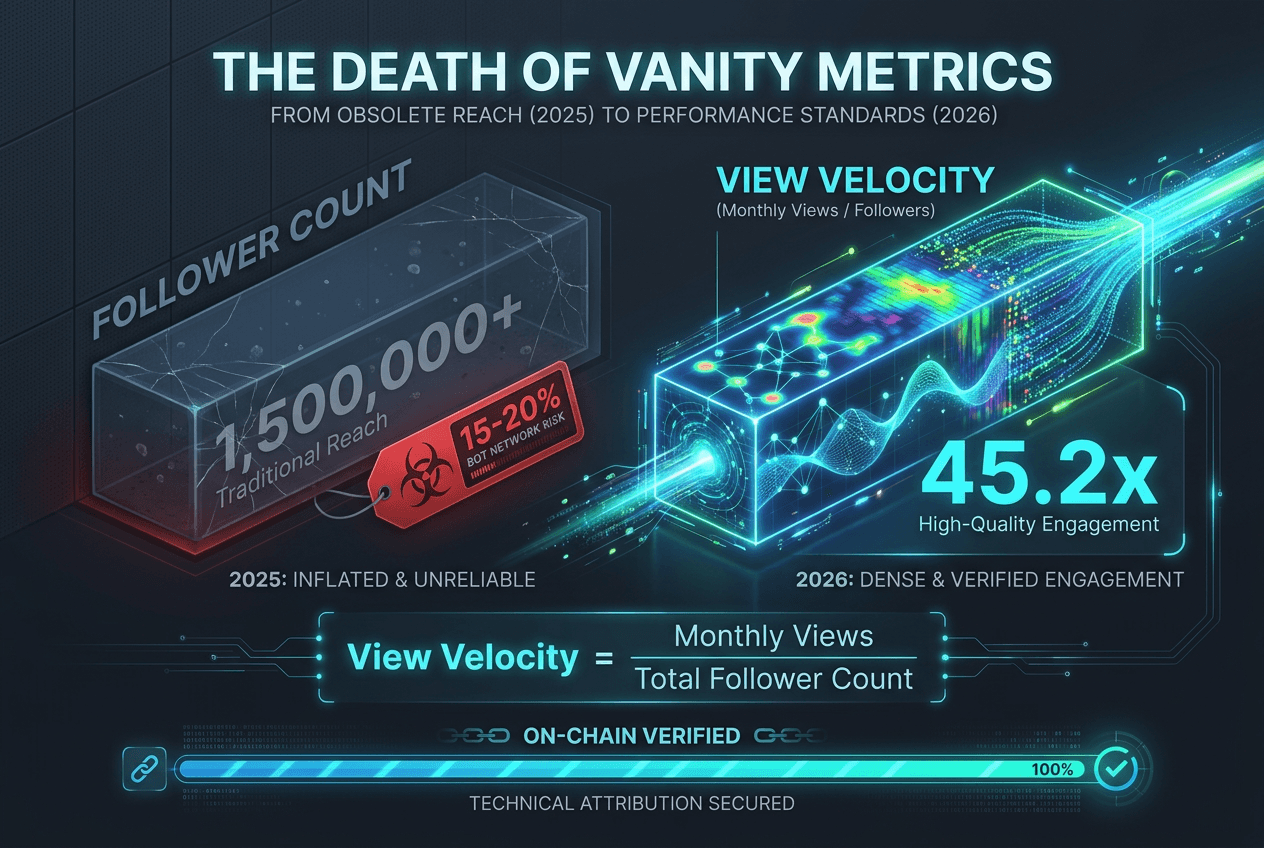
Move beyond vanity metrics by prioritizing View Velocity and filtering out the 15-20% bot presence common in legacy Web3 influencer accounts.
The data backing View Velocity is transparent and platform-native. On X (formerly Twitter), monthly impressions are public for verified accounts. On YouTube, view counts are tracked per video. TikTok and Instagram provide insights dashboards to creators. This makes View Velocity independently verifiable - unlike engagement rates, which can be gamed with coordinated like campaigns or comment pods.
On-Chain Attribution: Mapping Social to TVL
On-chain attribution connects every KOL post to specific wallet activations, deposits, and protocol interactions. The technical pattern is straightforward: generate a unique UTM-tagged landing page for each influencer, embed that URL in their content, and track wallet connections originating from that page using event pixels and on-chain address monitoring.
When a user clicks a KOL's link, lands on the protocol's site, and connects their wallet, that wallet address becomes an attributed user. Every subsequent action - staking, swapping, providing liquidity - is tied back to the originating KOL. This allows protocols to calculate true ROI per influencer: if a KOL was paid $5,000 and drove $180,000 in TVL with a 2.5% protocol fee structure, the campaign generated measurable revenue that can be compared directly to paid media channels.
Strategic influencer marketing in Web3 generates $6.50 ROI for every dollar spent when using multi-tier architecture, according to combined research from RZLT and NinjaPromo. That performance benchmark is only achievable with full attribution. Without it, protocols can't isolate which KOLs drive conversions versus which drive vanity engagement - and budget allocation becomes guesswork.
The infrastructure required for on-chain attribution is now standard among serious Web3 marketing operations. Tools like Dune Analytics, Nansen, and custom event tracking via Google Tag Manager or Segment allow real-time monitoring of wallet behavior. Protocols running crypto paid advertising campaigns already use these tools for media attribution - extending them to KOL partnerships is a natural evolution.
What changes: KOLs who deliver high View Velocity but low on-chain conversions get reallocated to top-of-funnel awareness roles. KOLs who drive wallet activations at scale become core growth partners with recurring deals. And the entire partnership model shifts from one-off posts to performance-based structures where KOLs earn bonuses tied to TVL thresholds or user retention milestones.
Multi-Tier Architecture: The 10/70/20 Rule
The 10/70/20 rule structures KOL budgets to maximize ROI while maintaining brand credibility and community trust. The breakdown: 10% of spend goes to nano-influencers (1K-10K followers), 70% to micro-influencers (10K-100K followers), and 20% to macro-influencers (100K+ followers). This allocation is optimized for the conversion dynamics verified by 2026 campaign data.
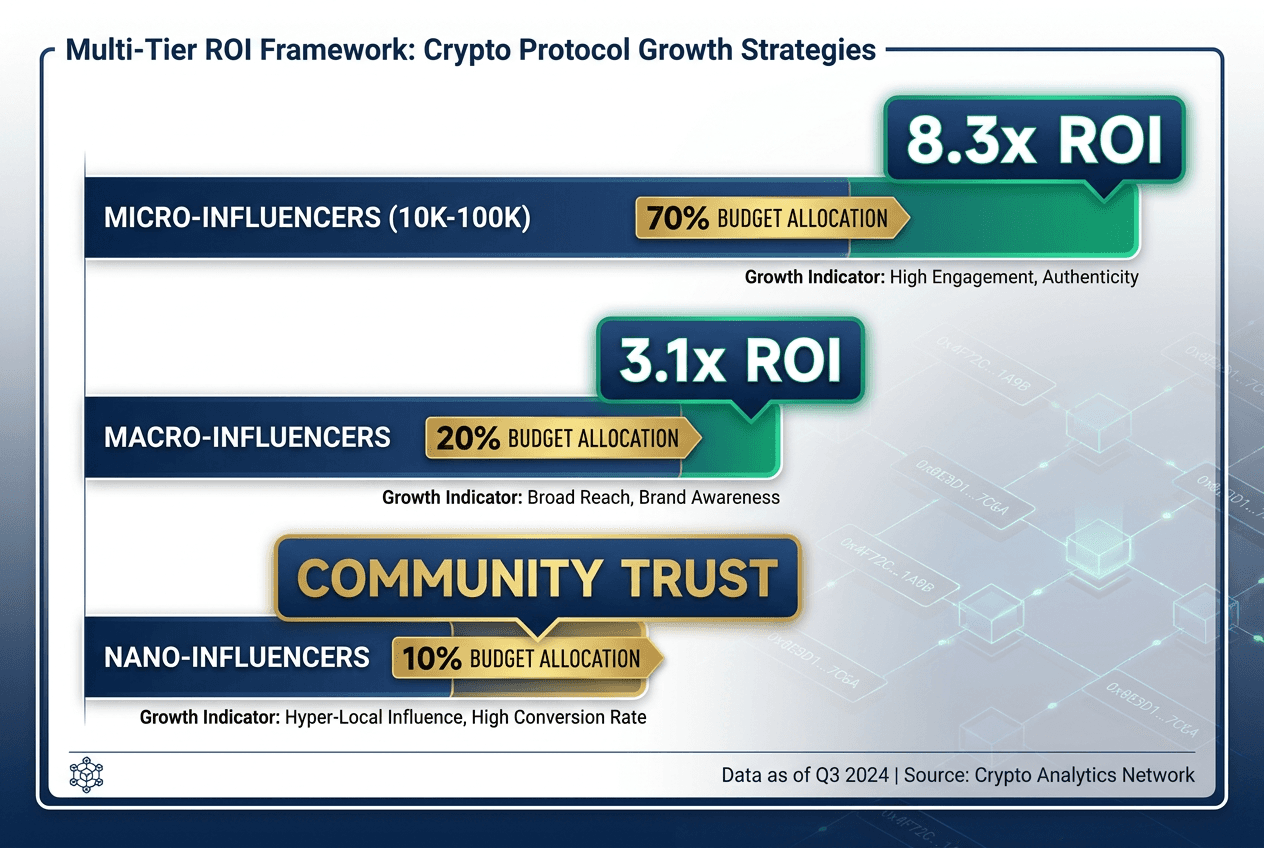
The 10/70/20 architecture prioritizes micro-influencers to achieve a verified 8.3x ROI, balancing community trust with scalable retail reach and protocol legitimacy.
Micro-influencers deliver an 8.3x ROI in 2026 compared to 3.1x for macro-influencers, according to research from the Blockchain Marketing Consortium. That gap exists because micro-influencers operate in tight niche communities where trust is high and audience intent is strong. A DeFi protocol paying a 40K-follower yield farming educator $2,000 for a detailed tutorial thread will reach users actively searching for new opportunities - not passive scrollers who follow macro accounts for entertainment.
The math becomes obvious at scale. A $50,000 KOL budget under the 10/70/20 rule allocates $35,000 to micro-tier partnerships - enough for 15-20 activations across different sub-niches (liquid staking, perpetuals, RWA, governance). Each activation targets a distinct audience segment, creating multiple entry points into the protocol rather than betting everything on one or two big names.
Nano-Influencers: Community Trust Layer (10%)
Nano-influencers are the ground truth. They're active community members, Discord mods, governance participants, and niche educators who've built small but intensely loyal followings. Their value isn't reach - it's credibility. When a respected community figure endorses a protocol, their audience assumes they've done the diligence and genuinely believe in the product.
The $5,000 allocated to nano-tier partnerships funds 8-12 micro-activations: AMAs in specialized Discord servers, detailed Twitter threads from governance-focused accounts, or YouTube explainers from educators covering specific verticals like restaking or validator economics. These placements don't move the TVL needle directly, but they establish legitimacy within the core community that every protocol needs to sustain long-term growth.
Early-stage Web3 projects typically allocate 15-25% of marketing budgets to KOL partnerships, according to Whiz Marketers research. For pre-seed or seed-stage protocols, the nano tier often becomes the primary focus because community credibility matters more than mass awareness when you're trying to cross the first $1M in TVL.
Micro-Influencers: The ROI Engine (70%)
Micro-influencers are where performance happens. These are creators with 20K-80K followers who've built audiences around actionable content: yield strategies, protocol comparisons, airdrop guides, technical deep-dives. Their followers aren't passive - they're users actively looking for the next protocol to deploy capital into.
The $35,000 micro-tier budget supports 12-18 partnerships depending on rates and deliverables. A typical structure: $1,500-$3,000 per creator for a content package that includes a Twitter thread breaking down the protocol's value proposition, a 5-10 minute video walkthrough, and integration into their weekly newsletter or community calls.
Because micro-influencers operate in specific niches, campaigns can be vertically targeted. A liquid staking protocol might partner with 8 creators who exclusively cover staking yields, validator economics, and Ethereum scaling - ensuring every activation reaches an audience that already understands the product category and is primed to convert.
Instagram Reels-based token campaigns achieved an average CPA of $6.14 versus $22.80 for banner ads in 2026, according to Web3 Growth Labs. Short-form video content from micro-influencers - especially educational walkthroughs and "why I'm bullish" explainers - consistently outperforms static display ads because the format builds trust and demonstrates functionality in under 60 seconds.
Macro-Influencers: Legitimacy and Reach (20%)
Macro-influencers provide mainstream credibility and retail reach. These are the 200K+ follower accounts that show up on Crypto Twitter trending pages, get quoted in newsletters, and set narrative tone for broader market cycles. Their role isn't conversion - it's validation.
The $10,000 macro-tier budget typically funds 2-4 high-impact placements: a sponsored thread from a major CT personality, a podcast appearance with a Tier-1 crypto media figure, or a video feature from a top YouTube channel covering DeFi or infrastructure projects.
The conversion rate from macro-influencers is lower, but the brand lift is measurable. When a protocol gets featured by a 500K-follower account, it signals market legitimacy to VCs, exchanges, and institutional participants who track social proof as a proxy for traction. Projects with 50K+ community members saw 91% higher 180-day token price retention, according to Messari Research - and macro-influencer campaigns are often the catalyst that pushes community size past that threshold.
For protocols preparing for a token launch or seeking exchange listings, macro-tier visibility becomes strategically essential. Exchanges track social metrics when evaluating listing applications, and a single high-engagement post from a recognized influencer can move a project up the priority queue.
KOL Tier | Follower Range | Budget % | Primary Goal | Typical ROI Multiple | Best Use Case |
|---|---|---|---|---|---|
Nano | 1K-10K | 10% | Community trust & niche credibility | 4-6x | Early validation, governance participation |
Micro | 10K-100K | 70% | Direct conversions & TVL growth | 8.3x | Performance campaigns, user acquisition |
Macro | 100K+ | 20% | Brand legitimacy & retail awareness | 3.1x | Token launches, exchange listings, narrative |
Vertical-Specific KOL Strategies
DeFi protocols require KOL partnerships focused on yield discovery, risk analysis, and capital efficiency narratives. The user entering a DeFi protocol is solving a specific problem: where to deploy stablecoins for the highest risk-adjusted return, how to farm governance tokens before dilution, or which liquid staking derivative offers the best validator decentralization.
KOL content for DeFi must answer those questions directly. A generic "excited to partner with [Protocol]" post generates zero conversions. What works: detailed Twitter threads comparing the protocol's yield structure to competitors, video walkthroughs showing the deposit flow and fee breakdowns, or collaborative content where the KOL publicly deposits their own capital and tracks performance over 30-60 days.
The most effective DeFi KOL campaigns run in waves. Wave 1: Educational content explaining the mechanism and opportunity. Wave 2: Strategy content showing how to maximize returns or minimize IL. Wave 3: Performance updates and community AMAs addressing questions that emerged in the first two waves. This cadence mirrors how DeFi users actually evaluate protocols - they don't ape in on day one; they research, compare, and monitor before committing capital.
For protocols building DeFi marketing strategies, pairing KOL partnerships with strong SEO-optimized educational content creates a flywheel: the KOL drives initial awareness and traffic, while the protocol's owned content captures search intent from users doing their own research.
DePIN and Infrastructure: Technical Credibility
DePIN (Decentralized Physical Infrastructure Networks) and infrastructure protocols need KOLs who can communicate technical complexity to both developer and investor audiences. The average DePIN project - whether it's decentralized storage, compute networks, or wireless infrastructure - requires users to understand hardware requirements, token economics, and the long-term vision for network effects.
KOL selection for infrastructure projects prioritizes technical credibility over follower count. A blockchain developer with 8,000 followers who regularly breaks down node operator economics will outperform a generalist CT personality with 200,000 followers, because the 8K audience is composed of potential node operators and infrastructure investors.
Content formats that work: GitHub repository walkthroughs, node setup tutorials, tokenomics deep-dives comparing emissions schedules to similar networks, and interviews with the founding team covering roadmap milestones and ecosystem partnerships. Infrastructure projects often run months-long campaigns where the same KOL creates recurring content - weekly updates, governance proposal breakdowns, and technical AMAs - building continuous engagement rather than one-off hype spikes.
Because infrastructure protocols are capital-intensive (node hardware, token staking requirements), conversion timelines are longer. The attribution window needs to extend 60-90 days to capture users who research for weeks before committing. On-chain attribution becomes critical here - tracking wallet addresses that participate in testnets, stake tokens, or run nodes allows precise measurement of which KOLs drove actual infrastructure participation versus social engagement.
AI and Gaming: Immersive Previews and Virality Loops
AI protocols and Web3 gaming projects benefit from KOL strategies that emphasize visual storytelling and experiential content. AR NFT previews hit an 18.9% mint conversion rate compared to 4.2% for static images, according to IDC Global research - proof that immersive content formats significantly outperform traditional social posts.
For gaming projects, KOL partnerships should focus on gameplay footage, closed beta access, and community tournaments. The most successful campaigns give KOLs early access to the game, letting them create organic content around their actual experience rather than scripted promotional posts. TikTok surpassed YouTube in crypto video views with 38.4 billion views in Q1 2026, according to Web3 Growth Labs - making short-form gameplay clips and reaction videos essential for retail awareness.
AI protocol marketing requires a different approach: demonstrating real-world use cases. KOLs should create content showing the protocol solving actual problems - whether that's generating art, running inference models, or training on decentralized compute. The narrative needs to move beyond "AI + blockchain = revolutionary" to "here's what this protocol lets you do that centralized alternatives can't."
Virality loops are critical for both verticals. Gaming projects should incentivize KOLs to run giveaways where entry requires retweeting, joining Discord, and referring friends - creating compounding reach. AI projects benefit from challenges or bounties where KOLs use the protocol to create something shareable (AI-generated art, music, code) and their audience votes on winners.
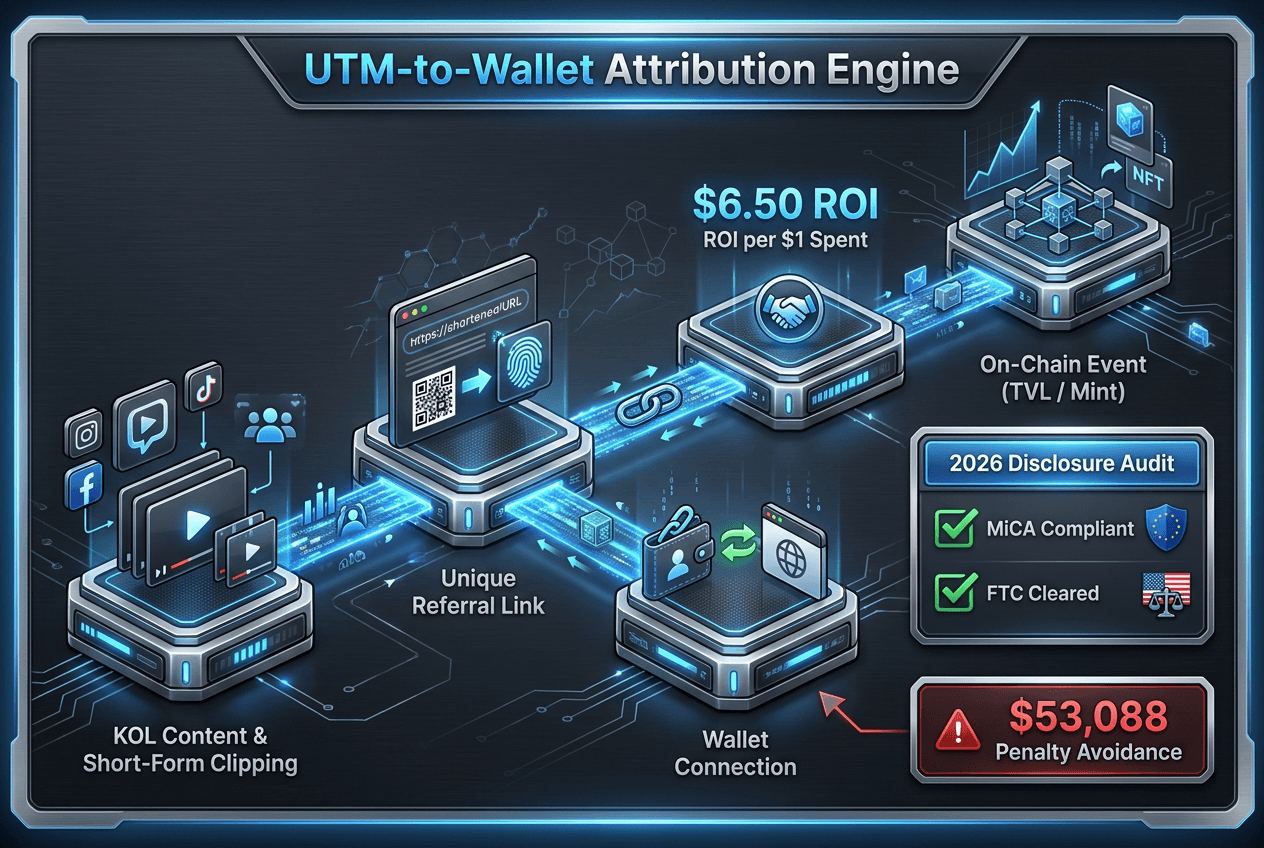
True performance marketing in Web3 requires mapping every KOL click to a specific on-chain action, ensuring a measurable $6.50 return on every dollar.
The Clipping Engine: Scaling One Interview into 50 Viral Moments
Crypto clipping is the practice of taking one long-form KOL collaboration - a podcast appearance, AMA, or video interview - and editing it into 30-60 second clips optimized for different platforms. A single 45-minute podcast with a Tier-1 influencer becomes 20+ clips distributed across TikTok, Instagram Reels, YouTube Shorts, and Twitter.
This strategy addresses the biggest inefficiency in traditional KOL deals: most users never see the full content. A Twitter thread gets 10,000 impressions but only 800 people read past the first tweet. A YouTube video gets 5,000 views but the average watch time is 2 minutes out of 15. Clipping ensures the highest-signal moments - the most counterintuitive take, the clearest value prop explanation, the funniest exchange - get isolated and redistributed where attention spans are shortest.
For protocols working with agencies experienced in crypto influencer marketing, the clipping workflow is now standard: record the full interview, transcribe it, identify 12-20 clip-worthy moments, edit vertical video versions for each, and distribute them over 2-3 weeks post-launch. This extends the campaign's effective reach from a single day (when the full video drops) to weeks of sustained visibility.
The performance delta is significant. One hour-long podcast might generate 15,000 views. The same podcast clipped into 25 short-form videos distributed across platforms can generate 200,000+ cumulative views because each clip is optimized for algorithmic discovery and shares. Protocols that master clipping see 6-10x content ROI from every major KOL partnership.
The 2026 Compliance Checklist
FTC violations for improper influencer disclosure now carry up to $53,088 penalties per post, according to 5WPR and FTC enforcement data from 2025. That risk extends to both the influencer and the sponsoring protocol, making compliance infrastructure non-negotiable for any serious KOL campaign.
The baseline requirement is simple: every paid partnership must include clear, conspicuous disclosure that the content is sponsored. On Twitter/X, that means #ad or #sponsored in the first line of the thread, not buried at the end. On YouTube, it means checking the "includes paid promotion" box and verbally disclosing the partnership in the first 30 seconds. On Instagram and TikTok, it means using the built-in "Paid Partnership" tag, not relying on vague language like "grateful for this opportunity."
But compliance in Web3 goes beyond FTC disclosure rules. The EU's Markets in Crypto-Assets (MiCA) regulation, which took full effect in 2026, requires specific risk disclaimers for any content promoting crypto assets. KOLs based in or targeting EU audiences must include language stating that crypto investments are volatile, not covered by deposit insurance, and may result in total loss.
In the US, the Digital Asset Market Architecture (DAMA) framework introduced registration requirements for entities marketing unregistered securities. If a protocol's token is potentially classifiable as a security, KOL partnerships promoting that token could trigger DAMA obligations - meaning the protocol needs legal sign-off before any influencer campaign launches.
Disclosure Best Practices by Platform
Platform | Required Disclosure Method | Placement Rule | Additional Notes |
|---|---|---|---|
Twitter/X | #ad or #sponsored hashtag | First line of thread | Must be visible without clicking "Show more" |
YouTube | Platform "Paid Promotion" toggle + verbal disclosure | First 30 seconds of video | Audio disclosure required, not just text overlay |
"Paid Partnership with [Brand]" tag | Visible above post content | Stories require tag on first frame | |
TikTok | "Paid Partnership" label + #ad hashtag | Caption and first 3 seconds of video | Both visual and text disclosure required |
Discord | Pinned disclosure message in announcement channel | Top of channel before campaign content | All promotional messages must reference disclosure |
Smart contracts and automated compliance tools are emerging as solutions. Some protocols now require KOLs to submit content for review via a portal that auto-checks for disclosure language and flags missing compliance elements before the post goes live. Others use blockchain-based disclosure registries where every paid partnership is logged on-chain, creating an immutable audit trail.
For protocols managing crypto community management alongside KOL campaigns, compliance training for community moderators is essential. User-generated content promoting the protocol in Discord or Telegram can create liability if it crosses into coordinated promotion without disclosure - moderators need to know when to intervene and require transparency.
International Regulatory Variance
Different jurisdictions impose different requirements. Singapore's MAS requires disclosures to specify that crypto is not legal tender. South Korea's FSC mandates risk warnings on all promotional crypto content. The UK's FCA requires balanced risk/reward messaging - meaning a KOL can't just hype upside without also mentioning downside scenarios.
Protocols running global campaigns need jurisdiction-specific disclosure templates. A European KOL gets one contract with MiCA-compliant language. A US-based KOL gets DAMA and FTC language. An Asian KOL working across Singapore, Korea, and Japan gets a hybrid template covering all three regulatory regimes.
The enforcement risk is real. In 2025, the FTC issued its first major fines against both a DeFi protocol and three influencers for undisclosed promotional posts - $380,000 total penalties. The SEC followed with enforcement actions against two token projects for violating securities laws via influencer campaigns that failed to register as advertising for unregistered securities offerings.
Working with a crypto marketing strategy partner that understands regulatory nuance is now essential. Compliance isn't a blocker - it's infrastructure that protects both the protocol and the KOLs from catastrophic legal exposure.
Avoiding the Agency Trap
Generalist marketing agencies fail Web3 KOL campaigns for three structural reasons: they lack technical vetting capabilities, they have no on-chain attribution infrastructure, and they optimize for metrics that don't correlate with protocol growth.
A typical generalist agency evaluates KOLs using follower count, engagement rate, and past brand partnerships. All three metrics are easily gamed. Follower count is inflated by bots. Engagement rate is manipulated through coordinated like pods or comment farms. Past brand deals mean nothing if those brands didn't measure on-chain outcomes.
What generalist agencies can't do: verify View Velocity using proprietary data tools, cross-reference KOL wallet addresses to check if they actually use the protocols they promote, map historical campaign performance to TVL or wallet activations, or build multi-tier attribution models that isolate KOL-driven conversions from organic growth.
The result is predictable. A protocol pays a generalist agency $30,000 to run a KOL campaign. The agency delivers a deck showing 2 million impressions, 45,000 engagements, and positive sentiment. The protocol checks Dune Analytics and sees zero change in TVL. The agency points to "brand lift" and "community growth" - metrics that can't be tied to revenue or long-term retention.
What Specialist Web3 Agencies Provide
Specialist Web3 marketing agencies - those with 5+ years operating in crypto-native environments - bring infrastructure that generalist shops can't replicate:
Proprietary KOL Networks: Years of relationship-building create vetted creator rosters where past performance is documented and verified. If a micro-influencer drove 180 wallet activations for one DeFi protocol, that data informs budget allocation for the next campaign.
On-Chain Analytics Integration: Specialist agencies use Dune, Nansen, and custom dashboards to track wallet behavior in real time. They know which KOLs drove users who stayed versus users who farmed airdrops and left. That intelligence compounds over dozens of campaigns.
Vertical Expertise: Agencies focused exclusively on Web3 understand the difference between marketing a liquid staking protocol versus a memecoin versus a DePIN network. The messaging, KOL selection, and content formats change completely across verticals - something a generalist team running both crypto and SaaS clients won't internalize.
Regulatory Infrastructure: Specialist agencies have legal templates, compliance checklists, and established processes for navigating MiCA, DAMA, and FTC requirements across jurisdictions. They know which disclosures are required, how to structure contracts to minimize liability, and when to escalate questions to legal counsel.
For protocols evaluating agencies, the qualification questions are specific: Can you show us the on-chain attribution model from your last three campaigns? What View Velocity thresholds do you use to filter KOLs? How do you verify that an influencer's audience is real versus bot-inflated? What's your process for MiCA compliance when targeting EU users?
If an agency can't answer those questions with data and process documentation, they're not equipped to run performance-driven KOL campaigns in 2026. The market has moved past "awareness" and "engagement" - outcomes are now measurable, and accountability is non-negotiable.
Red Flags in Agency Pitches
Certain agency promises immediately signal inexperience or dishonesty:
"We guarantee X million impressions." Impressions are the easiest metric to deliver and the least predictive of actual growth. Any pitch leading with reach guarantees rather than conversion targets is optimized for the wrong outcome.
"Our KOL network includes [Celebrity Name]." Celebrity endorsements in crypto are high-risk, low-conversion plays. Unless the protocol is specifically targeting mainstream retail for a token launch, celebrity partnerships burn budget without delivering qualified users.
"We'll get you trending on Crypto Twitter." Trending is a vanity outcome. What matters is whether the trend drives wallet connections, not whether it generates quote-tweets and debate threads.
"We don't track on-chain because social metrics are more reliable." This is disqualifying. Any agency in 2026 that isn't instrumenting on-chain attribution has either failed to build the capability or doesn't understand why it matters.
Protocols that have worked with OMNI Agency across crypto exchange marketing, token launches, and growth campaigns report the same differentiator: performance accountability. Every KOL partnership includes attribution tracking, every campaign has defined conversion targets, and every monthly report ties social activity to on-chain outcomes.
That's not a premium service. It's table stakes in 2026. Founders paying 15-25% of their marketing budget for KOL partnerships should expect the same rigor they demand from paid media teams: CAC by channel, LTV cohort analysis, and ROI calculated in dollars, not impressions.
h2, h3
