
59
Published
June 2026
Updated
2026-08-07
Web3 Go-to-Market Strategy for Crypto Infrastructure (2026)

Tyler Mullins
Founder & Owner of OMNI
Introduction
Most crypto infrastructure founders follow the playbook: ship code, announce testnet, open mainnet with a bang. But by week three post-launch, their Discord is full of bot accounts, user growth flatlines, and nobody knows which campaigns actually drive results. The painful reality? The hard work isn’t in writing code - it’s in orchestrating a go-to-market (GTM) motion that wins developer mindshare and on-chain traction, not just inflated vanity metrics.
Every cycle, we see promising projects burn six figures on paid media and influencer blitzes. Still, Gallup-level engagement lasts mere weeks, and token adoption slides as quickly as it spiked. According to Ment Tech, up to 60% of a founder’s launch-phase time gets sunk into chasing KPIs that don’t move real adoption - and the 2026 data shows: infrastructure projects that anchor GTM in systems and on-chain attribution double their ecosystem fund deployment within nine months.
There is a way through: a systems-driven GTM, built for the recursive nature of Web3, that stacks narrative, technical KOLs, sybil-resistant growth loops, and full-stack attribution. Not only does this approach expose the flaws in the “hype first, utility later” mindset - it sets B2B and infra projects up for scalable, defensible adoption in a market moving at light speed.
Key Takeaways
Web3 GTM for crypto infrastructure requires a phased roadmap (Whisper, Tease, Shout) built around narrative, not hype cycles.
Token incentives solve the cold-start problem but only work with strict sybil-resistance and on-chain attribution.
Testnet reward allocations typically range from 0.5% to 3.0% of token supply, and radically influence early traction quality.
Tools like Galxe, Human Passport, and Dune Analytics are core to filtering real users, driving engagement, and measuring ROI.
OMNI Agency bridges campaign execution, narrative, and on-chain measurement, reclaiming up to 60% of founder time during launch.
Table of Contents
The Web3 GTM Paradigm Shift: Why Your SaaS Playbook is Failing
The 3-Layer Narrative Architecture (Building the Foundation)
The 90-Day Execution Framework: Whisper, Tease, Shout
The Infrastructure Stack: Tools for a 2026 Launch
Measuring What Matters (Beyond Vanity Metrics)
Building Community for Web3 Middleware and RPC Projects
Technical KOL Strategy: From Hype Creators to Educators
Sybil and Bot Filtering: The Cost of Ignoring Proof of Personhood
Frequently Asked Questions
The Web3 GTM Paradigm Shift: Why Your SaaS Playbook is Failing
Web2 SaaS GTM strategies fail crypto infrastructure projects because linear funnels ignore network effects, token-driven growth cycles, and the recursive role of community ownership. Unlike Web2, where you buy users and track conversions, Web3 demands a multi-layered, systems-first approach that aligns technical users, liquidity, and narrative.
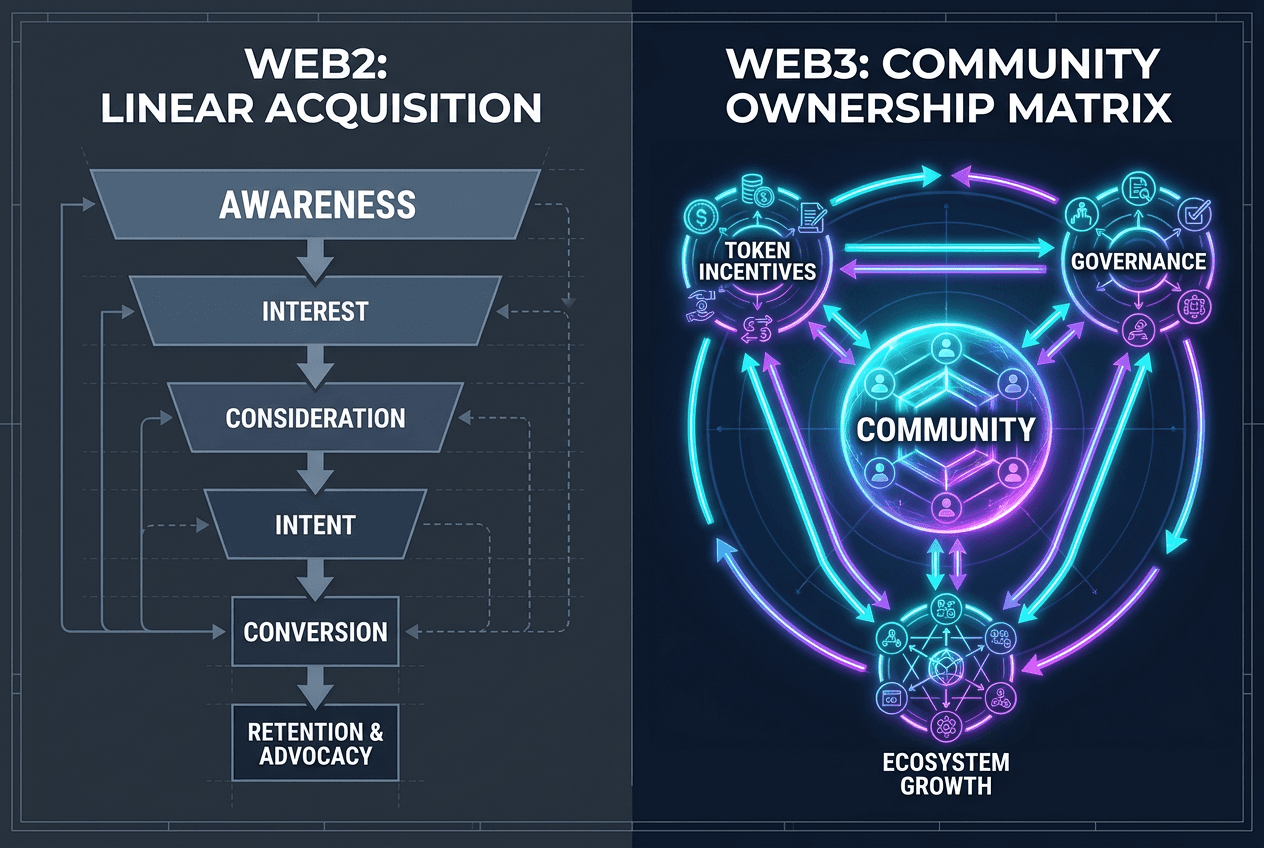
Traditional Web2 funnels fail in crypto because they ignore the recursive nature of community ownership and token-aligned incentives that drive infrastructure adoption.
Tokenized incentives “solve the cold start problem” by bootstrapping network effects, as a16z's framework suggests, yet this only succeeds when paired with strict sybil resistance and ROI-driven campaign architecture. Projects that treat GTM as a series of airdrops and paid media often wind up with fleets of bots and negligible developer engagement - what matters is sustainable onboarding and narrative-led community formation.
The agency-led, full-stack GTM model, as pioneered by OMNI, integrates narrative design, influencer strategy, paid campaigns, and on-chain analytics under one roof. This systems-driven approach outperforms DIY chaos precisely because it coordinates every layer - from Discord seeding to KOL activation to technical attribution - freeing infrastructure teams to focus on building.
The 3-Layer Narrative Architecture (Building the Foundation)
Winning in Web3 infrastructure starts with a three-part narrative: aligning macro trends (Market), staking your ground in the category (Category), and letting protocol mechanics (Protocol) do the talking.
Market Layer: Why Now? The macro “why” underpins every great protocol launch. Is the surge in ZK rollups creating new security primitives? Are rising gas fees bottlenecking developer demand? OMNI Agency helps teams root their launch in a trend that VCs, developers, and early users are already primed for.
Category Layer: Why You? Here, competitive positioning is critical: Are you the fastest L2? The most developer-friendly RPC? The most modular middleware? Your answer informs messaging, partnerships, and even the eventual liquidity funnel. Copycat launches die at this stage without clear differentiation.
Protocol Layer: How? Protocol mechanics - token utility, permissionless APIs, permissioned compliance, dual-token models - are the details that convert technical interest into real adoption. Founders must build “narrative bibles” that align documentation, onboarding, social, and KOL outputs into one cohesive vision. When these layers slip, adoption becomes a leaky bucket - regardless of how much hype you generate.
The 90-Day Execution Framework: Whisper, Tease, Shout
A 90-day phased GTM - Whisper, Tease, Shout - is the proven foundation for crypto infrastructure launches that convert attention into measurable user and volume growth.
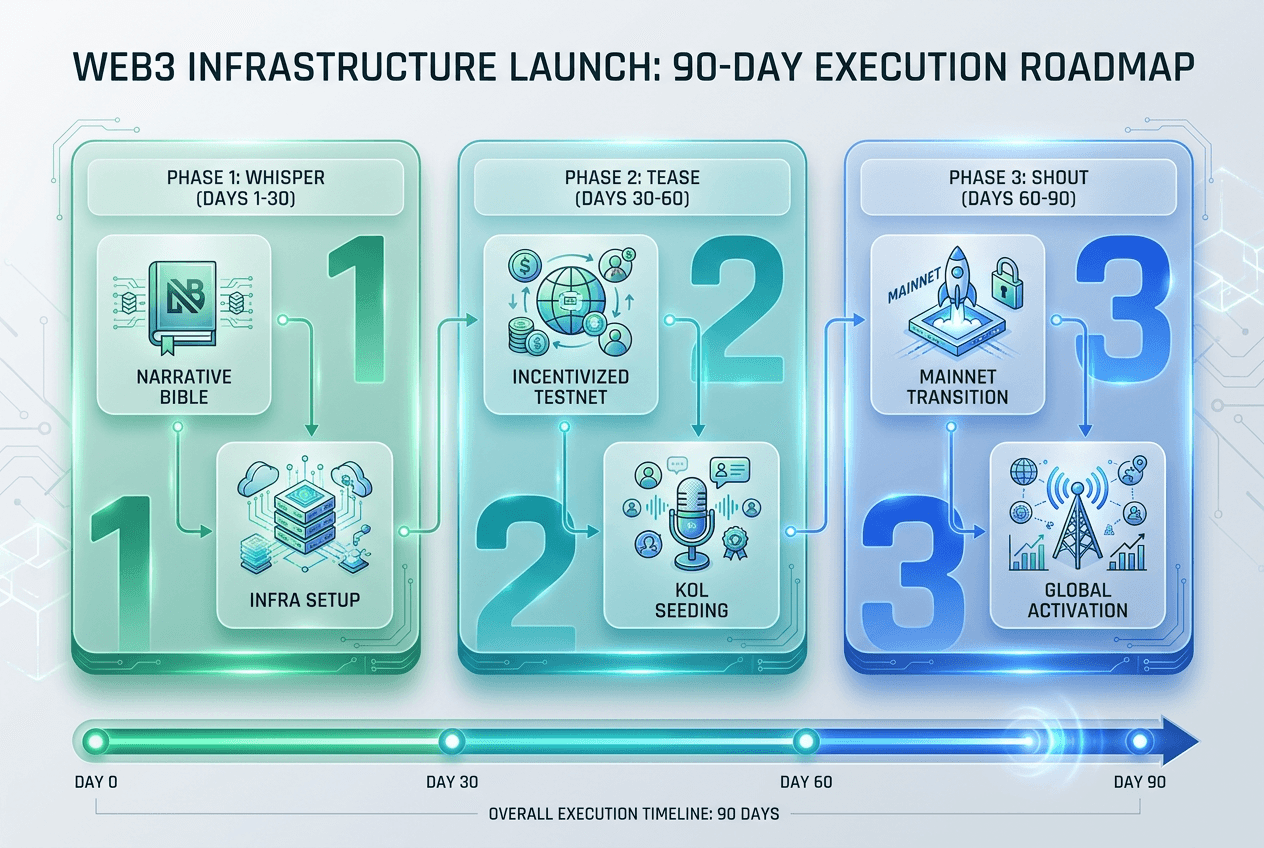
The Whisper-Tease-Shout framework provides a systematic approach to building anticipation and liquidity before a full-scale protocol launch.
Phase 1: Whisper (Days 1-30)
Internal GTM alignment and narrative bible creation.
Technical onboarding: developer docs, private testnet, SDKs.
Early influencer/KOL mapping for future activation.
Phase 2: Tease (Days 30-60)
Launch of incentivized testnets: allocate 0.5%-3.0% of total token supply for rewards (Surgence Labs, 2026).
Waitlist campaigns: Galxe quests, Layer3/Zealy on-chain verifications.
“Lunch & Learn” demos for high-value devs and decision-maker buyers.
Phase 3: Shout (Days 60-90)
Public mainnet launch coordination across all channels: technical KOL callouts, paid campaign bursts, Discord AMA takeovers.
Liquidity bootstrapping and integration bounties.
Real-time attribution dashboards (Dune, Nansen) for campaign ROI.
A leading RPC protocol saw $25M in launch volume and 150K transactions in 2 weeks using a compressed version of this playbook. This roadmap's power comes not from attention alone, but by weaving narrative, incentives, and technical education into a self-optimizing system.
The Infrastructure Stack: Tools for a 2026 Launch
Launching a crypto infrastructure protocol in 2026 demands a full-stack toolkit that addresses community growth, on-chain scaling, security, and attribution - with each tool selected for Web3-native use, not Web2 bolt-ons.
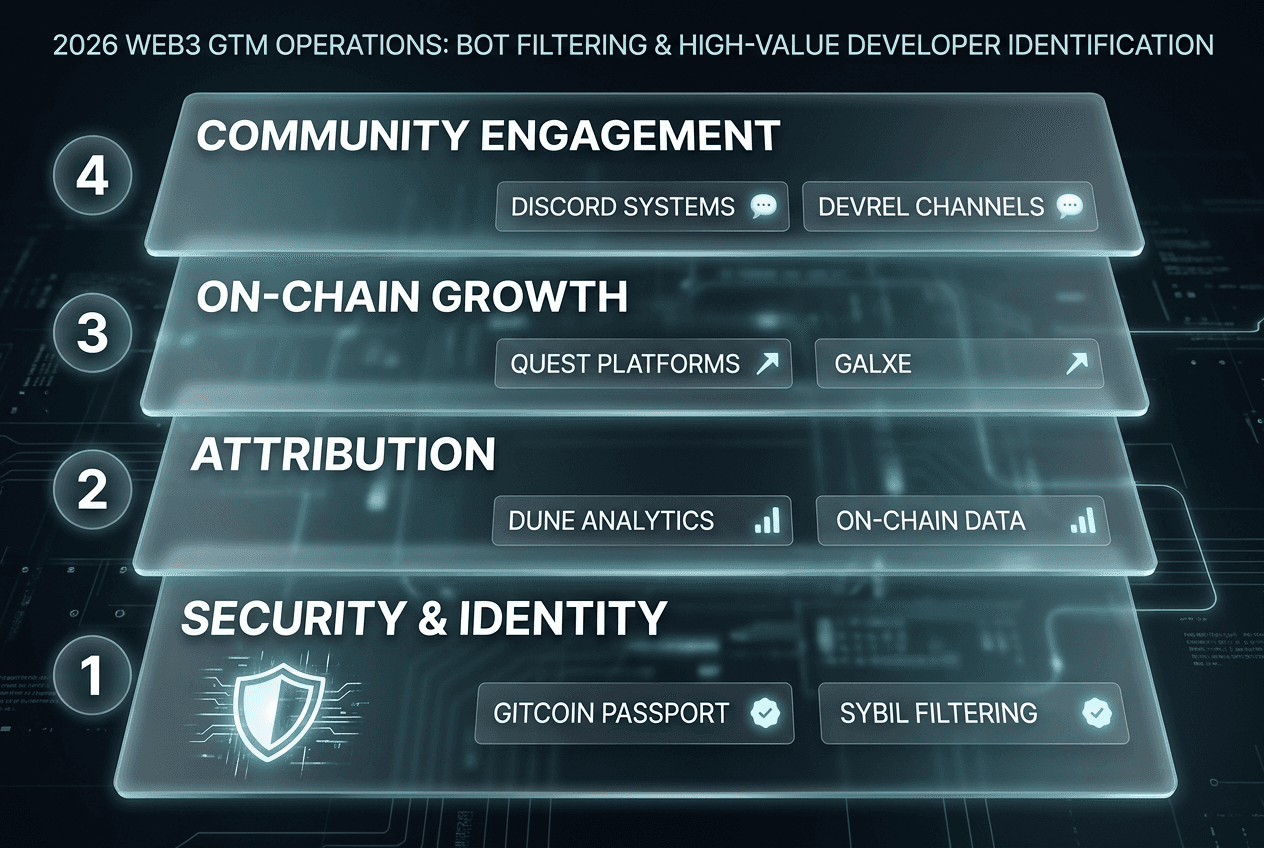
A modern GTM stack for infrastructure projects integrates sybil-resistant identity tools with deep on-chain attribution to ensure growth is organic and sustainable.
Stack Layer | Example Tools | Outcome |
|---|---|---|
Community | Discord, Telegram | Progression systems, support & global reach |
On-Chain Growth | Galxe, Layer3, Zealy | >36M quest-based users, on-chain users |
Security/Identity | Human Passport, Trusta Labs | $430M+ protected from sybils (120+ projects) |
Attribution | Dune Analytics, Nansen, Arkham | Real-time ROI analysis, ecosystem health |
Community Layer: Discord delivers deep progression (leveling, roles, “proof of build” contests), while Telegram expands reach via airdrop bots and global mod teams. For a step-by-step breakdown, see Building a Thriving Discord Community: A Step-by-Step Guide.
On-Chain Growth: Platforms like Galxe (with 36M+ users) and Layer3/Zealy drive user acquisition and keep campaigns sybil-resistant by tightly integrating identity and quest-based reward loops.
Security & Identity: Human Passport (formerly Gitcoin) is tier-one - protecting $430M in value - while Trusta Labs offers advanced bot filtering. Token allocations for testnet rewards here are a double-edged sword: 0.5%-3.0% is standard, but only when paired with these security tools.
Attribution: Dune, Nansen, and Arkham power campaign ROI tracking with real-time dashboards. Infrastructure teams adopting these tools reclaim up to 60% of founder bandwidth otherwise lost to spreadsheet chaos.
For help operationalizing this stack, OMNI's Crypto Community Management services and Crypto Influencer Marketing offer turnkey integration, having powered go-to-market success for projects like Polkadot and Slingshot.
Measuring What Matters (Beyond Vanity Metrics)
The most dangerous mistake in Web3 GTM is anchoring on vanity metrics - Twitter followers, Discord member counts, or superficial “community reach.” Instead, winning protocols track activation metrics with real economic impact: 30-day developer retention, TVL stickiness, testnet-to-mainnet conversion, and ecosystem fund deployment.
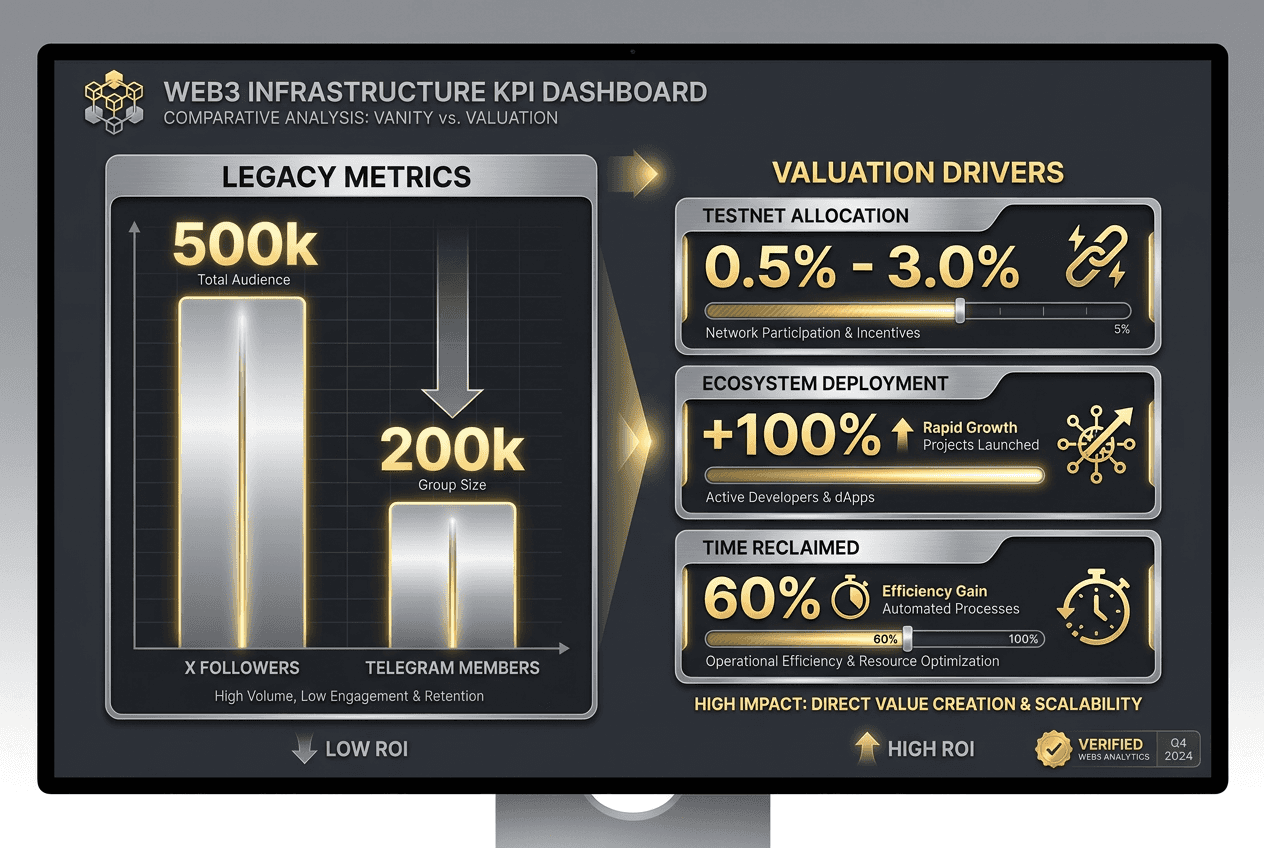
Shifting focus from vanity metrics to on-chain activation and ecosystem deployment is critical for establishing long-term protocol valuation and developer trust.
Metric Category | Examples | Why It Matters |
|---|---|---|
Vanity Metrics | Follower Count, Impressions, Airdrop Claims | Can be botted, rarely translate to adoption |
Activation Metrics | Day-30 Retention, TVL Stability, Ecosystem Fund Deployment | Predicts sustainable usage |
Surgence Labs documented a case where shifting GTM from “hype” to “activation” drove $2B+ in TVL and $6B in FDV for a DeFi protocol within five months - far outpacing metrics-driven teams who grew fast and fizzled. Post-launch, the right approach is "gardening," not harvesting: cultivate developer relations, run targeted upgrade quests, and monitor real upgrade events via on-chain attribution.
For a deep dive into measuring these KPIs while running marketing, see Mastering Crypto Exchange Marketing Strategies: A Comprehensive Guide.
Building Community for Web3 Middleware and RPC Projects
Community-building for Web3 middleware or RPC infrastructure goes far beyond simple Discord “hype.” It starts with Developer Relations (DevRel) as the primary GTM motion - targeting technical education, feedback loops, and integration support, not just airdrops or meme contests.
Direct developer engagement means recruiting early adopters in niche circles (Telegram, Discord, and specialized forums) and empowering them to become peer educators via ambassador programs. Middleware projects should structure feedback channels (dedicated “#builders” and “#integrations”), regular virtual hackathons, and gated access based on proof-of-use, not just social following.
Advanced community building leverages OMNI’s proprietary network of 500+ partner communities and product-oriented integrations, as executed in Slingshot’s launch, which built a 250,000-person base from zero by tapping technical users first and top-of-funnel followers later.
Middleware teams win when they track not just Discord growth, but also monthly active integrations, volume passing through APIs, and NPS from core developers. OMNI’s Web3 marketing strategy illustrates how infrastructure GTMs build real momentum by blending developer support and token-driven incentives.
Technical KOL Strategy: From Hype Creators to Educators
Securing technical Key Opinion Leaders (KOLs) is not about mass “hype spraying” - it’s about engaging educators who can credibly break down your protocol’s mechanics for (often skeptical) developer audiences.
Deploy a tiered KOL approach:
KOL Type | Audience | Ideal Activation Format | Outcome |
|---|---|---|---|
Hype Creators | Retail, NFT/DeFi | Giveaways, AMAs, Tweet threads | Short-term reach |
Technical Educators | Developers, B2B | Code reviews, live integrations, deep dives | Lasting trust & ecosystem growth |
Successful launches pair the two. For infra startups, Technical Educators matter most: their code walkthroughs, security critiques, and architecture sessions directly impact B2B adoption and integrations. OMNI leverages relationships with creators recognized in core crypto dev circles, not just X/Twitter threads.
To see KOL activation in a live context, the PiP World Case Study demonstrates how onboarding technical KOLs leads to over 500,000 active users - by fusing depth-first developer content with mainstream amplification.
For more on influencer segmentation, consult Web3 Influencer Marketing: The Future of Advertising.
Sybil and Bot Filtering: The Cost of Ignoring Proof of Personhood
Sybil and bot attacks are the single largest threats to sustainable community formation and reward distribution in Web3 infrastructure launches. Relying on follower counts or basic “wallet connect” quests is a fast track to skewed metrics and drained GTM budgets.
Robust filtering, using tools like Human Passport, now protects over $430M in capital and covers more than 120 live projects. Integrating sybil-resistant identity checks (CAPTCHAs, social graph clustering, GitHub SSO) is no longer optional for projects running testnet incentives or ecosystem bounties.
Deploying these tools costs a sliver of the GTM budget - often less than 1% of token launch expense - but failing to use them can mean losing over 50% of reward allocations to bots, according to Human Tech. The long-term ROI? Verified users with real LTV, and a foundation for frictionless deployment of token airdrop strategies that won’t flood your community with short-term mercenaries.
h2, h3
