
72
Published
July 2026
Updated
July 2026
How to Market a Crypto Trading Platform: The 2026 GTM & Content Strategy Playbook

Tyler Mullins
Founder & Owner of OMNI
Introduction
Most crypto trading platforms invest heavily in product features but struggle to gain users. They assume better charts, lower fees, or faster execution will automatically win traders. It doesn't work that way. By the time most founders realize their product isn't the problem - their distribution is - they've burned through 60% of their marketing budget on tactics that don't match how crypto traders actually discover and trust new platforms.
The issue compounds quickly. Traditional Web2 marketing playbooks fail in crypto because traders research across fragmented channels (X threads, Discord servers, Telegram groups), distrust centralized platforms after FTX, and demand proof of security and liquidity before signing up. Meanwhile, 84% of crypto users spend their time on X, Telegram, and YouTube - platforms where your typical Google Ads campaign gets ignored and your blog posts never surface.
What follows is the complete picture - the GTM and content infrastructure that works for crypto trading platforms in 2026, built on verified data from platforms that scaled to billions in trading volume. Not theory. Not hype. The exact frameworks that turn product builders into market leaders.
Key Takeaways
Traditional Web2 marketing fails for crypto trading platforms because traders demand on-chain proof and research across fragmented, crypto-native channels where standard ads and SEO don't reach them.
The 3-Layer Narrative Framework (Market, Category, Protocol) ensures your content stays relevant to broad trends while funneling users toward your platform's specific value proposition.
Educational SEO built as an "Academy" rather than a blog captures high-intent "how to trade" traffic and creates a moat that competitors can't quickly replicate.
The Whisper → Tease → Shout launch framework moves users from curiosity to active participation, driving maximum momentum for trading competitions and new feature rollouts.
Tracking LTV and ROAS instead of vanity metrics like follower count allows crypto platforms to optimize for actual growth and identify which channels convert users who trade.
Real-time "signal feeds" that share AI-detected patterns or on-chain data as social content turn your product into a content engine that attracts traders organically.
Table of Contents
Why Traditional Web2 Marketing Fails for Crypto Trading Platforms
The 3-Layer Narrative Framework: Designing Your Market, Category, and Protocol Stories
Educational SEO: Building an "Academy" vs. a Blog
How to Do Crypto Marketing Through Social Distribution
The Whisper → Tease → Shout Framework for Feature Launches
Technical Attribution: Tracking LTV and ROAS in Web3
Product Marketing vs. Token Marketing: Understanding the Distinction
Frequently Asked Questions
Why Traditional Web2 Marketing Fails for Crypto Trading Platforms
Traditional Web2 marketing doesn't work for crypto trading platforms because traders operate in a fundamentally different research and trust environment. Unlike SaaS or e-commerce buyers who rely on Google reviews and comparison sites, crypto traders cross-reference information across X threads, Discord channels, and Telegram groups before they'll deposit a single dollar. According to Chainalysis, $40.9 billion was received by illicit addresses in 2024 (with estimates reaching $51B), creating an environment where skepticism is rational and trust must be earned through transparency and proof.
Standard acquisition playbooks fail on three fronts. First, traders don't convert from generic "sign up now" ads - they need to see proof of liquidity, security audits, and real user activity before considering a new platform. Second, SEO strategies built around product pages miss the educational intent that drives most crypto searches. When someone searches "how to read candlestick patterns," they're not ready to sign up - they're looking for authority and structured learning that positions your platform as the expert. Third, traditional attribution models break in Web3. A trader might discover your platform through an X thread, lurk in your Discord for three weeks, watch a YouTube tutorial, then finally sign up through a direct link - and your analytics will credit "direct traffic."
The platforms that succeed in 2026 treat marketing as infrastructure, not campaigns. They build educational moats through comprehensive academies, turn product data into social content through real-time signal feeds, and optimize for long-term value (LTV) rather than vanity metrics. Adjust research shows that 70% of marketers struggle to act on marketing insights due to poor attribution tools - but the issue isn't the tools, it's the assumption that crypto buyers behave like Web2 consumers.
Here's what actually works: content that demonstrates expertise before asking for conversion, distribution across the platforms where traders already congregate (not where marketers wish they were), and measurement systems that track wallet connections and trading volume instead of page views and email opens. Every successful crypto trading platform we've worked with at OMNI Agency has made this shift - from treating marketing as a "launch campaign" to building it as an always-on content and community engine that compounds over time.
The 3-Layer Narrative Framework: Designing Your Market, Category, and Protocol Stories
The 3-Layer Narrative Framework ensures your content remains relevant at every stage of market awareness while systematically funneling users toward your specific platform. Developed by elite Web3 agencies and validated across dozens of protocol launches, this framework addresses a core problem: most crypto projects either talk only about themselves (too narrow) or only about "the future of finance" (too broad). Neither approach converts. The three layers are Market (macro trends), Category (your specific vertical), and Protocol (your unique solution) - and each layer targets a different user segment at a different awareness stage.
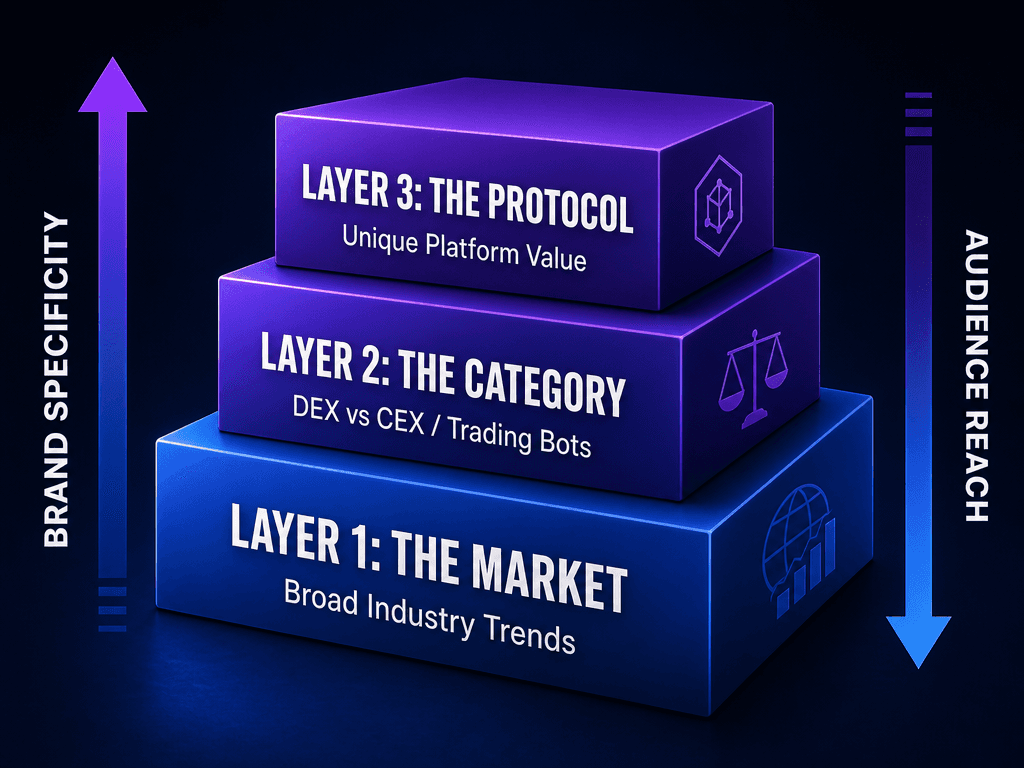
Implementing a three-layer narrative ensures your content remains relevant to broad market trends while effectively funneling users toward your platform's specific unique value proposition.
Layer 1: Market Narrative (Top of Funnel) This is your broadest content layer, designed to capture attention from anyone interested in crypto or decentralized finance - not just people actively searching for a trading platform. Market-layer content addresses macro trends: "Why on-chain trading volume is migrating from CEXs to DEXs," "How institutional adoption is changing crypto liquidity," or "The shift from speculative to utility-driven trading." This content lives on your blog, gets shared widely on X, and positions your brand within the larger industry conversation. The goal isn't immediate conversion - it's to become a recognized voice so that when a trader is ready to evaluate platforms, they already know your name.
Layer 2: Category Narrative (Middle of Funnel) Category content narrows the focus to your specific vertical within crypto trading. If you're a DEX, this is where you explain "How decentralized exchanges ensure custody and privacy" or "Why automated market makers (AMMs) outperform order books for mid-cap tokens." If you're a trading terminal, you're creating content around "How professional traders use multi-exchange aggregators" or "The role of advanced charting in swing trading strategies." This layer educates users on the problem your category solves and establishes the criteria by which platforms in your space should be evaluated - criteria where your platform excels.
Layer 3: Protocol Narrative (Bottom of Funnel) Protocol-layer content is platform-specific. It highlights your unique features, security architecture, fee structure, and user outcomes. This is where you publish "How [Platform Name] achieves sub-100ms execution speeds" or "Why [Platform Name] traders see 23% lower slippage on mid-cap pairs." You're no longer educating on the category - you're demonstrating why your platform is the best choice within that category. According to Surgence Labs, top crypto projects use this 3-Layer Narrative to ensure repeatable distribution by aligning content with each stage of user sophistication.
Here's how it works in practice. A trader searching "is crypto worth it in 2026" finds your Market-layer blog post and follows you on X. Two weeks later, they see your Category-layer thread explaining why DEXs are safer post-FTX and join your Discord. A month later, they're evaluating platforms and your Protocol-layer comparison page demonstrates lower fees and higher liquidity - and they sign up. Without the Market layer, they never knew you existed. Without the Category layer, they didn't understand why your type of platform mattered. Without the Protocol layer, they couldn't differentiate you from competitors.
Most trading platforms skip straight to Layer 3 and wonder why their content doesn't convert. The framework works because it mirrors how traders actually move through awareness stages - from general interest to category education to platform comparison. At OMNI Agency, we've used this structure to scale trading platforms from zero to millions in daily volume by ensuring content serves every stage of the user journey, not just the final conversion moment. For a deeper look at structuring crypto-native content strategies, see our comprehensive crypto marketing strategy guide.
Educational SEO: Building an "Academy" vs. a Blog
Building an "Academy" instead of a standard blog creates an educational moat that captures high-intent search traffic and establishes your platform as the authoritative source for trading education. The difference isn't cosmetic - it's structural. A blog publishes content chronologically with no learning path. An academy organizes content into progressive modules (Beginner, Intermediate, Advanced) that guide users from foundational concepts to advanced strategies, with your platform serving as the practical lab where they apply what they learn.
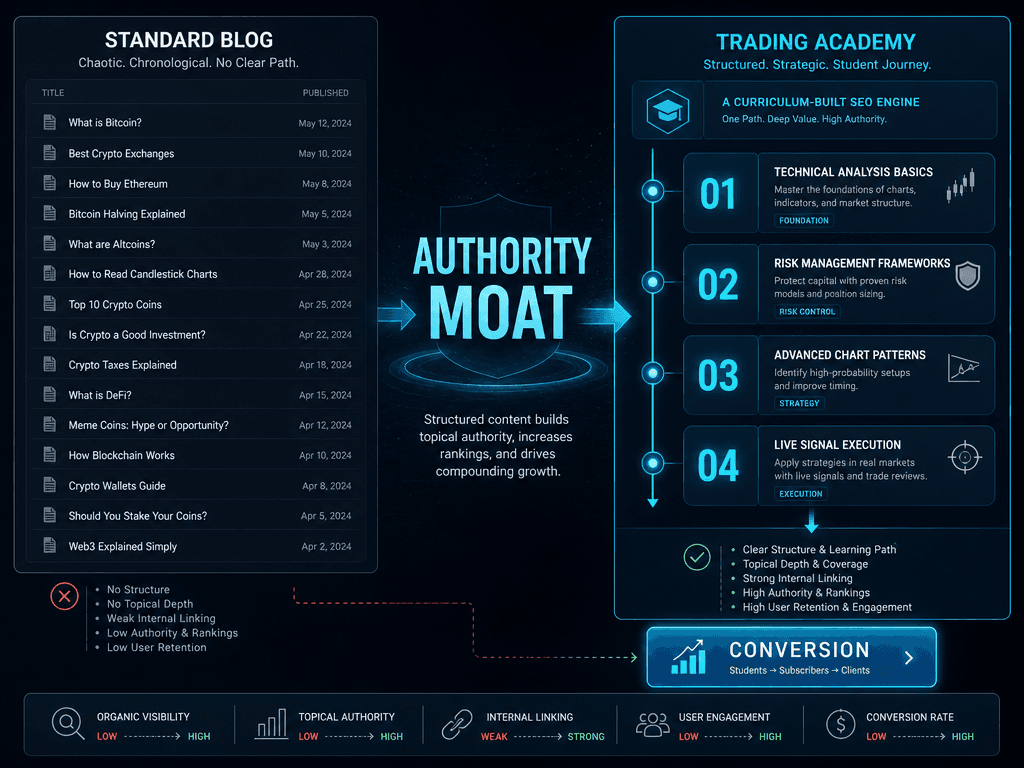
Transitioning from a standard blog to a structured academy creates an educational moat that captures high-intent search traffic and builds long-term trader loyalty.
Platforms like altFINS have proven this approach at scale. Instead of scattering trading education across disconnected blog posts, altFINS built a structured Knowledge Base with 10-13 lesson modules covering everything from candlestick patterns to AI-detected chart signals. The result: they rank for thousands of high-intent educational keywords ("how to read MACD," "bull flag pattern explained," "fibonacci retracement strategy") that competitors can't easily replicate because building a comprehensive academy requires months of coordinated effort. A blog post can be copied in a week. An academy takes institutional commitment.
Here's the structure that works. Module 1: Trading Fundamentals (Beginner) - covers basic concepts like order types, market vs. limit orders, reading price charts, and understanding liquidity. Module 2: Technical Analysis (Intermediate) - dives into candlestick patterns, trend lines, support/resistance levels, and indicator overlays (RSI, MACD, Bollinger Bands). Module 3: Advanced Strategies (Advanced) - explores swing trading, scalping, arbitrage, and risk management frameworks. Module 4: Platform Mastery (Conversion) - shows users how to execute these strategies specifically on your platform, with screenshots, video walkthroughs, and real trade examples.
Each module should contain 4-8 lessons, with every lesson optimized for a specific search query. The academy homepage becomes a hub page that ranks for "[Your Platform] trading guide" and "[Your Platform] academy," while individual lessons target long-tail keywords. Internal linking between lessons and from lessons to platform features ensures users naturally flow from education to activation.
The SEO advantage compounds over time. Blog posts compete with every other recent article on a topic. Academy lessons compete with permanent educational resources like Investopedia and Binance Academy - and you win by being more niche and platform-specific. When someone searches "how to trade breakouts on DEX," your academy lesson titled "Breakout Trading on Decentralized Exchanges: A Step-by-Step Guide" outranks generic blog posts because it matches the exact search intent and provides a complete answer.
Building an academy requires coordinated effort - keyword research to identify educational queries, a content team to write comprehensive lessons, a designer to create visual aids (annotated charts, comparison tables), and ongoing updates as trading strategies evolve. But the payoff is a permanent content asset that attracts traders at the top of the funnel, builds trust through education, and converts users by positioning your platform as the natural next step. At OMNI Agency, we've implemented academy-style SEO for multiple trading platforms, and the data is consistent: structured educational content generates 3-5x more organic traffic and converts 40% better than standard blog posts because users arrive with higher intent and greater trust in your expertise. To see how we've applied similar strategies in related verticals, explore our work on Web3 content distribution.
How to Do Crypto Marketing Through Social Distribution
Crypto marketing succeeds through social distribution because 84% of crypto users spend the majority of their time on X (formerly Twitter), Telegram, and YouTube - not on Google or traditional ad platforms. The research is definitive: according to CoinGecko's 2025 user survey, crypto traders discover new platforms, evaluate security claims, and decide where to trade based primarily on what they see in their social feeds and community channels. This means your distribution strategy isn't an add-on to your content strategy - it is your content strategy.
The platforms break down by function. X (Twitter) is where narrative spreads and credibility is established. Traders follow founders, analysts, and platforms that share real-time insights, chart analysis, and market commentary. A single well-timed thread breaking down a market move or explaining a new feature can generate thousands of impressions and drive meaningful traffic. Telegram is where communities congregate for real-time updates, trading signals, and support. Active Telegram groups signal legitimacy - inactive ones signal a dead project. YouTube is where educational content converts skeptics into users through long-form tutorials, platform walkthroughs, and strategy breakdowns that build trust over 10-20 minutes instead of 280 characters.
Here's the mistake most platforms make: they treat social as a broadcast channel. They post announcements, share blog links, and wonder why engagement flatlines. Social distribution in crypto works when you create content specifically for each platform's format and user behavior. On X, that means threads that teach or reveal something new, not promotional posts. On Telegram, that means facilitating user-to-user discussion and sharing real-time data (price alerts, volume spikes, new listings) that members find valuable. On YouTube, that means comprehensive tutorials that demonstrate your platform's value through screen recordings and real trade examples.
The highest-performing content type across all platforms is the "signal feed" - real-time data or analysis that positions your platform as a source of actionable intelligence. AltFINS does this by sharing AI-detected chart patterns the moment they appear: "Our system just flagged a bullish divergence on $SOL - here's the setup." This content serves two purposes: it provides immediate value to traders (who can act on the signal) and demonstrates the platform's core feature (AI-driven pattern recognition) without a sales pitch. Users share it because it's useful, and followers convert because they want access to the tool that generates these insights.
Platform | Primary Use Case | Content Format That Converts | Posting Frequency | Metric to Track |
|---|---|---|---|---|
X (Twitter) | Narrative building, real-time commentary | Threads (5-10 tweets), chart analysis with screenshots, market takes | 3-5x daily (mix of threads and quick takes) | Engagement rate (replies + RTs) |
Telegram | Community engagement, signal distribution | Price alerts, volume spikes, AMA sessions, trading tips | Multiple times daily (real-time updates) | Daily active users (DAU) |
YouTube | Education, platform demos | 8-15 min tutorials, strategy walkthroughs, platform feature deep-dives | 1-2x weekly | Watch time + click-through to platform |
Discord | Support, advanced user community | Dedicated channels for strategies, live trading discussions, bot integrations | Ongoing moderation + weekly events | Message count + wallet connections |
Long-form discussion, credibility building | Detailed market analysis, AMA threads, community-sourced insights | 2-3x weekly in relevant subreddits | Upvotes + comment depth |
The mistake to avoid: trying to be everywhere at once with thin content. Pick 2-3 platforms where your target users actually spend time and commit to creating platform-native content consistently. A trading terminal targeting active day traders should focus on X (for real-time market takes) and Discord (for advanced strategy discussion). A beginner-friendly DEX should prioritize YouTube (for educational walkthroughs) and Telegram (for community onboarding). At OMNI Agency, we've built social strategies that drove over 1.2 million community members and followers for crypto launches by matching content format to platform behavior instead of recycling the same post across every channel. For a closer look at how we execute platform-specific social strategies, see our crypto social media marketing work.
The Whisper → Tease → Shout Framework for Feature Launches
The Whisper → Tease → Shout framework moves users from curiosity to active participation by building insider momentum before any public announcement, ensuring that feature launches and trading competitions gain maximum traction the moment they go live. Developed by Surgence Labs and validated across dozens of protocol launches, this framework solves a core problem: most crypto projects announce features with a single "LIVE NOW" post and wonder why adoption is slow. The issue isn't the feature - it's the lack of pre-launch anticipation.
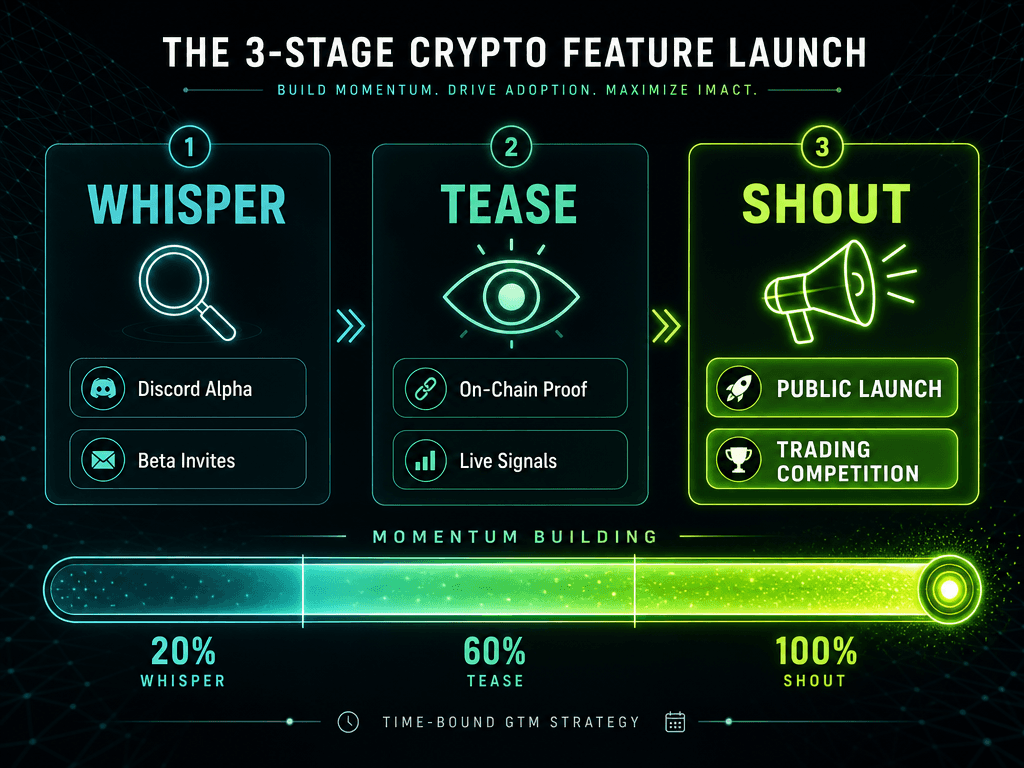
The Whisper-Tease-Shout framework moves users from curiosity to active participation, ensuring that feature launches and trading competitions gain maximum momentum within the community.
Here's how each phase works and what it accomplishes.
Phase 1: Whisper (2-4 Weeks Before Launch) This is the insider phase. You're not making public announcements - you're seeding curiosity among your most engaged community members, advisors, and strategic partners. In private Discord channels or Telegram groups, you drop hints about what's coming without revealing specifics: "We've been testing something that completely changes how you discover trading opportunities" or "Early access to a feature that's been requested for months - insiders will get it first." The goal is to create a sense of exclusivity and insider knowledge. Users start speculating, asking questions, and feeling like they're part of something before it's public. This builds organic word-of-mouth before you've spent a dollar on promotion.
For trading platforms, this phase works especially well for new asset listings, advanced charting features, or trading competitions. Let your top 100 traders know something is coming and that their feedback will shape the final version. The Whisper phase doesn't just build anticipation - it validates demand and surfaces potential issues before a public launch.
Phase 2: Tease (1-2 Weeks Before Launch) Now you go semi-public. Teasers hit your main social channels (X threads, YouTube community posts, Telegram announcements) but still don't reveal full details. You're showing just enough to generate FOMO while withholding the complete picture. Share screenshots with key details blurred, post countdown graphics, run polls asking users what they're most excited about, or release a behind-the-scenes video showing the team testing the feature. The Tease phase expands the insider circle from your core community to your broader audience.
For a trading competition, this is when you announce the prize pool and registration timeline without revealing the full rules. For a new charting tool, you show a single annotated screenshot demonstrating a unique capability. The content must be specific enough to be interesting but incomplete enough to drive users to your Discord or landing page for more information. During this phase, you're also building a waitlist or early access sign-up that converts curiosity into committed users before launch.
Phase 3: Shout (Launch Day & Post-Launch) The feature is live and you're shouting it from every channel. This is when you deploy paid ads, publish the full announcement blog post, send email blasts, coordinate influencer posts, and run live demos on YouTube or X Spaces. But because you ran Whisper and Tease phases, you're not launching into silence - you're launching into a community that's already primed and waiting. Your most engaged users have been waiting weeks for this moment and they're ready to participate, share, and amplify.
During the Shout phase, your goal shifts from building awareness (already done) to facilitating participation. For a trading competition, this means live leaderboards, real-time winner updates, and user-generated content showcasing big trades. For a new feature, this means tutorials, walkthroughs, and case studies showing how early adopters are already using it to improve their trading.
The framework works because it aligns with how crypto communities actually behave. Traders want to feel like insiders. They want to discover opportunities before the crowd and participate in exclusive events. According to Surgence Labs research, crypto projects using the Whisper-Tease-Shout framework see 3-5x higher participation rates on launch day compared to standard "big announcement" launches because users arrive with existing context, anticipation, and social proof that others are already engaged.
At OMNI Agency, we've applied this framework to feature launches for trading platforms and seen participation rates jump from 8-12% of the community (standard launch) to 35-40% (Whisper-Tease-Shout) because users felt included in the launch process rather than being marketed to. For a deeper dive into how we orchestrate these multi-phase launches across multiple channels, explore our crypto influencer marketing approach.
Technical Attribution: Tracking LTV and ROAS in Web3
Tracking lifetime value (LTV) and return on ad spend (ROAS) in Web3 requires abandoning vanity metrics like follower count and focusing on wallet connections, trading volume, and user retention - the only metrics that predict actual revenue. According to Adjust, 70% of marketers struggle to act on marketing insights due to poor attribution tools, but the real issue isn't the tools - it's that most crypto platforms measure the wrong things. A trader who signs up but never deposits is worthless. A trader who deposits $100, completes one trade, and leaves is marginally better. A trader who deposits $5,000 and trades weekly for six months is your target user - and you need to know which acquisition channel brought them in.

Moving beyond vanity metrics allows crypto trading platforms to optimize for actual growth by tracking Long-Term Value (LTV) and specific user activation data.
Here's the attribution model that works for crypto trading platforms.
Step 1: Define Activation Events (Not Just Sign-Ups) Activation is the point where a user demonstrates real intent to trade. For most platforms, this is "completed first trade" or "deposited funds." Everything before activation is a lead, not a user. Track activation rate by source: if paid ads drive 1,000 sign-ups but only 50 activations (5% activation rate) while X threads drive 200 sign-ups and 60 activations (30% activation rate), X is your better channel even though it delivers fewer raw sign-ups.
Step 2: Track Per-Channel LTV Over Time LTV is the total trading fees generated by a user over their lifetime on your platform. To calculate per-channel LTV, tag each user at acquisition with their source (X thread, YouTube tutorial, paid ad, referral) and track their trading volume over 30, 60, and 90 days. You'll quickly see that users from educational content (academy lessons, YouTube walkthroughs) have 2-3x higher LTV than users from paid ads because they arrive with higher intent and better understanding of your platform's value. This data should shift your budget allocation - if your academy-driven users generate $400 LTV and your paid ad users generate $120 LTV, you should invest more in SEO and content even if it takes longer to scale.
Step 3: Measure ROAS by Cohort, Not Campaign ROAS (Return on Ad Spend) in Web3 isn't measured in 7-day windows like e-commerce. A trader might discover your platform through a paid ad, research for two weeks, then activate after seeing an organic X post. Standard attribution tools will credit the last click (the X post) and miss the paid ad that started the journey. Instead, measure ROAS by acquisition cohort over 90 days. If you spent $10,000 on paid ads in January and those users generated $35,000 in trading fees by April, your true ROAS is 3.5x - even if your 7-day ROAS looked like 0.8x.
Step 4: Build a "Value Ladder" of User Actions Not every user action is equally valuable. A wallet connection is more valuable than a site visit. A first deposit is more valuable than a wallet connection. A $1,000 deposit is more valuable than a $50 deposit. A user who trades weekly is more valuable than a user who trades once. Build a scoring system that assigns points to each action and use it to calculate "value per acquisition source." This helps you identify which channels bring high-value users vs. low-value users who churn after one interaction.
Metric | Definition | Why It Matters | How to Track |
|---|---|---|---|
Activation Rate | % of sign-ups who complete their first trade or deposit | Separates real users from tire-kickers | Tag users at acquisition, measure first trade completion within 7 days |
LTV (Lifetime Value) | Total trading fees generated by a user over 90+ days | Tells you which channels drive profitable users, not just volume | Track per-user trading volume and multiply by fee % over time |
ROAS (Return on Ad Spend) | Revenue generated per dollar spent on acquisition | Determines which paid channels are profitable at scale | Measure cohort-level revenue over 90 days, not campaign-level over 7 days |
Retention Rate | % of activated users still trading after 30/60/90 days | Predicts long-term platform health and user satisfaction | Track weekly active users (WAU) by cohort |
Cost per Activation | Acquisition cost divided by activation rate | True cost of acquiring a real user, not a sign-up | Total spend / number of users who complete first trade |
Here's the strategic shift this data enables. If your YouTube tutorials cost $2,000 to produce and drive 40 activations (cost per activation: $50) with $400 LTV each, you're generating $16,000 in lifetime fees for a $2,000 investment (8x return). If your paid ads cost $5,000 and drive 200 activations (cost per activation: $25) with $120 LTV each, you're generating $24,000 in lifetime fees for a $5,000 investment (4.8x return). The paid ads look cheaper per activation, but the YouTube content delivers higher ROAS because it attracts better-quality users.
This is why the most successful trading platforms we've worked with at OMNI Agency allocate 60-70% of their budget to owned channels (SEO, YouTube, community) and 30-40% to paid acquisition. The owned channels take longer to scale but compound over time and attract higher-LTV users. The paid channels provide immediate volume to test messaging and fill gaps. For more on how we implement these measurement frameworks across crypto verticals, see our work on Web3 marketing ROI metrics.
Product Marketing vs. Token Marketing: Understanding the Distinction
Product marketing and token marketing serve fundamentally different goals and require separate strategies - one sells utility, the other sells speculation - and confusing the two is why many crypto platforms fail to gain traction despite having both a functional product and a tradable token. According to Surgence Labs, this distinction is one of the most critical strategic decisions a crypto project makes, yet most founders treat them as interchangeable. They're not.
Product marketing focuses on driving usage of your trading platform. The goal is to get traders to sign up, deposit funds, execute trades, and become active users. The messaging emphasizes features (lower fees, faster execution, better charts), benefits (make better trades, avoid slippage, access exclusive pairs), and outcomes (traders who use this platform see X% better performance). The audience is traders evaluating where to trade. The channels are educational content, tutorials, platform comparisons, and demo videos. Success is measured in DAU (daily active users), trading volume, and retention rate.
Token marketing focuses on driving demand for your platform's native token. The goal is to get investors to buy and hold the token based on its value accrual mechanisms, governance utility, or speculative upside. The messaging emphasizes tokenomics (deflationary supply, fee burn mechanisms, staking rewards), ecosystem growth (more users = more fees = more value), and narrative (positioning the token within a broader trend like DeFi or AI). The audience is token holders and speculators evaluating investment opportunities. The channels are token listings, crypto media coverage, KOL endorsements, and CEX/DEX liquidity. Success is measured in market cap, trading volume, and holder growth.
Here's why this matters: a trader looking for a better platform to execute swing trades doesn't care about your token's staking APY. An investor evaluating whether to buy your token doesn't care about your platform's charting tools. Using product messaging to market your token (or vice versa) creates confusion and fails to convert either audience.
Most successful crypto trading platforms separate the two strategies entirely. For product marketing, they build educational academies, run trading competitions, publish strategy guides, and focus on converting traders into active platform users. For token marketing, they coordinate exchange listings, publish tokenomics explainers, secure coverage in crypto media, and incentivize holding through staking or governance. The two strategies overlap in one place: incentivized usage programs where traders earn tokens for using the platform. This bridges product and token by rewarding platform activity with token distributions, aligning both user bases.
The mistake to avoid: launching a token and assuming it will drive platform adoption. It rarely works that way. Token launches create short-term attention (people buy the token, price spikes, media covers it) but don't convert token holders into active platform users unless there's a clear incentive to do so. The platforms that win use token launches as a catalyst for product adoption by structuring incentives correctly - traders who use the platform earn tokens, creating a flywheel where product usage drives token demand and token demand drives product awareness.
At OMNI Agency, we separate these strategies from the start. Product marketing gets allocated to owned content channels (SEO, YouTube, Discord community building) designed for long-term user acquisition. Token marketing gets allocated to paid media, influencer campaigns, and PR designed for short-term attention spikes around listing events. Both strategies feed the same ecosystem, but they're executed with different teams, different content, and different success metrics. For a deeper look at how we structure token launch strategies specifically, explore our crypto marketing strategy framework.
h2, h3
