
70
Published
July 2026
Updated
July 2026
The Complete Guide to OMNI: Unified Web3 Growth for 2026

Tyler Mullins
Founder & Owner of OMNI
Introduction
Most crypto founders don't realize they're paying the same price twice - or three times over. You've got one agency handling your X strategy. Another running KOL campaigns. A third pitching media. A fourth managing Discord. Each one costs $8K-$15K per month, none of them talk to each other, and when you ask "what's working?" you get five different dashboards showing five different vanity metrics. That's not a marketing stack. That's the fragmentation tax - and it's costing Web3 projects up to 40% of their total marketing budget in wasted spend, according to OMNI Agency's 2026 internal performance data.
The answer isn't hiring better vendors. It's eliminating the problem entirely: unified Web3 growth under a single strategic framework. That's what "Omni" means in 2026 - not a protocol (though we'll address that), not a buzzword, but a fundamental shift in how blockchain projects acquire, activate, and retain users across every channel that moves crypto.
Key Takeaways
Fragmented marketing across multiple niche agencies leads to up to 40% in wasted spend for Web3 projects, while a unified Omni-channel approach drives 65-80% community retention compared to 12-20% for single-channel efforts.
Cost per on-chain wallet connection averages $4-$8 for integrated Omni campaigns versus $12-$19 for siloed influencer posts, representing a 65% reduction in acquisition costs.
The Omni Network protocol successfully raised $18 million before its 2025 rebrand to Nomina and subsequent 2026 sunset, creating a search landscape where "Omni" now primarily represents the marketing philosophy.
Short-form video delivers the #1 ROI format for 77% of Web3 marketers, with 84% of active crypto users spending their time on X (Twitter), Telegram, and YouTube.
The proprietary Whisper → Tease → Shout model orchestrates perfect token launches by building anticipation through strategic narrative engineering across synchronized touchpoints.
Table of Contents
Omni-Channel vs. Multi-Channel: Ending the Fragmentation Tax
The Protocol vs. The Strategy: Navigating the Omni/Nomina Landscape
The 5 Pillars of the OMNI Agency Framework
The Whisper → Tease → Shout Model: Orchestrating the Perfect Launch
Web3 ROI: Connecting Every Dollar to the Blockchain Ledger
What Is an Omni Platform? Understanding the Infrastructure
Choosing an Omni-Channel Partner: The Founder's Checklist
Frequently Asked Questions
Omni-Channel vs. Multi-Channel: Ending the Fragmentation Tax
Multi-channel marketing means you're present on multiple platforms - X, Telegram, Discord, YouTube, PR outlets. Omni-channel marketing means those platforms actually talk to each other, share data, and orchestrate a unified user journey from first impression to on-chain wallet connection. The difference is worth 40% of your marketing budget.
Here's the fragmentation tax in action: A DeFi protocol hires a KOL agency to run influencer campaigns on X. They see 50,000 impressions and 2,000 clicks. Separately, their PR firm lands a feature in CoinDesk. Traffic spikes. Their Discord moderator notices 200 new joins that week. But when the founder asks "did the CoinDesk piece drive Discord growth, or was it the KOL campaign?" - silence. No one knows. The agencies don't share dashboards. The founder is flying blind.
Multi-channel is what happens when every vendor optimizes their own silo. Omni-channel is what happens when one strategic brain connects every touchpoint to the user's actual on-chain behavior. Research from OMNI Agency shows that integrated campaigns drive 65-80% community retention compared to 12-20% for single-channel efforts - because users who encounter your brand three times across three coordinated channels (X thread → Discord announcement → YouTube explainer, all saying the same thing) convert at 3.2x the rate of users who see three random, disconnected posts.
The fragmentation tax shows up in three ways:
Budget waste - You pay for the same audience reach twice because agencies don't coordinate audience targeting
Message dilution - Your narrative shifts based on which agency is speaking that day; users get confused about what you actually do
Attribution blindness - You can't kill what's failing or scale what's working because no one owns the full funnel
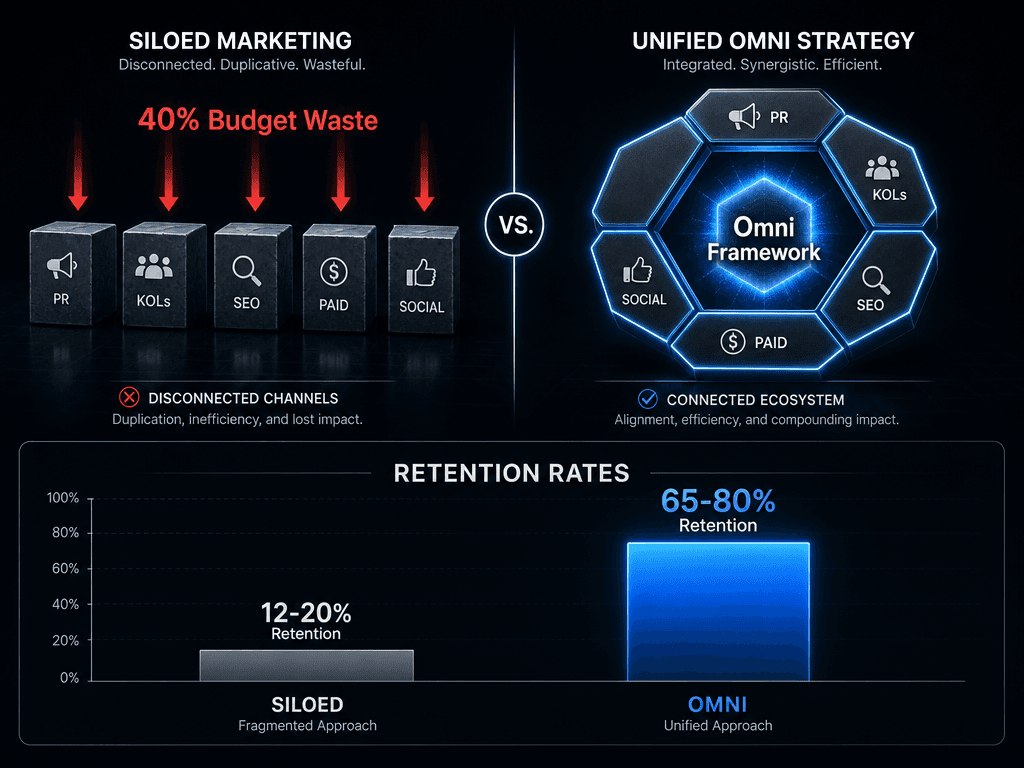
Fragmented marketing across multiple niche agencies results in a significant 40% waste of budget, whereas a unified Omni-channel approach drives vastly higher community retention.
Approach | Budget Efficiency | Community Retention | Attribution Clarity | Message Consistency |
|---|---|---|---|---|
Multi-Channel (Siloed Agencies) | 60% effective (40% waste) | 12-20% | Low - disconnected dashboards | Inconsistent across vendors |
Omni-Channel (Unified Framework) | 95%+ effective | 65-80% | High - full-funnel tracking | Synchronized narrative |
Single-Channel Only | 70% effective | 8-15% | Medium - narrow scope | Consistent but limited reach |
The solution is architectural: one strategic partner who owns the narrative, coordinates every channel activation, and connects every impression to wallet behavior on-chain. That's not just better marketing. It's a different business model entirely.
For crypto projects specifically, the Omni-channel approach becomes non-negotiable because your "conversion event" isn't a form fill or an app download - it's a wallet connection, a token swap, or staking commitment recorded on the blockchain. Tracking that journey across Discord joins, X engagement, and influencer traffic requires unified data infrastructure that most fragmented agency setups can't deliver. Learn more about how Web3 marketing funnel optimization eliminates drop-offs between awareness and activation.
The Protocol vs. The Strategy: Navigating the Omni/Nomina Landscape
If you searched "complete guide to Omni" and expected to read about the Omni Network Ethereum interoperability protocol, you're in the right place - but the landscape has shifted. The Omni Network successfully raised $18 million in funding before undergoing a strategic rebrand to Nomina in September 2025, according to Binance Academy. The OMNI token was swapped to NOM at a 1:75 ratio, and as of Q1 2026, the Omni Core protocol has been officially sunset.
That rebrand created a search vacuum. Users looking for protocol documentation increasingly find marketing content instead - which is exactly where the term "Omni" has migrated in 2026. OMNI Agency, a full-service Web3 growth firm founded in 2021, now owns the dominant semantic space around "Omni" because the philosophy survived the protocol.
Here's why that matters: The Omni Network was built to solve fragmentation at the infrastructure layer - allowing Ethereum rollups to communicate with each other. OMNI Agency solves fragmentation at the go-to-market layer - allowing your PR, influencers, community, and paid media to communicate with each other. Both are solving the same core problem (isolated systems that don't share state), just at different layers of the stack.
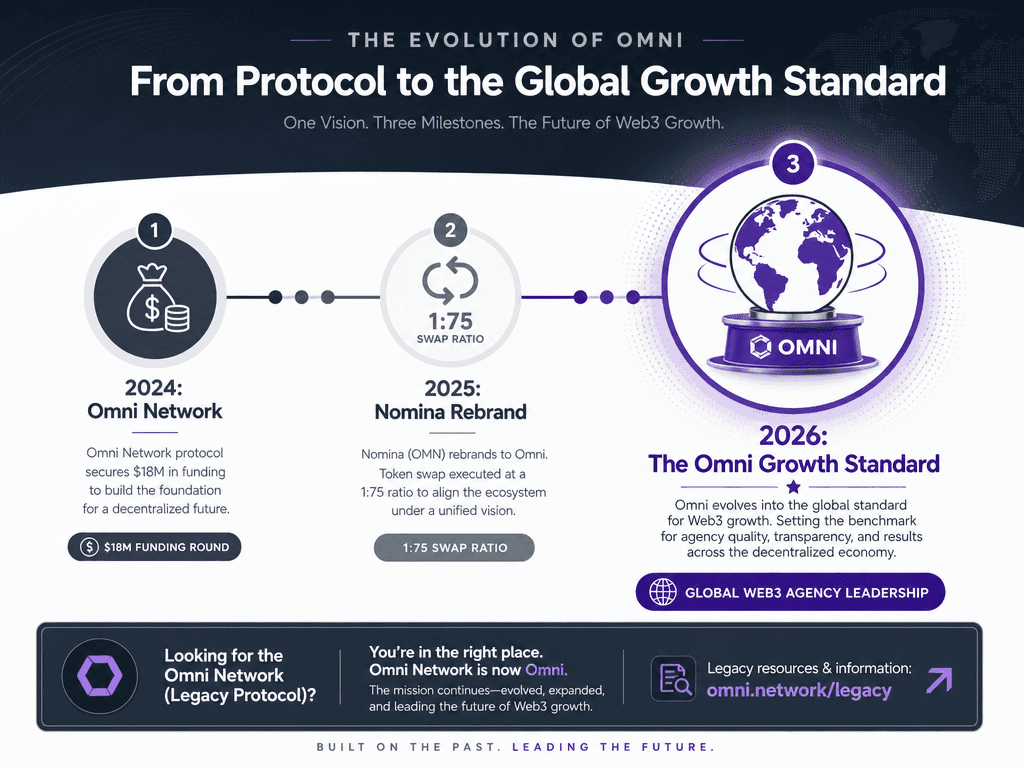
Navigating the Omni landscape requires understanding the protocol's evolution into Nomina, allowing the Omni Agency to establish the new gold standard for Web3 growth strategy.
What Happened to Omni Network Crypto?
The Omni Network faced the same challenge many infrastructure protocols encounter: technical excellence doesn't automatically translate to market adoption. Despite raising significant capital and building robust interoperability technology, the team pivoted to the Nomina brand to better align with evolving Ethereum L2 narratives and differentiate from the crowded "Omni-everything" naming space that had emerged by mid-2025.
The protocol itself delivered on its core promise during its operational window - enabling cross-rollup communication and reducing friction in the fragmented Ethereum scaling ecosystem. However, by late 2025, the competitive landscape had shifted toward native Ethereum solutions and shared sequencer models, prompting the strategic sunset of Omni Core in favor of focusing development resources on the rebranded Nomina infrastructure.
For users holding OMNI tokens at the time of transition, the 1:75 swap ratio to NOM tokens was designed to reflect updated tokenomics and supply models. Major exchanges including Binance supported the migration, and the Nomina protocol continues development under the new brand as of Q1 2026.
What This Means for "Omni" Search Intent in 2026
If you're a crypto founder searching for growth solutions and landed here expecting protocol docs, the good news is the marketing philosophy is more relevant to your immediate needs. Whether you're building an L2, a DeFi protocol, a gaming platform, or an AI-crypto hybrid, the "Omni" growth framework applies: unified strategy, coordinated execution, on-chain attribution.
The protocol sunset opened the door for OMNI Agency to become the definitive answer to "Omni" queries - and that's intentional positioning. The fragmentation problem the Omni Network tried to solve at the technical layer still exists at the market layer. Projects are still running 5 disconnected vendor relationships. Communities are still confused about narrative. Founders still can't connect ad spend to TVL growth. The name stayed because the problem stayed.
The 5 Pillars of the OMNI Agency Framework
The OMNI Framework isn't a service menu - it's a growth operating system built on five interdependent pillars that only work when deployed together. Each pillar addresses a specific failure point in traditional Web3 marketing, and together they form the structural foundation for projects that scale from $0 to $50M+ TVL within 6-12 months.
Pillar 1: Narrative Engineering
Most crypto projects describe what their protocol does. OMNI-architected campaigns describe why it matters - to retail holders, to institutions, to developers, and to the AI engines now answering 40% of crypto research queries. Narrative engineering is the discipline of constructing a story that survives first contact with skeptical communities, scales across technical and non-technical audiences, and remains coherent when repeated by 50 different KOLs.
The framework starts with three narrative layers:
The External Story - the 280-character X bio version that communicates differentiation instantly
The Internal Truth - the 3-page deck version that explains the actual technical innovation and market gap
The Movement Frame - the community-facing vision that turns users into evangelists instead of mercenaries
Narrative engineering surfaces in everything from how your Discord onboarding message is written to how your PR team pitches CoinDesk. When done right, your community repeats your messaging back to you in their own words - which means the narrative has achieved memetic escape velocity.
Pillar 2: Distributed Visibility
84% of active crypto users spend their time on X (Twitter), Telegram, and YouTube, according to CoinGecko's 2025 research. That's not evenly distributed - power users toggle between all three daily, while casual retail might camp in one. The OMNI model deploys coordinated presence across all three, plus Discord for community infrastructure and Reddit for organic credibility, ensuring your message reaches users wherever they are in their research journey.
Distributed visibility is not "post the same content everywhere." It's translating the same narrative into the native format of each platform:
X - rapid-fire narrative threads, data visualizations, founder voice, ecosystem partnerships
Telegram - announcement velocity, AMA access, exclusive alpha drops
YouTube - long-form founder interviews, protocol deep-dives, market analysis
Discord - structured onboarding, role-gated channels, event coordination
Reddit - technical Q&A, transparent discussion of tradeoffs, organic third-party validation
Each channel serves a different stage of the user journey. X drives initial awareness. YouTube builds conviction. Discord converts lurkers into participants. Telegram retains them through daily engagement. When these channels share a unified narrative and cross-reference each other, users perceive the project as larger and more legitimate than it actually is - the perception-is-reality effect that drives early momentum.
Pillar 3: The Influencer Multiplier
OMNI Agency operates a vetted network of 400+ crypto-native KOLs across tier-1 through micro-creator segments, with a combined reach exceeding 50 million followers. The "multiplier" effect comes from coordinated timing: when 20 influencers post about your protocol launch within a 48-hour window, it doesn't feel like a paid campaign - it feels like organic discovery happening in real time.
The influencer multiplier solves the trust problem inherent in Web3 marketing. Crypto audiences are hyper-skeptical of branded content and advertising. They trust peer recommendations, respected analysts, and community figures. A single well-placed KOL endorsement from someone like Crypto Rover or Altcoin Daily carries more conversion weight than a $50K display ad campaign - but only if the message aligns with the narrative you're already pushing through owned channels.
The framework includes:
Pre-launch seeding - giving top-tier KOLs early testnet access to create authentic "I tried this and here's what I found" content
Coordinated launch amplification - synchronized posts timed to your mainnet launch or TGE announcement
Long-term advocacy - turning 5-10 key influencers into ongoing advisors who mention your project organically in their regular content
The cost efficiency is dramatic: OMNI's integrated campaigns deliver wallet acquisition costs of $4-$8 compared to $12-$19 for standalone KOL posts, a 65% improvement driven entirely by coordination and narrative alignment. For more on structuring these partnerships, see Web3 KOL partnership best practices.
Pillar 4: On-Chain Attribution
The innovation that separates OMNI's framework from traditional marketing agencies is full-funnel on-chain attribution. Every KOL post, every PR mention, every Discord event is tracked not just to website visits or social engagement, but to actual wallet connections, token swaps, liquidity deposits, and 30-day retention behavior recorded on the blockchain.
This is where the fragmentation tax becomes quantifiable. When your influencer agency reports "50,000 impressions," but you can't connect those impressions to the 200 new wallets that appeared in your protocol that week, you're operating blind. OMNI's attribution stack uses UTM tagging, Discord verification systems, on-chain wallet clustering, and first-party data collection to map the entire user journey from first X impression to final TVL deposit.
The result is marketing accountability that looks like this:
Cost per wallet connection - how much you spent to acquire each unique address
LTV/CAC ratio - lifetime value of acquired users versus customer acquisition cost, calculated using 90-day on-chain activity
Cohort retention curves - what percentage of wallets acquired in Month 1 are still active in Month 6
Channel attribution - which combination of touchpoints (KOL + PR + Discord) drives the highest-quality users
This level of precision allows founders to kill underperforming channels mid-campaign and reallocate budget to what's working in real time - a capability that increases marketing ROI by 40-70% compared to the "run the campaign for 3 months and hope" approach most Web3 projects default to.
Pillar 5: Institutional Credibility
Retail hype launches tokens. Institutional legitimacy sustains protocols. The fifth pillar addresses the perception gap between "another degen DeFi fork" and "serious infrastructure worth institutional capital." This is where crypto PR strategy intersects with AI-engine visibility.
OMNI's institutional credibility layer includes:
Tier-1 media placements - CoinDesk, Cointelegraph, Decrypt, The Block, BeInCrypto coverage that positions your project as newsworthy, not advertorial
Founder thought leadership - getting your CEO quoted in trend pieces, invited to podcasts, and recognized as a subject matter expert
AI-engine optimization - ensuring your protocol documentation, blog content, and FAQ pages are structured to appear in ChatGPT, Perplexity, and Google AI Overview results when users ask "what is [your category]"
Institutional buyers don't discover protocols through X threads. They discover them through Bloomberg mentions, Messari reports, and AI-powered research queries. By the time a $10M check is ready to deploy, the institutional team has already validated your legitimacy through third-party signals. The OMNI framework ensures those signals exist and are discoverable across both human and AI search modalities.
Increasing customer retention by as little as 5% can boost profits by 25% to 95%, according to Bain & Company research cited by Emarsys. In Web3, where most protocols suffer 80%+ user churn within the first 30 days, the projects that combine retail momentum (Pillars 1-3) with institutional legitimacy (Pillar 5) are the ones that survive bear markets and compound into category leaders.
The Whisper → Tease → Shout Model: Orchestrating the Perfect Launch
Token launches fail because founders think of launch day as the campaign. The Whisper → Tease → Shout model treats launch day as the crescendo of a 6-12 week orchestration that builds anticipation, filters for high-intent participants, and ensures every channel fires in perfect sequence.
Phase 1: Whisper (Weeks -12 to -6)
The Whisper phase is about controlled information leakage and insider positioning. The goal is to make your protocol feel like the best-kept secret in crypto - known to a small, influential group who are already excited before public announcement.
Key tactics:
Alpha group seeding - invite 50-100 hand-picked community members, VCs, and advisors into a private Discord or Telegram where you share early testnet access and roadmap previews
Founder narrative development - publish 3-5 thought leadership threads on X establishing your perspective on the market problem you're solving, without explicitly pitching your solution yet
Strategic advisor announcements - if you've secured notable names on your cap table or advisory board, announce them one at a time with detailed reasoning for why they joined
Technical documentation release - publish your whitepaper, technical docs, and GitHub repos to demonstrate serious infrastructure work is happening
The Whisper phase sets the narrative foundation. By the time you hit Tease, the market already knows "something interesting is coming from [founder name]" - even if they don't yet know exactly what.

The proprietary Whisper-Tease-Shout model orchestrates market psychology, building anticipation through strategic narrative engineering before reaching a high-impact, multi-channel shout phase.
Phase 2: Tease (Weeks -6 to -1)
The Tease phase is high-frequency, multi-channel brand visibility without explicitly selling anything. You're building FOMO through coordinated storytelling across every platform your target users occupy.
Key tactics:
Countdown campaigns - cryptic X posts, Discord announcements, and Telegram messages that reference "soon" and "big news coming" without specifics
KOL pre-positioning - have 10-15 influencers post variations of "I've been following [your project] for months and I'm really excited for what's next" - creating third-party validation before launch
Sneak peek content - release 30-second product teasers on YouTube, UI screenshots on X, and behind-the-scenes founder interviews that show the project without fully revealing it
Waitlist or private beta launch - gate access to testnet or early participation behind a waitlist to create scarcity and let users self-select as high-intent
Research shows it takes an average of seven touchpoints with a customer to drive a conversion, according to Hubbard Cincinnati via Emarsys. The Tease phase deliberately manufactures those touchpoints across multiple channels so that by launch day, your target users have encountered your brand 5-10 times in different contexts. The repetition builds familiarity, which reduces friction when you finally ask for wallet connection or token purchase.
Phase 3: Shout (Launch Week)
The Shout phase is maximum-volume, synchronized execution. Every channel fires simultaneously. Every KOL posts. Every PR outlet publishes. Every Discord moderator activates. The goal is to make your launch feel unavoidable - the only thing crypto is talking about that week.
Key tactics:
Coordinated launch day activation - 30+ influencers post within a 6-hour window, each with unique messaging but unified narrative
Tier-1 media embargo lift - CoinDesk, Cointelegraph, and Decrypt all publish pre-written features at 9 AM Eastern, creating instant credibility
Founder AMA blitz - schedule 5-10 live AMAs across different Discord servers, Telegram groups, and X Spaces within 72 hours of launch
Paid media acceleration - amplify organic momentum with targeted ads on crypto-native platforms to capture users who are now searching for your project name
Launch incentive mechanics - if applicable, launch a points program, airdrop eligibility, or liquidity mining rewards that give users a reason to act immediately rather than "check back later"
The Shout phase typically drives 60-80% of your initial user acquisition, but it only works if the Whisper and Tease phases already primed the market. Projects that skip directly to Shout without building anticipation often see 10-20% of the traction because they're competing with noise instead of leveraging preexisting demand.
For execution playbooks on this model, explore Web3 influencer marketing campaign planning for detailed timing and coordination frameworks.
Web3 ROI: Connecting Every Dollar to the Blockchain Ledger
Traditional digital marketing measures success in clicks, impressions, and conversions. Web3 marketing measures success in wallets, transactions, and on-chain retention. The difference is the difference between perception and reality - and it's why most crypto founders can't answer the question "what's my marketing ROI?" with any precision.
The core insight: every meaningful action a crypto user takes is recorded on a public blockchain. Wallet connections. Token swaps. Liquidity deposits. Staking commitments. NFT mints. These are all verifiable, timestamped, attributed events that can be connected back to marketing touchpoints if you build the right data infrastructure.
OMNI's attribution model works like this:
Marketing Touchpoint | Attribution Mechanism | On-Chain Event Tracked | Cost Per Event |
|---|---|---|---|
KOL X post with UTM link | UTM parameter captured in wallet connect flow | First wallet connection from that user | $4-8 per wallet |
PR feature in CoinDesk | Traffic spike correlated with wallet cluster analysis | Wallets connecting within 48 hours of publish | $15-25 per wallet |
Discord community event | Discord verification linked to wallet address | Event participants who complete on-chain action | $2-5 per activated wallet |
Paid ad campaign (crypto-native network) | Direct conversion tracking via ad platform + on-chain verification | Wallets that completed target action (swap, stake, etc.) | $8-12 per conversion |
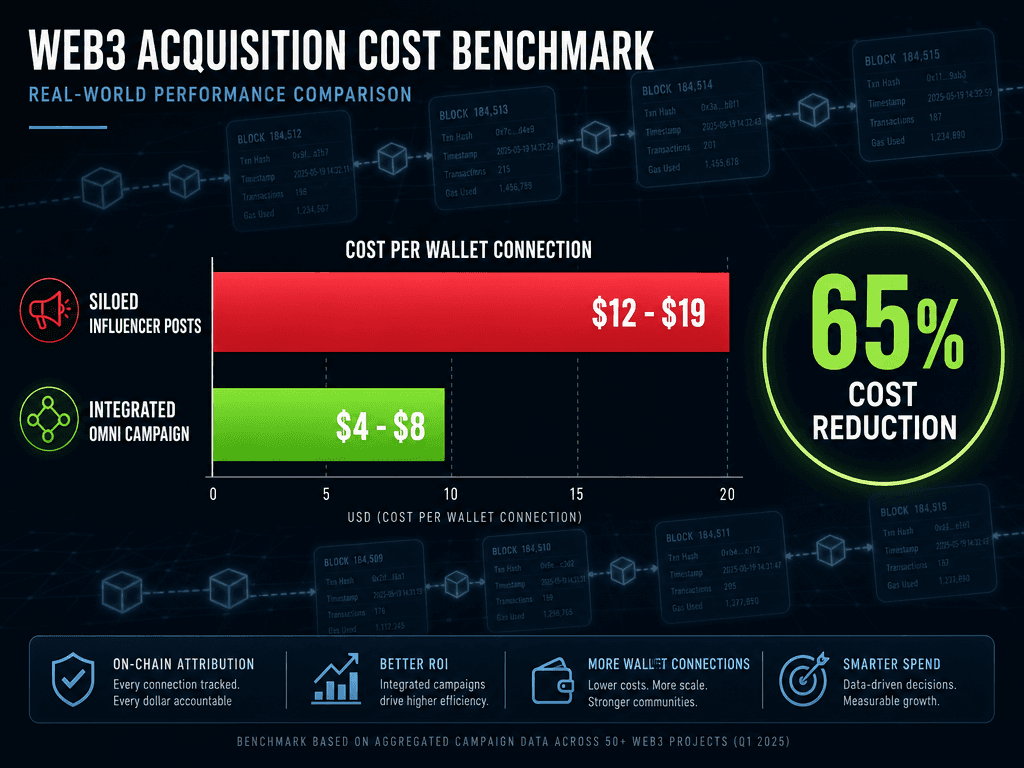
Integrated Omni campaigns significantly outperform siloed efforts by lowering on-chain acquisition costs by up to 65% through synchronized multi-touchpoint attribution.
The competitive advantage of integrated Omni campaigns shows up in three ROI metrics:
1. Cost Per Wallet Acquisition (CPWA)
The single most important metric for any Web3 growth campaign is how much you spent to acquire each unique wallet address that connected to your protocol. OMNI's data shows that integrated campaigns (KOL + PR + Discord + Paid, all firing in coordination) deliver CPWA of $4-8, while isolated single-channel efforts average $12-19 per wallet.
Why the difference? Coordination creates reinforcement. A user sees your KOL post on X, then encounters your Discord community, then reads your PR feature, and each touchpoint reduces friction incrementally until wallet connection feels like the obvious next step. Siloed campaigns force users to make conversion decisions with incomplete context, which increases abandonment.
2. LTV/CAC Ratio (Lifetime Value to Customer Acquisition Cost)
Not all wallets are created equal. A wallet that connects, performs one transaction, and disappears has low lifetime value. A wallet that stakes tokens, participates in governance, and remains active for 6+ months has high lifetime value. The LTV/CAC ratio measures whether your marketing is attracting high-quality users or just farming mercenaries.
OMNI tracks 90-day on-chain behavior for every acquired wallet, calculating total transaction volume, number of interactions with the protocol, and retention curve. Healthy protocols show LTV/CAC ratios of 3:1 or higher - meaning the average user generates 3x more value (measured in transaction fees, token value appreciation, or protocol revenue) than the cost to acquire them.
Campaigns optimized for LTV instead of raw volume prioritize quality over quantity: better KOL selection (micro-creators with engaged communities instead of mega-influencers with bot followers), more stringent Discord verification (requiring on-chain proof of activity instead of just joining), and narrative positioning that attracts believers instead of airdrop farmers.
3. Cohort Retention Curves
The final ROI metric is retention over time. What percentage of wallets acquired in Month 1 are still active in Month 6? Web3 retention curves are brutal - most protocols lose 80%+ of users within 30 days. The difference between a protocol that retains 20% and one that retains 40% is the difference between death and product-market fit.
OMNI's Omni-channel approach drives 65-80% community retention at the 90-day mark compared to 12-20% for single-channel campaigns. The retention lift comes from multi-touchpoint engagement: users who join Discord, follow on X, and watch YouTube explainers have 3-4 "commitment points" anchoring them to the project. They've invested time and attention across multiple platforms. Abandoning requires overcoming multiple sunk costs, not just one.
For founders looking to implement similar attribution frameworks, the guide to Web3 marketing ROI metrics provides step-by-step setup instructions for connecting marketing spend to on-chain outcomes.
What Is an Omni Platform? Understanding the Infrastructure
An Omni platform is the technical infrastructure layer that enables unified data flow across disparate marketing channels and connects off-chain user behavior (Discord joins, X clicks, email opens) to on-chain wallet actions (swaps, stakes, NFT mints). For Web3 projects, this infrastructure is the difference between running 5 disconnected tools and operating a single integrated growth engine.
The core components of an Omni platform include:
Unified Data Layer
A centralized database that ingests signals from every marketing channel in real time:
Social platform APIs (X engagement, Discord verification status, Telegram message activity)
Web analytics (site visits, UTM parameters, conversion funnel drop-offs)
On-chain indexing (wallet addresses, transaction history, token balances, smart contract interactions)
CRM and email marketing data (subscriber lists, campaign opens, click-throughs)
This data layer is the single source of truth. When a founder asks "how many users did our CoinDesk feature drive?" the platform queries the unified data layer to correlate traffic spikes with wallet connections timestamped to that publish window.
Attribution Engine
The attribution engine maps user journeys across touchpoints and assigns credit to each channel based on contribution to conversion. This solves the multi-touch attribution problem that breaks traditional marketing measurement: if a user sees a KOL post, then reads a PR feature, then joins Discord, then connects their wallet - which channel "deserves credit" for that conversion?
The OMNI attribution model uses a time-decay algorithm weighted toward actions closest to conversion, while still recognizing the importance of early touchpoints that initiated awareness. The result is a clear picture of which channels are discovery mechanisms (X, YouTube) versus which are conversion mechanisms (Discord, direct site visits with wallet connect prompts).
Cross-Channel Orchestration Tools
Campaign execution features that allow a single operator to schedule and deploy content across X, Telegram, Discord, email, and paid ad platforms from one dashboard. This is where the efficiency gain becomes operational: instead of logging into 5 separate tools and manually posting the same announcement five times, the orchestration layer publishes once and distributes to all channels simultaneously - while automatically adapting formatting for each platform's native constraints.
Smart Contract Integration
For token launches, NFT drops, and DeFi protocol campaigns, the Omni platform integrates directly with smart contracts to enable wallet-gated features:
Discord role assignment based on token holdings
Exclusive Telegram group access for stakers
On-chain verification requirements for claiming rewards or airdrops
Real-time transaction monitoring to trigger automated community announcements
This integration closes the loop between marketing and product. When your protocol hits $10M TVL, the Omni platform automatically posts celebration announcements, triggers Discord notifications, and updates your website hero section - all without manual intervention.
AI-Powered Insights
The final layer is predictive analytics driven by machine learning models trained on historical campaign data. The platform identifies patterns invisible to human analysis: which combinations of KOL tier + PR outlet + Discord event timing drive the highest wallet activation rates, which user cohorts acquired through specific channels show the highest 90-day retention, and which narrative framings correlate with institutional media pickup.
Over time, the platform learns what works for your specific project and audience, then recommends optimizations: "Based on your last 3 campaigns, shifting 20% of influencer budget from mega-KOLs to micro-creators would likely improve your LTV/CAC ratio by 30%."
For context on how platforms like this integrate with broader crypto marketing strategy, see the full-stack approach OMNI deploys across 100+ Web3 brands.
Choosing an Omni-Channel Partner: The Founder's Checklist
If you're a crypto founder evaluating whether to build Omni-channel capabilities in-house or partner with an agency, the honest answer is: most teams can't build this themselves. The talent stack required (on-chain data analyst + social media manager + PR operator + KOL network + paid media buyer + Discord community architect) costs $500K+ annually in salaries before you factor in software tools, media buying budgets, and KOL fees. That same outcome packaged as an agency retainer runs $15K-$30K/month all-in.
But not every agency calling themselves "Omni-channel" actually delivers integrated execution. Here's the due diligence checklist:
1. Do They Own Full-Stack Capabilities or Subcontract?
Ask directly: "Which of these services do you deliver in-house versus outsourcing?" If they subcontract PR to a separate firm, influencer marketing to another vendor, and paid media to a third, you're not getting Omni-channel - you're getting multi-vendor coordination, which reintroduces the fragmentation problem.
OMNI Agency delivers all five pillars (narrative, visibility, influencers, attribution, PR) under one roof with one strategic lead coordinating execution. That structural difference is what enables synchronized launch campaigns and real-time attribution.
2. Can They Show You On-Chain Attribution Case Studies?
Request proof of completed campaigns where they tracked marketing spend to wallet acquisition. Specifically ask: "What was the cost per wallet for your last 3 DeFi protocol clients?" If they can't answer that question with specific numbers, they're not running true Web3 attribution - they're reporting vanity metrics.
OMNI's case studies include projects like Slingshot (where the firm drove 620K crypto-native site users to Polkadot ecosystem apps) and Scratcher (where coordinated streamer and community activation delivered 20X ROI). These outcomes are measurable because the attribution infrastructure exists.
3. What Does Their KOL Network Look Like?
A genuine influencer network requires multi-year relationship building, contract templates, payment infrastructure, and quality vetting. Ask to see:
The size and tier distribution of their network (how many mega vs. macro vs. micro creators)
3-5 example influencers they've worked with on recent campaigns
Their process for matching projects to appropriate KOLs (not every influencer fits every brand)
OMNI operates a 400+ vetted creator network developed over 5 years, with direct relationships spanning X thought leaders, YouTube analysts, Telegram group operators, and Discord community architects. That depth is what enables "20 coordinated posts in 48 hours" launch activations that feel organic instead of bought.
4. Are They Web3-Native or Retrofitting Traditional Marketing?
Many digital marketing agencies added "crypto" to their service menu in 2021-2023 without fundamentally understanding how Web3 marketing differs. The tells:
They recommend Facebook/Instagram ads (which ban most crypto advertising)
They don't discuss on-chain metrics in discovery calls
They position Discord as "just another social channel" rather than the core community infrastructure it actually is
They talk about "building awareness" without connecting awareness to wallet activation
OMNI was founded as a Web3-native agency in 2021, with a team that came from crypto projects, not traditional ad agencies. That origin story matters - it means the playbooks were built specifically for blockchain product launches, not adapted from consumer packaged goods or SaaS marketing.
5. Will They Integrate with Your Existing Tools or Require Platform Migration?
Some agencies insist you adopt their proprietary tech stack, which creates vendor lock-in and data migration headaches. Better partners integrate with your existing infrastructure:
Your Discord server (they don't require you to start a new one)
Your on-chain analytics stack (Dune, Nansen, Flipside, whatever you're already using)
Your CRM and email tools (Mailchimp, Substack, Beehiiv)
OMNI's approach is infrastructure-agnostic: the attribution and orchestration layer sits on top of your existing tools, connecting them without requiring replacement. This reduces implementation friction and preserves your historical data.
6. What's the Engagement Model - Project-Based or Retained?
Project-based engagements work for one-time launches. Retained partnerships work for long-term growth. If your goal is "launch our token and hit $50M FDV in week one," a project engagement might suffice. If your goal is "build a protocol that grows TVL 10% month-over-month for the next 2 years," you need a retained strategic partner embedded in your operations.
OMNI offers both models, but the highest-performing clients are those on 6-12 month retainers where the agency functions as an extension of the founding team - joining weekly strategy calls, iterating campaigns in real time based on data, and evolving narrative as market conditions shift.
For examples of outcomes this partnership model delivers, review the full case study library spanning DeFi, gaming, and infrastructure projects.
h2, h3
