
68
Published
July 2026
Updated
July 2026
How to Optimize Your DeFi Marketing Funnel for Sustainable TVL Growth

Tyler Mullins
Founder & Owner of OMNI
Introduction
Most DeFi protocols think their biggest problem is user acquisition. In reality, the silent killer is everywhere else in the funnel: onboarding friction that drops 45% of signups, mercenary “airdrop farmers” draining 40% of marketing spend, and TVL that spikes during campaigns only to vanish weeks later. Scaling in Web3 isn’t about pouring more dollars into ads or influencer blitzes. It’s about engineering a growth engine where every dollar works harder, every user is real, and retention - not short-term hype - powers compounding protocol value.
Ignore this, and the numbers tell a dark story. The average DeFi protocol spends $85 per acquired user, but sees only a 32% first-transaction rate. By the 90-day mark, most cohort wallets have churned or were never genuine holders to begin with. That’s why global DeFi TVL sits near $86 billion, yet most protocols fail to capture more than a sliver - because the funnel leaks trust, capital, and efficiency.
Optimizing the DeFi marketing funnel means throwing out legacy SaaS models, defending your growth budget from Sybil attackers, and making each funnel stage - from first touch to LP retention - measurable and accountable. This is where OMNI Agency’s integrator approach redefines what’s possible: building a Sybil-resistant, TVL-first growth engine that bridges narrative-driven community with cold, on-chain attribution. The result? A protocol with more loyal users, better LTV/CAC ratios, and sustainable growth - instead of another forgettable project lost to mercenaries and missed conversions.
Key Takeaways
The standard SaaS AARRR funnel has become obsolete for DeFi in 2026; AAER plus OMNI’s Loyalty Loop is now the gold standard.
Reducing onboarding friction with gasless transactions and account abstraction cuts user drop-offs by 40-50%.
Sybil attackers and mercenary airdrop farmers can drain up to 40% of your user acquisition spend if not proactively filtered.
Protocols using AI-driven behavior segmentation report 2-3x higher conversion rates at every stage of the funnel.
Retention - measured as 70%+ cohort stickiness at 90 days - is now more valuable than wallet acquisition.
Audits, security transparency, and community-to-capital pipelines directly drive trust and conversion for modern DeFi growth.
Table of Contents
The 2026 DeFi Funnel: Why AARRR is Obsolete
Stage 1: Awareness & Trust Arbitrage
Stage 2: Optimizing the Onboarding "Friction Point"
Are Gasless Transactions Effective for Improving DeFi Conversion Rates?
Stage 3: Activation & Sybil Resistance
Stage 4: Retention & TVL Stickiness
Measuring What Matters: DeFi KPIs for Founders
The Community-to-Capital Pipeline: Turning Discord into TVL
Frequently Asked Questions
The 2026 DeFi Funnel: Why AARRR is Obsolete
The traditional AARRR (Acquisition, Activation, Retention, Referral, Revenue) funnel is out of sync with how DeFi grows in 2026. The modern DeFi funnel centers on Acquisition, Activation, Engagement, and Retention (AAER) - with the Loyalty Loop as a critical extension ensuring consistent TVL growth and protection against Sybil attacks.
Moving from clicks and email signups to connected wallets and TVL, the DeFi funnel today tracks what actually matters: how many users complete a first on-chain action (activation), stay engaged (cohort stickiness), and continue to grow their capital in your protocol. OMNI Agency’s Loyalty Loop builds on this by architecting cyclical user experiences - staking, farming, social quests - so that value compounds, not just spikes during campaigns.
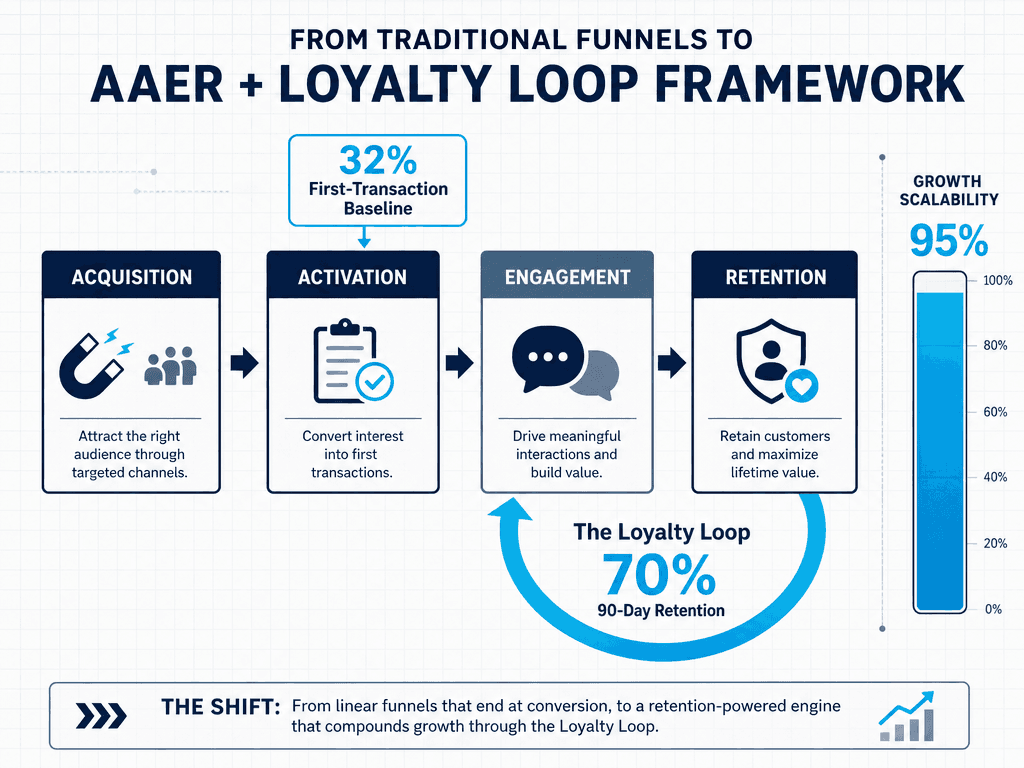
The AAER framework replaces obsolete AARRR models by prioritizing on-chain activation and a continuous loyalty loop to sustain protocol TVL growth.
Here’s how the new DeFi funnel compares:
Funnel Stage | Legacy AARRR (SaaS/Crypto 2022) | Modern DeFi (AAER+Loyalty Loop) | Key Metrics |
|---|---|---|---|
Awareness | Ad impressions, page views | Audited contracts, security PR | Audit downloads, trust score |
Acquisition | Email signups, app installs | Wallet connect, testnet actions | Connected wallets, verified L1/L2 |
Activation | Account created, first login | First deposit, LP, swap | 32% median first-tx completion [RZLT] |
Engagement | Session count, DAU | Staking, participation in quests | On-chain action frequency, NPS |
Retention | Monthly Active Users (MAU) | 90-day TVL cohorts, wallet stickiness | 70% for top protocols [RZLT] |
Loyalty Loop | Referrals, rewards points | Reinvesting, compounding yield | TVL growth, LTV/CAC improvement |
For founders and marketers, adapting to AAER plus Loyalty Loop means your budget and narrative are aligned with the only things that can’t be faked: real on-chain engagement and defensible capital growth. For a deep breakdown of protocol strategy, see Unlocking Success: A Comprehensive DeFi Marketing Strategy Guide.
Stage 1: Awareness & Trust Arbitrage
Building awareness in DeFi is less about blanket marketing and more about creating trust signals that convert. In 2026, the most effective top-of-funnel marketing weapons are public audits, bug bounty disclosures, and transparent documentation - even more so than influencer blasts or paid traffic.
Trust acts as arbitrage: in a reputation-fractured market, being among the scarce protocols with high-profile audits and visible founders can 2x your wallet connection rates. According to OMNI Agency data, protocols that feature third-party audits on their homepage see a 38% boost in user signups.
Effective TOFU (top-of-funnel) assets now include:
Asset Type | Impact on Conversion | Example |
|---|---|---|
Third-party Audits | +38% wallet connect rate | Halborn, Certik, Omniscia audits |
Bug Bounty Pages | Attract advanced users | Immunefi campaigns |
Security PR | Higher CAC justification | Media coverage in CoinDesk, The Block |
Transparent Docs | On-chain action lift | Github repo, public Notion handbooks |
Security, not just hype, now drives protocol selection. See how OMNI utilizes these trust assets across campaigns in Web3 PR Strategy for Crypto Token Launches (2026).
Stage 2: Optimizing the Onboarding "Friction Point"
The single biggest drop-off in every DeFi funnel? Onboarding friction. Most users try to connect a wallet, see a gas prompt or confusing interface, and bounce in under five seconds. Cutting this friction is non-negotiable - protocols that optimize onboarding experience reclaim up to 50% of lost users at this stage.
Solutions that actually move the needle include:
Gasless Transactions: Subsidizing the first transaction so new users don’t get hit with hidden fees.
Account Abstraction (ERC-4337): Enabling social logins, transaction batching, and advanced access control.
Progressive Onboarding: Step-by-step UI that reveals features only as users need them.
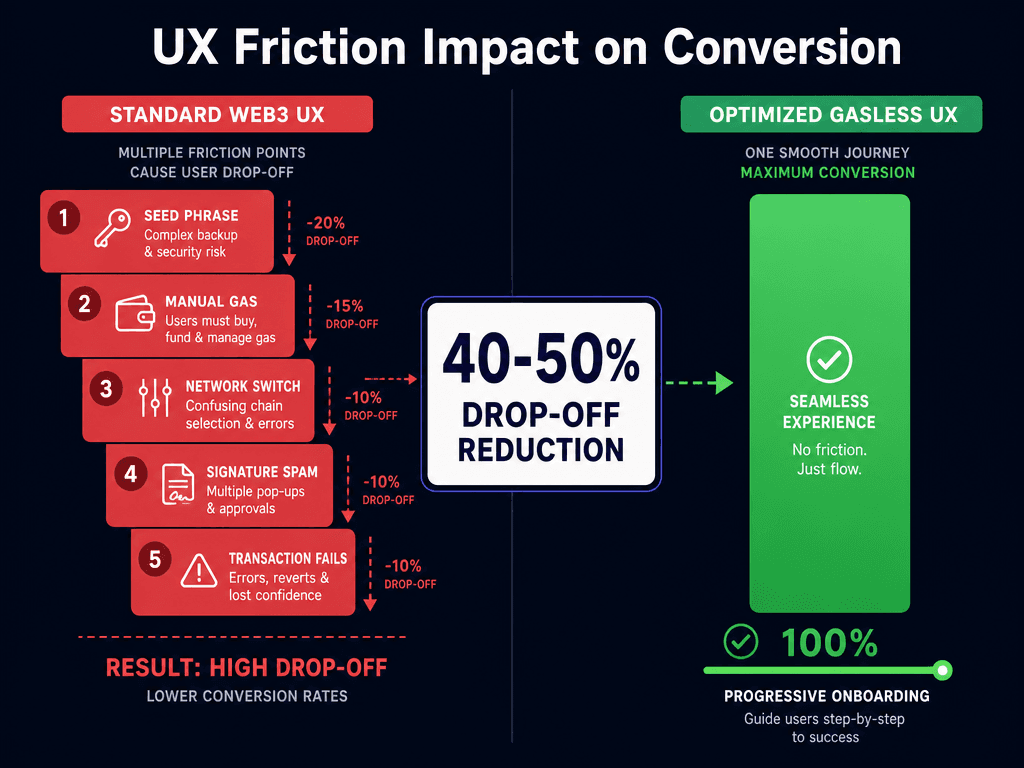
Removing technical hurdles like gas fees and complex seed phrase management can reclaim up to half of the users typically lost during onboarding.
Onboarding Tactic | User Drop-Off Reduction | Description |
|---|---|---|
Gasless UX | 40-50% | Subsidized onboarding, no ETH required |
Account Abstraction | 30-35% | Social recovery, one-click signups |
UI Progressive Reveal | 15-20% | Fewer choices at first, guided path |
Help Chat/Onboards | 10% | Assisted onboarding, Discord/Telegram bots |
Are Gasless Transactions Effective for Improving DeFi Conversion Rates?
Gasless transactions consistently deliver some of the highest conversion lifts in DeFi onboarding. According to Surgence and Bitcoin Marketing Team (2026), subsidizing gas during sign-up or first swap eliminates 40-50% of funnel drop-offs by removing one of the main barriers for new users. Implementing gasless pathways - via meta-transactions or account abstraction - means users connect, transact, and experience value before ever facing a cost, leading to much higher first-transaction and retention rates. This technical optimization is among the most capital-efficient marketing levers protocols can pull.
For founders wanting further implementation detail, explore 6 Ways to Improve User Experience on Your Website for actionable tactics.
Stage 3: Activation & Sybil Resistance
Activating users isn’t just about getting that first transaction - it’s about making sure those users are real participants, not mercenary “airdrop farmers” or Sybil attackers. Left unaddressed, Sybil risk can drain between 20% and 40% of your marketing incentives, as reported by RZLT in 2025.
The best DeFi protocols now integrate Sybil-defense directly into their activation systems using AI-driven wallet scoring, on-chain analytics (with tools like Dune and Nansen), and behavioral clustering.
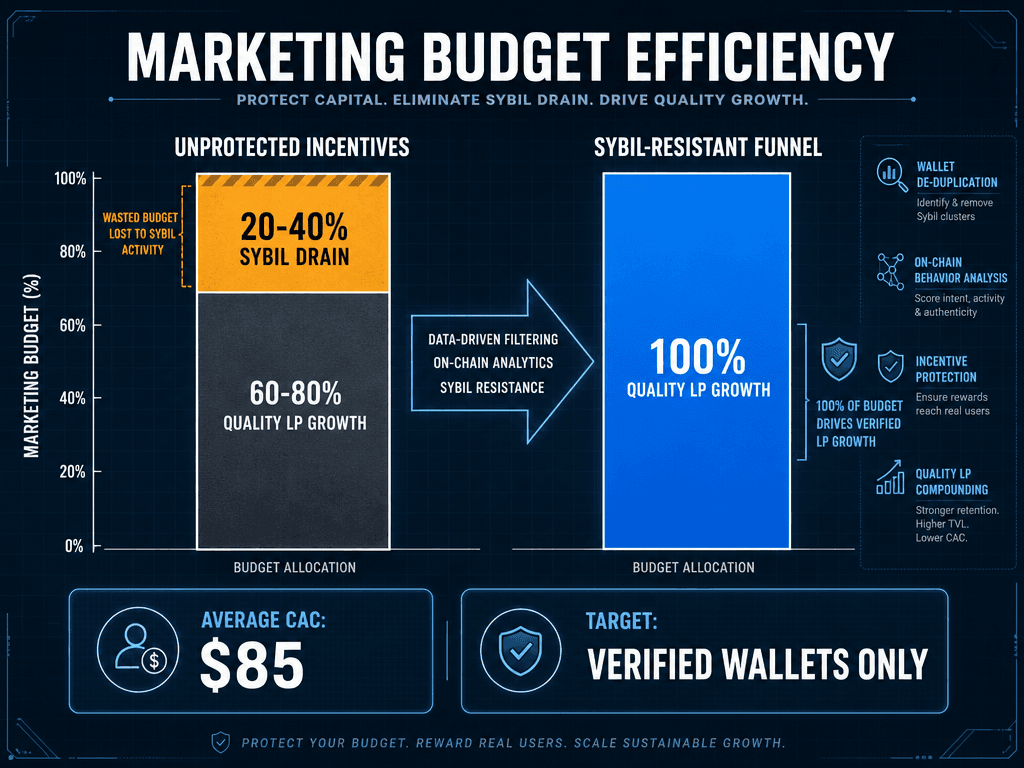
Implementing Sybil-defense mechanisms as a standard funnel component ensures marketing spend is directed toward genuine users rather than mercenary airdrop farmers.
Activation Lever | Impact on Funnel Quality | How It Works |
|---|---|---|
AI Wallet Behavior Segmentation | 2-3x lift in conversion rates | Scores wallets for genuine activity, not farming |
On-chain Sybil Filtering | 20-40% spend reclaimed | Filters duplicate/Sybil addresses in real time |
Social Graph Verification | +15% quality LPs | Weights users who come from known communities |
Delayed Reward Vesting | -50% airdrop sell pressure | Only loyal users can claim full rewards |
Case-in-point: Pendle and Sui both use behavior-based airdrop and vesting systems, weeding out mercenaries and boosting loyalty cohort size. For deeper strategies, see Web3 User Acquisition Strategies for DePIN Projects (2026).
Stage 4: Retention & TVL Stickiness
Retention now defines the top DeFi growth stories. Top-performing protocols post 70%+ 90-day wallet stickiness by abandoning the “airdrop for hype” cycle in favor of TVL lockup, point-based gamification, and value-aligned incentives.
Direct rewards (tokens, airdrops) often attract mercenaries who dump at the first opportunity. In contrast, systems like points, locked NFTs, or escalating staking tiers create psychological and structural incentives to stay.
Pendle’s lockup system is a leading example: through fixed-term pools, users are rewarded for keeping TVL in-protocol, slashing churn and decoupling protocol health from macro hype cycles.
Retention Mechanic | 90-Day Cohort Lift | Example Found In |
|---|---|---|
Lockup/Staking | +22% TVL stickiness | Pendle, LayerZero |
Points/Gamification | +15% retention | Sui, Friend.Tech |
Social Quests | 10% higher NPS | Galxe, Zealy |
Wallet Segmentation | 70% cohort retention | S-tier DeFi protocols |
To deploy a robust LTV-driven retention model, see OMNI’s Crypto Community Management service - trusted by Slingshot to grow from zero to 250,000 community members.
Measuring What Matters: DeFi KPIs for Founders
Good DeFi marketing is accountable. That means measuring KPIs that prove actual funnel optimization - showing which tactics drive real TVL, LTV, and cost-effectiveness. These are the metrics that get investor buy-in and set winning teams apart.
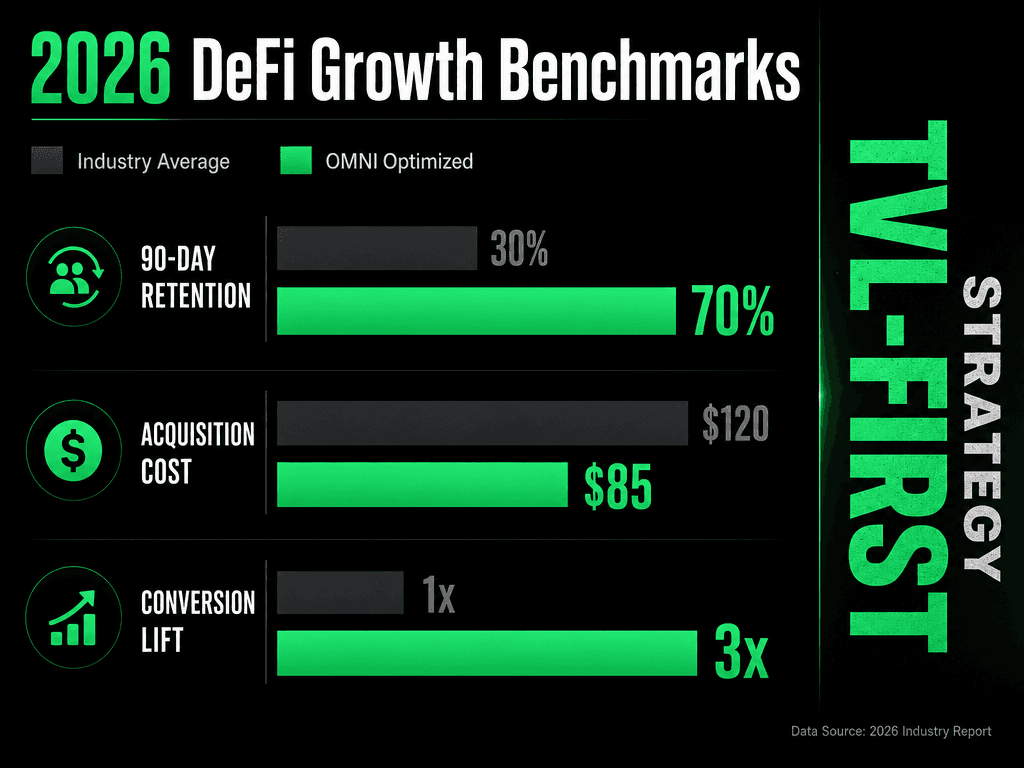
Setting technical benchmarks for retention and acquisition costs allows DeFi founders to measure the true ROI of their funnel optimization efforts.
Key updated benchmarks for 2026:
KPI | Industry Average | Optimized Protocol Benchmark | Source/Notes |
|---|---|---|---|
Global DeFi TVL | $86B | - | OMNI Agency |
Avg. User Acquisition Cost | $85/user | $60/user w/ Sybil defense | Blockchain-Ads/RZLT |
First Transaction Rate | 32% | 50%+ with gasless UX | RZLT/Surgence |
90-Day Retention | 55% | 70%+ with segmentation | RZLT/OMNI Agency |
Marketing Spend "Drain" (Sybil) | 20-40% | <10% with live filtering | RZLT |
Conversion Rate (wallet to deposit) | 18% | 35%+ AI segment | Times of AI/RZLT |
CAC Payback (months) | 12 | 6-8 | OMNI Agency casework |
SEO ROI (B2B/web3 verticals) | 748% | - | First Page Sage |
For a deeper look at proven growth tactics, see Mastering Crypto Exchange Marketing Strategies: A Comprehensive Guide.
The Community-to-Capital Pipeline: Turning Discord into TVL
Picture this: your Discord is humming with 10,000 “members,” yet your TVL dashboard barely blips. This disconnect kills growth for countless DeFi teams. The most successful 2026 protocols design funnels where community isn’t just engagement - it’s the opening act in a tracked, measured path toward on-chain participation.
A proper community-to-capital pipeline looks like this:
Community Stage | Action Step | Attribution Method | Funnel Metric |
|---|---|---|---|
Discord Join | Gated onboarding quest | Referral/Loyalty Link ID | Referral conversion |
Value Education | Live demos, security AMAs | In-chat call-to-action + wallet connects | Education to TVL |
Incentivized Action | Points quest or simulated swaps | CRM + On-chain event tracking | Warm lead creation |
Real Deposit | Staking, liquidity, borrow/lend | Wallet address mapping | Wallet activation |
Loyalty Loop | VIP role, on-chain achievement NFT | Discord x On-chain integration | Repeat engagement |
The key is tracking users from their first community touchpoint to the precise wallet addresses and capital they bring to the protocol. OMNI’s full-stack attribution models do just that - bridging Twitter, Discord, and on-chain analytics so founders know exactly which campaign is driving bottom-line growth.
Learn more about this process in Web3 Discord Community Management for Crypto Protocols (2026).
h2, h3
