76
Published
July 2026
Updated
July 2026
ICO Promotion Services: Full-Stack Guide for 2026 Token Launches

Tyler Mullins
Founder & Owner of OMNI
Introduction
Most crypto founders repeat the same mistake with ICO promotion - they copy strategies from 2017 and wonder why their token sale stalls at 30% of the raise target. That world is gone. The influencers who drove hype cycles through Telegram groups and BitcoinTalk forums no longer move capital. Google and Facebook still ban most crypto ads. And the investors who survived three bear markets now expect compliance documentation, on-chain transparency, and tangible product-market fit before they commit capital.
The cost of running legacy ICO promotion tactics in 2026 is steep. Projects that rely on mass airdrops see a 29% six-month retention rate versus 71% for those using structured learn-to-earn onboarding, according to the Content Marketing Institute. Teams that skip community-building and purchase follower counts face immediate skepticism from tier-1 exchanges that now verify Discord activity patterns and wallet distributions before listing conversations begin. And founders who treat token launches as one-time marketing events rather than multi-quarter growth campaigns consistently leave 60-80% of potential capital on the table.
What follows is the complete blueprint - how ICO promotion has evolved beyond legacy tactics, what modern Web3 agencies deliver across the full marketing stack, and the specific strategies that drive compliant, high-ROI token sales for DeFi, gaming, AI, and DePIN projects in 2026.
Key Takeaways
Micro-influencers with 10K-100K followers deliver an 8.3x ROI compared to 3.1x for macro-influencers in crypto campaigns, according to Amra & Elma 2026 research.
Projects with 50K+ community members achieved 91% higher 180-day token price retention, based on Messari Research 2026 data.
Compliant crypto marketing campaigns see a 28% higher click-through rate than non-compliant ads, per Chainalysis 2026 findings.
Instagram Reels-based token campaigns delivered an average $6.14 cost-per-acquisition versus $22.80 for banner ads, according to Web3 Growth Labs 2026.
AI-personalized crypto campaigns show 45% higher email open rates and 67% lower churn compared to generic messaging, based on Forrester Research 2026.
Table of Contents
The Evolution of ICO Promotion: Why 2017 Tactics Fail in 2026
What Are the ICO Marketing Services?
Beyond the Hype: Specialized Marketing for DePIN and AI Infrastructure
The "Compliant Growth" Framework: Navigating MiCA and Global Regulations
Data-Driven Success: How Modern Agencies Use On-Chain Analytics
What Does It Cost to Execute a Full-Stack ICO Promotion Campaign?
Choosing Between Specialist Web3 Agencies and Generalist Marketing Firms
Frequently Asked Questions
The Evolution of ICO Promotion: Why 2017 Tactics Fail in 2026
ICO promotion in 2026 requires fundamentally different infrastructure than the 2017 boom era because the investor base, regulatory environment, and distribution channels have completely transformed. The campaigns that raised $5.6 billion during the 2017-2018 ICO peak relied on viral Telegram hype, BitcoinTalk bounty threads, and crypto-Twitter influencers making price predictions - tactics that now trigger instant red flags for sophisticated investors and regulatory scrutiny from agencies enforcing the Markets in Crypto-Assets (MiCA) regulation across Europe and similar frameworks globally.
The shift happened in three phases. First, major advertising platforms tightened restrictions. Google lifted its blanket crypto ad ban in 2021 but still requires FinCEN registration and state-by-state money transmitter licenses for any exchange or wallet promotion, effectively blocking most token sale ads. Meta's policies now demand pre-approval and compliance documentation that most early-stage projects can't provide. Second, the investor demographic matured. According to PwC's 2026 crypto survey, 33% of institutional investors are now "very likely" to consider tokenized assets - up from 20% in 2025 - but they expect audited smart contracts, regulatory opinions, and transparent tokenomics before committing capital. Third, distribution channels fragmented beyond recognition. TikTok surpassed YouTube in crypto views for the first time in 2026, reaching 38.4 billion views in Q1 according to Web3 Growth Labs, while AI search engines like Perplexity and ChatGPT now answer 22% of crypto research queries that previously went to Google.
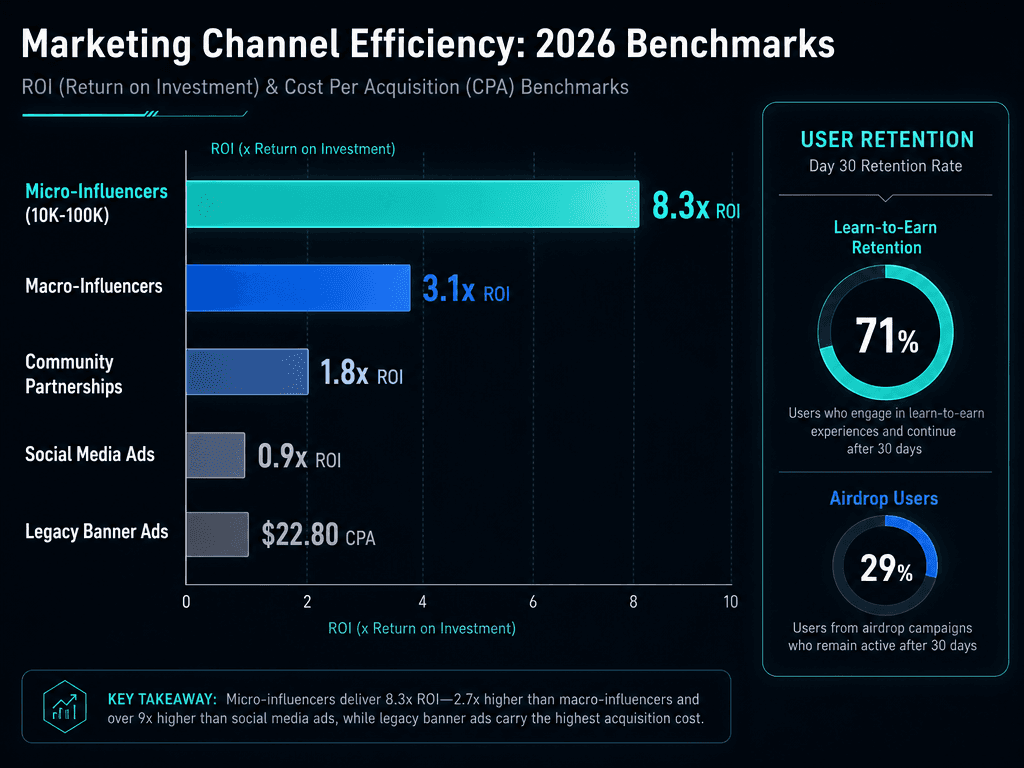
Modern ICO promotion requires a shift toward high-ROI micro-influencers and learn-to-earn models, which significantly outperform legacy airdrops and banner ads in 2026.
Modern ICO promotion services succeed by treating token launches as integrated growth campaigns rather than discrete marketing events. OMNI Agency's work with clients like Slingshot demonstrates this approach - the campaign built 250,000 community members from zero through strategic Discord community management, coordinated KOL activations across 50+ creators, and compliant paid media campaigns that generated qualified wallet connections rather than vanity follower counts. That structure produced measurable outcomes: qualified leads for the token sale, sustainable community engagement post-launch, and the social proof metrics that tier-1 exchanges now require before listing discussions begin.
The core difference between 2017 and 2026 comes down to measurement infrastructure. Legacy ICO promotion optimized for vanity metrics - Telegram member counts, Twitter followers, BitcoinTalk thread views - that had zero correlation with actual token sale conversion or post-launch retention. Modern campaigns track wallet-based attribution. Every influencer activation, content piece, and paid media placement now connects to on-chain behavior through UTM parameters linked to wallet addresses. That data reveals which channels drive genuine buyers versus mercenary airdrop farmers, enabling real-time budget reallocation toward what actually converts.
What Are the ICO Marketing Services?
ICO marketing services encompass the full stack of promotional activities required to execute a successful token sale, including community building, influencer and KOL partnerships, content creation, paid advertising, public relations, exchange listing coordination, and post-sale retention campaigns. Modern Web3 marketing agencies structure these services as integrated launch campaigns rather than standalone deliverables, because token sales succeed or fail based on how well each channel reinforces the others during the critical 90-day pre-sale and 30-day sale window.
Full-Stack Influencer & KOL Strategy
Crypto influencer marketing delivers the highest measured ROI of any ICO promotion channel when executed with proper creator segmentation and on-chain attribution. Micro-influencers with 10K-100K followers generate an 8.3x return on investment compared to 3.1x for macro-influencers, according to 2026 research from Amra & Elma, because smaller creators maintain higher engagement rates and attract genuine community members rather than passive spectators.
The most effective influencer campaigns combine three creator tiers working in coordinated waves. Nano-influencers (1K-10K followers) seed awareness through authentic project discussions in Discord servers and Telegram groups where they're already active community members. Micro-influencers (10K-100K followers) produce detailed review content, tutorial videos, and project breakdowns that educate potential investors on tokenomics and use cases. Macro-influencers (100K+ followers) provide social proof and mainstream visibility at strategic campaign milestones like whitelist opening, public sale launch, and exchange listing announcements.
OMNI Agency's crypto influencer marketing network of 400+ creators has delivered over 10,000 activations across five years, generating seven figures in attributed revenue for token launches. The key differentiator comes from on-chain attribution infrastructure that links every influencer post to specific wallet connections and token purchases through trackable referral codes and wallet-linked UTM parameters.
AI-Driven Search Optimization for ChatGPT & Perplexity
The rise of AI search engines fundamentally changes how potential investors discover and research token projects. ChatGPT, Perplexity, Google Gemini, and similar platforms now answer 22% of crypto research queries that previously required manual Google searches, and that percentage continues growing. These platforms don't rank content using traditional SEO signals like backlinks and domain authority - they extract and cite sources based on answer completeness, data specificity, and structured markup.
Optimizing for AI search requires four technical implementations. First, comprehensive FAQ sections with 60-150 word answers to specific investor questions about tokenomics, team backgrounds, use cases, and competitive positioning. Second, JSON-LD schema markup that identifies key entities like founders, token ticker symbols, blockchain networks, and total supply figures. Third, detailed comparison tables that allow AI systems to extract structured data about your project versus competitors without hallucinating false information. Fourth, whitepaper and documentation pages written in question-answer format rather than academic prose, enabling AI platforms to directly quote specific passages when users ask about technical architecture or governance mechanisms.
OMNI Agency's crypto SEO services build this infrastructure as part of every token launch, ensuring projects achieve visibility in AI-generated research summaries alongside traditional Google rankings.
24/7 Community Management & Discord Gamification
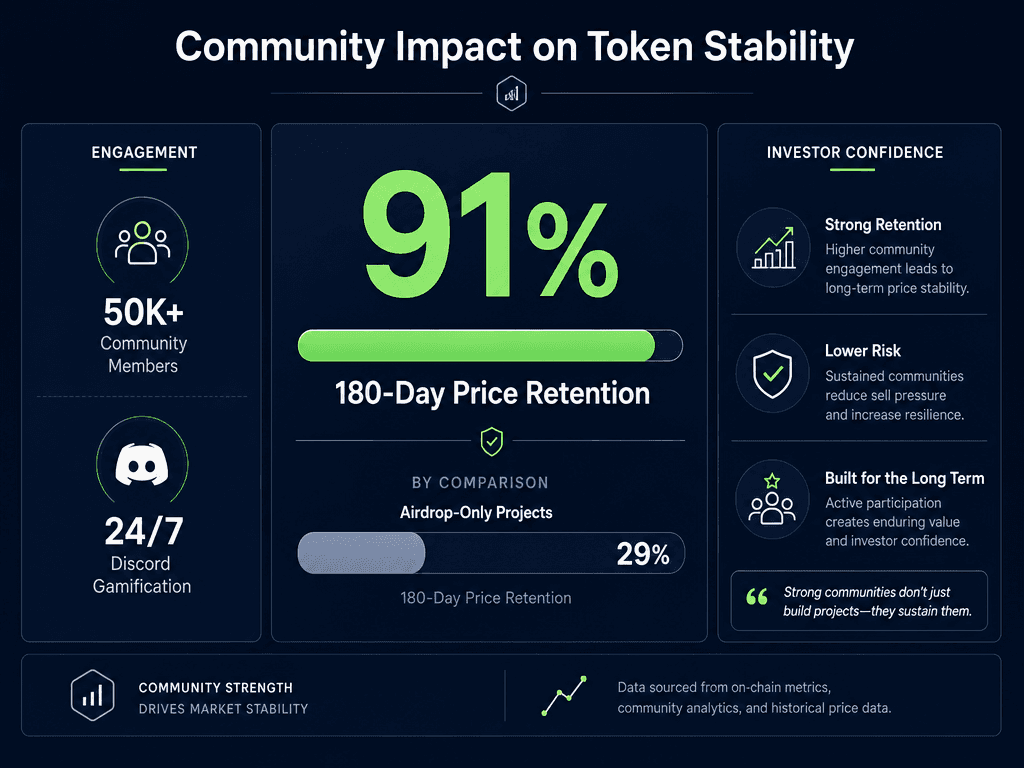
Building a robust, gamified community is the most effective way to ensure long-term token price stability and investor retention after a successful ICO.
Professional community management transforms Discord servers from passive announcement channels into active contribution ecosystems that directly impact token price stability. Projects with 50K+ community members achieved 91% higher 180-day token price retention compared to projects with smaller communities, according to Messari Research 2026 data, because large engaged communities create organic buy pressure, defend against FUD during market volatility, and provide the social proof that attracts institutional capital.
Effective Discord community management combines three operational layers. Moderation teams enforce community standards, filter spam and scam attempts, and maintain conversation quality across channels 24/7 in all major time zones. Engagement specialists run daily activities like trivia contests, AMAs with team members, educational workshops about project technology, and collaborative contribution campaigns that reward active members with role promotions and token incentives. Analytics teams track participation metrics, identify highly engaged members for ambassador roles, and measure how Discord activity correlates with on-chain behaviors like wallet connections and token purchases.
OMNI Agency's community management practice has built over 250,000 engaged participants for clients like Slingshot, Scratcher, and Bluff through structured onboarding sequences, gamified contribution systems, and integration with 500+ partner communities that provide cross-promotion opportunities. The Discord community management framework includes specialized playbooks for DeFi protocols, gaming projects, and infrastructure tokens that address the unique engagement patterns of each vertical.
Strategic Public Relations Through Crypto Media Networks
Distribution through established crypto media outlets builds credibility that paid advertising and social media alone cannot achieve. Coverage in CoinDesk, Cointelegraph, Decrypt, The Block, or BeInCrypto signals to potential investors that a project has passed editorial scrutiny and deserves serious consideration, particularly for institutional investors who rely on trusted publications for deal flow.
The challenge lies in access. Tier-1 crypto publications receive hundreds of project pitches weekly and maintain strict editorial standards against pay-for-play arrangements. Successful PR campaigns leverage existing journalist relationships, news hooks beyond just "we're launching a token," and exclusive data or insights that provide genuine value to readers rather than thinly disguised advertisements.
OMNI Agency's proprietary media network includes direct relationships with editors and journalists across major crypto publications, built through five years of delivering exclusive stories, expert commentary, and data-driven insights that publications actually want to cover. That access enabled clients like Music Protocol to secure strategic coverage timing that contributed to their $700K raise, and helped Neurochain AI achieve visibility that supported their $3M node sale.
Compliant Paid Advertising Across Crypto-Native Networks
Paid media for token launches requires navigating a complex compliance landscape where traditional platforms like Google and Meta impose strict restrictions, forcing projects toward specialized crypto advertising networks with their own targeting limitations and fraud risks. Instagram Reels-based token campaigns achieved an average cost-per-acquisition of $6.14 versus $22.80 for banner ads according to Web3 Growth Labs 2026 research, but accessing that inventory requires ad accounts with established compliance histories.
Successful paid campaigns diversify across four channel categories. Crypto-native ad networks like Coinzilla, Bitmedia, and A-Ads provide direct access to crypto-engaged audiences but require careful placement selection to avoid low-quality traffic from airdrop farmer bots. Social platform advertising through compliant Google Ads accounts targeting crypto keywords and Meta's allowlisted ad categories delivers higher-quality traffic but demands extensive documentation including regulatory opinions, terms of service, and KYC procedures. Programmatic display campaigns through platforms like StackAdapt reach crypto audiences on mainstream websites by targeting behavioral signals like crypto news readership. Influencer-amplified paid promotion combines organic creator content with paid boosting to achieve both authenticity and scale.
OMNI Agency's paid advertising practice manages seven figures in annual crypto ad spend across 100+ client campaigns, maintaining compliant account structures that survive platform policy changes while optimizing toward on-chain conversion metrics rather than vanity engagement rates.
Beyond the Hype: Specialized Marketing for DePIN and AI Infrastructure
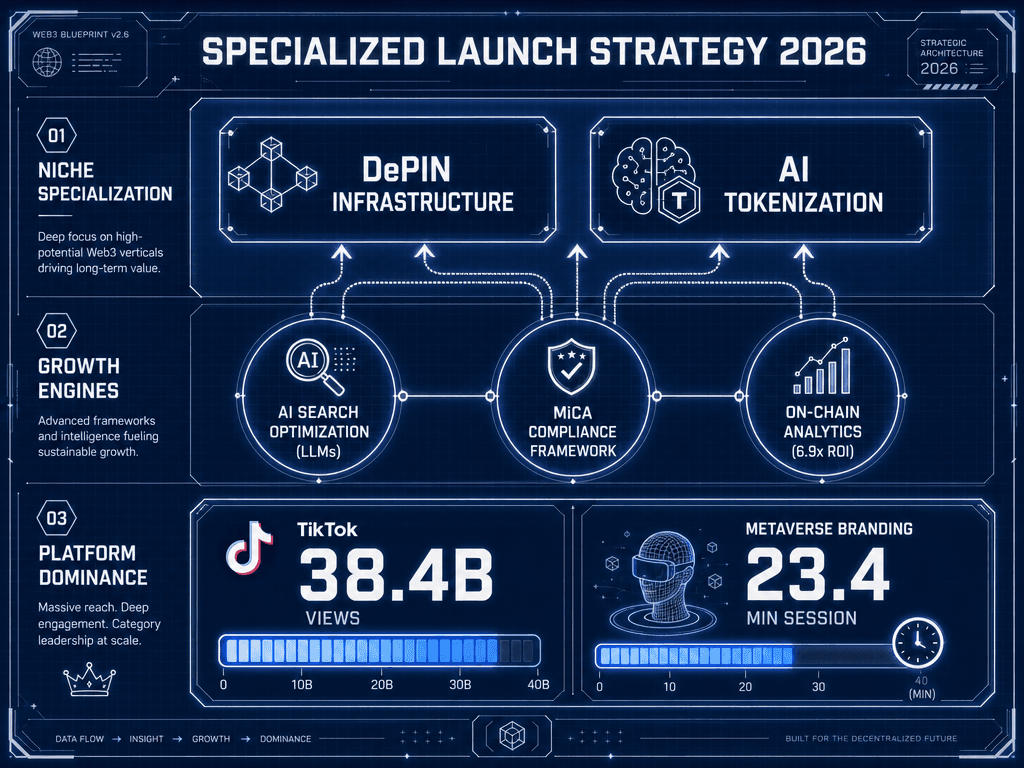
Success in 2026 requires a specialized approach for DePIN and AI projects, integrating on-chain analytics and LLM search optimization into the core marketing stack.
DeFi and gaming projects dominate ICO promotion case studies, but DePIN (Decentralized Physical Infrastructure) and AI infrastructure tokens require fundamentally different marketing approaches because their value propositions target enterprises and developers rather than retail speculators. A generic "token launch marketing agency" will fail DePIN projects by optimizing for hype cycles instead of technical credibility, and will fail AI projects by positioning compute tokens as speculative assets rather than infrastructure primitives.
The Technical Education Challenge
DePIN projects tokenizing physical infrastructure - wireless networks, GPU compute clusters, energy grids, storage systems - face the challenge that most potential token buyers don't initially understand how decentralized infrastructure works or why it matters. Marketing campaigns must educate audiences on complex technical concepts like proof-of-coverage for wireless networks, proof-of-spacetime for storage, or cryptographic verification of GPU compute before investors can evaluate whether the token economics make sense.
Effective DePIN marketing creates content ladders that progressively build technical understanding. Introductory content explains the problem with centralized infrastructure using concrete examples that non-technical audiences relate to - monopolistic pricing, coverage gaps in rural areas, vendor lock-in for cloud compute. Intermediate content introduces decentralization as the solution, explaining how token incentives enable coordination among individual infrastructure operators. Advanced content dives into technical architecture, tokenomics mechanisms, and specific advantages over both centralized incumbents and competing decentralized networks.
OMNI Agency's work with DePIN clients structures this education across multiple content formats - explainer videos for social distribution, technical documentation optimized for developer discovery, case studies demonstrating real-world infrastructure deployments, and comparison content that positions the project against both Web2 incumbents and Web3 competitors. The specialized Web3 user acquisition strategies developed for DePIN projects deliver 3-5x better unit economics than generic token launch campaigns because they target infrastructure operators and enterprise buyers rather than retail speculators.
Developer-First Go-to-Market for AI Infrastructure
AI infrastructure tokens - platforms providing decentralized compute for model training, inference marketplaces for AI applications, or tokenized GPU networks - require developer-first marketing that treats AI engineers and ML researchers as the primary audience rather than crypto investors. These buyers evaluate projects based on technical performance benchmarks, API documentation quality, integration complexity, and cost-per-compute comparisons against centralized alternatives like AWS or Google Cloud.
The marketing flywheel for AI infrastructure projects starts with developer adoption rather than token speculation. Early campaigns focus on technical content marketing - benchmark reports comparing decentralized compute performance against AWS, integration tutorials for popular ML frameworks like PyTorch and TensorFlow, case studies from early adopter developers, and detailed API documentation that appears in developer search results. Token promotion comes later in the funnel, positioned as the mechanism that enables developers to access discounted compute or participate in network governance rather than as an investment opportunity.
This developer-first approach requires specialized content expertise that generic crypto marketing agencies lack. OMNI Agency's Web3 go-to-market strategy for infrastructure projects combines technical content creation with distribution through developer-focused channels like GitHub repositories, technical documentation sites, ML research forums, and AI engineering communities rather than crypto-native platforms like CT or Telegram.
Positioning Against Enterprise Incumbents
Both DePIN and AI infrastructure projects face the unique challenge of competing against well-funded centralized incumbents with established enterprise sales teams, integration partnerships, and brand recognition. AWS doesn't need to explain what cloud compute is. Helium needs to explain why decentralized wireless infrastructure matters despite lower brand recognition and unproven operational track records.
Effective competitive positioning focuses on structural advantages that decentralization enables rather than making direct performance comparisons against incumbents. For DePIN projects, that means emphasizing censorship resistance, permissionless participation, transparent economics, and alignment between infrastructure operators and users. For AI infrastructure, positioning centers on cost advantages from utilizing idle compute capacity, privacy from keeping sensitive training data out of centralized clouds, and democratized access for developers in regions underserved by hyperscaler data centers.
Marketing materials must acknowledge incumbent strengths rather than pretending they don't exist, then articulate why decentralization matters despite those strengths. A wireless DePIN can't claim better coverage than Verizon's existing network in major cities - but it can explain why permissionless deployment enables coverage in rural areas and developing countries that centralized carriers ignore due to low profitability. An AI compute network can't match AWS's absolute performance - but it can offer 70% cost savings for workloads that don't require absolute maximum speed.
The "Compliant Growth" Framework: Navigating MiCA and Global Regulations
Regulatory compliance directly impacts ICO promotion effectiveness because compliant campaigns achieve 28% higher click-through rates than non-compliant ads according to Chainalysis 2026 research, access advertising platforms that ban non-compliant projects, and avoid the reputational damage and legal liability that comes from running promotions that trigger securities law violations.
MiCA Requirements for European Token Sales
The Markets in Crypto-Assets (MiCA) regulation that took full effect across the European Union in 2024 establishes comprehensive requirements for token issuers promoting sales to EU residents. Projects must publish a detailed whitepaper meeting specific disclosure standards, register with national financial authorities, implement robust KYC/AML procedures, and ensure all marketing materials include required disclosures about risks and regulatory status.
The practical impact on ICO promotion is significant. Paid advertising campaigns must geo-fence EU countries unless the project has completed MiCA registration, which can take 3-6 months and requires substantial legal investment. Influencer content must include disclosures when creators receive compensation for token promotion. Marketing materials cannot make claims about expected returns or compare tokens to securities without triggering additional registration requirements.
Forward-thinking projects treat MiCA compliance as a competitive advantage rather than a burden. Registration signals institutional-grade legitimacy that attracts European VC firms and sophisticated investors who won't touch unregistered tokens. Compliant marketing materials build long-term trust that sustains projects through bear markets when regulatory scrutiny intensifies and platforms purge non-compliant projects.
Global Regulatory Patchwork Strategy
Beyond MiCA, token promoters must navigate a complex patchwork of national regulations with conflicting requirements. The United States treats most tokens as unregistered securities requiring exemptions like Regulation D or Regulation S for sales to non-US persons. Singapore requires licenses for payment tokens and restricts advertising to accredited investors. The UAE's VARA framework permits token promotion but requires detailed disclosure documents and advertising approvals.
Successful global campaigns segment audiences and customize messaging by jurisdiction. Marketing to US audiences emphasizes utility and functionality rather than investment opportunity, uses Regulation D disclaimers for accredited investor outreach, and avoids any content that could constitute an offer of securities to the general public. EU-focused campaigns include MiCA-required disclosures and risk warnings. Asian campaigns navigate restrictions on retail advertising in Singapore and Hong Kong while taking advantage of more permissive regimes in jurisdictions like Dubai and Abu Dhabi.
The operational complexity requires specialized legal and compliance infrastructure that generic marketing agencies don't provide. OMNI Agency partners with crypto-specialized law firms to implement compliant campaign structures across all major jurisdictions, maintaining documentation that proves adherence to applicable regulations if questions arise later.
Building Compliance Into Campaign DNA
The most effective approach treats compliance as a campaign design principle rather than a checklist to complete after creative development. That means involving legal counsel during the messaging and positioning phase to identify claims that trigger securities law issues, structuring influencer agreements to include required disclosures and compensation transparency, implementing geo-targeting rules in paid media campaigns before launching ads, and maintaining audit trails that document compliance with applicable regulations.
This proactive approach prevents the costly campaign pivots that happen when legal review occurs late in the process and identifies fundamental compliance issues requiring complete creative overhauls. It also builds the compliance infrastructure that exchanges now require before listing discussions begin - major platforms ask detailed questions about marketing practices, KYC procedures, and regulatory registrations during due diligence.
Data-Driven Success: How Modern Agencies Use On-Chain Analytics
Revenue per dollar spent on combined on-chain and off-chain analytics averages $6.90 according to research from Nansen and Dune Analytics, making analytics infrastructure the highest-ROI investment in modern ICO promotion campaigns. Projects that implement proper tracking generate actionable insights about which marketing channels drive genuine buyers versus mercenary airdrop farmers, enabling real-time budget reallocation toward what converts.
Wallet-Based Attribution Infrastructure
The foundation of data-driven ICO promotion is wallet-based attribution that connects every marketing touchpoint to specific on-chain behaviors. Implementation requires three technical components working together. First, unique referral codes or UTM parameters for every marketing channel - influencer posts, paid ads, content pieces, community campaigns. Second, a wallet connection flow that captures the referral source when users connect their wallets to the project's website or application. Third, on-chain tracking that monitors wallet addresses for subsequent behaviors like token purchases, liquidity provision, or governance participation.
This infrastructure reveals which marketing channels drive which outcomes. An influencer might generate 10,000 wallet connections but only 50 token purchases, indicating their audience consists primarily of airdrop farmers rather than genuine investors. A paid media campaign might generate only 500 wallet connections but 300 token purchases, demonstrating high buyer intent. Content marketing might drive modest direct token sales but generate thousands of liquidity provider positions, indicating it attracts long-term oriented community members rather than short-term speculators.
Wallet-based attribution enables sophisticated budget optimization that isn't possible with traditional marketing measurement. Projects can calculate customer acquisition cost by channel based on actual token purchases rather than vanity metrics like impressions or clicks. They can identify which marketing activities drive desirable long-term behaviors like governance participation rather than mercenary farming. And they can model lifetime value by cohort to determine whether specific campaigns attract high-value community members or low-value speculators.
Competitive Intelligence Through On-Chain Analysis
On-chain analytics tools like Nansen, Dune Analytics, and Arkham Intelligence enable competitive intelligence that informs ICO promotion strategy. Projects can analyze competitor token sales to understand which marketing channels drove their success, identify the whale wallets that provided early capital, track how those wallets behaved post-sale, and reverse-engineer the distribution strategies that sustained price stability.
Specific competitive insights include identifying which KOLs and influencers drove measurable wallet activity for competing projects, analyzing the geographic and exchange distribution of token buyers, tracking how quickly post-sale sellers entered the market versus long-term holders, and evaluating whether airdrops and incentive programs generated sticky community members or temporary mercenaries.
This intelligence directly informs campaign strategy. If analysis reveals that a successful competitor derived most early capital from a small number of whale wallets discovered through private VC networks, that suggests prioritizing institutional outreach over retail marketing. If data shows competitors achieved strong post-sale retention through structured liquidity mining programs, that indicates similar programs should be part of the go-to-market plan. If wallet tracking demonstrates that airdrop recipients consistently sold tokens immediately, that argues for learn-to-earn programs instead.
Real-Time Campaign Optimization
The combination of wallet-based attribution and on-chain analytics enables real-time campaign optimization that continuously improves results throughout the token sale period. Marketing teams monitor dashboards showing wallet connections, token purchases, and downstream behaviors by channel, identify which activities drive target outcomes, and shift budget allocation toward high-performing channels within hours rather than weeks.
Practical examples include pausing underperforming influencer activations mid-campaign and reallocating budget to high-converting creators, identifying which paid media ad creatives drive actual buyers versus tire-kickers and concentrating spend on winning variations, and detecting which content topics correlate with high-quality community member acquisition and producing more of that content.
This optimization capability delivers compounding returns over 90-day pre-sale and 30-day sale windows because improvements compound across the campaign rather than only applying to future initiatives. A 20% improvement in conversion rate implemented week three of a campaign generates 6-7 weeks of benefit rather than zero benefit as would occur if the same insight was only applied to the next token launch.
What Does It Cost to Execute a Full-Stack ICO Promotion Campaign?
Full-service ICO promotion campaigns typically range from $150,000 to $500,000+ in agency fees plus marketing spend, with the specific investment determined by project complexity, target raise amount, and desired channel mix. Understanding the cost structure enables realistic budgeting and helps projects determine which agencies offer genuine value versus overpriced or underscoped services.
Agency Fee Structures and Typical Costs
Service Component | Typical Monthly Retainer | Typical Campaign Duration | Total Agency Investment |
|---|---|---|---|
Strategic Planning & Positioning | $15,000-$30,000 | One-time / Pre-launch | $15,000-$30,000 |
Community Building & Management | $10,000-$25,000 | 4-6 months (pre + post launch) | $40,000-$150,000 |
Influencer & KOL Campaigns | $20,000-$60,000 | 2-3 month activation period | $40,000-$180,000 |
Content Production & Distribution | $8,000-$20,000 | 3-4 months | $24,000-$80,000 |
Paid Media Management | 15-20% of ad spend | 2-3 month campaign | Varies by budget |
Public Relations & Media Outreach | $12,000-$30,000 | 3-4 months | $36,000-$120,000 |
Analytics & Reporting Infrastructure | $5,000-$15,000 | One-time setup + ongoing | $10,000-$30,000 |
Full-service retainer packages that bundle multiple services typically range from $40,000 to $100,000 per month for 3-4 month engagements, with projects raising under $5M gravitating toward the lower end and projects targeting $20M+ raises requiring premium service levels at the higher end.
Marketing Spend Budget Allocation
Beyond agency fees, successful token launches allocate 15-25% of the target raise amount toward direct marketing spend across paid media, influencer compensation, and promotional campaigns. A project targeting a $10M raise should budget $1.5M-$2.5M for marketing spend in addition to agency fees.
Typical budget allocation across channels for a balanced campaign includes 30-40% toward influencer and KOL partnerships, 25-35% toward paid advertising across crypto networks and compliant social platforms, 15-20% toward community growth campaigns including ambassador programs and engagement incentives, 10-15% toward content production including video, graphics, and written materials, and 5-10% reserved for opportunistic activations and crisis response.
Projects attempting token launches with insufficient marketing budgets consistently underperform targets because they lack the activation budget required to break through noise in a crowded market. A $2M raise attempt with only $50K in marketing spend faces almost certain failure because the budget cannot sustain the multi-channel presence required to build credibility and momentum during critical pre-sale and sale periods.
ROI Expectations and Performance Benchmarks
Well-executed ICO promotion campaigns should deliver 4-8x return on total marketing investment (agency fees plus ad spend) measured by raise amount achieved versus marketing costs. A project investing $300K in agency fees and $700K in marketing spend ($1M total) targeting a $10M raise should achieve that target, delivering 10x ROI on marketing investment.
Key performance indicators that predict success include pre-sale community growth to 30K+ engaged Discord and Telegram members, whitelist signup rates of 2-4% of total awareness audience, token sale conversion rates of 15-25% of whitelisted participants, and post-sale retention rates with 60%+ of token purchasers still holding after 90 days versus immediate selling.
Projects that hit these benchmarks typically achieve target raise amounts and sustain post-sale token price stability. Those falling significantly short on early indicators like community growth or whitelist conversion usually need to extend sale periods, reduce target raise amounts, or implement recovery campaigns that add costs and delay timelines.
Choosing Between Specialist Web3 Agencies and Generalist Marketing Firms
The choice between hiring a Web3-specialized marketing agency versus a generalist firm with crypto capabilities fundamentally determines campaign success because the operational knowledge, network access, and regulatory expertise required for token launches cannot be acquired quickly by generalist teams attempting to expand into crypto.
The "Tourist Agency" Trap: Why Generalist Marketing Fails Web3 Projects
Traditional marketing agencies that handle crypto as one vertical among many consistently underdeliver on token launches because they lack the specialized knowledge and relationships that determine success in Web3. The specific failure patterns include not understanding crypto-native channels like Discord community management, Telegram growth tactics, and crypto-Twitter engagement strategies that determine project visibility. Lacking direct relationships with tier-1 crypto media outlets, they produce press releases that get ignored rather than securing meaningful coverage. Not maintaining connections with verified crypto influencers, they partner with sketchy accounts that deliver bot followers rather than engaged communities.
Projects that hire generalist agencies with impressive client rosters from other industries frequently waste 6-8 weeks on campaign planning before realizing the team doesn't understand Web3 fundamentals. The agency produces beautiful creative assets and comprehensive media plans that would work for consumer products but completely miss how token buyers actually discover and evaluate projects. Course correction at that point means choosing between continuing with an underperforming partner or eating sunk costs and restarting with a specialized agency.
The underlying issue is that Web3 marketing requires different mental models than traditional marketing. Token launches aren't product launches. Communities aren't customer bases. Discord isn't Facebook. Influencers aren't spokespeople. The faster you realize that distinction and partner with specialists who live in Web3 rather than tourists passing through, the better your results.
Web3-Native Capabilities That Specialists Provide
Specialized Web3 agencies bring operational capabilities that generalist firms cannot replicate without years of investment. Direct relationships with verified crypto influencers and KOLs built through years of campaigns mean immediate access to creators who move capital rather than months spent cold-outreaching to accounts that may or may not be legitimate. Established partnerships with tier-1 crypto media outlets enable strategic coverage timing rather than hoping press releases get picked up. 24/7 community management teams experienced in crypto-native platforms understand Discord moderation, Telegram growth tactics, and the nuanced differences between genuine community building versus vanity metric chasing.
Technical expertise matters equally. Understanding how to implement wallet-based attribution requires both marketing knowledge and blockchain technical understanding. Optimizing for AI search engines requires understanding how ChatGPT and Perplexity extract crypto information. Navigating the MiCA regulatory framework requires staying current with evolving compliance requirements across multiple jurisdictions.
OMNI Agency's five years operating exclusively in Web3 means our team has executed over 100 token launches, built relationships with 400+ verified influencers, maintains partnerships with major crypto publications, and developed proprietary playbooks for every vertical from DeFi and gaming to DePIN and AI infrastructure. That specialization delivers measurable advantages - our influencer activations achieve 8.3x ROI because we know which creators actually drive capital versus which deliver vanity metrics. Our media network secures strategic coverage timing that supports key campaign milestones because editors trust our judgment about what's newsworthy. Our community management practice has built over 250,000 engaged participants because we understand the specific engagement tactics that work in crypto-native environments.
Evaluation Criteria for Vetting Agency Partners
Projects evaluating potential agency partners should assess specific capabilities that indicate genuine Web3 expertise versus surface-level crypto understanding. Request detailed case studies with specific outcomes - raise amounts achieved, community size built, conversion rates delivered - rather than testimonials that could apply to any marketing campaign. Ask about their influencer network and request to see the specific creators they work with, including follower counts, engagement rates, and past campaign performance. Review their content portfolio to evaluate whether they understand crypto-native communication styles or produce generic marketing content. Question their team about recent regulatory changes like MiCA implementation or evolving ad platform policies to assess whether they're actively engaged in the space.
Red flags include agencies that promise specific raise amounts or token price targets without understanding your project, inability to explain their influencer vetting process beyond follower counts, lack of crypto-specific case studies in your vertical, and sales teams that don't ask detailed questions about your tokenomics, target buyers, or competitive positioning.
The strongest indicator of genuine specialization is whether the agency asks hard questions rather than making easy promises. Legitimate Web3 agencies will challenge your assumptions about target raise amounts, timeline expectations, and budget allocation because they've seen hundreds of token launches and know what actually works versus founder optimism.
h2, h3