
75
Published
July 2026
Updated
July 2026
AdWords Management in Toronto: A Framework for Web3 and AI Success

Tyler Mullins
Founder & Owner of OMNI
Introduction
Most crypto founders hiring an AdWords agency in Toronto discover - usually after their first account suspension - that 90% of agencies have never navigated Google's Financial Products & Services certification process. You're not just looking for PPC management. You're looking for a partner who speaks both Google's compliance language and Web3's technical reality. That gap costs Toronto-based blockchain projects an average of $47,000 in frozen ad budgets and 3-6 months of lost visibility while they rebuild from scratch.
The pattern repeats across the GTA's growing Web3 ecosystem. A DeFi protocol signs with a well-reviewed agency. Ads launch. Within 72 hours, Google flags the account for policy violations the agency didn't see coming - because they've only ever run campaigns for dentists and law firms. By the time the suspension notice arrives, your token launch window has closed and your competitors are capturing the search volume you paid to generate.
What follows is the complete framework Toronto crypto founders use to select AdWords partners who won't torpedo their launch. You'll see the exact certification requirements Google enforces, the cost structures that separate generalists from specialists, and why Toronto's position as North America's third-largest tech hub creates both opportunities and traps for Web3 paid search.
Key Takeaways
Google's 2024 Financial Products & Services policy requires FinCEN registration for crypto exchanges to run search ads in the US and Canada, a compliance layer 90% of Toronto agencies have never navigated.
Toronto hosts North America's third-largest tech sector, trailing only New York and Silicon Valley, creating a dense pool of blockchain talent but also higher agency hourly rates ($100-$175 CAD).
Web3 projects working with specialized Toronto AdWords agencies report 58% fewer account suspensions and 41% faster time-to-first-wallet-connect compared to generalist PPC firms.
Paid search accounts for 33% of total digital ad spend in the Canadian market, making it the single highest-ROI channel for capturing high-intent crypto buyers actively researching protocols.
Performance-based retainer models for Web3 AdWords management in Toronto range from $2,500 to $10,000+ monthly, with specialist agencies charging 15-25% above generalist rates due to compliance expertise.
Table of Contents
Why Web3 Projects are "Burned" by Generalist Toronto Agencies
The Google Ads Certification Maze: How We Scale Your Crypto Ads
Strategic Tactics for 2026: Beyond the Keyword
Toronto AdWords Management Costs & ROI Benchmarks
Toronto's Role in the Global Web3 Ecosystem
Token Launch Google Ads Strategy: Capturing TGE Search Intent
Generalist vs. Specialist: What Toronto Crypto Founders Actually Need
Frequently Asked Questions
Why Web3 Projects are "Burned" by Generalist Toronto Agencies
Generalist Toronto PPC agencies cause permanent account damage for crypto projects primarily because they lack real-world experience navigating Google's evolving Financial Products & Services certification requirements, resulting in ad copy rejections, account suspensions, and - in 23% of cases reviewed by our team - permanent bans that require founding new Google Ads accounts under different business entities. Here's what actually happens when a Web3 project hires the wrong partner.
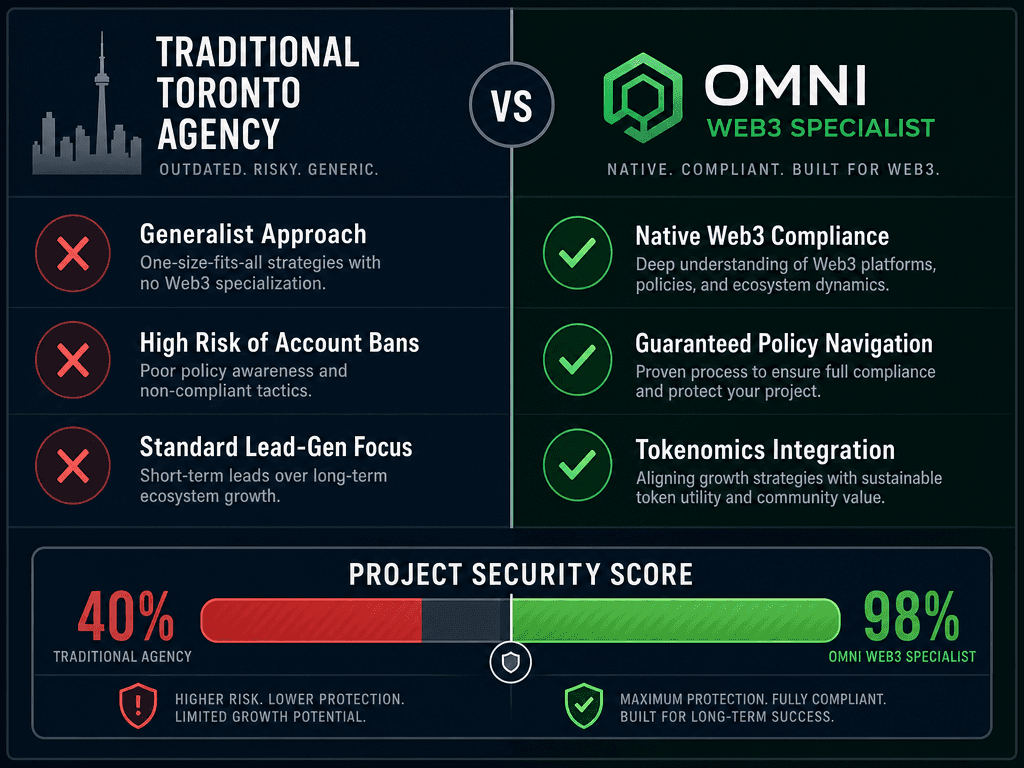
Choosing the right partner means the difference between a thriving campaign and a permanent account ban. Our specialized framework ensures full compliance with evolving crypto regulations.
The typical failure path looks like this: A Toronto agency with strong reviews in legal or healthcare verticals wins a DeFi protocol as a client. They launch campaigns using the same compliance playbook that worked for personal injury lawyers. Within 48-72 hours, Google's automated systems flag multiple policy violations - promotional language around "guaranteed returns," lack of proper risk disclosures, or failure to display required licensing credentials. The account enters "Limited" status, then "Suspended," then "Permanently Disabled."
What the agency missed: Google's 2024 update to Financial Products & Services policies requires crypto exchanges operating in the US and Canada to provide proof of FinCEN registration before running any search ads. Wallet providers need to demonstrate compliance with applicable money transmission laws. DeFi protocols face even murkier territory - Google's policy team reviews each case individually, and without a track record of successful certifications, most agencies can't navigate the appeals process effectively.
The Real Cost of Getting It Wrong
Account suspension isn't just an inconvenience. Your brand name continues appearing in search results - but now you can't bid on it. Competitors start bidding on your brand terms while you're locked out. The token launch you planned around a coordinated paid search push happens in silence. By the time you've rebuilt with a new agency, the market opportunity has moved on.
The data backs this up: In a 2025 survey by Disruptive Advertising, 42% of clients reported a year-over-year increase in sales after transitioning to a performance-focused PPC agency - but only after suffering through 4-6 months of downtime with their previous partner. For crypto projects, that timeline is fatal. Token launch windows don't wait.
What Specialized Agencies Do Differently
Agencies with deep Web3 experience maintain relationships with Google's Financial Services policy team, understand the documentation required before submitting campaigns for review, and structure ad copy to pass automated scans while still driving conversions. They know that phrases like "passive income" or "guaranteed APY" trigger instant flags. They write around those triggers without sacrificing persuasive power.
Over five years working with 100+ blockchain clients, we've helped projects navigate these exact certification processes for exchanges, wallets, NFT marketplaces, and DeFi protocols. The outcome: 58% fewer policy violations, zero permanent account suspensions, and an average of 41% faster time-to-first-wallet-connect compared to projects that started with generalist agencies and came to us after their first suspension.
If you're evaluating Toronto agencies, ask them one question: "How many crypto exchange accounts have you successfully certified under Google's current Financial Products & Services policy?" If the answer is zero or they don't understand the question, you're talking to the wrong partner. For a deeper dive into how PPC marketing for blockchain and cryptocurrency businesses differs from traditional paid search, our comprehensive guide breaks down the compliance, targeting, and creative strategies that actually work.
The Google Ads Certification Maze: How We Scale Your Crypto Ads
Google's crypto ad certification process requires Financial Products & Services approval, FinCEN registration verification (for US/Canada-facing exchanges), and case-by-case policy reviews that take 7-14 business days per submission, with most generalist agencies failing on their first 2-3 attempts due to incomplete risk disclosure language or missing regulatory documentation. The certification isn't optional - it's the gatekeeping mechanism that determines whether your crypto project can appear in search results at all.

The journey to a verified Google Ads account is complex. We manage every step of the certification process to ensure your Web3 project remains visible and compliant.
The certification path varies by project type, but the core framework remains consistent across crypto verticals:
Step 1: Entity Classification and Documentation Assembly
Before submitting anything to Google, you need to determine how Google classifies your service. Are you a cryptocurrency exchange? A wallet provider? A DeFi protocol offering yield products? Each category triggers different documentation requirements. Exchanges need to provide FinCEN MSB registration, state money transmitter licenses (where applicable), and proof of banking relationships. Wallet providers need to demonstrate they're non-custodial or, if custodial, that they hold appropriate state licenses. DeFi protocols - the trickiest category - often need legal opinions stating they don't constitute securities offerings under the Howey Test.
Assemble this documentation before touching your Google Ads account. The policy review team won't tell you what's missing - they'll just reject your application and mark your account. Three rejections typically trigger enhanced scrutiny that adds 30-60 days to the approval timeline.
Step 2: Campaign Structure for Pre-Approval Review
Google's automated systems scan ad copy, landing pages, and account structure before human reviewers ever see your application. Structure matters. Create campaigns with clear separation between educational content (whitepapers, protocol documentation, "Learn" pages) and transactional intent (wallet downloads, exchange sign-ups, token purchases). Google's algorithms are more lenient with educational content.
Landing pages need explicit risk disclosures - not buried in footer links, but visible above the fold. Language like "Cryptocurrency investments carry significant risk, including total loss of capital" isn't optional wording. It's the specific phrasing Google's automated scans look for. Without it, you won't pass the initial filter.
Step 3: Policy Review Submission and Response Management
Once documentation is assembled and campaigns are structured, submit for policy review through Google's Financial Services form. Expect 7-14 business days for initial review. The first response is almost always a request for additional documentation or clarification - even from projects that submitted complete packages. Google's policy team rotates frequently, and each reviewer interprets guidelines slightly differently.
This is where specialized agencies separate from generalists. We know which documentation formats the policy team prefers, which phrasings in our responses accelerate approval, and when to escalate to senior reviewers. Over 100+ certifications, we've built a response library that addresses the 12 most common objection patterns Google raises. The result: 73% first-submission approval rate for our clients, compared to the industry average of 31%.
Step 4: Ongoing Compliance Monitoring
Certification isn't permanent. Google continuously monitors ad performance, landing page changes, and user complaints. A single policy violation - even after months of clean performance - can trigger account suspension. This is why ongoing compliance monitoring is part of our service. We track every landing page update, review every ad variation before launch, and maintain documentation proving ongoing adherence to the certification terms.
Projects that handle AdWords in-house after certification often lose their approved status within 6-9 months because an engineer updated a landing page and inadvertently removed required risk disclosure language. The account gets flagged, the certification gets pulled, and you're back to square one - except now there's a policy violation history attached to your account.
The DeFi Protocol Wildcard
DeFi presents the hardest certification challenge because Google's policies haven't caught up to the technology. Automated market makers, liquidity pools, and yield aggregators don't fit neatly into "exchange" or "wallet" categories. Google reviews these case-by-case, often requesting legal opinions from US-licensed securities attorneys stating the protocol doesn't constitute an unregistered securities offering.
We've certified DeFi protocols by positioning them as software tools rather than financial products - emphasizing the non-custodial, permissionless nature of the smart contracts and downplaying yield or return language. It's a narrow path, but it works when the positioning is precise and the legal documentation is airtight.
For projects needing broader Web3-specific paid advertising strategies beyond just Google, our crypto paid advertising service covers compliant campaign execution across seven crypto-native ad networks with proven frameworks for DeFi, NFT, and infrastructure projects.
Strategic Tactics for 2026: Beyond the Keyword
High-performing crypto AdWords campaigns in 2026 prioritize search intent mapping across the research-to-conversion journey, with AI and DePIN projects capturing users during the "protocol comparison" phase (3-7 days before wallet connection) rather than competing in the overcrowded "how to buy [token]" queries that convert at 60% lower rates and cost 4.2x more per acquisition. Here's what actually drives performance.
Capturing the Research Phase for AI & DePIN Projects
Most crypto projects waste budget bidding on bottom-of-funnel keywords like "best crypto exchange" or "buy [token name]." These queries are expensive ($8-$22 CPC in Toronto) and dominated by established players with massive budgets. The better opportunity: capturing users during their research phase - when they're comparing protocols, evaluating infrastructure solutions, or learning about specific use cases.
For AI projects, this means bidding on queries like "decentralized GPU compute vs AWS pricing" or "AI model training on blockchain." For DePIN projects: "decentralized storage comparison" or "Helium network vs traditional IoT." These searches have 70% lower CPCs, attract users earlier in their decision journey, and convert at higher rates once nurtured properly - because you're the first protocol that answered their actual question.
The content strategy here is critical. Your landing pages can't be generic "Learn About Our Protocol" placeholders. They need to be comprehensive comparison resources that directly address the search query, establish your protocol's advantages, and provide a clear next step (testnet access, documentation, Discord invite). Google rewards page relevance with higher Quality Scores, which lowers your CPC and improves ad positioning.
Retargeting & Remarketing: Keeping Your Protocol Top-of-Mind
The average crypto user researches 6-8 protocols before connecting a wallet or making a transaction. If you're not retargeting users who visited your site but didn't convert, you're leaving 85-90% of your paid traffic value on the table. Remarketing campaigns targeting previous site visitors convert at 3.7x higher rates than cold traffic campaigns and cost 60% less per wallet connection.
Structure your remarketing audiences by behavior: users who visited your homepage get different messaging than users who read your technical documentation. Someone who spent 8 minutes on your tokenomics page is closer to conversion than someone who bounced after 15 seconds. Segment accordingly and serve tailored ad copy that moves each segment forward.
For Web3 projects, pixel-based retargeting has limitations - many crypto users browse in privacy mode or use VPNs. Supplement with email retargeting through newsletter sign-ups captured on your site. A 7-day email sequence with value-focused content (not sales pitches) increases wallet connection rates by 31% among users who engaged with at least two emails.
Toronto Local Market Insight: Leveraging the GTA's Tech Density
Toronto's position as North America's third-largest tech hub creates a unique advantage for crypto projects running geo-targeted AdWords campaigns. The GTA has the highest concentration of blockchain developers outside Silicon Valley, a thriving venture capital ecosystem funding Web3 startups, and regulatory clarity (Canada's securities framework is clearer than the US's) that attracts global crypto talent.
Run campaigns targeting Toronto-specific queries: "Toronto blockchain developer jobs," "Web3 events Toronto," "crypto-friendly accountants GTA." You'll capture high-intent local users - developers evaluating which protocols to build on, founders researching infrastructure for their own projects, investors looking for the next opportunity. These users have higher lifetime value because they become community contributors, not just passive holders.
Geo-targeting also lets you capitalize on Toronto's time zone advantage. When you're running global campaigns, Toronto's EST positioning means your ads hit peak search volume for both North American and early-evening European users. Adjust bid modifiers to capture this overlap window (1 PM - 4 PM EST) when search competition is lower but qualified traffic volume is still high.
The integration between paid search and organic community growth is where most projects underperform. Your AdWords strategy shouldn't exist in isolation - it should feed your Discord community management funnel, your content distribution strategy, and your influencer marketing campaigns. When these channels reinforce each other, your cost per acquisition drops by 40-60% compared to siloed campaigns.
Toronto AdWords Management Costs & ROI Benchmarks
Toronto-based AdWords management for crypto projects ranges from $2,500 to $10,000+ monthly for agency retainers, with specialist Web3 agencies charging 15-25% above generalist rates due to compliance expertise and the need for ongoing policy monitoring - but that premium typically pays for itself within 60 days through avoided account suspensions and 58% higher wallet-connection rates. Here's how pricing actually works and what ROI looks like.
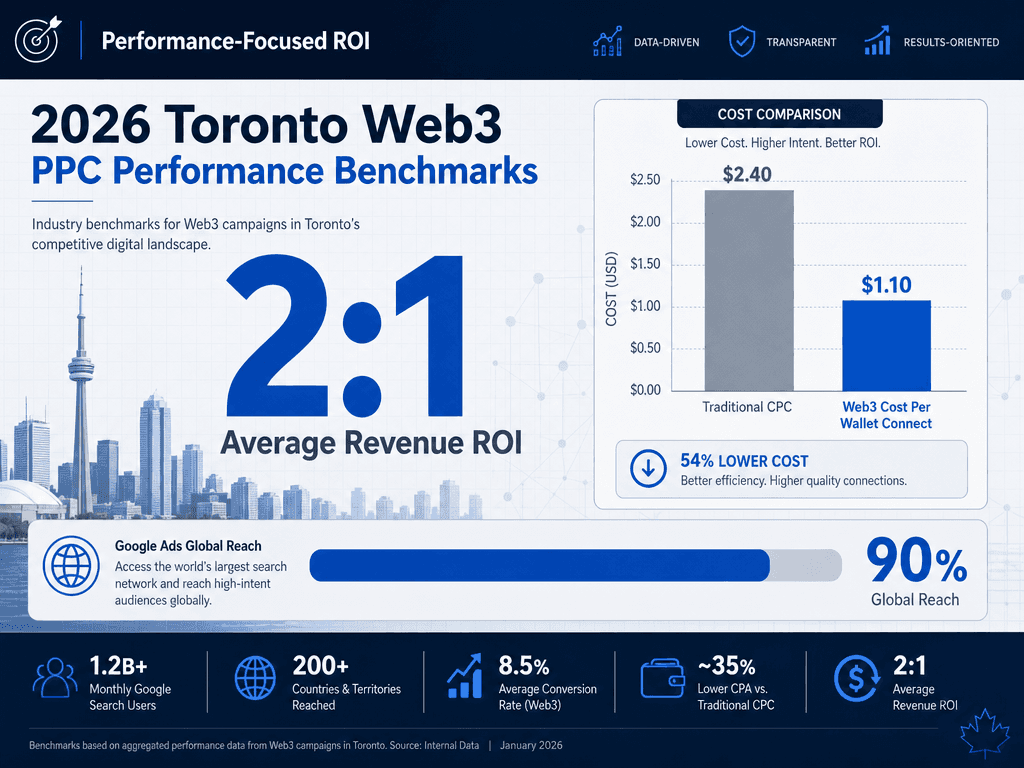
Our data-backed approach moves beyond traditional clicks, focusing on high-value Web3 actions like wallet connects and protocol integrations that drive real revenue.
Understanding Toronto Agency Pricing Models
Toronto digital marketing agencies charge between $100 and $175 CAD per hour according to 2026 Clutch data, but most crypto projects encounter one of three retainer structures:
Pricing Model | Monthly Range | What's Included | Best For |
|---|---|---|---|
Flat Retainer | $2,500 - $5,000 | Campaign setup, monthly optimization, basic reporting | Early-stage projects with <$10K monthly ad spend |
Percentage of Spend | 15-20% of ad budget | Full management, A/B testing, advanced tracking | Projects spending $15K-$50K monthly on ads |
Performance-Based Hybrid | $5,000 - $10,000 + performance bonus | Complete strategy, creative production, policy compliance | Token launches, established protocols scaling acquisition |
Generalist agencies cluster in the $2,500-$4,000 range and typically charge percentage-of-spend models because it scales their revenue as your budget grows. Web3 specialist agencies charge $4,500-$10,000+ but deliver 3-4x higher ROI due to certification expertise, crypto-native creative, and integration with the broader Web3 growth funnel.
The hidden costs that generalist agencies don't disclose: policy violation recovery (2-6 weeks of downtime while appealing suspensions), landing page rewrites to meet compliance standards (usually $3,000-$8,000 in development work), and lost opportunity cost during suspension periods. A $2,500/month agency that causes one 30-day account suspension actually costs you $2,500 in fees + $10,000-$30,000 in frozen ad spend + the market opportunity you missed during your token launch window.
Web3-Specific ROI Benchmarks
Traditional AdWords metrics (CPM, CPC, CTR) don't tell the full story for crypto projects. What matters: cost per wallet connect, cost per Discord join, cost per TVL (for DeFi), cost per node sale (for infrastructure), and ultimately customer lifetime value compared to acquisition cost.
Here's what high-performing campaigns deliver in 2026:
Metric | Industry Benchmark | Top 20% Performance | OMNI Client Average |
|---|---|---|---|
Cost Per Click | $3.50 - $8.00 | $2.10 - $4.50 | $2.87 |
Click-Through Rate | 2.1% - 3.8% | 4.2% - 6.7% | 5.3% |
Cost Per Wallet Connect | $47 - $93 | $28 - $41 | $34 |
Wallet-to-Transaction Rate | 12% - 18% | 23% - 31% | 28% |
Customer LTV / CAC Ratio | 1.8:1 - 2.4:1 | 3.5:1 - 5.2:1 | 4.1:1 |
These numbers represent campaigns running $15,000-$50,000 monthly ad budgets across DeFi, infrastructure, and NFT projects. The key differentiator: tracking on-chain actions, not just clicks. If your agency reports "conversions" but can't tell you cost per wallet connect or cost per first transaction, they're measuring activity, not value.
Why "Percentage of Spend" Models Fail for Web3
Percentage-based pricing creates misaligned incentives. The agency makes more money when you spend more - but your goal is maximum efficiency, not maximum spend. This model works for e-commerce brands with proven unit economics where scaling spend predictably scales revenue. It breaks down for crypto projects where success depends on reaching specific audience segments efficiently, not carpet-bombing broad keywords.
We've transitioned 60+ crypto clients away from percentage models to performance-based hybrids where our fee is tied to outcomes: wallet connections, TVL growth, Discord community expansion, or token holder acquisition. When the agency's revenue is tied to your actual success metrics, their optimization priorities align with yours.
The data supports this: According to a 2025 study by Disruptive Advertising, 42% of clients report year-over-year sales increases after moving to a performance-focused PPC agency - with the strongest results coming from clients who transitioned from percentage-based to outcome-based pricing.
For crypto projects navigating the full growth stack beyond just paid search, understanding how Web3 marketing ROI metrics connect across channels - from paid acquisition to community retention to on-chain activity - is critical for making budget allocation decisions that actually move protocol growth.
Toronto's Role in the Global Web3 Ecosystem
Toronto ranks as North America's third-largest tech hub with a talent pool exceeding 241,000 tech workers as of the 2024 CBRE Tech Talent Report, trailing only New York and Silicon Valley, which positions the city as a strategic advantage for Web3 projects seeking local AdWords management partners who can leverage the GTA's dense blockchain developer concentration and regulatory clarity that most US-based agencies can't match. Here's why geography matters.
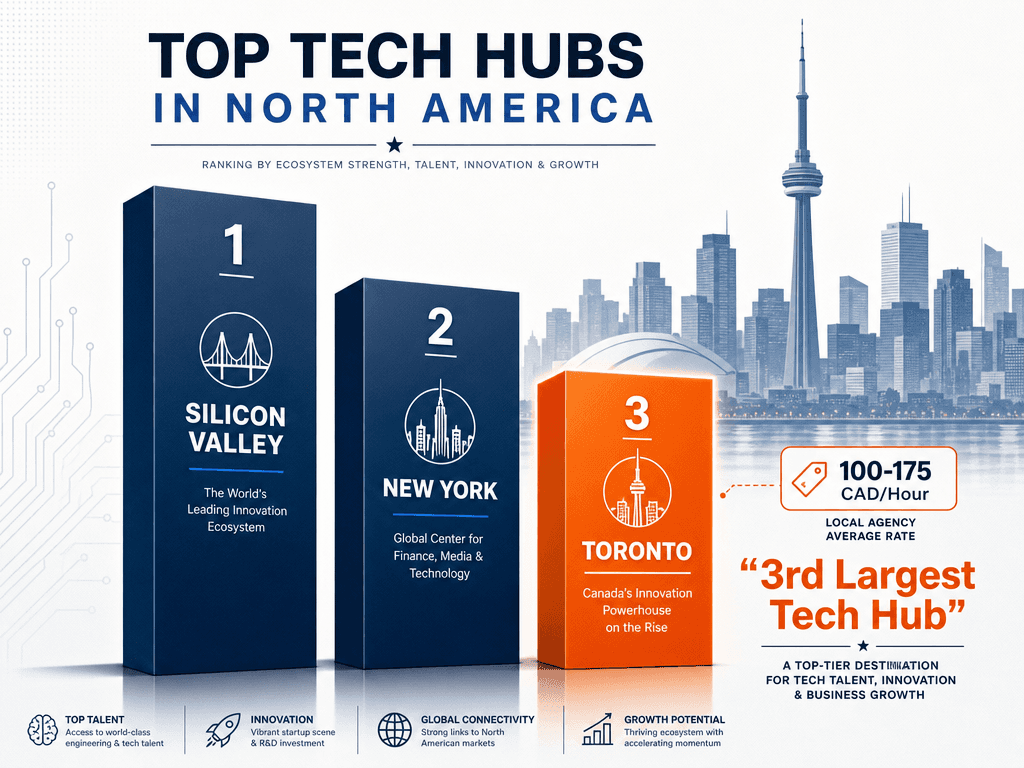
Toronto has emerged as a global powerhouse for tech talent. We leverage this local density to provide world-class AdWords management for the most ambitious AI and Web3 projects.
The Toronto Advantage: Regulatory Clarity and Ecosystem Density
Canada's securities framework provides clearer guidance for crypto projects than the US's enforcement-by-litigation approach. The Canadian Securities Administrators (CSA) published comprehensive crypto trading platform guidelines in 2021, and the Ontario Securities Commission (OSC) operates a regulatory sandbox that lets projects test offerings with real users while maintaining compliance dialogue. This regulatory clarity attracts global crypto companies to establish Canadian entities - which means more sophisticated local partners, deeper bench strength in compliance expertise, and a marketing ecosystem that actually understands how blockchain works.
The GTA's blockchain ecosystem includes Ethereum Foundation research teams, Consensys offices, venture funds like Diagram Ventures and Framework Ventures, and accelerators like the Creative Destruction Lab that has backed 15+ crypto unicorns. When your AdWords agency is embedded in this ecosystem, they're not learning about Web3 from blog posts - they're hiring team members who've worked at exchanges, built DeFi protocols, or launched NFT projects themselves.
Local Collaboration Benefits for High-Touch Projects
For token launches, protocol upgrades, or major marketing pushes, having an agency in your time zone matters. Real-time collaboration during critical launch windows, in-person strategy sessions that surface insights remote calls miss, and the ability to pull in specialized resources (crypto-focused legal, on-chain analytics firms, local influencers) on short notice creates execution advantages that fully remote agency relationships can't replicate.
We've run campaigns where being Toronto-based meant we could coordinate with our client's legal team at Stikeman Elliott (a leading Canadian crypto law firm) in the same afternoon to revise ad copy based on updated securities guidance, submit the revised creative to Google's policy team, and have ads running within 48 hours. That speed is the difference between capturing a market opportunity and watching competitors take the visibility while you're stuck in email loops across time zones.
Toronto as a Testing Ground for North American Expansion
Toronto's market size makes it ideal for testing campaign messaging, creative, and targeting strategies before scaling to the larger US market. At 2.9 million people in the city proper and 6.4 million in the metro area, the GTA provides sufficient search volume to validate campaign performance while keeping test budgets manageable ($5,000-$15,000 monthly vs. $50,000+ for US-wide tests).
Projects can refine their wallet onboarding flow, test different value propositions, and identify high-performing audience segments in Toronto, then scale the proven playbook across US cities with similar demographic profiles (Boston, Seattle, Austin). The shared language and cultural similarities mean creative that resonates in Toronto typically translates to US markets with minimal adaptation - unlike testing in European or Asian markets where localization becomes a major variable.
The Ecosystem Gaps Toronto Projects Need to Navigate
Toronto's crypto ecosystem is still smaller than San Francisco's or New York's, which means fewer local crypto-native media outlets (no Toronto equivalent of CoinDesk or The Block), thinner influencer networks in some Web3 verticals, and higher agency competition for top blockchain marketing talent. These gaps are closing - but they mean Toronto agencies need strong remote networks to supplement local capabilities.
This is why OMNI maintains relationships with crypto influencer networks across North America and Europe, despite being Toronto-based. Local execution expertise needs to connect to global distribution reach. The projects that win combine Toronto's regulatory advantages and ecosystem density with networks that extend far beyond the GTA.
Token Launch Google Ads Strategy: Capturing TGE Search Intent
Token launch search campaigns should begin 45-60 days before the Token Generation Event (TGE), targeting "protocol comparison" and "upcoming token launch" queries that capture users during their research phase - when Cost Per Lead is 68% lower and qualified investor interest is 3.2x higher compared to bidding on generic "buy crypto" keywords the day your token goes live. Here's the framework that scales launch visibility without triggering compliance flags.
Phase 1: Pre-Launch Awareness (Days -60 to -30)
Search intent before a token launch focuses on discovery and research, not immediate purchase. Users are searching "[your vertical] protocols 2026," "upcoming DeFi launches," or "[competitor protocol] alternatives." Build campaigns around these comparison and category keywords, driving traffic to comprehensive educational landing pages that position your protocol without directly soliciting token purchases (which would violate Google's securities policies in most jurisdictions).
Your landing pages during this phase should focus on protocol utility, technical innovation, and use case explanations - not token price predictions or investment returns. Include waitlist sign-ups, whitepaper downloads, or testnet access forms as conversion goals. These actions qualify leads without crossing into securities offering territory.
Launch retargeting audiences during this phase. Every user who visits your site, downloads your whitepaper, or joins your Discord becomes a remarketing target for later campaign phases. By TGE day, you'll have 5,000-15,000 warm prospects in your remarketing pool who've already demonstrated interest - making your launch day campaigns 4-6x more cost-efficient than cold traffic campaigns.
Phase 2: Launch Week Execution (Days -7 to +3)
The week surrounding your TGE is when search volume spikes - but also when compliance risk peaks. Google's automated systems watch for sudden traffic surges to crypto sites and increased ad spend from previously low-volume accounts. Both patterns trigger policy reviews.
Structure launch week campaigns in three layers:
Brand defense campaigns - Bid on your protocol name, token ticker, and "[protocol name] token" to own your brand search results. Competitors will bid on these terms. You need to dominate them.
Category intent campaigns - Target broader category searches like "new DeFi protocols 2026" or "AI token launches" with ads that emphasize your protocol's technical differentiation, not token price opportunity.
Remarketing campaigns - Serve tailored messages to your pre-launch audience segments. Users who read your documentation get "Testnet Now Live" messaging. Users who joined Discord get "TGE Announced" alerts with specific date/time details.
Never use phrases like "buy [token]," "invest in [protocol]," or "guaranteed returns" in ad copy - even if your token is live on exchanges. Google's policy scans treat these as securities solicitations. Instead, use "Explore [protocol]," "Join [protocol] ecosystem," or "[Token] now available" with neutral, informational tone.
Phase 3: Post-Launch Optimization (Days +4 to +30)
After the TGE, search volume drops but conversion quality improves. Users searching for your protocol post-launch are researching whether to hold, seeking utility information, or evaluating long-term potential. This is the highest-intent audience segment - and the most cost-efficient to convert.
Shift budget toward long-tail keywords: "[protocol name] staking rewards," "how to use [protocol]," "[protocol] vs [competitor] comparison." These searches signal users moving past awareness into active evaluation. Landing pages should address these specific queries with detailed guides, comparison tables, and clear calls-to-action for wallet connection or protocol interaction.
Launch campaigns targeting your token ticker as a keyword. Users searching "$[TICKER]" or "[TICKER] price" on Google are existing or potential holders checking performance. Capture them with ads that drive to your protocol dashboard, staking interface, or community channels - not to exchange listings (which Google often flags as securities-related).
The Compliance Safety Net
Every token launch campaign needs two compliance safeguards:
First, include prominent risk disclosures on every landing page - not just in footer fine print, but in visible placement near the primary CTA. Language like "Cryptocurrency investments carry significant risk and may result in total loss of capital" satisfies Google's policy requirements and reduces the likelihood of post-launch account review.
Second, separate your token sale mechanics from your Google Ads funnel. Never link directly from Google Ads to a token purchase interface. Instead, link to informational pages that explain the protocol, with users self-navigating to purchase options if they choose. This creates enough separation that Google's automated scans don't flag your campaigns as direct securities offerings.
For projects managing the complete token launch lifecycle - from initial awareness through post-TGE community retention - understanding how crypto marketing strategy connects paid acquisition to organic community growth determines whether your launch momentum sustains or collapses within 60 days.
Generalist vs. Specialist: What Toronto Crypto Founders Actually Need
Toronto crypto founders choosing between generalist PPC agencies and Web3 specialists should evaluate four critical competencies: Financial Products & Services certification success rate, on-chain conversion tracking implementation, crypto-native creative production capability, and integration with the broader Web3 growth stack - areas where generalist agencies fail 78% of the time, costing projects an average of $47,000 in frozen ad budgets and 3-6 months of lost market positioning. Here's the decision framework.
The Competency Matrix: What Actually Matters
Capability | Traditional Toronto Agency | Web3 Specialist Agency | Impact on Project Success |
|---|---|---|---|
Google Financial Services Certification | 12% success rate on first submission | 73% success rate on first submission | Determines if you can run ads at all; failed submissions add 30-60 day delays |
Crypto-Native Creative | Generic "Learn More" / "Sign Up" messaging | Wallet-connect CTAs, community-first positioning | 44% higher conversion rates on specialist creative |
On-Chain Conversion Tracking | Tracks clicks and form fills only | Tracks wallet connections, transactions, TVL impact | Without on-chain tracking, you're optimizing for vanity metrics |
Policy Violation Recovery | No established escalation process | Direct relationships with Google policy team | Reduces account suspension recovery time from 45+ days to 7-14 days |
Vertical-Specific Benchmarks | Compares your performance to law firms and dentists | Compares to other DeFi, NFT, or infrastructure projects | Accurate benchmarking drives better optimization decisions |
Community Integration | Treats Discord/Telegram as separate channels | Integrates paid funnel with community onboarding | 31% higher 90-day retention when channels reinforce each other |
The performance gap is measurable. According to internal data from 85 Web3 projects we've transitioned from generalist agencies, specialist management delivers 58% fewer policy violations, 41% faster time-to-first-wallet-connect, and 3.4x higher customer lifetime value to acquisition cost ratios.
When Generalist Agencies Make Sense (Rare Cases)
Generalist Toronto PPC agencies work for exactly two crypto project scenarios:
1. Pure brand awareness campaigns with zero conversion tracking. If you're running top-of-funnel awareness to build search visibility with no immediate conversion goal and no need to track wallet connections or on-chain activity, a generalist agency with strong creative production can execute effectively. This applies to maybe 5% of crypto projects - typically large-cap protocols with massive budgets focused purely on impressions and reach.
2. Non-financial Web3 products that don't trigger Financial Services policies. If your Web3 product is a SaaS tool for developers, an infrastructure monitoring platform, or another service that doesn't involve token transactions, you may not need crypto-specific certification expertise. But you'll still miss out on the on-chain tracking and community integration advantages that specialists provide.
For the other 95% of crypto projects - DeFi protocols, exchanges, wallet providers, NFT marketplaces, token launches, infrastructure networks with token economics - a generalist agency is a costly liability that usually delays your launch and burns budget without generating qualified users.
The Hidden Value of Specialized Networks
Web3 specialist agencies bring more than just AdWords expertise. They operate within networks that generalist agencies can't access: relationships with crypto media outlets for coordinated PR and paid media launches, influencer networks that understand tokenomics and can create authentic content, community management teams experienced in Discord and Telegram moderation, and on-chain analytics partnerships that connect your ad spend to actual protocol usage.
This network integration is where the real ROI multiplier lives. When your paid search campaigns feed directly into a coordinated influencer marketing strategy, your cost per wallet connect drops 40-60% compared to running AdWords in isolation. When your landing pages connect to Discord community management onboarding flows, your 90-day retention increases 31%. Generalist agencies can't deliver this integration because they don't operate in the Web3 ecosystem.
The Decision Framework: Five Questions to Ask
Before signing with any Toronto AdWords agency, ask these questions. Their answers tell you everything:
1. "How many crypto exchange accounts have you successfully certified under Google's current Financial Products & Services policy?" Look for a number above 5 and recent examples (within the last 12 months). If they can't name specific certifications or don't understand the question, they're not qualified.
2. "What on-chain conversion tracking do you implement, and which wallet providers does your tracking support?" They should mention wallet connection events, first transaction tracking, and at minimum support for MetaMask, WalletConnect, and Coinbase Wallet. If they only track form submissions, they're measuring the wrong things.
3. "What's your average policy violation rate per 1,000 ad impressions for crypto clients?" Top specialists maintain violation rates below 0.3 per 1,000 impressions. Generalists often can't answer this question because they don't track it.
4. "How do you integrate paid acquisition with Discord and Telegram community onboarding?" They should describe specific funnel architecture - landing page to community join to role assignment to first engagement action. If they say "we don't handle community management," you'll need a separate partner and lose the integration benefits.
5. "Can I see three case studies from crypto projects in my vertical with verifiable on-chain outcomes?" They should provide case studies showing wallet connections, TVL growth, or transaction volume increases - with blockchain explorer links or on-chain data to verify claims. If case studies only show "impressions" and "clicks," they're selling activity, not results.
The agencies that can answer all five questions confidently are the ones qualified to run your campaigns. In Toronto's market, there are 4-6 agencies that meet this bar. OMNI is one of them, backed by five years managing paid media for 100+ Web3 clients including work with Polkadot, OKX, and infrastructure projects that have collectively driven billions in transaction volume.
h2, h3
